wayground logo

Free Printable Worksheets

NEW

Font size

S
M
L
XL
Worksheets

Bonding Test Review

Total questions: 46

Worksheet time: 1hrs 8mins

Name
Class
Date
1.
The type of bond where valence electrons are SHARED is called: 
a)
Covalent
b)
Ionic
c)
Hydrogen
d)
Isotope 
2.
The type of bond where valence electrons are TRANSFERRED is called: 
a)
Covalent
b)
Ionic
c)
Hydrogen
d)
Isotope
3.
Atoms are most stable when their outer shell is complete.
a)
true
b)
false
4.
Which of the following is an example of an IONIC COMPOUND?
a)
NaCl
b)
H2O
c)
CO2
d)
NO
5.
Which of the following is an example of a COVALENT COMPOUND?
a)
H2S
b)
KI
c)
CaCl2
d)
MgO
6.
Which category of elements have the property of being malleable and ductile?
a)
gases
b)
metals
c)
metalloids
d)
nonmetals
7.
Ionic bonds are between _______ and ________. 
a)
nonmetals and nonmetals 
b)
metals and metals 
c)
metals and nonmetals
d)
none
8.
How does a positively charged ion form?
a)
An atom loses an electron
b)
An atom gains an electron
c)
An atom gains a proton
d)
An ionic compound dissolves
9.
Covalent bonds tend to happen between two
a)
metals
b)
nonmetals
c)
metal and nonmetal
10.
Atoms want
a)
A full outer shell of electrons
b)
One electron short of a full shell
c)
kit kats
11.
The compound formed between lithium and chlorine is _________.
a)
ionic
b)
covalent
12.
Does HCl have hydrogen bonding?
a)
yes
b)
no
13.
Does CH4 have hydrogen bonding?
a)
yes
b)
no
14.

Intermolecular forces for: NH3

a)

Dispersion Force

b)

Dipole dipole

c)

Hydrogen bonding

15.
Which of the following statements correctly explains why hydrogen bonding is such a strong intermolecular force?
a)
There is an attraction between a small, weakly electronegative hydrogen atom and a large, strongly electronegative atom of fluorine, nitrogen, or oxygen
b)
There is an attraction between a small, highly electronegative hydrogen atom and a large, highly electronegative fluorine atom
c)
There is an attraction between the hydrogen and oxygen atoms, only
d)
There is an attraction between the hydrogen and nitrogen atoms, only
16.
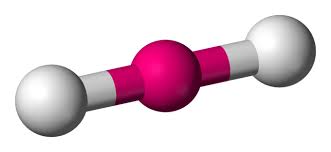
Choose the correct shape for this molecule:
a)
Trigonal planar
b)
Trigonal pyramidal
c)
Tetrahedral
d)
Linear
17.

This carbon atom went through ....

a)

sp hybridization

b)

sp2 hybridization

c)

sp3 hybridization

d)

dsp3 hybridization

18.

What is the hybridization of a linear molecule?

a)

sp

b)

sp2

c)

sp3

d)

sp3d

19.

Which of the following images represents a Trigonal Planar molecular geometry?

a)
b)
c)
d)
20.

What is the bond angle for the CH4 molecule?

a)

120°

b)

107°

c)

109.5°

d)

90°

21.

Which of the following hybrid orbitals is used by the central atom for bonding in CO32-?

a)

sp2

b)

sp3

c)

sp3d

d)

sp3d2

22.

Molecule CO2

a)

undergoes sp2 hybridisation

b)

has 2 σ bond and 2 π bond

c)

undergoes sp3d hybridisation

d)

is trigonal planar molecule

23.

What is the correct Lewis Dot Structure for ammonia NH3

a)
b)
c)
d)
24.

Which is the correct molecular structure for carbon dioxide?

a)
b)
c)
d)
25.
Which of the following is the correct Lewis dot structure for the molecule fluorine (F2)?
a)
A
b)
B
c)
C
d)
D
26.
Which of the following is the correct Lewis structure for the compound PBr3?
a)
structure A
b)
structure B
c)
structure C
d)
structure D
27.

What is the correct structure for BF3?

a)

Option A.

b)

Option B.

c)

Option C.

d)

Option D.

28.
According to the octet rule most elements need _______ valence electrons.
a)
2
b)
8
c)
6
d)
18
29.
Each line in a Lewis Structure represents __________ electron(s).
a)
3
b)
2
c)
1
d)
4
30.

In HCN (Carbon is usually the central atom) what kind of bond is between the C and N

a)

Single

b)

Double

c)

Triple

31.

The electrons in a polar covalent molecule are shared...

a)

Evenly

b)

Unevenly

c)

Electrons are not shared

d)

None of the Above

32.

The electrons in a nonpolar covalent molecule are shared...

a)

Evenly

b)

Unevenly

c)

Electrons are not shared

d)

None of the Above

33.

The polarity of a bond is determined by...

a)

The sum of the electronegativities of the two atoms

b)

The difference in the electronegativities of the two atoms

c)

The charges of the atoms

d)

None of the Above

34.

A diatomic molecule like O2 is always _____ because electrons are shared _____

a)

nonpolar; unequally

b)

polar; equally

c)

nonpolar; equally

d)

polar; unequally

35.

Is this molecule polar or non-polar?

a)

Polar

b)

Non-polar

36.

Is this molecule polar or non-polar?

a)

Polar

b)

Non-polar

37.

Is this molecule polar or non-polar?

a)

Non-polar

b)

Polar

38.

Is this molecule polar or non-polar?

a)

Non-polar

b)

Polar

39.
If Bromine bonds with Hydrogen, a ____________ bond forms.
a)
polar covalent
b)
nonpolar covalent
c)
metallic
d)
ionic
40.
Which formula represents a polar molecule?
a)
H2
b)
H2O
c)
CO2
d)
CCl4
41.
What geometry will this molecular structure have?: CCl4
a)
bent
b)
tetrahedral
c)
linear
d)
trigonal pyramidal
42.
Will this molecule be polar or nonpolar? CCl4
a)
polar
b)
nonpolar
43.
Will this molecule be polar or nonpolar? H2S
a)
polar
b)
nonpolar
44.

Which electron configuration belongs to a Chloride (Cl-) ion?

a)

1s2 2s2 2p6 3s2 3p5

b)

1s2 2s2 2p6 3s2 3p6

c)

1s2 2s2 2p6 3s2 3p7

d)

1s2 2s2 2p6 3p7

45.

An aluminium ion would have which electron configuration?

a)

1s2 2s2 2p6 3s2

b)

1s2 2s2 2p6 3s2 3p1

c)

1s2 2s2 2p6 3s2 3p6

d)

1s2 2s2 2p6

46.

The electron configuration for Cobalt is 1s22s22p63s23p64s23d7. What would the ion configuration look like if Cobalt has a +2 charge?

a)

1s22s22p63s23p64s23d7

b)

1s22s22p63s23p63d7

c)

1s22s22p63s23p64s23d5

d)

1s22s22p63s23p64s23d10