
 Worksheets
Unit 1 Test Review-ChemBH-Tri 3
Total questions: 87
Worksheet time: 2hrs 33mins
Name this formula:
KNO3
Potassium Nitrogen Oxide
Potassium Nitride
Potassium Nitrate
Potassium (I) Nitrite
Name the compound NH4OH
ammonium hydroxide
ammonia oxyhydride
mononitrogen tetraoxihydride
hydrogen nitrate
Name the compound CuO
copper (II) oxide
copper oxide
copper (I) oxide
carbon uranium oxide

This functional group is used as an artificial flavoring and is made by bonding an alcohol and a carboxylic acid:
ether
ester
alcohol
halide
This functional group is one of the carbonyls. It has a carbon double bonded to an oxygen can have pleasant odors such as vanilla, cinnamon or rose.
halide
ketone
ether
alkene
Which functional groups are used to produce esters through dehydration synthesis?
alcohols and ketones
alcohol and carboxylic acids
amines and aldehydes
amines and carboxylic acids


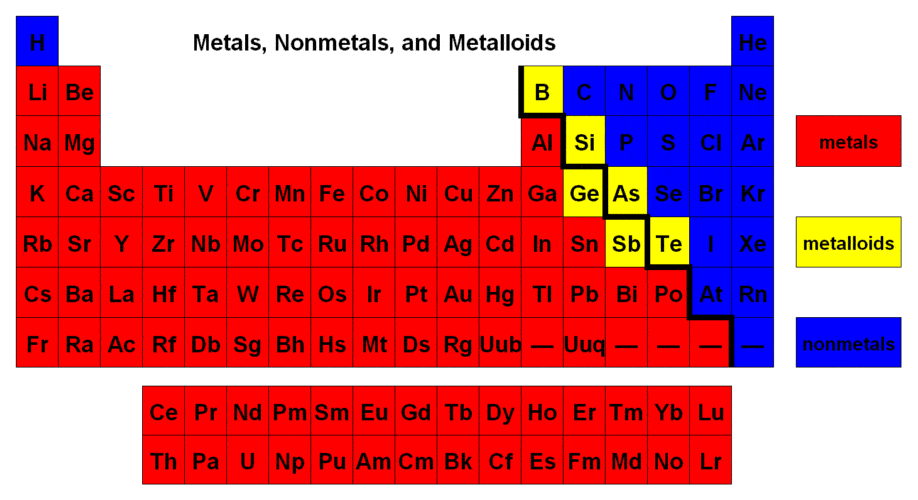
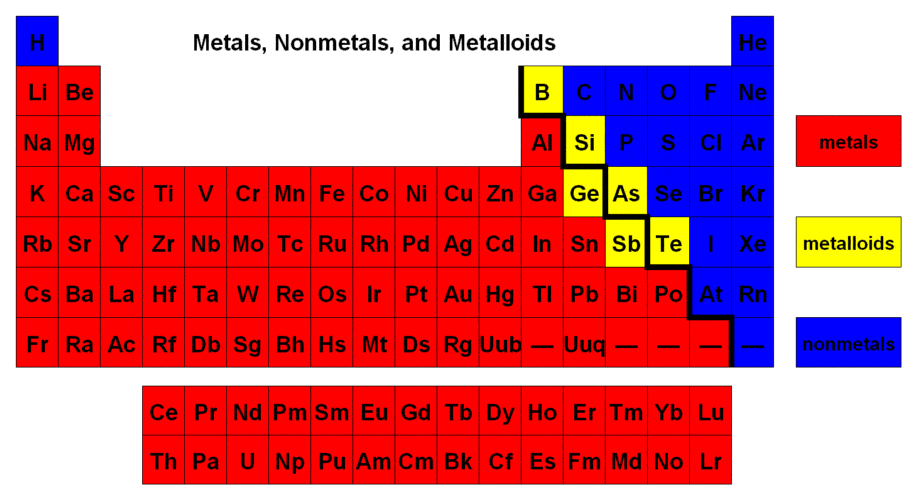

Is this compound Ionic or Covalent: Ca3(PO4)2
ionic
covalent
What type of bond will conduct electricity in a dissolved state?
ionic
covalent
Which substance would have the weakest intermolecular forces of attraction?
CH4
NaCl
H2O
MgF2
________________________ have the strongest intermolecular forces of attraction.
Dipole- Dipole
Dispersion
Hydrogen Bonds
Each contains polar bonds but only one is a polar molecule
CO2
NH3
CCl4
CH4
The shape of a molecule with 4 pairs of bonding electrons
linear
tetrahedral
trigonal planar
trigonal pyramidal
Why do atoms bond?
to become more polar
to increase their atomic number
to have noble gas electron configuration
to become ions
VSEPR indicates ____ must be as far apart as possible
inner electrons
hybrid electrons
valence electrons
dipole electrons
The shape of methane CH4
square pyramidal
trigonal pyramidal
tetrahedral
saw horse
Which intermolecular force is weakest
single covalent bond
London dispersion
hydrogen bond
dipole interactions
A substance that has regions of positive change and negative charge is
an ion
heterogeneous mixtures
polar molecules
oxygen gas
What type of solid has the highest boiling point
network solid
nonmetallic solid
ionic solid
metals
Poor electrical conductivity
Ionic compounds
Covalent compounds
Always a solid at room temperature
Ionic compounds
Covalent compounds
Can be a solid, liquid, or gas at room temperature
Ionic compounds
Covalent compounds
Generally high melting & boiling points
Ionic compounds
Covalent compounds
Generally low melting and boiling points
Ionic compounds
Covalent compounds

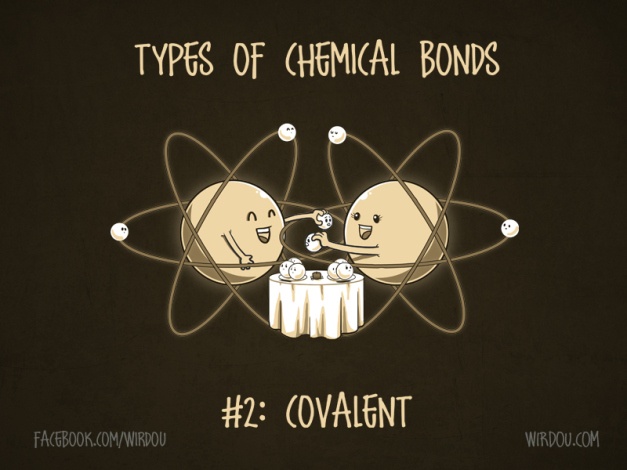
What kind of bond does this show?
Ionic
Covalent

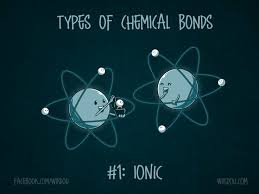
What kind of bonds are shown here?
Covalent
Ionic
What happens when you put an ionic compound in water?
The ions separate
The ions pack more closely together
Nothing happens

What type of bonding does this picture show?
Ionic
Covalent

What type of bonding does this picture show?
Ionic
Covalent

What is the molecular formula for structure showed?
C8H18
C3H3
C8H3
C3H2(CH3)3

How many hydrogens are missing from this extended structural formula?
6
7
8
9
All of these molecules smell sweet, except for ___?
L-carvone (C10H14O)
Butanone (C4H8O)
Methanol (CH4O)
Pulegone (C10H16O)
Ketone (C3H6O)

Both of these molecules are _____
Sweet smelling
Fishy smelling
Isomers
Ionic compounds
Metallic

Functional Groups are ___
Fishy smelling substances
A specific grouping of atoms within a molecule that have their own characteristics and properties.
Different molecules with the same molecular formula
Covalent molecules that have double bonds

According to the Octet Rule, Nitrogen (N) has ____ valence electrons and forms ___ bonds
2, 6
3, 5
4, 4
5, 3

The Lewis Dot structure for Oxygen shows ___ valance electrons. Of these, ___ are paired, and ___ are unpaired. Oxygen forms ___ covalent bonds.
6, 2, 4, 2
6, 4, 2, 2
4, 2, 1, 4
4, 1, 2, 4

This molecule can be best described as ___
Ionic compound
Metallic
Network Covalent
Polar Covalent
Nonpolar Covalent

This is the Lewis Dot Structure for Carbon Monoxide, a colorless, odorless, and poisonous gas. This structure does not fit the HONC 1234 Rule at all, but does fit the Octet Rule. What is going on here?
The Octet Rule and the HONC 1234 Rule are just rules of thumb. They don't explain the structures of all molecules. Chemists have devised other means for predicting and explaining this structure.
I plan to take AP Chemistry to find out what is going on here.
The body can't easily break the triple covalent bond of carbon monoxide. So when you breath it in it displaces the oxygen (O2) in your lungs. CO is an asphyxiant.

What is the correct Lewis Dot Structure for ammonia NH3


Identify the functional group present in this compound.
Ketone
Carboxyl
Ester
Amine
Predict the smell of this compound
fishy
putrid (stinky)
sweet
minty
The electrons in a polar covalent molecule are shared...
Evenly
Unevenly
Electrons are not shared
None of the Above
The electrons in a nonpolar covalent molecule are shared...
Evenly
Unevenly
Electrons are not shared
None of the Above
In a polar covalent bond, the electrons gather around...
The atom with the Greatest Electronegativity
The atom with the Lowest Electronegativity
Each atom Equally
None of the Above
Partial charges are present in which type of bond?
Ionic
Nonpolar Covalent
Polar Covalent
Both Polar Covalent and Ionic
What must the difference in electronegativity between two atoms be in order for the bond between them to be polar covalent?
less than 0.4
greater than 1.7
between 0.4 and 1.7
exactly 0
What must the difference in electronegativity between two atoms be in order for the bond between them to be nonpolar covalent?
less than 0.4
greater than 1.7
between 0.4 and 1.7
exactly 0
A diatomic molecule like O2 is always _____ because electrons are shared _____
nonpolar; unequally
polar; equally
nonpolar; equally
polar; unequally
Order the types of bonds based on the charge of their molecules. (lowest amount of charge to greatest)
Polar Covalent --> Ionic --> Nonpolar Covalent
Ionic --> Nonpolar Covalent --> Polar Covalent
Ionic --> Polar Covalent --> Nonpolar Covalent
Nonpolar Covalent --> Polar Covalent --> Ionic

When you have H-Cl, what is the polarity?
nonpolar
polar
ionic

When you have Br-Br, what is the polarity?
Polar
nonpolar
Ionic

When you have F-F, what is the polarity?
nonpolar
polar
ionic
When you have Zn-F, what is the polarity?
nonpolar
polar
ionic
What would solubility look like for polar covalent bond in water?
soluable
nonsoluable
What would solubility look like for nonpolar covalent bond in water?
soluable
nonsoluable

