
 Worksheets
Reflection and Refraction
Total questions: 53
Worksheet time: 27mins


Objects that reflect well are
Matte surfaces
Smooth, shiny surfaces
Dark coloured surfaces
Medium coloured surfaces
The law of reflection states that
Angle of incidence = Angle of reflection
Angle of incidence = Angle of incidence
Angle of reflection = Angle of translucence
Angle of reflection = Angle of reflection
A concave mirror
Curves inwards
Curves outwards
Curves sideways
Curves in multiple directions
A convex mirror
Curves inwards
Curves outwards
Curves sideways
Curves in multiple directions

The angle of reflection is
90 degrees
55 degrees
45 degrees
135 degrees
Refraction is
The bending of light as it passes through the one substance at an angle
A light beam shone in one end of an optical fibre and totally internally reflected at the other end
The bending of light as it passes from one substance to another at an angle
A type of convex object used in everyday life

The above image is an example of a ____________. They happen because cool and hot air have a different ___________________________.
Mirage; angle of incidence
Optical fibre; refractive index
Lateral inversion; angle of reflection
Mirage; refractive index
Refraction happens because light travels _____________ in glass or water compared to air
Faster
The same
At the speed of sound
Slower
A convex lens produces a _______ image whereas a concave lens produces a _______ image
Virtual, real
Virtual; diffused
Real; refracted
Real; virtual
An example of total internal reflection is
Diamond
Looking down at someone in a swimming pool
A camera inserted in a person's body during surgery
The 'pool' of water seen when looking into the distance on a hot day
The refractive index of a substance
Is the degrees between the reflected ray and the normal
Is a number that tells you how much the light bends when going from air into that substance
Is a number that tells you how fast the light bends when going from air into that substance
Is the degrees between an incident ray and the normal

The angle of incidence is
56 degrees
124 degrees
90 degrees
34 degrees
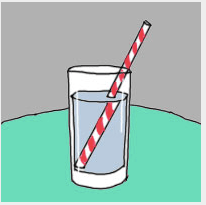
Why does the straw appear to be bent?
light is reflected
light is absorbed
light is turned
light is refracted
What do we call a material that light can travel through?
air
water
medium
pathway
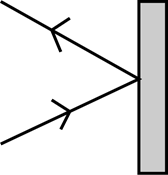
In the illustration, the light ray striking the object is-

In the picture, the light is being ______
Reflected
Absorbed
Transmitted
Scattered

In the picture, the light is being ______
Reflected
Absorbed
Transmitted
Scattered

In the picture, the light is being ______
Reflected
Absorbed
Transmitted
Scattered

In the picture, the light is being ______
Reflected
Absorbed
Transmitted
Scattered
Why do apples appear to be color red?
When light reaches the apple, all 7 colors of the spectrum are absorbed.
When light reaches the apple, all 7 colors of the spectrum are reflected.
When light reaches the apple, the color red is reflected and the remaining colors are absorbed.
When light reaches the apple, the color red is absorbed and the remaining colors are reflected.
What happens when light reaches a white object?
It scatters all the light.
It absorbs all the light.
It transforms all the light.
It reflects all the light
Which statement is true?
The lighter the color of the object, the more heat it emits.
The darker the object, the more heat it emits.
Color doesn't affect the temperature of a material.
Light and color has no relationship with one another.
Objects that allow a material to pass through them is ______
Transparent
Tranaslucent
Opaque
Some light is scattered or absorbed and you cannot see them clearly
Transparent
Tranaslucent
Opaque
Some materials may appear to be invisible because most light is transmitted through this kind of material.
Transparent
Tranaslucent
Opaque
It does not allow light to pass through at all.
Transparent
Tranaslucent
Opaque

What kind of material is in the picture?
Transparent
Tranaslucent
Opaque

What kind of material is in the picture?
Transparent
Tranaslucent
Opaque

What kind of material is in the picture?
Transparent
Tranaslucent
Opaque

What kind of material is in the picture?
Transparent
Tranaslucent
Opaque

What kind of material is in the picture?
Transparent
Tranaslucent
Opaque

What kind of material is in the picture? (Lens)
Transparent
Tranaslucent
Opaque

What kind of material is in the picture? (Lens)
Transparent
Tranaslucent
Opaque

Type of mirror used in a convenience store to provide a wide angle view...
Plane
Convex
Concave

Type of mirror used by a dentist to get magnified view of a patient's teeth...
Plane
Convex
Concave

Type of mirror found in a bathroom...
Plane
Convex
Concave

Type of mirror used as a side mirror on a vehicle to provide a wide angle view...
Plane
Convex
Concave

Type of mirror that can produce a real image...
Plane
Convex
Concave

Type of mirror that can produce an inverted image...
Plane
Convex
Concave

Type of mirror that provides a wide angle view...
Plane
Convex
Concave

The size of an object and its image are the same in this type of mirror...
Plane
Convex
Concave

According to the law of reflection the angle of incidence is ____________ the angle of reflection.
less than
greater than
equal to

