wayground logo

Free Printable Worksheets

Font size

S
M
L
XL
Worksheets

Friday, 1st April, 2022

Total questions: 76

Worksheet time: 1hrs 23mins

Name
Class
Date
1.

When an opaque object comes in the path of light it forms

a)

an image with colours

b)

depends on the colour of the light

c)

black and white image

d)

shadow

2.

Which types of objects do not allow light to pass through them?

a)

Translucent

b)

Opaque

c)

Transparent

d)

all the above

3.

A mirror is an example of

a)

transparent object

b)

opaque object

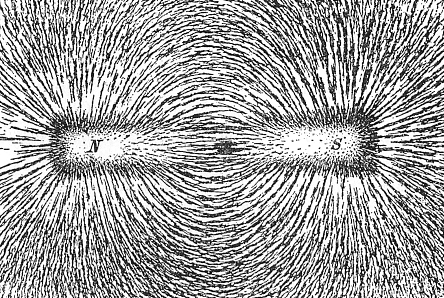
c)

translucent

d)

none of these

4.

Which one of the following is the natural source of light?

a)

Electric bulb

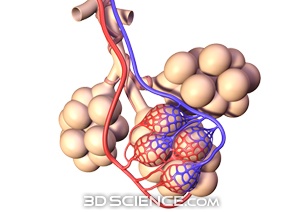
b)

Moon

c)

Tube light

d)

Sun

5.

What does the Moon do

a)

Produces Heat

b)

Reflects the Sun's light

c)

Produces light

d)

Reflects the Sun's heat

6.

What time is it in picture A

a)

12 P.M.

b)

8 A.M.

c)

4 P.M.

d)

12 A.M.

7.

Why is there no shadow on the screen?

a)

There is no light.

b)

There is no transparent object.

c)

There is no screen.

d)

There is no opaque object

8.

What is the colour of the shadow of these clothes?

a)

White

b)

no shadow

c)

Black

d)

same colour as clothes

9.
The velocity of light in vacuum is _______ m/s
a)
3x10⁸
b)
3x10¹²
c)
3x10⁶
d)
3x10¹⁰
10.
How does light behave as it enters these mediums?
a)
continue its path as straight line.
b)
bends toward the normal
c)
bends away from the normal
d)
reflects
11.
What is this called?
a)
refraction
b)
reflection
c)
reconstroction
d)
retraction
12.

When light passes at an angle to the normal from one medium into another in which its speed is higher

a)

it is bent toward the normal.

b)

it always lies along the normal.

c)

it is unaffected.

d)

it is bent away from the normal.

13.

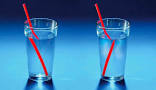
A student placed a pencil in a cup of water. The pencil appears broken because light

a)

always travels in a straight line.

b)

bends when it passes through water.

c)

makes the water in the glass evaporate.

d)

reflects the pencil on the water's surface.

14.

Based on the image, as light passes from medium 1 to medium 2

a)

light speeds up and bends towards the normal

b)

light speeds up and bends away from the normal

c)

light slows down and bends towards the normal

d)

light slows down and bends away from the normal

15.
In what medium does light travel the fastest?
a)
vacuum
b)
air
c)
water
d)
glass
16.
If you want to change the pitch of a sound, you have to change the ___
a)
frequency
b)
amplitude
c)
speed
d)
volume
17.
What happens when you increase the amplitude of a sound?
a)
it makes the sound louder
b)
it makes the sound travel faster
c)
it increases the wavelength of the sound
d)
it increases the frequency of the sound
18.
This is the unit used to measure the volume of a sound. 
a)
Decibel
b)
Medium
c)
Vibration
d)
Oscilloscope
19.
What is a pitch?
a)
highness or lowness of a sound
b)
the intensity of a vibration
c)
the amplitude of the sound wave
d)
volume of sound
20.

Why do we see lightning before we hear the thunder?

a)

Lightning is an illusion.

b)

Light travels faster than sound

c)

Sound travels faster than light.

21.

Which device measures sound waves?

a)

Oscilloscope

b)

Stethoscope

c)

Antenna

d)

Microscope

22.

Area of a longitudinal wave where particles are APART.

a)

Compression

b)

Rarefaction

c)

Refraction

d)

Compassion

23.

What element rusts?

a)

carbon

b)

manganese

c)

iron

d)

potassium

24.

Rusting is an example of

a)

oxidation

b)

reduction

25.

What two things cause Iron to Rust ?

a)

Air and Oxygen

b)

Water and Carbon dioxide

c)

Oxygen and Water

d)

Carbon dioxide and Air

26.

What is the chemical name given to Rust ?

a)

Iron dioxide

b)

Iron oxide

c)

Steel oxide

d)

Carbon dioxide

27.

What prevents Rusting

a)

Painting , Oiling , Galvinising

b)

Washing with water

28.

Raising the temperature of a chemical reaction would make the reaction __________________.

a)

happen slower

b)

stop completely

c)

happen faster

d)

proceed as normal

29.

In which tube will the nail go rusty?

a)

The nail in tube A will go rusty.

b)

The nail in tube B will go rusty.

c)

The nail in tube C will go rusty.

30.

Which part of a plant anchors the plant to the ground and soaks up water and minerals?

a)

stem

b)

leaves

c)

roots

d)

petals

31.

Which of the following helps with plant reproduction?

a)

Pollen

b)

Stem

c)

Roots

d)

Leaves

32.

Which part of the plant holds the main networks of xylem and phloem?

a)

leaves

b)

petals

c)

stem

d)

roots

33.

Xylem carries-

a)

water up from the roots

b)

water down from the leaves

c)

Glucose from the roots

d)

Glucose down the stem

34.

Where is the main site of photosynthesis on a plant?

a)

Stem

b)

Leaves

c)

Petals

d)

Pollen

35.

Which of the following is NOT another word for the energy a plant takes in to make photosynthesis happen?

a)

Sunlight

b)

Radiant Energy

c)

Light Energy

d)

Thermal Energy

36.

In which organelle does photosynthesis occur?

a)

Cell Wall

b)

Chlorophyll

c)

Chloroplast

d)

Cytoplasm

37.

What are the end products of photosynthesis?

a)

Carbon Dioxide and Water

b)

Glucose and Carbon Dioxide

c)

Oxygen and Glucose

d)

Water and Glucose

38.

When light intensity goes up, the rate of photosynthesis goes _______.

a)

up

b)

down

c)

at the same rate. It does not change.
39.
What kind of magnet can be turned on and off?
a)
refridgerator magnet
b)
electromagnet
c)
magnetite
d)
iron
40.
Surrounding every magnet is a __________  __________.
a)
magnetic field
b)
electrical current
c)
another magnet
d)
an enemy
41.
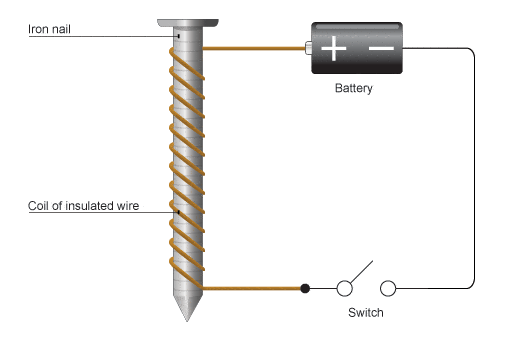
What is most likely to happen when the switch is closed?
a)
A magnetic field should be produced
b)
The nail will rust
c)
The battery will explode
d)
The wire will catch on fire
42.
What are the ends of a magnet called?
a)
East and west poles
b)
Left and Right ends
c)
North and South ends
d)
North and South poles
43.
How do electromagnets differ from regular magnets? 
a)
A. They  can be turned off and on 
b)
B. Their polarity can be reversed
c)
C. Their strength can be changed
d)
D. All of the above
44.
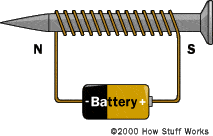
This is a picture of a simple electromagnet. How can the electromagnet be made stronger?
a)
Add more coils of wire to the nail.
b)
Use a smaller battery.
c)
Reverse the poles of the magnet.
d)
Remove all the coils and the nail.
45.

Magnets on refrigerator cannot be turned off. Which type of magnets they belong?

a)

electromagnets

b)

battery

c)

permanent magnets

d)

copper wire

46.

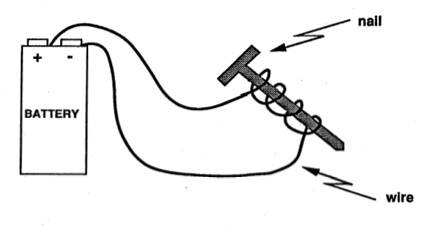
What are the components of the electromagnets?

a)

battery, wire and bulb

b)

battery , copper wire and plastic bottle

c)

battery, copper wire and iron nail

d)

battery, wire and aluminum

47.

What is the role of the battery in the electromagnet?

a)

It provides light energy for the electromagnet.

b)

It provides magnetic field for the electromagnet.

c)

It provides sound energy for the electromagnet.

d)

It provides the power source for the electromagnet.
48.
The air sacs that are covered with capillaries where gas exchange takes place
a)
bronchi
b)
lungs
c)
oxygen
d)
alveoli
49.

Flap of tissue that covers the opening to the windpipe during swallowing

a)

Pharynx

b)

Trachea

c)

Epiglottis

d)

bronchioles

50.

The only externally visible part of the respiratory system

a)

Eyes

b)

Nose

c)

Pharynx

d)

Larynx

51.

Which part of the Respiratory System plays a major role in speech? Also known as the voice box.

a)

nose

b)

pharynx

c)

larynx

d)

trachea

52.

The two narrower tubes branching from the trachea that leads into the lungs

a)

nose

b)

bronchi

c)

lungs

d)

alveoli

53.

The air tubes in your lungs branch off into smaller, narrower tubes called

a)

bronchioles

b)

trachea

c)

larynx

d)

cilia

54.
What is the main function of the respiratory system?
a)
to provide oxygen and remove carbon dioxide from the body
b)
to bring oxygen to the body
c)
to break down food and absorb nutrients
d)
to remove oxygen from the body and deliver carbon dioxide
55.

This area warms, moisturizes, and filters air before going to the lungs. What is it?

a)

nasal cavity

b)

nose

c)

mouth

d)

trachea

56.

What is the formal name for your throat area?

a)

pharynx

b)

larynx

c)

throat

d)

esophagus

57.

Your windpipe is also called the...

a)

trachea

b)

larynx

c)

pharynx

d)

esophagus

58.
What products are produced when we react an acid with an alkali?
a)
salt + carbon dioxide + water
b)
salt + hydrogen
c)
salt + water
d)
salt + water + hydrogen
59.
What salt is produced if you react sodium hydroxide with hydrochloric acid?
a)
sodium hydroxide
b)
sodium sulfate
c)
sodium nitrate
d)
sodium chloride
60.
A salt is formed when nitric acid combines with sodium hydroxide. What is the name of the salt?
a)
Sodium chloride
b)
Sodium nitrate
c)
Hydrogen Nitrate
d)
Nirate
61.
The products of a neutralisation reaction are lithium sulfate and water. What is the name of the acid used to neutralise the alkali lithium hydroxide?
a)
hydrochloric acid
b)
sulfuric acid
c)
nitric acid
d)
phosphoric acid
62.
Which reactants are used to produce sodium chloride (salt and water)
a)
sodium hydroxide and nitric acid
b)
sodium hydroxide and sulfuric acid
c)
sodium hydroxide and phosphoric acid 
d)
sodium hydroxide and hydrochloric acid
63.
Sodium hydroxide + sulphuric acid —> ...?
a)
sodium carbonate
b)
sodium sulphate
64.

Which reactants are used to produce sodium chloride and water?

a)

sodium hydroxide and nitric acid

b)

sodium hydroxide and sulfuric acid

c)

sodium hydroxide and phosphoric acid

d)

sodium hydroxide and hydrochloric acid

65.
Salts that are made with hydrochloric acid are called ______________.
a)
chlorides
b)
sulfates
c)
nitrates
d)
carbonates
66.
Salts that are made with nitric acid are called ______________.
a)
chlorides
b)
sulfates
c)
nitrates
d)
carbonates
67.
A salt is formed when nitric acid combines with sodium hydroxide. What is the name of the salt?
a)
Sodium chloride
b)
Sodium nitrate
c)
Hydrogen Nitrate
d)
Nirate
68.

What would the independent variable be in an experiment testing which type of paper airplane goes the furthest?

a)

the type of paper used.

b)

the distance each plane flies.

c)

how hard the plane is thrown.

d)

the type of paper airplane.

69.
Mr. S set up an experiment to see how the mass of a ball affects the distance it rolls off a ramp. Identify the independent variable.
a)
Distance traveled by the ball
b)
Height of the ramp
c)
Mass of the ball
70.
This variable in an experiment is the one being deliberately changed by the scientist. 
a)
dependent variable
b)
independent variable
c)
data
d)
control group
71.
Steve wanted to see if the type of fertilizer made sunflowers grow larger. What is the independent variable 
a)
Type of fertilizer
b)
Size of sunflower
c)
type of sun flower
72.
Molly investigated if the age of students caused them to be better drivers. What is the independent variable?
a)
Type of car
b)
Skill of driving
c)
Age of student
73.
Sam wanted to know if the color of the chair you sat in when taking a test affected your test grade. What is the dependent variable.
a)
Color or chair
b)
Grade on test
c)
Age of students
74.
Robert wanted to know if the type of phone you used gave you better or worse service. What is the independent variable. 
a)
Location of phone call
b)
Type of phone
c)
How good the service was
75.
What would the INDEPENDENT variable be in an experiment testing which types of paper airplane goes furthest?
a)
the paper used
b)
the type of paper airplane
c)
the distance of each plane's flight
d)
how hard the plane is thrown
76.
An experiment is performed on plants to see how different liquids affect plant growth. Each plant in the experiment is given a different liquid; water, apple juice, or milk. Each plant has the same amount of soil, sunlight, and listens to the same music. In this investigation, the independent variable is ...
a)
The type of plant
b)
The amount of sunlight
c)
The type of music
d)
The type of liquid