wayground logo

Free Printable Worksheets

NEW

Font size

S
M
L
XL
Worksheets

EOC 2 - Cells

Total questions: 46

Worksheet time: 1hrs 25mins

Name
Class
Date
1.
.  A student investigated the effects of the enzyme amylase on starch digestion. The student followed this procedure: • Soak a different paper disk in one of six solutions. • Place the disks on an agar plate containing starch. • Store the agar plate at 37°C for one hour. • Flood the agar plate with iodine and then drain. • Observe the results.
A white area around a disk indicates starch digestion. The student’s results are shown in this diagram.  
Which conclusion about the enzyme amylase do the student’s results support?
a)
Iodine destroys amylase.
b)
Amylase does not digest starch.
c)
Amylase works best in basic solutions.
d)
The action of amylase is sensitive to pH.
2.
Proteins are made of monomers called ___________
a)
Nucleotides
b)
Monosaccharides
c)
Amino Acids
d)
Glycerol and fatty acids
3.
DNA and RNA are examples of 
a)
Carbohydrates
b)
Lipids
c)
Proteins
d)
Nucleic Acids
4.
Nucleotides are monomers of
a)
Carbohydrates
b)
Lipids
c)
Proteins
d)
Nucleic Acids
5.
Monosaccharides are monomers of
a)
Carbohydrates
b)
Lipids
c)
Proteins
d)
Nucleic Acids
6.
Waxes, oils and fats are examples of
a)
Carbohydrates
b)
Lipids
c)
Proteins
d)
Nucleic Acids
7.
Which macromolecule is shown?
 View Figure 1 (if not visible)
a)
lipid
b)
protein
c)
nucleic acid
d)
carbohydrate
8.
What is the function of nucleic acids?
a)
store genetic information
b)
store energy (long-term)
c)
store energy (short-term)
d)
build skin, hair, nails, muscles
9.
Which of the following organic compounds is the main source of energy for living things?
a)
carbohydrates
b)
lipids
c)
nucleic acids
d)
proteins
10.
Which macromolecule stores energy, insulates us, and makes up the cell membrane?
a)
lipids
b)
proteins
c)
carbohydrates
d)
nucleic acids
11.
All organic compounds contain the element
a)
carbon
b)
nitrogen
c)
phosphorus
d)
sulfur
12.
Large bodies of water do not quickly fluctuate in temperature. Why?
a)
Water is a solvent.
b)
Water has a high heat capacity.
c)
Water acts as a buffer.
d)
Water is non-polar.
13.
Water striders can walk across the surface of calm water. Their feet push the surface of the water down slightly, but they do not break the surface. Why?
a)
The insects are light enough so they do not break the hydrogen bonds holding the water molecules together
b)
The insects actually use their wings to hover slightly above the water’s surface and they only skim it with their feet.
c)
The insect’s feet are non-polar, so they are repelled by the polar water molecules and are pushed away from the water’s surface.
d)
The insects are small enough to see the individual water molecules, so they are able to step carefully from one molecule to the next
14.
Water is polar because...
a)
The unequal sharing of electrons gives the water molecule a slight negative charge near its oxygen atom and a slight positive charge near its hydrogen atoms.
b)
The molecule has two poles, at which the it is colder than other regions of the molecule.
c)
The unequal sharing of electrons gives the water molecule a slight negative charge near its hydrogen atoms and a slight positive charge near its oxygen atom.
d)
The water molecule is neutral.
15.

The bond that holds the Oxygen and Hydrogen atoms together in a water molecule is a ________ bond.

a)

ionic

b)

Hydrogen

c)

Covalent

d)

Weak

16.
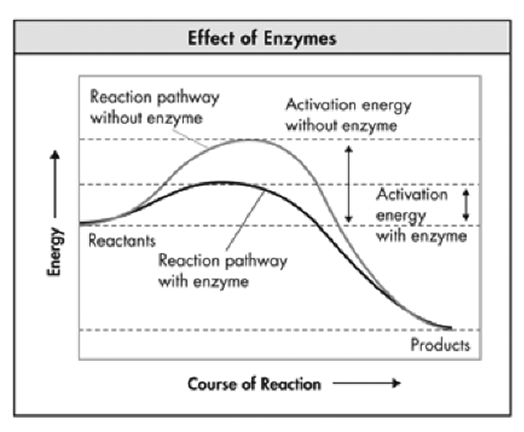
The graph shows how enzymes affect reactions in cells. Which statement best summarizes the information shown in the graph?
a)
Enzymes increase the energy of the reactants.
b)
Enzymes decrease the energy level of the products.
c)
Enzyme decrease the activation energy of the reaction.
d)
Enzymes reverse the direction of the reaction.
17.
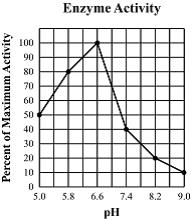
Which of the following conclusions can be drawn from this graph?
a)
The optimum pH of the enzyme is 6.6.
b)
The optimum pH of the enzyme is 5.8
c)
The enzyme’s activity increases as pH increases 5.0 to 9.0
d)
The enzyme’s activity is greater around pH of 8.0 .
18.
Any substance that is acted upon by an enzyme is called a(n)?
a)
Coenzyme
b)
Substrate
c)
Vitamin
d)
Polypeptide
19.
What is the function of an enzyme?
a)
enzymes break themselves into small pieces
b)
enzymes slow down chemical reactions
c)
enzymes speed up chemical reactions
d)
enzymes combine products to form reactants 
20.
Which of these is most likely an enzyme?  
a)
Sucrose
b)
Galactose
c)
Fructose
d)
Amylase
21.
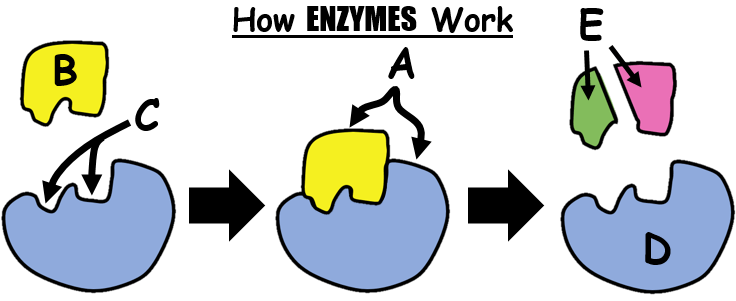
Letter C...
a)
active site
b)
enzymes
c)
substrate
d)
products
22.
The function of the plasma membrane is....
a)
to regulate what enters and leaves the cell.
b)
fight bacteria and viruses that enter the cell.
c)
provide rigid support and protection to the cell.
d)
make sure each cell can move
23.
What is NOT TRUE about the cell membrane
a)
It controls what enters and leaves the cell
b)
Semipermeable
c)
Phospholipid bilayer
d)
Contains digestive enzymes
24.

The movement of particles from an area of high to low concentration is known as--

a)

Passive Transport

b)

Active Transport

25.

What is it called when large molecules move across the cell membrane from an area of high concentration to an area of low concentration through a protein channel?

a)

Diffusion

b)

Osmosis

c)

Active Transport

d)

Facilitated Diffusion

26.

Cell membrane transport that occurs without energy is called--

a)

active transport

b)

endocytosis

c)

passive transport

d)

exocytosis

27.

What is the name of the process in which small molecules move from an area of high concentration to an area of low concentration across the cell membrane

a)

Diffusion

b)

Osmosis

c)

Active Transport

d)

Facilitated Diffusion

28.
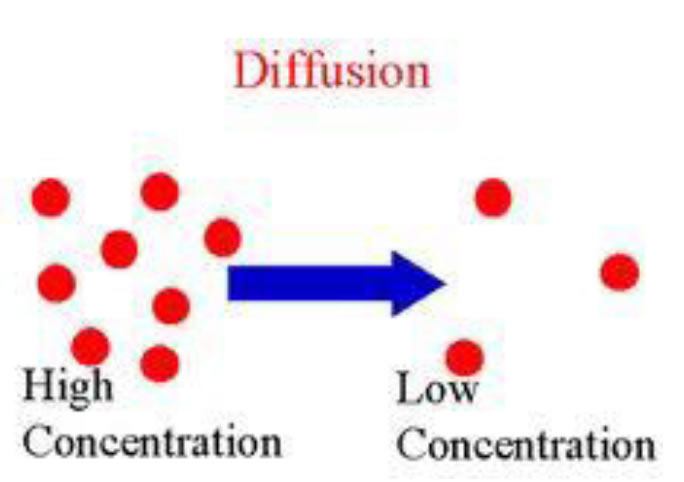
The picture is an example of...
a)
active tranport
b)
passive transport
c)
diffusion
d)
osmosis
29.
Energy is released from ATP when
a)
a phosphate group is added
b)
adenine bonds to ribose
c)
ATP is exposed to sunlight
d)
a phosphate group is removed
30.
What are the products of photosynthesis?
a)
water and carbon dioxide
b)
oxygen and glucose
c)
oxygen and carbon dioxide
d)
oxygen and water
31.
Plants need carbon dioxide from their environment to produce glucose during which stage of photosynthesis? 
a)
The light-dependent stage
b)
The light-independent stage 
c)
The electron transport chain
d)
ATP formation
32.
Which of the following is the correct equation for PHOTOSYNTHESIS?
a)
carbon dioxide + water --> oxygen + glucose
b)
carbon dioxide + glucose + water --> oxygen 
c)
oxygen + water --> carbon dioxide + glucose
d)
glucose+ oxygen ---> water + carbon dioxide 
33.
Which organelle does photosynthesis take place in?
a)
Mitochondrion
b)
Chloroplast
c)
Cytoplasm
d)
Nucleus
34.
What are the products of the light DEPENDENT reactions? 
a)
Glucose and Oxygen
b)
NADPH/ATP and Oxygen
c)
Glucose and Carbon Dioxide
d)
Carbon Dioxide and Water
35.

What is an enzyme that catalyzes the reaction in which a free Phosphate is added to an ADP molecule

a)

ADP synthase

b)

ATP polymerase

c)

ATP synthase

d)

ATT synthase

36.
Where does aerobic respiration take place?
a)
Cytoplasm
b)
Mitochondria
c)
Stroma
d)
Thylakoid
37.
Glucose is broken down during which process?
a)
Calvin cycle
b)
Glycolysis
c)
Krebs Cycle
d)
Photosynthesis 
38.
The overall goal of cellular respiration is to make:
a)
Glucose
b)
ATP
c)
Oxygen
d)
Water
39.

Which stage of the cellular respiration process produces the most ATP?

a)

Glycolysis

b)

Acetyl CoA

c)

Kreb's Cycle

d)

Electron Transport Chain

40.
Which is true of prokaryotic and eukaryotic cells?
a)
Prokaryotic cells are larger than eukaryotic cells.
b)
Eukaryotic cells do not have nuclei, and prokaryotic cells do have nuclei.
c)
Prokaryotic cells lack membrane-bound organelles, and eukaryotic cells contain membrane-bound organelles.
d)
Eukaryotic cells are simpler than prokaryotic cells.
41.

Which do BOTH prokaryotes and eukaryotes contain?

a)

nucleus

b)

mitochondria

c)

ribosomes

d)

cell wall

42.

Which does only eukaryotic cells contain?

a)

nucleus

b)

DNA

c)

cell membrane

d)

ribosomes

43.

You can distinguish a prokaryote apart from a nucleus by--

a)

The presence of a ribosome

b)

The presence of a cell membrane

c)

The presence of DNA

d)

The presence of a nuclear membrane

44.

Bacteria is an example of a(n)

a)

prokaryotic cell.

b)

eukaryotic cell.

45.
"Storage tanks" Can hold food, water or waste for the cell
a)
Ribosomes
b)
Vacuole
c)
Chloroplast
d)
Nucleolus
46.
Which organelle is only found in a plant cell? 
a)
nucleus
b)
chloroplast
c)
mitochondria
d)
cell membrane