
Font size
 Worksheets
Kinetics Unit Practice
Total questions: 69
Worksheet time: 1hrs 9mins
The rate of a chemical reaction normally
increases as temperature decreases.
decreases when a catalyst is added.
increases as reactant concentration increases.
decreases as reactant concentration increases.
Crushing a solid into a powder will increase reaction rate because:
the particles will collide with more energy
the orientation of colliding particles will be improved
the activation energy barrier will be lowered
the powdered form has more surface area
A lump of ignited charcoal which is glowing in air burns more vigorously when lowered into a bottle of pure oxygen. This is due to an increase in
surface area
temperature
concentration
volume
What happens to a catalyst in a reaction?
It remains unchanged.
It is incorporated into the reactants.
It is incorporated into the products.
It evaporates.
Which out of the following is NOT a factor that affects the rate of a reaction between a solid and liquid reactant?
temperature
concentration
surface area
volume
catalysts
How does a catalyst work in speeding up a reaction?
by lowering the activation energy (minimum energy needed for the reaction to take place)
by giving the reactants more energy
by increasing the number of reactant particles
by increasing the temperature
Why does a higher concentration increase the rate of reaction?
it increases the amount of reactants
it lowers the activation energy
it increases the energy of particle collisions
it increases the frequency of particle collisions
Which of the following increases the reaction rate?
less surface area
lower temperature
more particle size
increased concentration


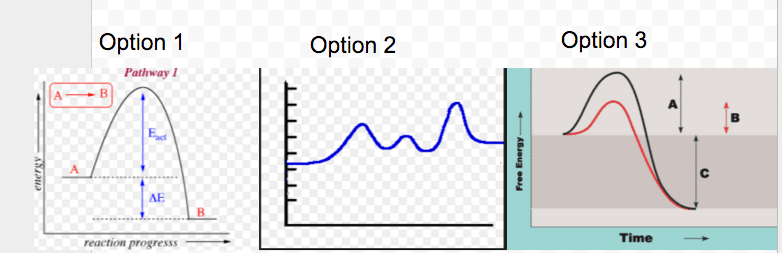
The potential energy diagram of a reaction is shown. Which represents the enthalpy change for the reaction?
1
2
3
4
In an exothermic process the surroundings looses heat.

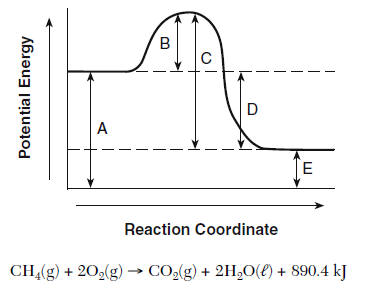
What is the Heat of Reaction ΔH for this reaction?
-200 KJ
200 KJ
400 KJ
-300 KJ
What type of reaction is this?
Exothermic
Endothermic
Energy Producing
No way to tell
What kind of energy is stored in the bonding of atoms?
Potential
Kinetic
None of the above
All of the above
The ____________ states that atoms, ions, or molecules must collide in order to react.
transition state
activation energy
rate law
collision theory
Increasing the ____ causes the particles (atoms
or molecules) of the reactants to move more quickly so that
they collide with each other more frequently and with more
energy.
Catalyst
Surface Area
Temperature
Concentration
________ is the measure of how much area of an
object is exposed.
Surface Area
Catalyst
Temperature
Concentration
Grains of sugar have a greater _______ than a solid cube of
sugar of the same mass, and therefore will dissolve quicker in water.
Surface Area
Catalyst
Temperature
Concentratrion
The energy needed for substance to initiate reaction is called...
Initiation energy
Propagation energy
Activation energy
Enthalpy
From options below, which one is an exothermic reaction?
Photosynthesis
Melting ice cube
Sublimation
Magnesium Combusting
When the value of ΔH is negative, which one(s) from below is/are true?
The reaction is fast
The reaction releases energy
It is a combustion reaction
The energy of product is lower than reactant
When KNO3 salt is dissolved in water, the water becomes colder. By that information, we know that the solvation of KNO3 is...
Endothermic reaction
Endothermic process
Exothermic reaction
Exothermic process
ΔH is –85 kJ/mole
ΔH is +85 kJ/mole
ΔS is –85 kJ/mole
ΔS is +85 kJ/mole

Given the reaction: C6H12O6(s) + 6O2(g) --> 6H2O(l) + 6CO2(g) + energy
What is the ΔH and ΔS?
ΔH is + & ΔS is +
ΔH is + & ΔS is -
ΔH is - & ΔS is +
ΔH is - & ΔS is -
In Table i the reaction of hydrogen and oxygen to form water is best described as
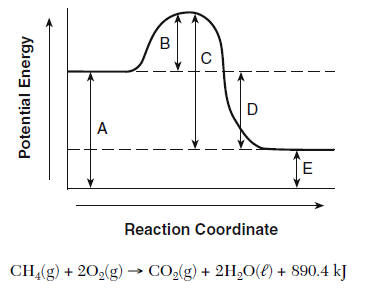
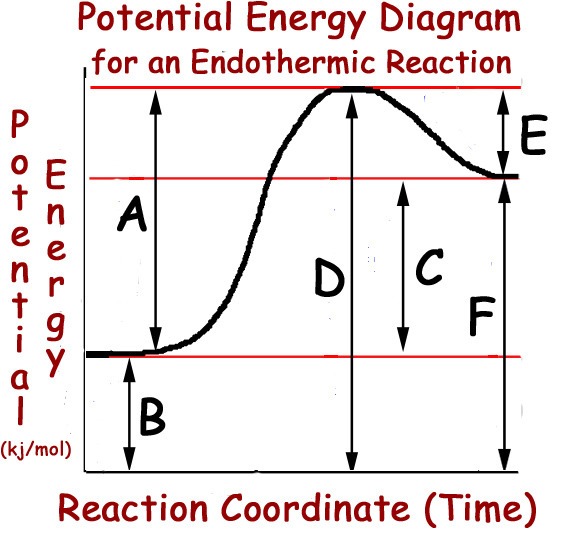
Which numbered intervals on the diagram would change when a catalyst is added?
A & E
A & D
E & D
Which term refers to the difference between the potential energy of the products and the potential energy of the reactants for any chemical change?
What is the symbol for entropy?
H
G
S
E
Which represents a decrease in entropy?
sublimation of CO2
boiling water
condensation of steam on cold glass
NaCl dissolving in water
Which represents a -ΔS?
ice melting
salt dissolving
water boiling
none of these
wood burning
Which of the following scenarios describes a process with a negative entropy change?
Building a skyscraper
A clean room becomes cluttered
An igloo melting
salt dissolving in water
Which of these have a DECREASE in entropy?
CaCO3(s) → CaO(s) + CO2(g)
N2(g) and 3H2(g) → 2NH3(g)
C6H6(l) → 6C(s)+ H2(g)
The entropy can be thought of as
the amount of disorder and spread
the amount of order and organization
the amount of heat energy
Which combination of ΔH and ΔS always has a spontaneous reaction?
+ΔH and +ΔS
+ΔH and -ΔS
-ΔH and -ΔS
-ΔH and +ΔS
Which combination of ΔH and ΔS NEVER has a spontaneous reaction?
+ΔH and +ΔS
+ΔH and -ΔS
-ΔH and -ΔS
-ΔH and +ΔS
Ammonium nitrate dissolves in water. The solution becomes colder as it dissolves. It is a spontaneous endothermic process in the chemistry room because there is
a decrease in enthalpy and the temperature of the room is high enough
an increase in entropy and the temperature of the room is high enough
an increase in enthalpy and of the room the temperature is cold enough
a decrease in entropy and the temperature of the room is cold enough
What is a spontaneous process ?
slow process
fast process
process that needs an external intervention to occur
process that does not need external intervention to occur / keep happening

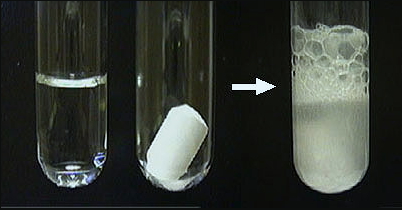
How could we make this reaction happen more quickly?
Decrease the concentration of the acid
crush the chalk to increase the surface area
Put the test tube in an ice bath
What type of reaction is this?
Endothermic
Exothermic
Predict the signs of ΔH , ΔS and spontaneity of the melting of iron:
Fe(s) + energy --> Fe(l)
Δ H = - , Δ S = + and spontaneous at all temperature
Δ H = + , Δ S = + and spontaneous at high temperature
Δ H = + , Δ S = + and never spontaneous
Δ H = - , Δ S = - and spontaneous at all temperature
Which factor can only affect the rate of reaction when gases are one of the reactants?
Concentration of reactants
Pressure
Temperature
Size of reactants
A catalyst only changes...
the speed of the reaction
the ΔH of the reaction
the amount of product produced when the reaction is finished
The ΔS of the reaction
If ΔH is negative, heat would be shown on the _____ side of the thermochemical equation.
In an exothermic process the system looses heat.
In an endothermic reaction the surroundings are losing energy.
ΔH value in an exothermic reaction is a positive number.
Which interval represents the PE of the Products?
Which represents a +ΔS?
water freezing
water condensing
photosynthesis
none of these
wood burning
According to table i, which two of the following will feel colder when dissolving into room temperature water?
NaOH(s)
NH4Cl(s)
LiBr(s)
KNO3(s)
According to table i, which two of the following will feel hotter when dissolving into room temperature water?
NaOH(s)
NaCl(s)
LiBr(s)
KNO3(s)

