
 Worksheets
blood
Total questions: 55
Worksheet time: 57mins
What makes up around 55% of the blood?
Plasma
Red Blood Cells
White Blood Cells
Platelets
What carries oxygen around the body?
Plasma
Red Blood Cells
Platelets
White Blood Cells
What causes the blood to be the distinct red colour?
Haemoglobin
Glucose
Hormones
Oxygen
What is the function (job) of the platelets?
To form clots (i.e. scabs) when you have cuts and grazes.
To transport oxygen to the muscles
To carry dissolved sugars.
To produce antibodies
What is the function (job) of the plasma?
To release antibodies to fight infections.
To transport oxygen around the body.
To carry dissolved nutrients and sugars.
To transport oxygen around the body.
What is the function (job) of the red blood cells?
To transport oxygen around the body and to the muscles.
To release antibodies to fight infections.
To carry dissolved nutrients and sugars.
To clot and form scabs if there is a wound on the body.

What is plasma?
only white blood cells
only red blood cells
fluid part of blood
hemoglobin

1. vascular spasm
2. ___________
3. coagulation

How much blood does an adult have?
5 liters
10 liters
8 liters
20 liters

State the chemical nature of hemoglobin
Lipid
Polysaccharide
Polypeptide
Triglyceride

Refers to the nature of blood plasma
Consists mostly of water
Nonpolar
Hydrophobic
Consists of solid particles such as blood cells
This best describes positive cooperativity of hemoglobin
As 1 O2 binds to a heme group, it causes a sudden shift of polarity, attracting more O2
As 1 O2 binds to a heme group, a conformational change occurs, making it more likely for additional O2 to bind
As 1 O2 binds to a heme group, hemoglobin becomes slightly less hydrophilic
As 1 O2 binds to a globin group, the binding site of O2 within the molecule becomes more exposed

What explains the steep slope of the curve?
Binding of O2 within the heme groups
O2 loading into hemoglobin
Unloading of O2 from hemoglobin
Positive cooperativity

Assume the biomolecule pictured in the illustration is normal. "C" (rectangular discs) represent _________.
Hemoglobin S
Heme
Iron (Fe)
Beta-Chains
Hemoglobin
Hemoglobin is made up of ___ protein chains.
2
4
6
1
8
1 Hemoglobin can carry ___ molecules of oxygen.
2
4
6
1
8
This part of hemoglobin is responsible for binding oxygen.
Hemoglobin S
Heme
Iron (Fe)
Beta-Chains
Hemoglobin
A normal RBC is ____.
Disc-Shaped, Biconcave
Cresent-Shaped, Sickle-Shaped
Globular
Flexible
Clumped (Fibrous)
Which of the following is true of a normal adult hemoglobin oxygen dissociation curve?
I. it is sigmoidal
II. it is easier for the last O2 to bind than the second and third
III. at lower partial pressures of oxygen, hemoglobin has a lower affinity for oxygen
I and II only
I and III only
II and III only
I, II and III

With reference to the graph, which of the areas represent the percentage saturation in a resting muscle tissue?
A and C
A alone
B and C
B alone

Which of the following is true about percentage saturation of blood in region C
That is the percentage saturation of blood that is entering the lungs
That is the percentage saturation of blood leaving the lungs
That is the percentage saturation of the alveolar air space
That is the percentage saturation of the plasma

Using the graph, what does graph A represent?
graph of fetal haemoglobin
graph of sickle celled haemoglobin
graph of adult haemoglobin
graph of denatured haemoglobin

Which statement truly represents the difference between the two curves?
Curve A represents an haemoglobin that has higher affinity for oxygen at all partial pressures of oxygen
Curve A represents a curve that has higher affinity for haemobloby at only at low partial pressures of oxygen
Curve A represents haemoglobin that will readily release oxygen at all partial pressures
Curve A represents haemoglobin that will not readily bind to oxygen even at high partial pressure of oxygen

Which of the following statements is true from the curve?
any decrease in partial pressure will always cause curve A's haemoglobin to release more oxygen
any decrease in partial pressure will always cause curve B's haemoglobin to release more oxygen
any decrease in partial pressure will only cause curve A's haemoglobin to release more oxygen at low partial pressures of oxygen
any decrease in partial pressure will only cause curve A's haemoglobin to release more oxygen at high partial pressures of oxygen
When you damage a blood vessel what is the first thing that happens?
Vasoconstriction
Platelet plug formation
Coagulation
Release of extra Leukocytes
Which blood type has both A and B antibodies?
A
B
AB
O
What color is your blood without oxygen?
Dark Red
Blue
Scarlet Red
Magenta
An inherited condition in which erythrocytes rupture or are destroyed at a faster rate than is normal is known as ____.
aplastic anemia
sickle-cell anemia
iron-deficiency anemia
hemolytic anemia
The average lifespan of a red blood cell is
90 days
120 days
360 days
24 hours
a hormone that controls the homeostasis mechanism of RBC production
erythropoietin
thymopoietin
vasopressin
estradiol
Which ions must be present for thromboplastin to work?
Na+
Cl-
Ca2+
H+
Thrombin is an enzyme that converts fibrin to fibrinogen
True
False
What is the role of fibrin in blood clotting?
acts as an enzyme
forms a mesh of fibres to cover the wound
causes smooth muscles in blood vessels to contract
starts off the whole process

What is this blood type?
A+
AB+
AB-
A-

What is the blood type?
O+
B+
AB-
AB+

What is the blood type?
O-
O+
Not Valid
AB+
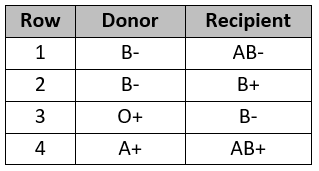

Using the diagram to determine the blood type
Type A
Type B
Type AB
Type Z - for Zebra this blood is from a zoo
What is the reason for a RBC to eject mitochondria
Without the mitochondria, the Red blood cells will be able to clot
If the RBC's had mitochondria, they would consume the Oxygen the RBC are carrying
If the blood cells had mitochondria, the RBC's cannot form hemoglobin
Without the mitochondria, the RBC's are about the be the right shape.

