wayground logo

Free Printable Worksheets

Font size

S
M
L
XL
Worksheets

APES PBL Unit 3 Pretest

Total questions: 78

Worksheet time: 58mins

Name
Class
Date
1.
_______ is the type of soil used most often with plants. It is a mixture of clay, sand, and silt.
a)
loam
b)
humus
c)
mud
d)
dirt
2.
Humus is.....
a)
the dead parts of plants and animals in soil.
b)
A food we eat with pretzels.
c)
The tiny particles inside of soil
d)
The roots that come off of a plant and live in soil.
3.
When there are not enough plants to hold topsoil in place, water and  _______ carry the topsoil away, leaving the subsoil exposed
a)
sunlight
b)
birds
c)
magnetic fields
d)
wind
4.
Which of the following is the largest particle in soil?
a)
sand
b)
silt
c)
humus
d)
clay
5.
Many plants cannot grow in sandy soil. Why is this true?
a)
Sandy soil does not hold enough water.
b)
Oxygen cannot pass through sandy soil.
c)
Roots cannot easily push through clay soil.
d)
Sandy soil has too many nutrients.
6.
Soil is made of
a)
weathered rocks and minerals
b)
dead plants and animals
c)
air and water
d)
all of the above
7.
Which layer of soil is on the bottom?
a)
topsoil
b)
subsoil
c)
bedrock
d)
bottomsoil
8.
What is the process of rocks being broken down over time called?
a)
Weathering
b)
Accumulation
c)
Condensation
d)
Evaporation
9.
THIS LAYER CONTAINS UNWEATHERED SOLID ROCK AND IS BENEATH ALL OTHER LAYERS......
a)
HORIZON A
b)
HORIZON O
c)
HORIZON D
d)
HORIZON C
10.
THIS HORIZON IS MADE OF DECAYING LEAVES, TWIGS AND ANIMAL REMAINS/WASTES......
a)
A
b)
B
c)
C
d)
O
11.

The cultivation of a single crop in a given area

a)

polyculture

b)

monoculture

c)

inorganic farming

d)

organic farming

12.

All-natural farming practice-no pesticides used

a)

inorganic farming

b)

organic farming

c)

monoculture farming

d)

polyculture farming

13.

DDT accumulation in North American Eagles, pelicans, and other birds disrupted birds' calcium metabolism, causing...

a)

Infertility

b)

Thin Eggshells

c)

Severe nerve damage

d)

Adult Deformities

e)

All of these are correct

14.

___________________ can be done to reduce the impact of pesticide residue.

i) implementing pesticide related laws.

ii)usage of compost can be reduced.

iii) promoting organic farming

iv) using antibiotics

a)

All of the above

b)

i and ii

c)

i ,ii and iv

d)

i and iii

15.
Industrialized agriculture is often referred to as "high input" because it requires a great deal of:
a)
pesticides
b)
fertilizers
c)
fossil fuels
d)
all of these 
16.
Which of the following best describes IPM?
a)
Spraying broad-spectrum chemical pesticides as the first line of defense 
b)
Complete elimination of all chemical pesticides
c)
Implementing a variety of cultivation and biological techniques and only spraying pesticides as a last resort
d)
Utilizing only trap cropping and crop rotation
17.
Which of the following describes a fundamental characteristic of the Green Revolution?
a)
The application of higher levels of organic fertilizers.
b)
The addition of calorie, fat, and fiber content to food labels.
c)
The development of new strains of crops with higher yields.
d)
Deforestation to provide crops with additional sunlight.
18.
Repeated application of irrigated water in dry climates leads to...
a)
a drop in productivity of the land by more than 10%, leading to desertification
b)
a build up of nutrients, leading to increased levels of erosion
c)
a build up of salts in the soil, leading to salinization
d)
decreased phosphorus and nitrogen, leading to eutrophication
19.
The use of synthetic fertilizers can increase crop yield, but also
a)
destroy nitrifying bacteria in the soil
b)
increase nutrient runoff into nearby surface waters
c)
slow the release of organic nutrients from compost
d)
increase fish populations in nearby streams
20.
Concentrated Animal Feedlot Operations (CAFO's) can BEST be described as...
a)
a method of producing meat with more land
b)
an experiment to test the effectiveness of antibiotics
c)
the storing of grain as a nutritional supplement
d)
large numbers of livestock in confined spaces
21.
All of the following are disadvantages of raising animals in feedlots, EXCEPT
a)
less land use
b)
uses more water
c)
produces large amounts of animal waste
d)
increased antibiotic use
22.
Which of the following are harmful effects of agriculture?
a)
Algal blooms due to fertilizer runoff
b)
Climate change associated with methane emissions from livestock and rice paddies
c)
Pesticide residue in food, water, and air
d)
All of the above
23.
Which of the following best describes a genetically modified organism (GMO)?
a)
An organism that has been selectively bred for the best traits
b)
An organism that contains foreign DNA
c)
An organism that is produced after exposure to a mutagen.
d)
An organism that has been cloned
24.
Which of the following soil erosion techniques is demonstrated in the picture?
a)
contour plowing
b)
terracing
c)
windbreaks
d)
intercropping
25.
All of the following are benefits of pesticide use EXCEPT
a)
disease control
b)
crop protection
c)
genetic resistance
d)
lower food costs for consumers
26.
A farmer discovers pests have become resistant to the atrazine she's been using so she must use larger, more frequent doses.  This is known as 
a)
the pesticide treadmill
b)
both an acute and a chronic effect
c)
a synergistic effect
d)
an antagonistic effect
27.
Which of the following is NOT a key component of organic agriculture?
a)
Using genetically modified seeds.
b)
Applying manure as fertilizer.
c)
Integrated Pest Management
d)
Crop Rotation
28.
Which type of soil conservation strategy is being  used in this picture?
a)
windbreaks
b)
contour plowing
c)
alley cropping
d)
terracing
29.

The development of dangerous strains of bacteria is a result of which agricultural practice...

a)

using herbicides in large scale grain farming

b)

growing crops that are genetically modified for increased yields

c)

increasing the use of legumes into crop rotation protocols

d)

incorporating the use of antibiotics into the feeding regimes of densely concentrated livestock

30.

Choose the age of a person who is at the greatest risk if exposed by a pesticide

a)

child

b)

20

c)

30

d)

90

31.

The amount of a pesticide that has killed half of the 

    animals in a laboratory test

a)

toxicity

b)

hazard

c)

LD50

d)

dose

32.

Between 1950 and 1990, wheat production in India in average pounds per acre more than tripled, which allowed India to meet its population's need for food. Which of the following best explains this change?

a)

The elimination of poverty in India's rural regions

b)

The use of genetically modified seeds

c)

The increase of microloan programs that provide farmers with credit

d)

The use of large farm tractors and combine harvesters

e)

The use of improved plant hybrids and agricultural chemicals.

33.

In which of the following world regions has the Green Revolution had the least impact on agriculture?

a)

East Asia

b)

South Asia

c)

Southeast Asia

d)

Central America

e)

Sub-Saharan Africa

34.

In less developed countries, pesticides are typically applied by hand, whereas pesticides are typically applied by tractors or aircraft in more developed countries. Which of the following best explains the risks associated with pesticide applications?

a)

Crop dusters are at risk when applying pesticides with aircraft in more developed countries, whereas environmental pollution is a risk in less developed countries.

b)

Farm animals used to plow fields are at risk from pesticides in more developed countries, whereas environmental pollution is a risk is less developed countries.

c)

Farmers' health is at risk in less developed countries, whereas environmental pollution is a risk in more developed countries.

d)

Crops are at risk in more developed countries, whereas environmental pollution is a risk in less developed countries.

e)

Contract harvesters are at risk in more developed countries, whereas environmental pollution is a risk in less developed countries.

35.
A super bacteria is one...
a)
that kills you quickly
b)
a very large bacteria
c)
a bacteria that is resistant to pesticides
d)
a bacteria that is resistant to antibiotics
36.
A medicine that kills bacteria
a)
antiviral
b)
antibiotic
c)
anti-fungal
d)
antiacid
37.
A  population of cockroaches was sprayed with an insecticide.  Some cockroaches survived and produced a population of cockroaches that was resistant to this spray.  What can BEST be inferred from this example?
a)
species will adapt no matter what the environment
b)
environment has no effect on the survival of an organism
c)
Individuals with favorable variations survive and reproduce
d)
Insecticides cause mutations that are passed on to the next generation
38.

What converts nitrogen gas into a usable form for plants and animals?

a)

bacteria

b)

rain

c)

fungi

d)

car exhaust

39.

How is nitrogen "fixed" into a usable form for plants?

a)

Through action of bacteria only

b)

Through lightning only

c)

Through action of bacteria and lightning

d)

Through photosynthesis

40.

What is the process of combining nitrogen gas with other elements to make nitrogen into usable compounds?

a)

nitrogen composition

b)

nitrogen fixation

c)

ammonia

d)

denitrification

41.

What is the formula for atmospheric nitrogen?

a)

N

b)

N2

c)

NH3

d)

NO3

42.

What process occurs when dead plant and animal matter decomposes and nitrogen is released back into the atmosphere?

a)

Assimilation

b)

Fixation

c)

Ammonification

d)

Denitrification

43.

Plants and animals cannot use nitrogen directly from the air.

a)

True

b)

False

44.

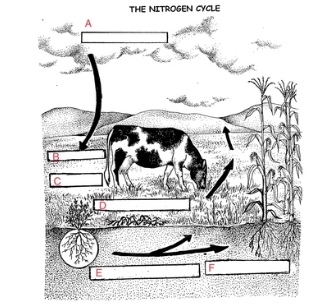
In the nitrogen cycle, what does label A in the diagram represent?

a)

Gas

b)

Clouds

c)

Carbon dioxide in the atmosphere

d)

Nitrogen in the atmosphere

45.
Plants and animals need nitrogen to make __________.
a)
Protein
b)
Carbohydrates
c)
Lipids
d)
Minerals
46.

This is NOT a part of the phosphorus cycle.

a)

Phosphate is incorporated into sedimentary rocks

b)

Phosphate bound to soil

c)

Atmospheric phosphate

d)

Phosphate is absorbed from the soil by plants

47.

_____ brings phosphorous into our waterways. .

a)

Precipitation

b)

Runoff

c)

Transpiration

d)

Condensation

48.
Which of the following statements is true of the phosphorus cycle?
a)
Phosphorus enters the atmosphere as phosphates.
b)
The phosphorus cycle utilizes the processes of erosion, and weathering.
c)
Phosphates are used in carbohydrate and glucose storage.
d)
The phosphorus cycle utilizes bacteria to breakdown phosphates and make them available for plants.
49.
What role do decomposers play in the phosphorous cycle?
a)
absorb phosphorous 
b)
release phosphorous into atmosphere
c)
return phosphorous into the soil
d)
combustion
50.

This is released by the weathering of rocks.

a)

Carbonate

b)

Phosphate

c)

Phosphorus

d)

Nitrogen

51.

Too much phosphorus in waterways (rivers, lakes) can lead to___________.

a)

eutrophication

b)

nothing

c)

decreased pH levels

d)

diseases

52.

The major sink for phosphorus is

a)

sedimentary rock

b)

atmospheric gases

c)

seawater

d)

plants

53.

What things add phosphorus to the soil? Check all that apply.

a)

Decomposition

b)

Erosion

c)

Excretion

d)

Lightning

e)

Respiration

54.
The amount of a potentially harmful substance an individual ingests, inhales, or absorbs through the skin.
a)
dose
b)
LD50
c)
median lethal dose
d)
dose-response curve
55.
Amount of a toxic material per unit of body weight of test animals that kills half the test population in a certain time
a)
risk assessment
b)
risk management
c)
LD50
d)
LD60
56.

What is biomagnification?

a)

Only in animals found in oceans

b)

Cells storing nutrients and essential minerals.

c)

Lower level of harmful chemicals in the cells of organisms.

d)

Higher concentration of harmful chemicals in cells of organisms.

57.
Which of the following is a neurotoxin?
a)
Asbestos
b)
Thalidomide
c)
Mercury
d)
DDT
58.
Which list is made up of toxic metal pollutants?
a)
PCB, BPA, mercury, & potassium
b)
cadmium, arsenic, lead, & mercury
c)
DDT, cadmium, lead, potassium, & BPA
d)
argon, neon, chromium, & mercury
59.
What is the threshold dose of Toxin B?
a)
13 mg
b)
50 mg
c)
25 mg
d)
35 mg
60.
What is the LD-50 for Toxin B?
a)
10 mg
b)
13 mg
c)
25 mg
d)
50 mg
61.

This is the picture of __________ irrigation method

a)

A) Drip

b)

B) Sprinkle

c)

C) Surface

62.

The most expensive but most efficient method of irrigation is

a)

Sprinkler

b)

surface

c)

Drip

d)

Basin

63.

environmental advantage of no-till agriculture

a)

less erosion

b)

decrease in labor costs

c)

increased use of herbicides and pesticides

d)

increased need for irrigation

64.

When roots become saturated with water due to over-irrigation, it causes death in plant roots. This is called:

a)

salinization

b)

desertification

c)

agroforestry

d)

waterlogging

65.

Which of the following is the leading use of water globally?

a)

Domestic/Residential

b)

Industry

c)

Business/Commercial

d)

Agriculture

66.

Which methods of irrigation is the least efficient with the highest rate of evaporation?

a)

spray irrigation

b)

drip irrigation

c)

furrow irrigation

d)

flood irrigation

67.

This type of irrigation uses a large system of sprinklers that must be manually moved from field to field and has very large evaporative losses.

a)

Drip Irrigation

b)

Flood irrigation

c)

Furrow irrigation

d)

Spray irrigation

68.

A farmer discovers pests have become resistant to the atrazine she's been using so she must use larger, more frequent doses. This is known as

a)

the pesticide treadmill

b)

Acute biological effect

c)

a synergistic effect

d)

GMO

69.
Top-level predators often eat indirectly absorb toxins as a result of 
a)
bioaccumulation
b)
persistence
c)
overnutrition
d)
biomagnification
70.

Which IPM control relies on predation and parasitism?

a)

Biological Control

b)

Mechanical Control

c)

Cultural Control

d)

Genetic Control

71.
Scientists have inserted a gene for the production of vitamin A into rice.  This practice of changing the genetic structure of agricultural products to improve desirable traits is known as
a)
Genetic Engineering.
b)
Transmodification.
c)
Selective Breeding.
d)
Natural Selection.
72.

Which of the following is NOT a cause of Soil Degradation?

a)

overgrazing of livestock

b)

deforestation due to clearing for farmland

c)

mismanagement of agricultural activities

d)

No-Till Agriculture

73.

Which of the following is a benefit of using organic fertilizer

a)

Organic fertilizers do not require fossil fuels for production.

b)

exact amounts of needed nutrients is not easily determined

c)

more difficult to spread

d)

help decrease the water retention ability of soil

74.

Good Drainage, Good Aeration, Large Pore Space and poor fertility are characteristics of which soil type?

a)

Clay

b)

Sandy

c)

Loam

d)

Silt

75.

Poor Drainage, Poor Aeration, Prone to Water logging , Small Pore Space and Fertile

a)

Clay

b)

Loam

c)

Sandy

76.

A soil with 60% clay, 20% silt and 20% sand is...

a)

Clay

b)

Clay loam

c)

Silty clay loam

d)

Sandy clay loam

77.

10% sand, 20% clay, 70%silt

a)

Clay

b)

Loamy sand

c)

Silt

d)

Silt loam

78.

A soil that has 40% Sand and equal amounts of silt and clay is ...

a)

Loam

b)

Clay loam

c)

Silt loam

d)

Sandy loam