wayground logo

Free Printable Worksheets

Font size

S
M
L
XL
Worksheets

BIO EOC Review - GRIT

Total questions: 78

Worksheet time: 3hrs 36mins

Name
Class
Date
1.

The reactants(what is needed) of photosynthesis are:

a)

A. sugar and water

b)

B. sugar and oxygen

c)

C. carbon dioxide and water

d)

D. carbon dioxide and oxygen

2.

Plants get the energy they need for photosynthesis from __________.


A. water

B. soil

C. sunlight

D. they don't need energy

a)

A. water.

b)

B. Plants get the energy they need for photosynthesis from soil.

c)

C. Plants get the energy they need for photosynthesis from sunlight.

d)

D. Plants do not require energy to perform photosynthesis.

3.

What are the products(what comes out) of photosynthesis?

a)

A. carbon dioxide and water

b)

B. carbon dioxide and oxygen

c)

C. glucose and oxygen

d)

D. glucose and water

4.

PHOTOSYNTHESIS takes place in which part of the plant?

a)

Leaf

b)

Flower

c)

Stem

d)

Roots

5.

Which gas goes into the plant during photosynthesis?

a)

hydrogen

b)

oxygen

c)

nitrogen

d)

carbon dioxide

6.

What is the purpose of photosynthesis?

a)

A. Plants turn light energy into Chemical Energy(Sugar)

b)

B. Animals turn light energy into Chemical Energy(Sugar)

c)

C. Cells convert ATP to Chemical Energy

d)

D. Plants convert Chemical Energy into ATP

7.

When Food is consumed, it is absorbed into the blood and goes to the Mitochondria. What happens next?

a)

A. glucose and water combine to produce energy

b)

B. glucose and oxygen combine to produce energy

c)

C. oxygen light and glucose combine to produce energy

d)

D. oxygen, carbon dioxide and glucose combine to produce energy

8.

What does cellular respiration need to begin?


A. Nitrogen

B. Carbon Dioxide

C. Glucose

D. Water

a)

oxygen

b)

carbon dioxide

c)

glucose

d)

water

9.

Jose says Cellular Respiration needs Glucose and oxygen and gives off Energy and Carbon Dioxide. Is he correct?

a)

A. Jose is completely correct

b)

B. Jose is partially correct, he forgot to add it also gives off water

c)

C. Jose is partially correct, he forgot that it gives off oxygen

d)

D. Jose is incorrect it needs oxygen and Carbon dioxide

10.

What would happen to the rate of photosynthesis if the amount of water that is available to plants decreases? Photosynthesis will....

a)

A. increase because the plants will share water

b)

B. decrease because water is needed to make glucose

c)

C. increase because it can make more glucose

d)

D. decrease because is has more sunlight

11.

Latisha is observing cells over time and noticed an increase in energy available to the cells which process is responsible for the increase in energy?


Photosynthesis OR Cellular Respiration

a)

Photosynthesis

b)

Cellular Respiration

12.

Sunshine is what TYPE of energy?

a)

A. Mechanical Energy

b)

B. Chemical Energy

c)

C. Light Energy

d)

D. Thermal Energy

13.

Glucose (sugar) is what TYPE of energy?

a)

A. Mechanical Energy

b)

B. Chemical Energy

c)

C. Light Energy

d)

D. Thermal Energy

14.

Which of the following occurs in the cytoplasm and produces only 2 ATP molecules?

a)

glycolysis

b)

Krebs Cycle

c)

electron transport chain

d)

Calvin Cycle

15.

Which of the following types of cellular respiration does NOT require oxygen?

a)

anaerobic respiration

b)

aerobic respiration

c)

light dependent respiration

d)

light independent respiration

16.
Which of the following is the correct equation for cellular respiration?
a)
6CO2 + 6H2→ 6O2 + C6H12O6 + Energy
b)
6O2 + C6H12O→ 6CO2 + 6H2O + Energy
c)
6CO2 + 6H2O + Energy → 6O2 + C6H12O6
d)
6O2 + C6H12O6 + Energy → 6CO2 + 6H2O
17.
What is the function of ATP in living things?
a)
provides energy for cells
b)
stores genetic information
c)
provides structure in the nucleus
18.
Which bond of the ATP molecule is broken in order to release energy?
a)
A
b)
B
c)
C
d)
D
19.

What process creates the most ATP ?

a)

Glycolysis

b)

Aerobic respiration

c)

Aerobic fermentation

d)

Anaerobic fermentation

20.

Which of the following are gametes?

A Egg

B Testis

C Ovary

D Sperm

a)

A and C only

b)

A and D only

c)

B and C only

d)

A, B, C and D

21.

Which organ allows the sperm to exit the male reproductive system?

a)

A

b)

B

c)

C

d)

D

22.

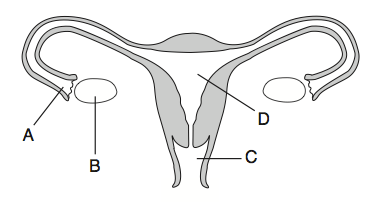
Which organ produces sperm?

a)

A

b)

B

c)

C

d)

D

23.
Which organ produces eggs?
a)
A
b)
B
c)
C
d)
D
24.

After the egg is fertilized in the fallopian tubes, where does the fertilized egg implant and develop?

a)

A

b)

B

c)

C

d)

D

25.
The function of part B is to _______. 
a)
produce eggs
b)
produce sperms
c)
allow fertiisation to take place 
d)
release the sperms
26.

Where does fertilization take place?

a)

Ovary

b)

Womb

c)

Vagina

d)

Fallopian tube

27.

How does the baby exchange substances between the baby and the mother?

a)

Ovary

b)

Womb

c)

Placenta

d)

Fallopian tube

28.

State the process shown in the picture.

a)

pollination

b)

fertilization

c)

seed dispersal

d)

germination

29.

Which of the following statements is true about the process shown in the picture?

a)

Many sperms will enter the egg.

b)

Only 1 sperm will fertilize the egg.

c)

Many sperms will fertilize many eggs.

d)

None of the sperms will enter the eggs.

30.

Which of the following statements about reproduction are true?

A) Fertilization only occurs in sexual reproduction.

B) Reproduction is to ensure the continuity of living things.

C) In reproduction, both male and female produces eggs and sperms.

a)

A and B only

b)

A and C only

c)

B and C only

d)

A, B and C

31.
What type of RNA carries the DNA message out of the nucleus to the ribosomes?
a)
mRNA
b)
tRNA
c)
RNA
d)
DNA
32.
What do we call the process of turning DNA into mRNA?
a)
Translation
b)
Transcription 
c)
Replication
33.
When DNA is transcribed to RNA.... 
a)
A pairs with U
b)
C pairs with U
c)
A pairs with T
d)
C pairs with T
34.
Amino acids are the building blocks of... 
a)
DNA
b)
RNA
c)
Atoms
d)
Proteins
35.
In translation, C pairs with 
a)
U
b)
G
c)
A
d)
T
36.
Where does transcription take place?
a)
nucleus
b)
cytoplasm
c)
ribosome
37.
One difference between DNA and RNA is that....
a)
Only RNA has the base Uracil
b)
only RNA contains the base Thymine
c)
only RNA contains the base Cytocine
d)
only RNA contained the base Guanine
38.
True or false:  RNA is double-stranded.
a)
true
b)
false
c)
it depends on the type
39.
Which of these bases does not exist in RNA?
a)
C
b)
T
c)
U
d)
A
40.
_______ is made during transcription and ________ is made during translation.
a)
mRNA / a protein
b)
a protein / mRNA
c)
Ribosome / Nucleus
d)
mRNA / tRNA
41.
In comparison to a DNA strand, a 
a)
mRNA strand is shorter and single stranded
b)
mRNA strand is longer and single stranded
c)
mRNA strand is shorter and double stranded
d)
mRNA strand is longer and double stranded
42.
Nucleotides are made up of a sugar, phosphate, and..?
a)
nitrogenous base
b)
nucleic acid
c)
cholesterol
d)
fatty acid
43.
Which of the following is the sugar found in RNA?
a)
Ribose
b)
Maltose
c)
Deoxyribose
d)
Amylose
44.
Codons contain ______ bases
a)
1
b)
3
c)
6
d)
9
45.
Which is the organelle that makes proteins?
a)
Nucleus
b)
Ribosomes
c)
Rough ER
d)
Golgi Apparatus
46.
What is true about RNA?
a)
It is indestructible
b)
It can travel outside of the nucleus
c)
It has five nucleotides
d)
It contains twice as much thymine as DNA
47.
What is the correct order?
a)
Transcription then Translation
b)
Translation then transcription
c)
Translation then replication
d)
Replication then Translation
48.
DNA codes for...
a)
cholesterol
b)
proteins
c)
fatty acids
d)
a sandwich
49.
Brings the amino acids to the ribosome
a)
mRNA
b)
tRNA
c)
rRNA
d)
DNA
50.
What amino acid is represented by the codon CAG?
a)
Aspartic Acid
b)
Histidine
c)
Glutamine
d)
Methionine
51.
How many amino acids are coded for by this sequence of nucleotides:
ATG GGA  ACT
a)
4
b)
3
c)
6
d)
2
52.
What will be the resulting mRNA from this DNA sequence:
GAT-TAC-AGA-TTA-CAT?
a)
CTA-ATG-TCT-AAT-GTA
b)
GAU-UAG-UGA-UUA-GUT
c)
CUA-AUG-UCU-AAU-GUA
d)
CAT-ACA-TAC-ATA-TAG
53.
Which amino acid is made from the RNA codon UUA?
a)
Phenylalanine
b)
Leucine
c)
Serine
d)
Tyrosine
54.
Which amino acid is made from the RNA codon GUA?
a)
Phenylalanine
b)
Leucine
c)
Serine
d)
Valine
55.
What is the correct sequence?
a)
RNA --> DNA --> Protein
b)
Protein --> RNA --> DNA
c)
DNA --> RNA --> Protein
d)
DNA --> Protein --> RNA
56.
Proteins are made of monomers called ___________
a)
Nucleotides
b)
Monosaccharides
c)
Amino Acids
d)
Glycerol and fatty acids
57.
The element _______is found in all of the organic compounds.
a)
Iron
b)
Nitrogen
c)
Carbon
d)
Oxygen
58.
DNA and RNA are examples of 
a)
Carbohydrates
b)
Lipids
c)
Proteins
d)
Nucleic Acids
59.
Nucleotides are monomers of
a)
Carbohydrates
b)
Lipids
c)
Proteins
d)
Nucleic Acids
60.
Monosaccharides are monomers of
a)
Carbohydrates
b)
Lipids
c)
Proteins
d)
Nucleic Acids
61.
Waxes, oils and fats are examples of
a)
Carbohydrates
b)
Lipids
c)
Proteins
d)
Nucleic Acids
62.
Glycerol and fatty acids are the monomers of
a)
Carbohydrates
b)
Lipids
c)
Proteins
d)
Nucleic Acids
63.
The organic compounds that have many structural purposes and are used in many processes within the
cell are called ____________________.
a)
Carbohydrates
b)
Lipids
c)
Proteins
d)
Nucleic Acids
64.

Which macromolecule is shown?

a)

lipid

b)

protein

c)

nucleic acid

d)

carbohydrate

65.
What is the function of nucleic acids?
a)
store genetic information
b)
store energy (long-term)
c)
store energy (short-term)
d)
build skin, hair, nails, muscles
66.

Which macromolecule is shown?

a)

lipid

b)

protein

c)

nucleic acid

d)

carbohydrate

67.
What type of macromolecule are enzymes?
a)
Protein
b)
Carbohydrate
c)
Lipid
d)
Nucleic Acid
68.
Which of the following organic compounds is the main source of energy for living things?
a)
carbohydrates
b)
lipids
c)
nucleic acids
d)
proteins
69.
Which macromolecule stores energy, insulates us, and makes up the cell membrane?
a)
lipids
b)
proteins
c)
carbohydrates
d)
nucleic acids
70.
This is one job proteins do NOT have in the body
a)
insulation
b)
structure for tissues and organs
c)
speed up chemical reactions
d)
transport things through cell membrane
71.
What are the four macromolecules?
a)
proteins, nucleic acids, carbohydrates, and lipids
b)
monosaccharides, lipids, polysaccaharides, and proteins
c)
RNA, DNA, proteins, and carbohydrates
d)
proteins, DNA, RNA, and steroids
72.
What suffix (word ending) is used in the names of most carbohydrates?
a)
-ase
b)
-nic
c)
-ose
d)
-yme
73.

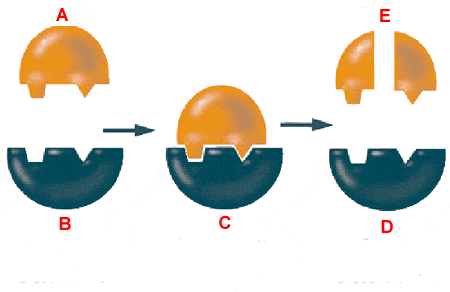
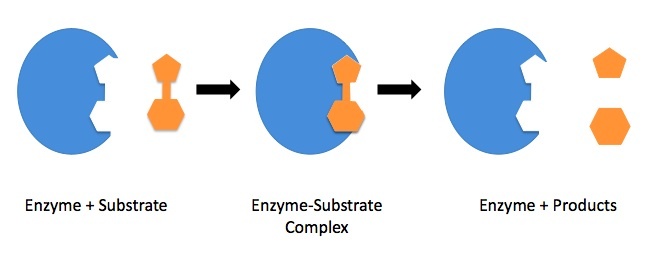
What is the purpose of an enzyme?

a)

give permission for the reaction

b)

raise activation energy

c)

speed up reactions (catalyst)

d)

control how many reactions occur

74.
Which biomolecule is also known as enzymes?
a)
Carbohydrate
b)
Lipid
c)
Nucleic Acid
d)
Protein
75.
Enzymes catalyze reactions by ___________ Activation Energy.
a)
Increasing
b)
Decreasing
76.
Most enzymes have the ending:
a)
-ase
b)
-ose
c)
-ic acid
d)
-ate
77.
Which of these is NOT true?
a)
Enzymes can denature (change shape) when the temperature gets too high.
b)
Enzymes can only be used once in a chemical reaction. 
c)
Extreme pH can denature enzymes.
d)
Enzymes speed up chemical reactions. 
78.
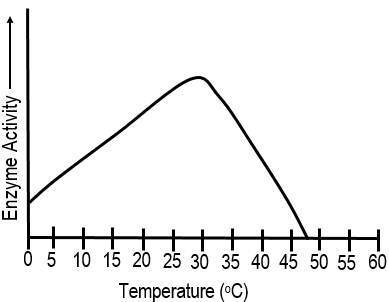
Based on the graph, what temperature does this enzyme work best? 
a)
15 C
b)
40 C
c)
30 C
d)
47 C