wayground logo

Free Printable Worksheets

Font size

S
M
L
XL
Worksheets

Weather Fronts and Air Mass practice

Total questions: 93

Worksheet time: 1hrs 25mins
Name
Class
Date
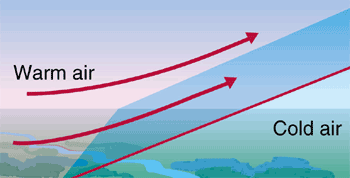
1.
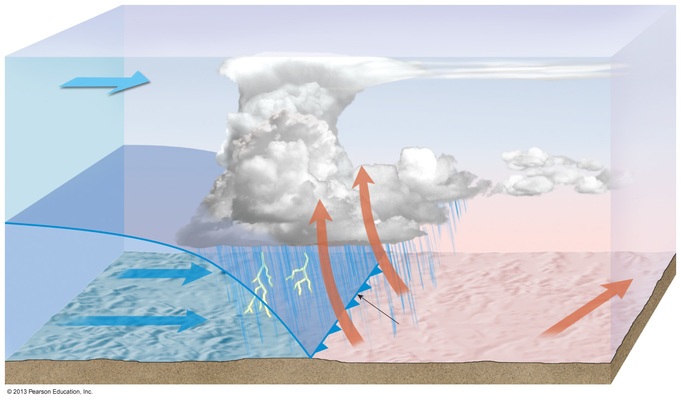
What type of storm front is this? 
a)
warm front
b)
cold front
c)
stationary front
d)
occluded front
2.
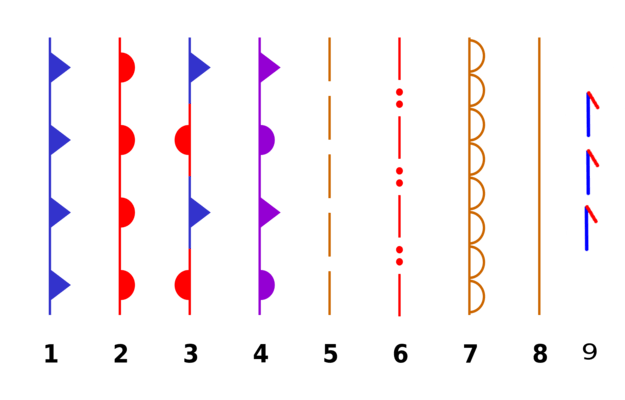
What does symbol # 3 mean?
a)
stationary front
b)
occluded front
c)
warm front
d)
cold front
3.
A front is
a)
where warm air is cooling at earth's surface
b)
a line where hot and cold air are separating
c)
a line where two different air masses meet
d)
where cold air is rising and forming rain clouds
4.
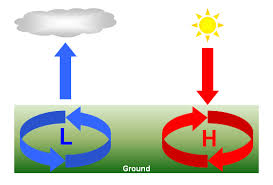
Which most likely produces clear, cool weather?
a)
zero air pressure
b)
stable air pressure
c)
a low pressure system
d)
a high pressure system
5.
_____________ air is more dense and tends to sink
a)
cold
b)
warm
c)
moist
d)
dry
6.
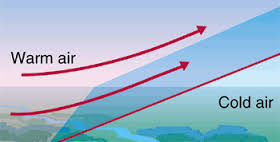
Which type of front is pictured?
a)
Cold front
b)
Warm front
c)
Occluded front
d)
Stationary front
7.
What symbol is this?
a)
warm front
b)
cold front
c)
stationary front
d)
occluded front
8.
Which system results in rainy or stormy weather?
a)
high pressure
b)
low pressure
c)
hurricane
d)
weather system
9.
Which system results in drier, fairer weather?
a)
high pressure
b)
low pressure
c)
hurricane
d)
weather system
10.
Which type of front is associated with purple humps and triangles facing the same direction?
a)
Cold
b)
Warm
c)
Stationary
d)
Occluded
11.
How are fronts formed?
a)
When two air masses meet
b)
when two winds meet
c)
when two clouds meet
12.

What type of front is shown?

a)

Warm Front

b)

Cold Front

c)

Occluded Front

d)

Stationary Front

13.
In a high pressure systems
a)
there are few clouds because the air in moving downward
b)
there are many clouds because the air is very humid
c)
there are few clouds because the air is moving outward
d)
there are many clouds because the air is moving upward
14.
A front is
a)
where warm air is cooling at earth's surface
b)
a line where hot and cold air are separating
c)
a line where two different air masses meet
d)
where cold air is rising and forming rain clouds
15.
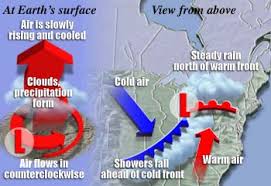
When I cold front is approaching, what happens?
a)
warm air is pushing under cold air causing humid weather and lower temperatures
b)
warm air is pushing under cold air causing humid weather and higher temperatures
c)
warm air rises, cools, and causes rain and thunderstorms
d)
cold air is pushed over warm air causing rain and thunderstorms
16.
The symbol on a weather map for a cold front is what?
a)
a line with triangles on it
b)
a line with semi-circles on it
c)
a line with squares on it
d)
a line with circles on it
17.
If an air mass is rising, it must be
a)
cold and less dense
b)
cold and more dense
c)
warm and more dense
d)
warm and less dense
18.
If an air mass is sinking, it must be
a)
cold and less dense
b)
cold and more dense
c)
warm and more dense
d)
warm and less dense
19.
When two air masses meet, what happens?
a)
The weather changes and precipitation usually occurs.
b)
wind
c)
water
d)
volcano
20.
Air masses are different in many ways. Which of these is NOT different?
a)
moisture contents 
b)
ratio of oxygen/nitrogen  
c)
 atmospheric pressure
d)
 temperature  
21.
When a cold front or a warm front stays in place for several days without invading another front, it is called a ______. 
a)
stationary front 
b)
 cold front 
c)
occluded front
d)
warm front 
22.
This is the symbol for which type of front?
a)
cold front
b)
warm front
c)
stationary front
d)
occluded front
23.
This is the symbol for which type of front?
a)
cold front
b)
warm front
c)
occluded front
d)
stationary front
24.
What does this symbol on a weather map indicate? 
a)
High pressure system
b)
Low pressure system
c)
Cold front
d)
Warm front
25.
What does this symbol on a weather map indicate? 
a)
High pressure system
b)
Low pressure system
c)
Cold Front
d)
Warm Front
26.
Winds are caused by differences in 
a)
precipitation
b)
humidity
c)
air pressure
d)
turbulance
27.
A front is
a)
where warm air is cooling at earth's surface
b)
a line where hot and cold air are separating
c)
a line where two different air masses meet
d)
where cold air is rising and forming rain clouds
28.
Which type of front is pictured?
a)
Cold front
b)
Warm front
c)
Occluded front
d)
Stationary front
29.
What symbol is this?
a)
warm front
b)
cold front
c)
stationary front
d)
occluded front
30.
Which type of front is associated with purple humps and triangles facing the same direction?
a)
Cold
b)
Warm
c)
Stationary
d)
Occluded
31.
How are fronts formed?
a)
When two air masses meet
b)
when two winds meet
c)
when two clouds meet
32.

What type of front is shown?

a)

Warm Front

b)

Cold Front

c)

Occluded Front

d)

Stationary Front

33.
When a cold front or a warm front stays in place for several days without invading another front, it is called a ______. 
a)
stationary front 
b)
 cold front 
c)
occluded front
d)
warm front 
34.
This is the symbol for which type of front?
a)
cold front
b)
warm front
c)
stationary front
d)
occluded front
35.

This is the symbol for a _____________ weather front.

a)

Cold

b)

Warm

c)

Stationary

d)

Occluded

36.

A _____________ weather front occurs when a cold air mass moves forward, pushing the warm air mass up.

a)

Cold

b)

Warm

c)

Stationary

d)

Occluded

37.

A _____________ weather front occurs two cold air masses meet and push/force the warm air in the middle upwards.

a)

Cold

b)

Warm

c)

Stationary

d)

Occluded

38.

Why does warm air rise above cold air?

a)

Warm air is less dense

b)

Warm air is more dense

c)

Cold air is stronger than warm air

39.

Which type of weather front can produce foggy weather that can last for several days?

a)

Cold

b)

Warm

c)

Stationary

d)

Occluded

40.

Which type of weather front can produce precipitation (rain or snow)?

a)

Cold

b)

Warm

c)

Stationary

d)

Occluded

e)

All of the above

41.

What type of weather will you see along a cold front?

a)

Thunderstorms

b)

Sunny skies

c)

Gentle rain

d)

No weather

42.

Large pockets of air that may cover ten thousand or more square miles are called______________________.

a)

air masses

b)

weather fronts

c)

stationary fronts

d)

pressure zones

43.

Air masses are named for _______________________.

a)

The type of air they contain

b)

where they form

c)

people

d)

countries

44.

Low pressure air masses are called _______________________.

a)

anticyclones

b)

cyclones

c)

occluded fronts

d)

stationary fronts

45.

A cold front usually brings what kind of weather?

a)

sunny and fair

b)

rain and/or thunderstorms

c)

snow

d)

cool and dry air

46.

When a cold front or a warm front stays in place for several days without invading another front, it is called a____________________.

a)

warm front

b)

cold front

c)

occluded front

d)

stationary front

47.

When two air masses meet, what happens?

a)

it always rains

b)

the weather changes and precipitation usually occurs

c)

it becomes sunny and mild weather

d)

the weather will become colder

48.

Warm air is ______________________.

a)

less dense than cold air

b)

lighter than cold air

c)

thinner than cold air

d)

all of the answers

49.

When a warm and a cold air mass meet, what happens?

a)

The warm air would slide up and over the cold air.

b)

The heavier cold air would sink and slide in under the warm air.

c)

Some form of precipitation would occur.

d)

all of the answers

50.

Cooler air can hold less water than warm air.

a)

false

b)

true

51.

Air masses are different in many ways. Which of these is NOT different?

a)

ratio of oxygen/nitrogen

b)

atmospheric (air) pressure

c)

temperature

d)

moisture contents

52.

What kind of weather would a maritime tropical air mass bring? paragraph 5

a)

cold dry air,

b)

warm dry air, heat

c)

cold moist air, snow

d)

warm moist air, may bring rain

53.

What would an air mass that forms over land near the arctic be called_____________________?paragraph 4

a)

continental polar

b)

continental maritime

c)

continental arctic

d)

maritime continental

54.

The edge between two air masses is called a_______________.paragraph 8

a)

wedge

b)

line

c)

front

d)

boundary

55.

Low pressure air masses rotate in what direction? paragraph 6

a)

clockwise

b)

counterclockwise

c)

to the west

d)

to the east

56.

What happens after a cold air mass passes through and area? paragraph 9

a)

It snows and stays for many days.

b)

Only cold weather forms in the area.

c)

Any rain stops. Dry, clear cool or cold weather follows.

d)

It rains or snows for many days.

57.
A colder air mass moves toward a warmer air mass. 
a)
cold
b)
warm
c)
stationary
d)
occluded
58.
An approaching front stalls.
a)
Cold
b)
Warm
c)
Stationary
d)
Occluded
59.
Warm air glides above a cold air mass
a)
cold
b)
warm
c)
stationary
d)
occluded
60.
A fast-moving cold front catches up with a slow-moving warm front
a)
cold
b)
warm
c)
stationary
d)
occluded
61.
The boundary between two air
masses stalls.
a)
cold
b)
warm
c)
stationary
d)
occluded
62.
A wide blanket of clouds is created.
a)
cold
b)
warm
c)
stationary
d)
occluded
63.
A few days of warm weather occur.
a)
cold
b)
warm
c)
stationary
d)
occluded
64.
Warm air is forced to rise
a)
cold
b)
warm
c)
stationary
d)
occluded
65.
This front moves faster than a warm front
a)
cold
b)
warm
c)
stationary
d)
occluded
66.

Where do CONTINENTAL air masses form?

a)

Over water

b)

Over land

67.

Where do MARITIME air masses form?

a)

Over water

b)

Over land

68.

Which type of air mass brings WARM and DRY weather?

a)

Maritime Polar (mP)

b)

Maritime Tropical (mT)

c)

Continental Polar (cP)

d)

Continental Tropical (cT)

69.

Which type of air mass brings WARM and WET weather?

a)

Maritime Polar (mP)

b)

Maritime Tropical (mT)

c)

Continental Polar (cP)

d)

Continental Tropical (cT)

70.

Which type of air mass bring COLD and WET weather?

a)

Maritime Polar (mP)

b)

Maritime Tropical (mT)

c)

Continental Polar (cP)

d)

Continental Tropical (cT)

71.

Which type of air mass bring COLD and DRY weather?

a)

Maritime Polar (mP)

b)

Maritime Tropical (mT)

c)

Continental Polar (cP)

d)

Continental Tropical (cT)

72.

An air mass is a portion of the atmosphere that has similar...

a)

Water and temperature

b)

Air pressure and wind speed

c)

Humidity and temperature

d)

Humidity and air pressure

73.

Which air mass would be classified as Maritime Polar (mP)?

a)

purple

b)

green

c)

blue

d)

yellow

e)

red

74.

Which air mass would be classified as Maritime Tropical (mT)?

a)

purple

b)

green

c)

blue

d)

yellow

e)

red

75.

Which air mass would be classified as Continental Tropical (cT)?

a)

purple

b)

green

c)

blue

d)

yellow

e)

red

76.

Which air mass would bring warm and wet weather?

a)

purple

b)

green

c)

blue

d)

yellow

e)

red

77.

Which air mass is higher in humidity?

a)

purple

b)

blue

78.

Which air mass is warmer?

a)

red

b)

yellow

79.
How do we name air masses?
a)
Water and temperature
b)
Air pressure
c)
Humidity and temperature
d)
Cold and warm
80.
How do we characterize an air mass that forms over the ocean?
a)
Dry
b)
Wet
c)
Cold
d)
Warm
81.
How do we characterize an air mass that forms over land?
a)
Dry
b)
Wet
c)
Cold
d)
Warm
82.
How do we characterize an air mass that forms over near the equator?
a)
Dry
b)
Wet
c)
Cold
d)
Warm
83.
How do we characterize an air mass that forms near the poles?
a)
Dry
b)
Wet
c)
Warm
d)
Cold
84.
What types of air masses form over oceans?
a)
Maritime
b)
Continental
c)
Polar
d)
Tropical
85.
What types of air masses form over land?
a)
Maritime
b)
Continental
c)
Polar
d)
Tropical
86.
What types of air masses would be colder?
a)
Maritime
b)
Continental
c)
Polar
d)
Tropical
87.
What types of air masses would be warmer?
a)
Maritime
b)
Continental
c)
Polar
d)
Tropical
88.

What's the humidity and temperature of a continental tropical (cT) air mass?

a)

Wet and cold

b)

Dry and warm

c)

Wet and warm

d)

Dry and cold

89.

What's the humidity and temperature of a maritime tropical (mT) air mass?

a)

Wet and cold

b)

Dry and warm

c)

Wet and warm

d)

Dry and cold

90.
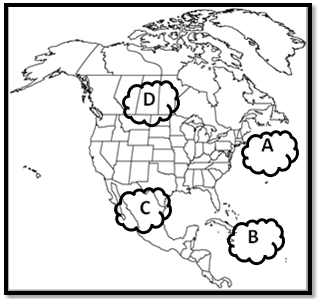
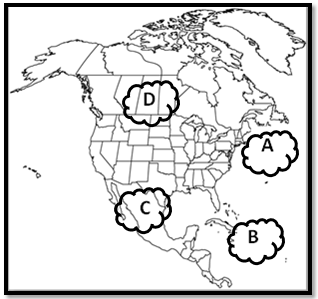
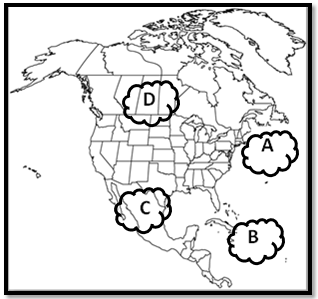
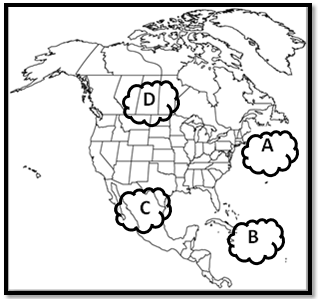
Which type of air would you find at air mass A?
a)
cold, dry
b)
warm, humid
c)
warm, dry
d)
cold, humid
91.
Which type of air would you find at air mass B?
a)
cold, dry
b)
warm, humid
c)
warm, dry
d)
cold, humid
92.

Which type of air would you find at air mass C?

a)

mT

b)

mP

c)

cT

d)

cP

93.

Which type of air would you find at air mass D?

a)

mT

b)

mP

c)

cP

d)

cT