wayground logo

Free Printable Worksheets

NEW

Font size

S
M
L
XL
Worksheets

Reproduction

Total questions: 65

Worksheet time: 1hrs 7mins

Name
Class
Date
1.

The main function of the placenta is to :

a)

allow direct exchange of blood between the mother and fetus for nutrition.

b)

facilitate gas and nutrient exchange between the fetus and mother.

c)

support the weight of the developing fetus in the uterus.

d)

store gases and nutrients for later delivery to the fetus.
2.

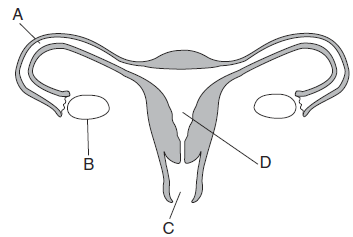
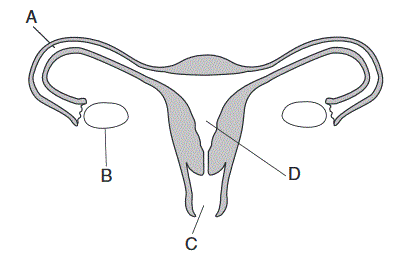
The diagram below represents structures found in the female reproductive system. If the areas labeled A were completely blocked on both sides, the most likely result would be that

a)

egg production would stop

b)

sperm production would stop

c)

fertilization would not occur

d)

an embryo would develop

3.

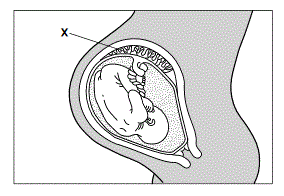
Which statement best describes an important

process carried out by structure X (placenta)

a)

Milk passes from the mother to the fetus

b)

Material are exchanged between fetal and maternal blood.

c)

Maternal blood is converted into fetal blood

d)

Oxygen diffuses from fetal blood to maternal blood.
4.

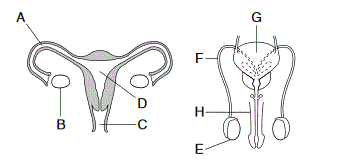
The diagram represents the reproductive systems of the human female and male. In which two structure are the gametes made

a)

B and E

b)

B and H

c)

H and E

d)

D and G

5.

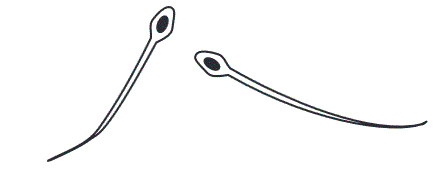
Which statement about the gametes represented

in the diagram below is correct?

a)

They are produced by females

b)

They are fertilized in an ovary.

c)

They transport genetic material

d)

They are produced by mitosis

6.

A fertilized egg undergoes several stages before it is implanted. In which of the following structure of the female reproductive system is the blastocyst (fertilized egg) implanted.

a)

Ovary

b)

uterus

c)

vagina

d)

amniotic sac

7.

A fertilized egg undergoes several stages before it is implanted. In which of the following structure of the female reproductive system is the egg fertilized?

a)

Ovary

b)

Uterus

c)

Fallopian tube

d)

Cervix

8.
When is ovulation most likely to occur?
a)
About halfway between the start of one menstruation and the next
b)
At the start of menstruation
c)
1-5 days before the start of menstruation
d)
5-10 days after the start of menstruation
9.

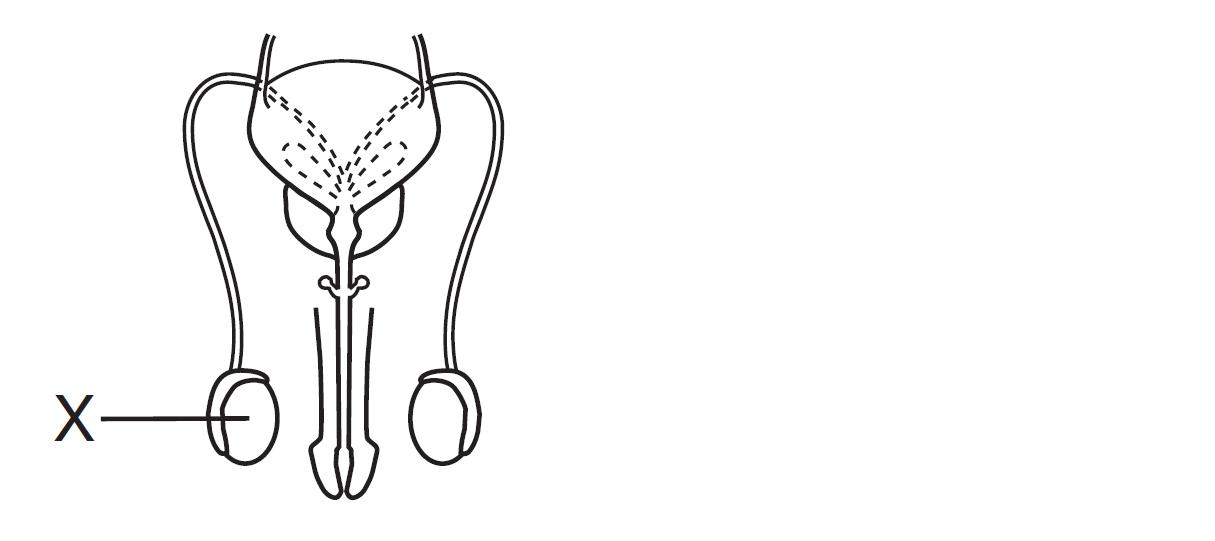
The diagram below represents a system in the human body. The function of structure X is to _____________

a)

produce energy needed for sperm to move

b)

provide food for the sperm to carry to the egg

c)

produce and store urine

d)

produce sperms and male sex hormones

10.

The human female reproductive system is represented below. Where will the embryo attach itself after fertilization?

a)

A

b)

B

c)

C

d)

D

11.

What is the scrotum?

a)

A pouch of skin surrounding the testes

b)

A fold of skin that protects the penis

c)

An additional gland located at the end of the urethra

12.

Which part of the uterus is connected to the vagina?

a)

The fallopian tubes

b)

The cervix

c)

The ovaries

13.

What is the name of the internal wall of the uterus?

a)

endometrium

b)

exometrium

c)

testometrium

14.

The main function of the placenta is to :

a)

allow direct exchange of blood between the mother and fetus for nutrition.

b)

facilitate gas and nutrient exchange between the fetus and mother.

c)

support the weight of the developing fetus in the uterus.

d)

store gases and nutrients for later delivery to the fetus.

15.

Which is true for sexual reproduction?

a)

It involves a male and female parts to reproduce.

b)

It does not involve any male or female parts to reproduce.

c)

It takes one mate to reproduce.

16.

Fertilisation is when a sperm fuses with an egg.

a)

True

b)

False

17.
Chimpanzees have 48 chromosomes in each normal body cell. How many chromosomes does a chimpanzee gamete contain?
a)
23
b)
24
c)
46
d)
48
18.
The skin cells of an animal contain 8 chromosomes. How many chromosomes will be present in each of the gametes produced by this animal?
a)
16
b)
8
c)
4
d)
2
19.
Fruit fly body cells have 8 chromosomes. After mitosis, you would expect a resulting fruit fly daughter cell to have ...
a)
16 chromosomes.
b)
46 chromosomes.
c)
8 chromosomes.
d)
4 chromosomes.
20.
In which type of cells will mitosis occur?
a)
egg cells
b)
sperm cells
c)
jail cells
d)
Body cells except the sperm and egg cells
21.
After meiosis is complete, the new cells:
a)
are all identical
b)
are all different
c)
are half identical and half different
d)
are all stretched out
22.
How many daughter cells are produced from meiosis ?
a)
10
b)
6
c)
4
d)
2
23.
The female sex cell is called
a)
zygote
b)
sperm
c)
fertilization
d)
egg
24.
The male sex cell is called
a)
egg
b)
zygote
c)
sperm
d)
mitosis
25.
Humans have how may chromosomes ?
a)
112
b)
46
c)
8
d)
67
26.
Most of the cells in the human body are produced by
a)
mitosis
b)
meiosis
27.
Why do we need meiosis?
a)
To double the number of chromosomes going into sex cells
b)
To halve the number of chromosomes going into sex cells
c)
To triple the number of chromosomes going into sex cells
d)
To not change the number of chromosomes going into sex cells
28.
Name that process
a)
Mitosis
b)
Meiosis
c)
Mutation
d)
Cell Cycle
29.
During which phase of the meiotic cell cycle does DNA Replication occur?
a)
Interphase 
b)
Prophase 
c)
Metaphase 
d)
Telophase
30.
In Meiosis if the parent cells has 40 chromosomes, then how many will the daughter cells have 
a)
40
b)
10
c)
20
d)
18
31.
The stages of mitosis in order
a)
Metaphase, Anaphase, Prophase, Telophase
b)
Prophase, Anaphase, Metaphase, Telophase
c)
Prophase, Metaphase, Anaphase, Telophase
d)
Anaphase, Prophase, Telophase, Metaphase
32.
A cat has a total of 38 chromosomes in its body cells.  How many in its gametes?
a)
38
b)
19
c)
76
d)
10
33.

Inside the nucleus of cells, you can find ________; the “instructions for life”

a)

nuclear membrane

b)

chromosomes

c)

mitosis

d)

mitochondria

34.

Human cells have _____ pairs of chromosomes- ____ chromosomes in total

a)

23, 46

b)

23, 23

c)

46, 46

d)

1, 2

35.

A human haploid cell (gamete, sex cell) has ________ chromosomes; half the number of a human diploid cell

a)

1

b)

10

c)

23

d)

46

36.

Mitosis takes place in _____

a)

sex cells (gametes)

b)

somatic cell (non sex cells)

37.

Mitosis turns a single parent cell into ____ new cells

a)

0

b)

1

c)

2

d)

4

38.

Meiosis turns a single parent cell into _______ new daughter cells

a)

0

b)

1

c)

2

d)

4

39.

Meiosis takes place in ____

a)

gametes (sex cells)

b)

somatic cells (non sex cells)

40.

The primary function of mitosis is _______

a)

to create genetic variety

b)

growth and repair of cells

41.

The primary function of meiosis is _______

a)

growth and repair

b)

to create genetic variety

42.

Mitosis creates daughter cells which are genetically identical to the parent cell

a)

True

b)

False

43.

In the process of meiosis, ____________are created

a)

4 haploid gametes

b)

2 diploid sex cells

c)

4 diploid reproductive cells

d)

2 haploid reproductive cells

44.

If the egg cell of a fruit fly has 4 chromosomes, how many chromosomes would a wing cell have?

a)

8

b)

4

c)

2

d)

16

45.

What best describes cancer?

a)

uncontrolled cell growth

b)

meiosis

c)

mitosis

d)

trisomy

46.
What does DNA stand for?
a)
DeNatured Acid
b)
DomiNant Acid
c)
DeoxyriboNucleic Acid
d)
DiriboNucleic Acid
47.

Chromosome pairs split apart and begin to move to opposite sides of the cell.

a)

Interphase

b)

cytokinesis

c)

Anaphase

d)

Metaphase

e)

Prophase

48.

Chromosome pairs line up along the middle of the cell.

a)

Interphase

b)

cytokinesis

c)

Anaphase

d)

Metaphase

e)

Prophase

49.
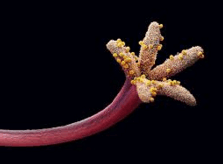
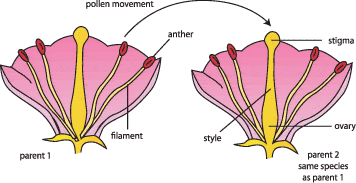
The tip of the style that has sticky hairs to trap pollen is the ___.
a)
stamen
b)
stigma
c)
ovary
d)
style
50.
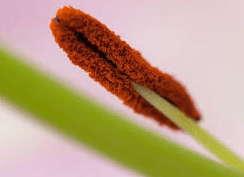
The part of the stamen that produces pollen grains is the ___.
a)
anther
b)
pistil
c)
filament
d)
ovary
51.
The part of the flower on which the pollen grains land.
a)
anther
b)
stamen
c)
style
d)
stigma
52.
The part of a flower that produces the male reproductive cells.
a)
anther
b)
style
c)
stigma
d)
filament
53.
Pollination can occur between flowers of the same plant. 
a)
True 
b)
False 
54.
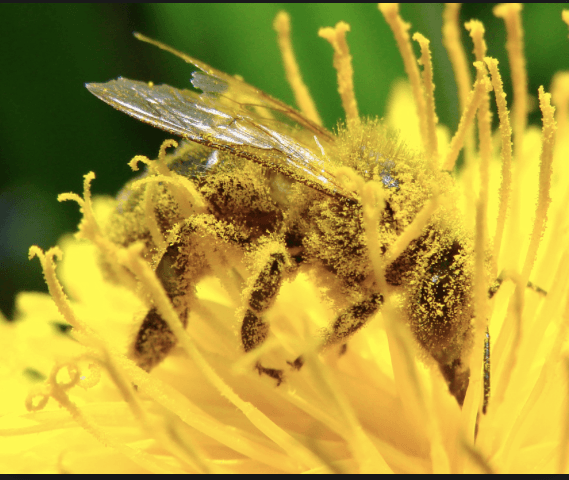
Pollination is the process by which pollen
a)
causes people to sneeze
b)
is formed inside a plant
c)
moves from stamen to stigma
d)
moves from stigma to stamen
55.
Brightly colored parts of flowers that attract insects.
a)
petals
b)
pistils
c)
stamen
d)
filaments
56.

The menstrual cycle repeats every?

a)

Month

b)

28 days

c)

Week

d)

Year

57.

Ovulation typically occurs on what day of the cycle?

a)

1

b)

14

c)

20

d)

7

58.
What does ovulation mean?
a)
A sperm is released
b)
The lining of the uterus breaks down
c)
An egg is released
d)
Menstruation occurs
59.

In which part of the female reproductive system does a baby develop?

a)

Ovaries

b)

Vagina

c)

Cervix

d)

Uterus

60.

The egg cell develops in the

a)

vagina

b)

ovary

c)

oviduct

d)

uterus

61.
The diagram shows the female reproductive system. The part labelled B is called  
a)
sperm 
b)
the egg  
c)
the womb  
d)
the ovary 
62.
This occurs on days 1 to 5 of the menstrual cycle.
a)
The lining of the uterus remains in place in preparation for the possible arrival of an early embryo.
b)
Shedding of the lining of the uterus
c)
An egg is released from the ovaries
d)
The lining of the uterus builds up
63.

A temporary suspension of the menstrual cycle normally occurs during

a)

menstruation

b)

pregnancy

c)

ovulation

d)

menopause

64.
If fertilisation does not occur...
a)
the egg dies 
b)
the egg leaves the body when the uterus lining is shed
c)
both
65.
For normal human fertilization to occur, -
a)
many ova must be released.
b)
the uterus must be enlarged. 
c)
only one sperm need penetrate one egg. 
d)
the secondary oocyte must implant in the uterus.