
 Worksheets
final revision g 8 q 3
Total questions: 100
Worksheet time: 1hrs 26mins
What kind of matter is soil?
Element
Compound
Homogeneous Mixture
Heterogeneous Mixture
What kind of matter is salt (NaCl)?
Element
Compound
Homogeneous Mixture
Heterogeneous Mixture
What kind of matter is milk?
Element
Compound
Homogeneous Mixture
Heterogeneous Mixture
A physical blend of 2 or more components not bonded together is called a ____.
type of element
mixture
chemical reaction
physical property
A mixture in which the composition is unevenly mixed is ...........
Heterogeneous
Homogeneous

What type of substance is gold ?
compound
heterogeneous mixture
homogeneous mixture
element
two or more types of atoms bonded together?
The center of an atom is the nucleus. The nucleus is made up of:
Protons and Electrons
Protons and Neutrons
Eggs and Bacon
Protons and Atoms
A neutron is a particle in the atom that has a __________ charge.
Neutral/No charge
Negative
Positive
All of these
If salt is mixed in a glass of water, what is the water called?
solute
solution
solvent
element
What do we used to represent the elements and ratio of atoms in a compound?
chemical bond
element
chemical formula
compound
Air is an example of...
a homogenous mixture
a heterogenous mixure
a single compound
compound


Which of the following could indicate that a chemical change took place?
Change in color
Production of Energy
Formation of Gas
All are correct
During Chemical Reactions, the new substances created are called?
Precipitate
Corrosion
Reactants
Products
During Chemical Reactions, the substances that are used are called?
Precipitate
Corrosion
Reactants
Products
burning.
melting.
freezing.
boiling.
malleability
conductivity
melting process
B. conductivity

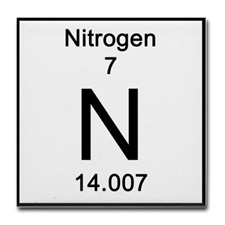
From this element key of Nitrogen, determine the atomic mass of nitrogen
7
7.01
14.01
21.01
the smallest unit of an element that maintains the properties of the element.
atom
neutron
electron
atomic number
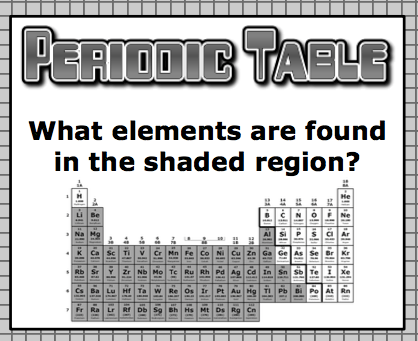
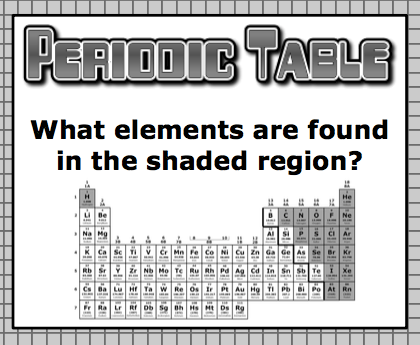
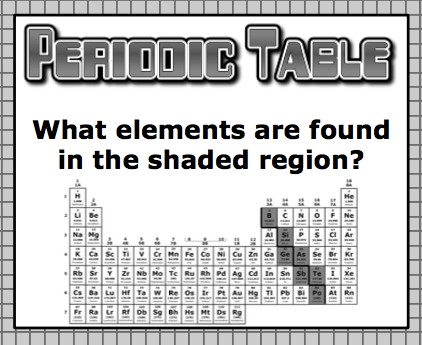
the law that states that the repeating chemical and physical properties of elements change periodically with the atomic numbers of the elements.
periodic law
nonperiodic
alkaline-earth metal
alkali metal
Mendeleev arranged the elements by
density
melting point.
appearance
increasing atomic mass.
How do the physical and chemical properties of the elements change?
periodically within a group
periodically across each period
periodically within a family
periodically across each group

The letter C is carbon’s
atomic number.
atomic mass.
chemical symbol.
element name.
A characteristic that can be observed or measured such as color, state, or hardness is referred to as a...
Physical property
Chemical property
Physical change
Chemical change
What happens to a solid object with a density that is less than water when it is placed in water?
The object sinks about halfway into the water.
The object displaces a quantity of water greater than its volume.
The object settles to the bottom of the water.
The object floats on top of the water.
When the temperature of matter increases the particles (usually)...
speed up and move closer
speed up and move farther apart
slow down and move closer together
slow down and move farther apart
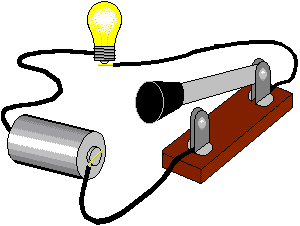
When physical properties change when the size of an object changes or example volume or mass
Size Dependent
Size Independent
physical change
Density
When physical properties do not change when the size of an object changes. Examples, color, taste, state of matter
chemical changes
dependent properties
size independent properties
Which of the following units would be BEST to use to measure mass ?


Water evaporation is evidence that a ______________ has taken place.


In the diagram, atoms in molecules break apart and rejoin to form different molecules. This is an example of a
physical property of matter
physical change in matter
chemical property of matter
chemical change in matter

What are the products of the chemical reaction pictured?
CH4 and CO2
CH4 and O2
CO2 and H2O
O2 and H2O


balance the chemical equation... Al + O2 --> Al2O3
.....................................
...............................
...................................
...................................
Balance this equation. Na + Cl2 --> NaCl
.............................
.................................
......................................
....................................
Balance this equation Mg + O2 --> MgO
.........................
.......................
...........................
............................
More collisions correspond to a:
Faster reaction rate
Slower reaction rate
Constant reaction rate
Al2O3 --> Al + O2



