wayground logo

Free Printable Worksheets

Font size

S
M
L
XL
Worksheets

Ch 15 Modern Genetics

Total questions: 56

Worksheet time: 30mins

Name
Class
Date
1.
A person who has one recessive allele for a trait, but does not have the trait.
a)
carrier
b)
homozygous dominant
c)
homozygous recessive
d)
codominant
2.
An organism that is genetically identical to the organism from which it was produced.
a)
clone
b)
meiosis
c)
sex cell
d)
Y chromosome
3.
The transfer of a gene from the DNA of one organism into another organism, in order to produce an organism with desired traits.
a)
genetic engineering
b)
hybridization
c)
meiosis
d)
cloning
4.
An abnormal condition that a person inherits through genes or chromosomes.
a)
genetic disorder
b)
disease
c)
pathogen
d)
mutation
5.
A picture of all the chromosomes in a cell arranged in pairs.
a)
karyotype
b)
genotype
c)
phenotype
d)
hybrid
6.
A chart or “family tree” that tracks which members of a family have a particular trait.
a)
pedigree
b)
punnett square
c)
cladogram
d)
branching tree
7.
A pair of chromosomes carrying genes that determine whether a person is male or female.
a)
sex chromosomes
b)
sex genes
c)
gender chromosomes
d)
gender alleles
8.
How many people in the 4th generation are colorblind?
a)
5
b)
1
c)
3
d)
2
9.
What does 'X linked' mean in the chart?
a)
the trait is found on every chromosome
b)
the trait is on all X chromosomes
c)
the trait is only found on an X sex chromosome
d)
the trait is for females only
10.
How many females are neither carriers nor have the colorblind trait?
a)
8
b)
6
c)
3
d)
not enough information
11.
What is the sex of all of the carriers?
a)
male
b)
female
12.
What is one drawback to inbreeding?
a)
increase the chance of genetic disorders
b)
too many similar traits
c)
increase the chance of a mutation
d)
chance of genetically identical offspring
13.
Which of the following is an example of genetic engineering?
a)
replacing a gene that causes a genetic disorder with one that does not
b)
duplicating a strand of DNA and implanting it in a new cell
c)
breeding two similar organisms in the hope that the offspring have similar traits
d)
breeding two different organisms in the hope that the offsring inherit specific traits from each parent
14.
One way to produce large numbers of genetically identical offspring is by
a)
cloning
b)
selective breeding
c)
fertilization
d)
hybridization
15.
When a person's teeth are x-rayed, other parts of this person are covered by a protective blanket to prevent
a)
hair loss
b)
increase in cell size
c)
changes in DNA structure
d)
changes in glucose structure
16.
What type of heredity is shown in the pedigree?
a)
Y-linked dominant
b)
sex linked recessive
c)
autosomal recessive
d)
autosomal dominant
17.
Which disease or disorder causes people to have abnormal hemoglobin?
a)
Cystic Fibrosis
b)
Albinism
c)
Sickle-cell Disease
d)
Down Syndrome
18.
Which disease or disorder is the result of having an extra chromosome?
a)
Cystic Fibrosis
b)
Down Syndrome
c)
Colorblindness
d)
Sickle-cell Disease
19.
Which genetic disorder or disease is a sex-linked trait and carried on the X chromosome?
a)
Cystic Fibrosis
b)
Sickle-cell Disease
c)
Hemophilia
d)
Down Syndrome
20.
In order to trace occurrence of a trait through several generations of a family, you could create a ____________.
a)
karyotype
b)
hemoglobin
c)
pedigree
d)
chromosomal map
21.
a)
Not Affected Male
b)
Not Affected Female
c)
Affected Male
d)
Affected Female
22.
In the second generation-how many people are carriers of the trait?
a)
2
b)
3
c)
5
d)
6
23.
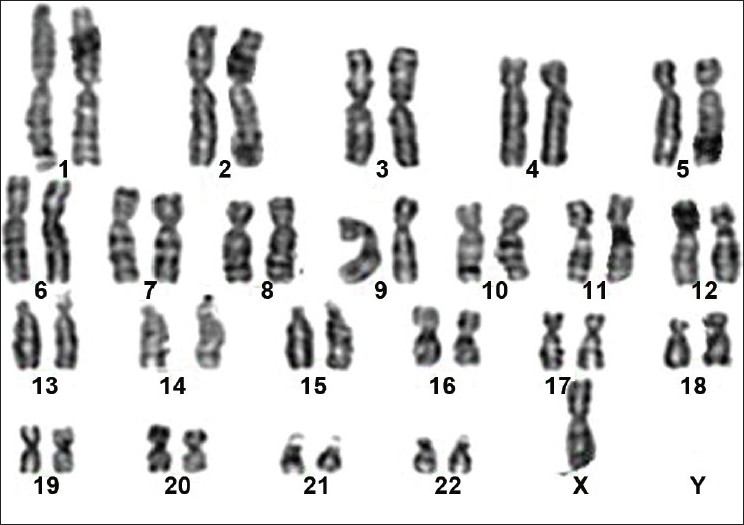
What is the gender of the individual whose karyotype is seen in the image?
a)
Male
b)
Female
24.
a)
This karyotype shows Trisomy 21
b)
This karyotype has no abnormality
c)
This karyotype is missing a sex chromosome (monosomy x)
d)
This karyotype is from a gamete
25.
What is the chromosomal condition of the individual whose karyotype is seen in the image?
a)
Trisomy 21 (Down's Syndrome)
b)
Trisomy 13 (Patau Syndrome)
c)
Trisomy 18 (Edward's Syndrome)
d)
XXY Sex Chromosomes (Klinefelter's Syndrome)
26.

What is the mode of inheritance shown here?

a)

Recessive because it "skips" a generation

b)

Dominant because it shows up in every generation

27.
What does a horizontal line between a square and a circle mean?
a)
They are siblings
b)
They are cousins
c)
They are married ("together")
d)
They are the children
28.
What does a vertical line coming down from a square and circle that are connected by horizontal line indicate?
a)
They are cousins
b)
The children
c)
Aunts and Uncles
29.
Which individual in the first generation is a carrier?
a)
The male
b)
The female
c)
individual 1
d)
None of the above
30.
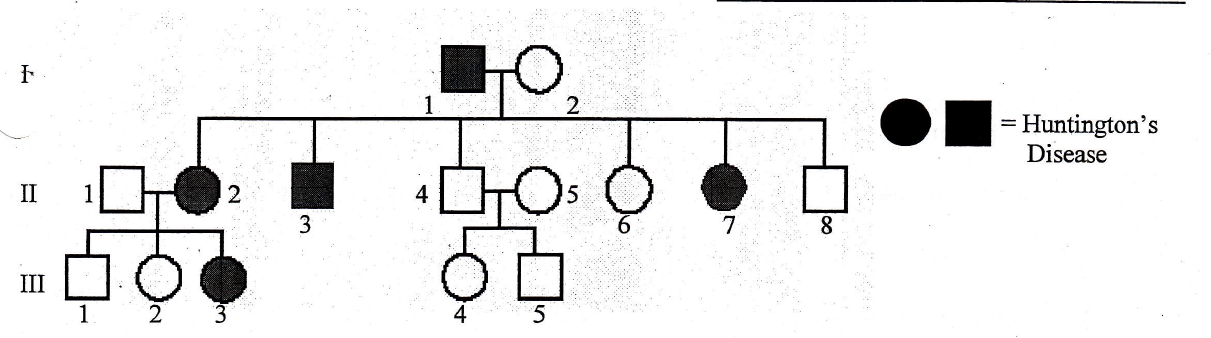
There are no carriers for Huntington's Disease- you either have it or you don't. Is Huntington's disease caused by a dominant or recessive trait?
a)
Dominant
b)
Recessive
31.
What is the genotype of the mother?
a)
BB
b)
bb
c)
Bb
d)
BB or Bb
32.
a)
Not affected Female
b)
Not affected Male
c)
Affected Male
d)
Affected Female
33.
What is the gender of the individual whose karyotype is seen in the image?
a)
Male
b)
Female
34.

What is Hemophilia?

a)

a medical condition in which the ability of the blood to clot is severely reduced, causing the sufferer to bleed severely from even a slight injury.

b)

a genetic disorder where there is a 23rd chromosome

c)

a type of gene

d)

an allele

35.

How do you obtain Hemophilia?

a)

You get it from your mother's genes

b)

It's random

c)

You contract it from an infected person

d)

You don't know

36.

Is Hemophilia curable?

a)

Yes

b)

No

37.

What's another name Hemophilia?

a)

Royal Disease

b)

Crown Disease

c)

Queen's Son's Disease

d)

Royal Blood

38.

Who cured the Tsar of Russia's son?

a)

Rasputin

b)

Joseph Stalin

c)

A sorceror

d)

Ivan The Terrible

39.

What are some symptoms of CF?

a)

Salty-Tasting Sweat

b)

Cold Feet

c)

Yellow Eyes

d)

Digestive System Problems

e)

Chest Problems

40.

______ ________ is a hereditary disease that affects the lungs and digestive system. The body produces thick and sticky mucus that can clog the lungs and obstruct the pancreas.

a)

cistic fibrosis

b)

fibrocratic cysts

c)

cystic fibrosis

d)

cystic fibrois

41.

What is the mucus like that is in the lungs when a person has Cystic fibrosis.

a)

thin and sticky

b)

thick and slimey

c)

thin and slimey

d)

thick and sticky

42.

Knowing that it effects the lungs, what does Cystic fibrosis make it hard to do?

a)

Walk

b)

Talk

c)

Sleep

d)

Eat

e)

Breathe

43.

In order to have Down Syndrome you must be born with it. True or False.

a)

True

b)

False

44.

Can Down Syndrome be prevented or cured?

a)

Yes

b)

No

45.

Why does Down Syndrome happen?

a)

2 chromosomes

b)

Extra chromosome

c)

A missing chromosome

d)

No chromosomes

46.

People with Down Syndrome will have certain physical features and may have medical problems

a)

True

b)

False

47.
Sickle red blood cells have a decreased ability to carry 
a)
nutrients
b)
wastes
c)
oxygen
d)
proteins
48.
Which is NOT a symptom of sickle cell disease?
a)
shortness of breath
b)
pain and tissue damage
c)
increased infections
d)
enlarged blood vessels
49.

When you look at the cells of individuals with sickle cell anemia, what do you expect to see?

a)

C-shaped cells

b)

S-shaped cells

c)

Disk-Shaped Cells

d)

Globular shaped cells

e)

Sick cells

50.

Symptoms of sickle cell include

a)

Low red blood cell count

b)

High red blood cell count

c)

Recurrent infections

d)

Periodic pain episodes

e)

Nausea

51.

Sickle cell symptoms usually begin

a)

Early childhood

b)

20s/30s

c)

40s/50s

d)

60s/70s

e)

Puberty

52.

Normal RBC

a)

A

b)

B

53.

Sickled RBC

a)

A

b)

B

54.

The sickle-shaped cells can also stick to vessel walls, causing a blockage that slows or stops the flow of blood. When this happens, oxygen can't reach nearby tissues. The lack of oxygen can cause ______.

a)

Anemia

b)

Sickle Cell Anemia

c)

Sickle Cell Trait

d)

Episodes of Pain

e)

Red Blood Cells

55.

The sickle-shaped cells can also ______ vessel walls, causing a blockage that slows or stops the flow of blood. When this happens, _____ can't reach nearby tissues.

a)

stick to, oxygen

b)

scrape, oxygen

c)

burst through, carbon dioxide

d)

scrape, carbon dioxide

e)

stick to, carbon oxygen

56.

Who is most at risk for sickle cell disease?

a)

African Americans

b)

Hispanics

c)

Asians

d)

Native Americans

e)

Caucasians