wayground logo

Free Printable Worksheets

Font size

S
M
L
XL
Worksheets

Atomic Theory and Periodic Trends

Total questions: 90

Worksheet time: 1hrs 28mins

Name
Class
Date
1.
This particle is found in the nucleus and has no charge
a)
Neutron
b)
Proton
c)
Electron
d)
Orbital
2.
This particle is found in the nucleus and has a positive charge
a)
Electron
b)
Proton
c)
Neutron
d)
Neutral
3.
This is a negatively charged particle found outside the nucleus
a)
Electron
b)
Proton
c)
Neutron
d)
Orbital
4.
The first person to propose a theory about an atom was
a)
Democritus
b)
Rutherford
c)
Dalton
d)
Aristotle
5.
Rutherford's gold foil experiment provided evidence that...
a)
Negative and positive charges are spread evenly throughout the atom.
b)
Alpha particles have a positive charge.
c)
Gold is not a dense as previously thought.
d)
There is a dense positively charged nucleus at the center of an atom.
6.
J.J. Thomson provided evidence that an atom...
a)
is the smallest particle of matter
b)
contains negatively and positively charged particles
c)
has an overall negative charge
d)
has an overall positive charge
7.
What scientist is best known for his "Plum Pudding" model of the atom?
a)
J.J. Thomson
b)
Ernest Rutherford
c)
John Dalton
d)
Democritus
8.
The central region of an atom where its neutrons and protons are is its 
a)
Nucleus 
b)
Electron Cloud
c)
Core 
d)
Center 
9.
The word atom comes from a Greek word "atomos" that means
a)
Invisible
b)
Indivisible
c)
Undivided
d)
Indestructable 
10.
The smallest unit of a pure substance that has the properties of that substance
a)
element
b)
atom
c)
neutron
d)
compound
11.
Atoms are made up of three basic parts, which are -
a)
Protons, neutrons, electrons
b)
neutrinos, protons, neutrons
c)
quarks, protons, electrons
d)
electrons, neutrons, and quarks
12.
The nucleus is made up of -
a)
neutrons and electrons
b)
protons and neutrons
c)
protons and electrons
d)
electrons and quarks
13.
An atom's overall charge is ________.
a)
positive 
b)
depends
c)
neutral 
d)
negative 
14.

Where is the element's atomic NUMBER located?

a)

the top

b)

the bottom

c)

the top + the bottom

d)

the number of protons + the number of neutrons

15.

Where is the element's atomic MASS located?

a)

at the top

b)

at the bottom

c)

the top number + the bottom number

d)

the number of protons + the number of neutrons

16.

Generally, the number of neutrons ____ the number of protons in an atom.

a)

=

b)

<

c)

>

17.
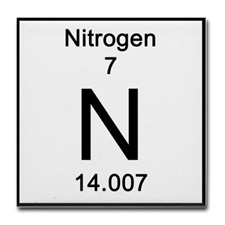
What is the number of protons that the element in this image contain?
a)
14
b)
7
c)
15
d)
18
18.
What is the atomic mass of "F"
a)
9
b)
18
c)
17
d)
19
19.
an atom with atomic number 6 would have how many protons 
a)
6
b)
12
c)
3
d)
cannot be determined 
20.
a)
2
b)
8
c)
3
d)
13
21.
a)
2
b)
6
c)
10
d)
16
22.
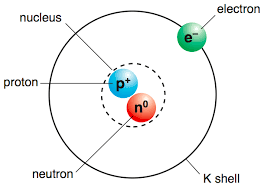
What subatomic particle(s) would be found orbiting the nucleus?
a)
Neutrons only
b)
Electrons only
c)
Protons and Neutrons
d)
Protons and Electrons
23.

Which subatomic particles contribute the most to the mass of an atom?

a)

Protons and Neutrons

b)

Protons only

c)

Electrons only

24.

Valence electrons are the number of

a)

protons in the atom

b)

electrons in the atom

c)

protons + neutrons in the nucleus

d)

electrons in the outside shell of the atom

25.
The symbol for Carbon is
a)
6
b)
12.011
c)
C
d)
Ca
26.
In the modern periodic table elements are arranged by:
a)
atomic mass
b)
atomic number
c)
valence electrons
d)
number of isotopes
27.
All matter is made of 
a)
energy 
b)
atoms 
c)
air
d)
chemistry
28.
What is the atomic number for an element with twelve protons?
a)
2
b)
12
c)
24
d)
6
29.

If the atomic mass is 55.85, what is the name of this element?

a)

Iron

b)

Fe

c)

Manganese

d)

Mn

30.

If the atomic mass is 55.85, what is the atomic number?

a)

56

b)

26

c)

30

d)

25

31.

If the atomic mass is 55.85, what is the number of electrons

a)

25

b)

30

c)

26

d)

59

32.

If the atomic mass is 55.85, what is the number of neutrons?

a)

26

b)

56

c)

30

d)

25

33.

If the atomic mass is 55.85, what is the number of protons?

a)

26

b)

56

c)

30

d)

25

34.

What is the number of electrons?

a)

13

b)

14

c)

26.98

d)

27

35.

What is the atomic number?

a)

14

b)

27

c)

26.98

d)

13

36.

What is the atomic mass of this atom?

a)

59

b)

31

c)

28

d)

30

37.

What is the atomic number of this atom?

a)

59

b)

31

c)

28

d)

30

38.

What is the number of electrons of this atom?

a)

31

b)

28

c)

30

d)

59

39.

What is the number of neutrons of this atom?

a)

31

b)

28

c)

30

d)

59

40.

An atom that has gained or lost electrons in an attempt to become stable/bond with another atom.

a)

Normal/Neutral Atom

b)

Ion

c)

Isotope

41.

A negatively charged ion that has gained electrons to satisfy the octet rule (metals do this)

a)

Anion

b)

Cation

c)

Neutral Atom

d)

Isotope

42.

A positively charged ion that has lost electrons to satisfy the octet rule (non-metals do this)

a)

Anion

b)

Cation

c)

Neutral Atom

d)

Isotope

43.

Atoms of the same element that have different mass than expected because they have a different number of neutrons.

a)

Neutral Atom

b)

Ion

c)

Isotope

d)

Cation

44.

If an ion has a positive charge you would __________ the charge number from the number of protons to figure out how many electrons there are.

a)

subtract

b)

add

c)

multiply

d)

divide

45.

If an ion has a negative charge you would __________ the charge number to the number of protons to figure out how many electrons there are.

a)

Add

b)

Subtract

c)

Divide

d)

Multiply

46.

If an atom has 9 protons and 10 electrons it has a charge of ____.

a)

0

b)

-1

c)

+1

d)

-2

47.

If an atom has 4 protons and 2 electrons it has a charge of ____.

a)

0

b)

-2

c)

+2

d)

+1

48.

If an atom has a charge of +3 and an atomic number of 5 it should have _______ electrons.

a)

1

b)

2

c)

3

d)

4

49.

If an atom has a charge of -2 and an atomic number of 16 it should have _______ electrons.

a)

14

b)

16

c)

18

d)

20

50.

If an atom has a charge of 0 (neutral) and an atomic number of 8 it should have ____ electrons.

a)

0

b)

8

c)

7

d)

9

51.
Which item on this element square represents the atomic number?
a)
13
b)
Al
c)
Aluminum
d)
26.981538
52.

a collection of atoms of one type that cannot be broken down into simpler substances by ordinary chemical or physical means

a)

element

b)

subatomic particle

c)

electron

d)

matter

53.

an arrangement of the elements according to their atomic numbers so that elements with similar properties are in the same column and properties repeat from row to row

a)

Periodic Table of Elements

b)

Atomic Theory

c)

Isotopes

d)

Subatomic Particles

54.

one or two letters that represent the name of an element

a)

element name

b)

element symbol

c)

atomic number

d)

atomic mass

55.

a grouping of elements based on similar properties, arranged by columns in the periodic table; also known as a group

a)

family

b)

period

c)

row

d)

isotope

56.

a row on the Periodic Table of Elements

a)

family

b)

period

c)

row

d)

isotope

57.

one of several forms of a single element, which contains the same number of protons, but different numbers of neutrons

a)

isotope

b)

ion

c)

orbital

d)

nucleus

58.

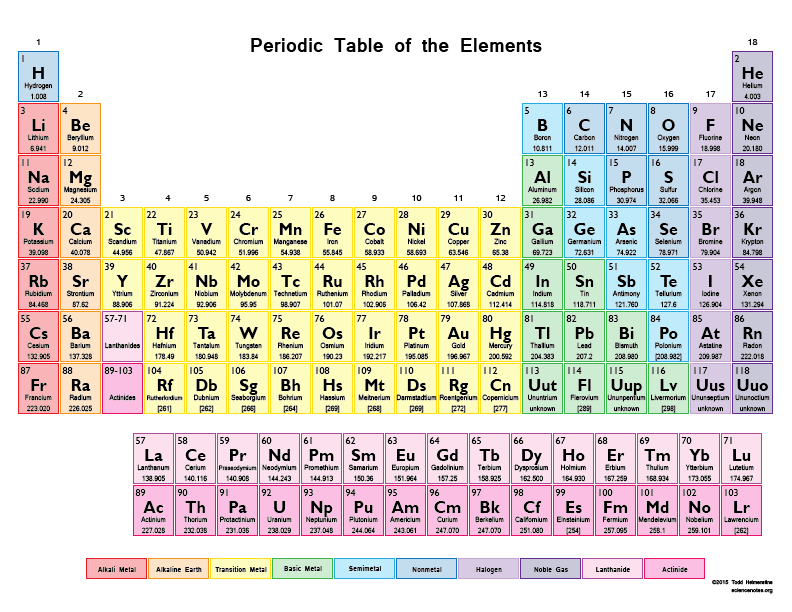
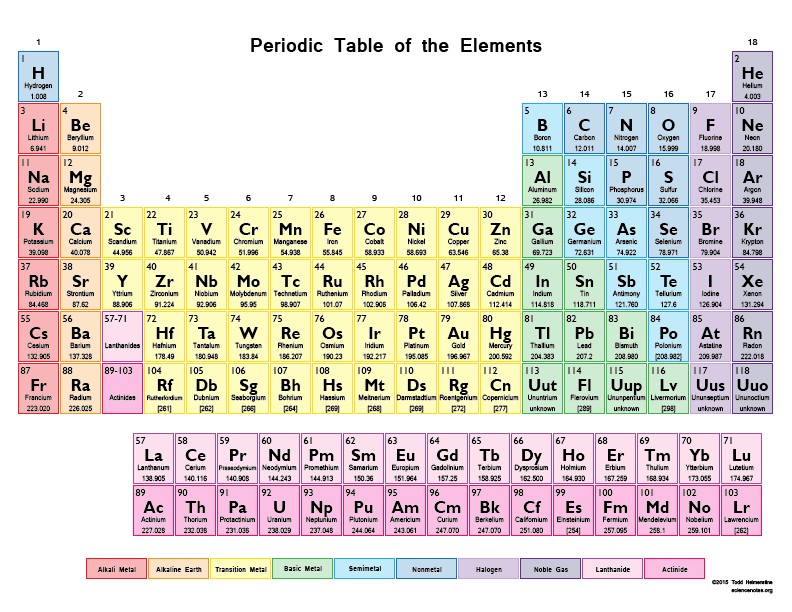
What is the atomic number of Barium, Ba? (enlarge the periodic table)

a)

20

b)

38

c)

56

d)

88

59.

How many protons are in a sodium atom, Na? (tap to enlarge the periodic table)

a)

Sodium has 1 proton.

b)

Sodium has 3 protons.

c)

Sodium has 11 protons

60.

What are the vertical columns on the periodic called?

a)

groups

b)

periods

c)

nonmetals

d)

metals

e)

metalloids

61.

What are the horizontal rows on the periodic table called?

a)

periods

b)

groups

c)

metals

d)

nonmetals

e)

metalloids

62.

How do you calculate the number of neutrons? *

a)

Mass = Atomic number - Neutrons

b)

Mass - Atomic number = Neutrons

c)

Atomic number = Neutrons

63.

What is the name of the element? (Periodic table will be needed)

a)

sodium

b)

magnesium

c)

vanadium

64.

What group and period does this element belong in? *

a)

period 1 and group 3

b)

period 3 and group 1

c)

period 2 and group 3

d)

period 3 and group 2

65.
Which group of the periodic table is composed of inert (not reactive)  gases?
a)
alkali metals
b)
alkaline earth metals
c)
halogens
d)
noble gases
66.
The atoms along the staircase are called 
a)
metals
b)
nonmetals
c)
metalloids
d)
noble gases
67.
Which is an alkali metal?
a)
Magnesium
b)
Iron
c)
Sodium
d)
Europium
68.
Which is a halogen?
a)
Helium
b)
Chlorine
c)
Oxygen
d)
Neptune
69.
Which of the following will have a larger radius than Zinc?
a)
Gallium
b)
Aluminum
c)
Magnesium
d)
Strontium
70.
As you move down a group, atomic radius increases because - 
a)
you add more and more neutrons
b)
you add more and more protons
c)
you add more and more shells (energy levels)
d)
you add more atomic mass
71.
Francium (Fr) has the lowest ionization energy in Group 1 because - 
a)
it has the smallest number of valence electrons
b)
it has the greatest atomic mass
c)
it has the greatest number of protons, so it attracts its electrons the strongest
d)
its 1 valence electron is very far from the nucleus, so little energy is needed to remove it
72.
Electronegativity is...
a)
the ability of an atom to attract/ accept electrons
b)
the ability of an atom to lose electrons
c)
the energy required to remove an electron from a specific atom
d)
how easy it is to make friends. 
73.
As atoms of elements in group 16 are considered in order from top to bottom, the electronegativity of each successive element....
a)
decreases
b)
increases
c)
remains the same
d)
none of the above
74.
As you move across the periodic table atoms tend to get smaller because, ______________.
a)
the atoms have more mass.
b)
the atoms have less mass
c)
the atoms have more protons.
d)
the atoms have less electrons.
75.
The period for Bromine is ___________.
a)
3
b)
2
c)
4
76.
Beryllium is in group number______.
a)
Group 2
b)
Group 3
c)
Group 4
d)
Group 7
77.
The majority of elements on the periodic table are
a)
man made.
b)
nonmetals.
c)
metals.
d)
gases.
78.
Which elements have the most similar chemical properties?
a)
K and Na
b)
K and Ca
c)
K and Cl
d)
K and S
79.
Name group 1A on the periodic table.
a)
alkali metals
b)
alkaline earth metals
c)
noble gases
noble gases
d)
halogens
80.
Name group 2A on the periodic table.
a)
alkali metals
b)
alkaline earth metals
c)
noble gases
d)
transition metals
81.
Name group 8A on the periodic table.
a)
alkali metals
b)
alkaline earth metals
c)
transition metals
d)
noble gases
82.
Name groups 3B - 12B on the periodic table.
a)
noble gases
b)
halogens
c)
metalloids
d)
transition metals
83.
Name group 7A on the periodic table.
a)
transition metals
b)
metalloids
c)
halogens
d)
alkali metals
84.
Which group has the most reactive nonmetals?
a)
alkali metals
b)
noble gases
c)
metalloids
d)
halogens
85.
The atoms along the staircase are called 
a)
metals
b)
nonmetals
c)
metalloids
d)
noble gases
86.
Where are the nonmetals located on the periodic table?
a)
top left corner
b)
bottom left corner
c)
top right corner
d)
bottom left corner
87.
The Lanthanide elements are known as the:
a)
Common earth metals
b)
Alkaline earth metals
c)
Rare earth metals
d)
Heavy earth metals
88.
What statement is true about ALL of the elements in Group 18 OR Group 8A?
a)
They ALL have 6 valence electrons.
b)
They ALL are gases at room temperature.
c)
They ALL react easily with other elements.
d)
They ALL form +2 charges.
89.
Which statement is true about the carbon family?
a)
They are all non-metals.
b)
They all have four valence electrons.
c)
They are all metals.
d)
They do not react with other elements.
90.
Which statement is true about the alkaline earth metal family?
a)
They have 2 valence electrons.
b)
They are found on the right side of the periodic table.
c)
They form -2 charges.
d)
They tend to gain valence electrons.