wayground logo

Free Printable Worksheets

Font size

S
M
L
XL
Worksheets

Properties of Matter Test Review

Total questions: 92

Worksheet time: 1hrs 27mins

Name
Class
Date
1.
The amount of matter in an object is a measure of the object's ________________.
a)
volume
b)
density
c)
mass
d)
solubility
2.
Which of the following units provides the best measure for the amount of space that matter occupies?
a)
mL
b)
grams
c)
cm3
d)
Both mL and cm3
3.
What is the volume of the rock? The water level is displaced from 20 mL to 23 mL with the rock.
a)
3 mL
b)
23 mL
c)
20 mL
d)
43 mL
4.
What would be the best way to measure the volume of a small rock?
a)
L x W x H with a ruler
b)
Put on triple beam balance
c)
Mass ÷ Volume
d)
Displacement method using graduated cylinder
5.
Which of the following is not a characteristic property of matter?
a)
Density
b)
Mass
c)
Phase/State
d)
Solubility
6.
What is the formula for calculating density?
a)
Mass ∗ Volume
b)
Volume ∗ Mass
c)
Mass ÷ Volume
d)
Volume ÷ Mass
7.
If you had a sealed bottle of water, how would the mass of the water bottle change after a 5 day period?
a)
Mass would increase. 
b)
Mass would stay the same. 
c)
Mass would decrease. 
d)
None of the above.
8.
Which statement is true?
a)
Oil is the most dense substance.
b)
Corn syrup is less dense than water.
c)
Oil is less dense than water.
d)
Oil and corn syrup have the same density but different masses.
9.
An object has a density of 3 g/cm3. When submerged in water, the object will ___________.
a)
float
b)
sink
c)
float halfway in the water
d)
float then sink
10.
What is the most dense metal?
a)
Aluminum 
2.7 g/cm3
b)
Steel
7.14 g/cm3
c)
Nylon
1.2 g/cm3
d)
Copper 
8.14 g/cm3
11.
In which state does matter completely fill its closed container?
a)
Gas
b)
Liquid
c)
Solid
d)
Ice
12.
Which state of matter has a fixed shape and volume and it's molecules move very slowly?
a)
Liquid
b)
Gas
c)
Solid
d)
Plasma
13.
The boiling point of water is ______________.
a)
0° C
b)
50° C
c)
200° C
d)
100° C
14.
The volume of water in a beaker was 215 mL. After 5 days, the volume of the water was 200 mL. What best explains the change in volume?
a)
Some of the water absorbed the air. 
b)
Some of the water evaporated and escaped into the air as water vapor.
c)
Some of the water disappeared.
d)
Some of the water was released due to condensation.
15.
When a gas turns into a liquid, it is called ___________________.
a)
Condensation
b)
Evaporation
c)
Melting
d)
Freezing
16.
5 grams of salt was mixed with 50 mL of water to form a solution. In the solution, the water was which of the following?
a)
Solvent
b)
Saturate
c)
Solute
d)
Transparent
17.
I added scoop after scoop of a specific solute until I saw the solute build up at the bottom of the test tube and knew the solute was no longer able to dissolve. This is an example of a(n) _____________.
a)
Insoluble solute
b)
Solvent
c)
Saturated Solution
d)
Homogeneous Mixture
18.
I was able to add 6 grams of sodium nitrate to 10 mL of water and 3.5 grams of sodium chloride to 10 mL of water before the solutes stopped dissolving. Which substance is more soluble?
a)
Sodium Nitrate
b)
Sodium Chloride
19.

Mass divided by volume is the formula for calculating----

a)

Mass

b)

Volume

c)

Density

d)

Matter

20.

Reactivity (bubbling, fizzing) is a --- property.

a)

Chemical

b)

Physical

21.

The ability to burn is known as---

a)

Flammability

b)

Combustion

c)

Density

d)

Exploding

22.
Ice melting is an example of a
a)
physical change
b)
chemical change
c)
physical property
d)
chemical property
23.
Physical properties are
a)
properties that can be observed without changing the identity of the substance
b)
properties that describe how a substance changes into a completely different substance
c)
properties that we can only observe with our eyes
d)
properties that we need special tools to observe
24.
Which is an example of a chemical change?
a)
melting ice to make water
b)
baking cake batter to make a cake
c)
putting cheese on bread to make a cheese sandwich
d)
cutting an orange into slices for a snack
25.
Hammering wood together to build a playhouse
a)
Chemical change
b)
Physical change
26.
a copper penny turning greenish after a few years.
a)
Chemical Change
b)
Physical Change
27.
Burning a marshmallow over a campfire
a)
Physical
b)
Chemical
28.

______________________ can only be recognized when substances react or do not react chemically with one another.

a)

Physical properties

b)

Chemical properties

c)

Flammable properties

d)

Colorful properties

29.
Which is an example of a physical property?
a)
ability to react with acid
b)
 state of matter
c)
flammability
d)
ability to react with oxygen
30.
Which of the following is NOT an example of a physical change?
a)
crumpled paper
b)
pencil sharpening
c)
shrunken clothing
d)
rust
31.
Evidence of a chemical reactions is anything that shows - 
a)
a new substance has formed
b)
a solid dissolved in a liquid
c)
interaction between 2 gases
d)
a change in the state of matter
32.
One of the signs of a chemical reaction taking place is:
a)
Bubbles are produced 
b)
Reactants are not combining
c)
Products are not forming
d)
Color is not changing
33.
Which of the following describes a precipitate?
a)
a liquid forms when a block of metal is heated
b)
a solid forms when one liquid is poured into another
c)
a gas forms when a solid is placed in a liquid
d)
bubbles form when an acid is poured on a rock
34.
Which is NOT an indication of a chemical change?
a)
temperature change
b)
formation of a precipitate
c)
shape change
d)
production of light
35.
You know you a chemical reaction has occurred if 
a)
there is a precipitate.
b)
there is a color change.
c)
there is a temperature change.
d)
All of these answers are evidence.
36.
A clear liquid from a flask is poured into another clear liquid in a beaker. Which of the following results of this procedure would indicate a new substance was formed?
a)
The level of the substance in the beaker is higher after the other liquid is added.
b)
A yellow solid forms and then settles to the bottom of the beaker.
c)
Small white crystals are left behind in the flask that held the first liquid.
d)
The mass of the combined liquids is greater than either original liquid.
37.
Which of the following is an example that includes evidence of a chemical reaction?
a)
A sample of zinc is placed in water and it settles to the bottom
b)
A solid block of ice is heated and it completely melts into a liquid. 
c)
Sugar that is burned gives off an odor and turns brown and then black.
d)
A tomato is placed into a blender and chopped up into smaller pieces.
38.
Four students performed four different investigations by combining different substances. Which of the observations is most indicative of a chemical reaction?
a)
investigation 1
b)
investigation 2
c)
investigation 3
d)
investigation 4
39.
A student places a piece of a potato into a container of hydrogen peroxide. One observation the student makes is that bubbles form around the potato. The presence of bubbles might indicate the formation of a new substance because bubbles - 
a)
could show that a gas is forming.
b)
always rise to the top of a liquid. 
c)
are almost always perfectly spherical.
d)
usually burst after a few minutes.
40.
In a container, a solid consisting of clear crystals is combined with a blue liquid and the following observations are obtained: How many of the listed observations indicate a new substance was formed?
a)
1
b)
2
c)
3
d)
4
41.

What is the phase change of a solid to a liquid?

a)

freezing

b)

melting

c)

boiling

d)

condensation

42.
7. All phase changes (changing states) requires energy to be added or taken away.
a)
True
b)
False
43.

What happens to particles when energy is added (heated)?

a)

They speed up and spread out

b)

They slow down and compress

c)

They stop moving

d)

They move closer together and speed up

44.
A gas
a)
has a definite shape but no definite volume
b)
has a definite volume but no definite shape
c)
has fast-moving particles
45.
In a solid, the particles
a)
vibrate in place
b)
slide past one another
c)
overcome the strong attraction
46.

Is the substance gaining or losing energy?

a)

Gaining

b)

Losing

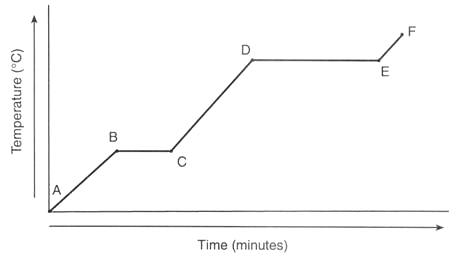
47.

Are the particles moving faster or slower as time goes on?

a)

Faster

b)

Slower

48.

What state/phase is the object likely from points A to B?

a)

Solid

b)

Liquid

c)

Gas

d)

Plasma

49.

What is happening to the particles in the substance between points A and B?

a)

Melting

b)

Freezing

c)

Speeding Up

d)

Slowing Down

50.

Is the substance gaining or losing energy?

a)

Gaining

b)

Losing

51.

Four light sticks are placed in water baths of varying temperatures. At which temperature would the light stick glow the brightest?

a)

0° C

b)

20° C

c)

30° C

d)

40° C

52.

Which phrase describes what happens to atoms in a chemical reaction?

a)

never lost or gained, just rearranged

b)

sometimes lost, never rearranged

c)

sometimes lost, gained, or rearranged

d)

lost or gained, never rearranged

53.

________ the concentration ______ the reaction rate.

a)

increasing; decreases

b)

increasing; increases

c)

decreasing; increases

d)

decreasing; does not effect

54.

Enzymes in your body act as catalysts. Thus, the role of enzymes is to___________.

a)

inhibit chemical reactions.

b)

increase the rate of chemical reactions.

c)

decrease the rate of chemical reactions.

55.

Which of the following materials will burn the fastest in open air?

a)

A solid log

b)

A log cut in half

c)

A pile of wood chips

d)

Both logs and wood chips burn at the same rate

56.

The minimum amount of energy needed for substances to react is called__________.

a)

Activation Energy

b)

Catalyst Energy

c)

Endothermic Energy

d)

Exothermic Energy

57.
Look at this image.  Which object has the LOWEST density in water? How
a)
The Ping Pong Ball because it floats to the top 
b)
The bolt because it has sunk to the bottom
c)
The soda cap because it is not just full of air like the Ping Pong ball
58.
Jack has a rock. The rock has a mass of 14g and a volume of 2cm3. What is the density of the rock?
a)
7 mL
b)
7 g/cm3
c)
28 g/cm3
d)
1/7 g/cm3
59.
If an object has a density of .6 g/mL and you put it into water, will it sink or float?  
a)
sink
b)
float
60.
If an object has a density of 3.6 g/mL and you put it into water, will it sink or float?  
a)
sink
b)
float
61.
Frank has an eraser. It has a mass of 4g, and a volume of 2cm3. What is its density?
a)
8 g/cm3
b)
2 g/cm3
c)
1/2 g/cm3
d)
24 g/cm3
62.
What units are used to measure mass?
a)
g
b)
cm3
c)
g/cm3
d)
cm3/g
63.
What is the formula for density?
a)
density = mass x volume
b)
density = mass / volume
c)
density = mass + volume
d)
density = mass - volume
64.
Helium balloons rise on earth because
a)
helium is less dense than air
b)
helium is more dense than air
c)
helium is cooler than air
d)
helium is warmer than air
65.
True or False:  The density of a specific type of material never changes.  
a)
True
b)
False
66.
Calculate the density of the cube.
a)
2 g/cm3
b)
4 g/cm3
c)
6 g/cm3
d)
8 g/cm3
67.

Which of the following is a characteristic property of matter?

a)

solubility

b)

volume

c)

mass

d)

temperature

68.

Which of the following is a characteristic property?

a)

Melting Point

b)

Mass

c)

Volume

d)

Shape

69.

Which of the following is a characteristic property?

a)

Texture

b)

Boiling Point

c)

Volume

d)

Taste

70.

True or False: Mass is a characteristic property.

a)

True

b)

False

71.

If two substances have different volumes...

a)

they are the same substance.

b)

they are not the same substance.

c)

volume is a non characteristic property, it can't be used to determine if substances are the same.

72.
The temperature of water is a characteristic property of water.
a)
True
b)
False
73.
A pure substance that cannot be broken down into other substances by chemical or physical means. 
a)
compound          
b)
atom
c)
mixture 
d)
element
74.

Which of these is an element?

a)

Salt (NaCl)

b)

Water (H20)

c)

Oxygen (O)

d)

Carbon Dioxide (CO2)

75.

Which of these is a compound?

a)

Aluminium (Al)

b)

Carbon Dioxide (CO2)

c)

Nitrogen (N)

d)

Sand

76.

Which of these is a mixture?

a)

Laundry Detergent

b)

Salt (NaCl)

c)

Oxygen (O)

d)

Fluorine (Fl)

77.

Air is:

a)

An element

b)

A compound

c)

A mixture

d)

None of these

78.
What is an example of a mixture?
a)
iron
b)
ice
c)
soil
d)
gold
79.
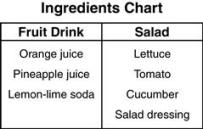
Jorge prepared a drink and salad for dinner. The chart lists the ingredients for both.
Using the information in the chart, which statement is the BEST description of the drink and salad?
a)
The salad and fruit drink are both mixtures.
b)
The salad and the fruit drink are both solutions.
c)
The fruit drink is a mixture because the ingredients can't be separated.
d)
The salad is a solution because the ingredients can't be separated.
80.

Which of the following is classified as a pure substance?

a)

Lemonade

b)

Fruit punch

c)

ketchup

d)

Helium

81.
A mixture that is uniform and well mixed is _____.
a)
homogeneous
b)
hetergeneous
c)
pure substance
d)
compoud
82.
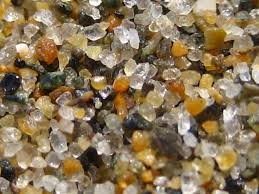
The picture shown here is what type of mixture?
a)
homogeneous
b)
hetergeneous
c)
pure substance
d)
element
83.
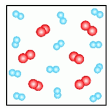
This diagram represents a _____.
a)
pure substance that is a compound
b)
mixture of elements
c)
pure substance that is an element
d)
mixture of compounds
84.

Identify the following substance.

a)

Element

b)

Compound

c)

Mixture

d)

Diatomic Molecule

85.

Identify the following substance

a)

Element

b)

Compound

c)

Mixture

d)

Diatomic Molecule

86.

What are 3 effects on SOLUBILITY? (Check all that apply)

a)

Temperature

b)

Color

c)

Noise

d)

Pressure

e)

Molecular structure

87.

How you would separate a saltwater solution which the water is collected?

a)

Filtration – using filter paper

b)

Distillation – vapor is collected

c)

Evaporation – solution is boiled and remains are collected

d)

Sieve – sifting (through a strainer)

e)

Magnetism – separating using a magnet

88.

The particle diagram shown is a:

a)

pure substance

b)

mixture

89.

The particle diagram shown is a:

a)

pure substance

b)

mixture

90.

Which picture(s) represents a mixture between two elements?

a)

A

b)

B

c)

C

d)

A and C

91.

Which picture(s) represents a mixture between an element and a compound?

a)

A

b)

B

c)

D

d)

B and D

92.

Which picture represents a mixture that is 75% compound and 25% element?

a)

A

b)

B

c)

C

d)

D