
 Worksheets
IONIC BONDING QUIZ
Total questions: 71
Worksheet time: 1hrs 16mins
Ionic bonds are formed between...
Non - metals
A metal and a non-metal
Metals
How is an ionic bond formed?
Sharing of electrons
Delocalised electrons
Transfer of electrons
Which of the below is an ionic compounds?
Ni
MgCl2
H2O
CH4
An example of an ionic compound is Sodium Chloride, which is made from Na+ and Cl- ions. Why do these ions form an ionic bond?
They have like charges
They are from the same group
They are from the same period
They have opposite charges
Lithium is in group 1 of the periodic table, which ion would it form?
Li-
Li2-
Li+
Li2+
Oxygen is in group 6 of the periodic table, which ion would it form?
O-
O+
O2-
O2+
Which of the following could NOT form an ionic compound? Check all that apply.
Li+ and Cl-
F- and O2-
Ba2+ and Ag+
Mg2+ and S2-
Which element(s) will form negative ions? Check all that apply.
Potassium
Sulfur
Iodine
Magnesium
Calcium Fluoride has a chemical formula of CaF2. What does the chemical formula tell you?
There are 2 Calcium ions for every 1 Fluoride ion in the crystal
There is 1 Calcium ion for every 2 Fluoride ions in the crystal
Which of the following is true for ionic bonding & ionic compounds? (check all that apply)
They must be made of ions with like charges.
The negative ion must be written first.
Compounds must have an overall charge of zero.
They are made of metals and nonmetals.
The positive ion must be written first.
Which of the following pairs of elements will NOT form an ionic compound?
sodium and fluorine
phosphorous and aluminum
potassium and magnesium
strontium and oxygen
molecule
ion
isotope
element
negative
positive
neutral
ficticious
An anion will be a ____ ion.
negative
positive
neutral
ficticious
Nitrogen, N, will form which of the following ions?
N
N-3
N-5
N+5
Al+3
Al
O-2
O
Ionic bonds happen because of the ____ of valence electrons.
sharing
transfer
keeping
covering
Boron, B, will ____ valence electrons when forming an ionic bond.
lose three
gain three
lose 5
gain 5
Sulfur, S, will ____ valence electrons when forming an ionic bond.
gain 1
lose 1
gain 2
lose 2
oppositely charged ions
similarly charged ions
neutral ions
neutral atoms
What will be the charge of a bromine ion?
+7
-7
-1
+1
Which element below would have a 3+ charge as an ion?
nitrogen (N)
boron (B)
silicon (Si)
argon (Ar)
NaCl
I am stealing 2 electrons
I am losing 2 electrons
I am in period 2
I have an atomic # of 2
Positive because I've added to my atom
negative because I've added electrons
same because I'm balanced
equal because now I have electrons
How many valence electrons does Mg have?
1
2
3
4
5

Atoms are most stable when their outer shell is complete.
True
False

Why do elements form chemical bonds?
Because they're friendly
To create a new element
To become stable
Because they all need to gain more electrons

Cations _______ electrons, becoming _______ charged.
Gain; positively (+)
Gain; negatively (-)
Lose; positively (+)
Lose; negatively (-)

Anions ____ electrons, becoming _____ charged.
Gain; positively (+)
Gain; negatively (-)
Lose; positively (+)
Lose; negatively (-)

Which block on this periodic table represents the transition metals?
s block
d block
p block
f block
Which of the following is not a transition metals?
sodium
chromium
iron
nickel
If an ion's charge is 2+ what does that say about that ion?
The ion gained 2 electrons.
The ion lost 2 electrons.
The ion is in period 2 of the periodic table.
The ion's atomic number is 2.
What will an atom do if it has only 1 or 2 valence electrons?
Give up its electron
Look for other atoms who want to give up an electron.
What will an atom do if it has almost full valence shell?
Look for other atoms who want to give up an electron
Give up its electron
Electrons and protons attract each other because their charges are
opposite
alike/same
neutral
What are valence electrons?
The total amount of electrons
The number of electrons in the first region.
The number of electrons in the outer region.
The number of electrons that are in region number 4.
What sub-atomic particle is involved in bonding?
electron
proton
neutron
How many Aluminum atoms are in Al2O3?
3
1
2
5
Name the following ionic compound: NaF
nitrogen fluorine
sodium fluoride
nitrogen fluoride
sodium fluorine
0; they don't exchange electrons
+1; they give away an electron
-1; they gain an electron
1; they form only single bonds

Ionic bonding can be defined as:
Bonding in which electrons are either gained or lost to form molecules.
Bonding in which electrons are shared to form ions.
Bonding in which electrons are either gained or lost to form ions.
Bonding in which electrons are shared to form molecules.

This is how an ionic bond takes place between lithium and oxygen:
TRUE
FALSE

This is how an ionic bond takes place between magnesium and chlorine:
TRUE
FALSE
What makes an atom stable?
getting rid of all of its electrons
having a full valence energy level
having at least 2 energy levels
having a negative charge
To form the nitride ion, the nitrogen atom needs to _____ electrons and will have a ______ charge.
gain 3; 3−
gain 3; −3
lose 5; 5−
lose 5; 5+
How many valence electrons do elements in Group 15 have?
15
5
4
Sodium (Na) will more likely bond with:
Bromine (Br)
Sulfur (S)
What type of bonding occurs when electrons are transferred from one atom to another?
Covalent Bonding
Ionic Bonding
Metallic Bonding
Hydrogen Bonding

This is an image of the giant ionic lattice representing Sodium Chloride, what is represented by the +?
Cl ion
Cl atom
Na atom
Na ion
This is an image of the giant ionic lattice representing Sodium Chloride, what is represented by the -?
Cl ion
Cl atom
Na atom
Na ion

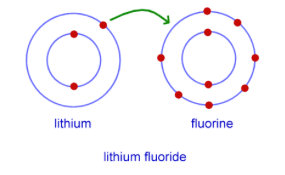
This image shows the bonding between Lithium and Fluorine. What does the red arrow show?
electrons being shared
electrons being transferred to Fluorine
electrons being transferred to Lithium
electrons being destroyed

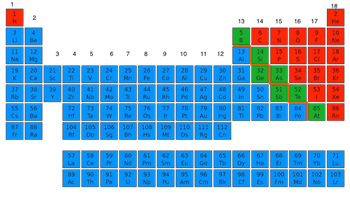
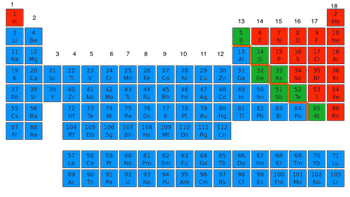

This could be the dot diagram of
Mg
Cl
C
O
How many valence electrons should Lithium have in its Lewis dot model?
1
2
3
4

