Wayground logo

Free Printable Worksheets

Font size

S
M
L
XL
Worksheets

OLD Unit 7- Motion & Forces Review

Total questions: 150

Worksheet time: 3hrs 21mins

Name
Class
Date
1.
How much time does it take a person to walk 12 km north at a velocity of 6.5 km/h?
a)
0.54 h
b)
1.85 h
c)
78 h
d)
5.5 h
2.
A car goes from rest to 50m/s in 5 seconds. What is the acceleration?
a)
-10m/s2
b)
250 m/s2
c)
25 m/s2
d)
10 m/s2
3.

The football player ran 40 yards in 4.2 seconds.

a)

Speed

b)

Acceleration

c)

Velocity

4.

The train traveled east by southeast at 20 km/s.

a)

Speed

b)

Acceleration

c)

Velocity

5.
How long did it take this object to travel 10 m?
a)
0 s
b)
10 s
c)
15 s
d)
20 s
6.
What is happening at C?
a)
Stationary
b)
Accelerating
c)
Fast steady speed; moving away from the starting position
d)
Slower steady speed; moving away from the starting position
7.
What is happening at D?
a)
Stationary
b)
Accelerating
c)
Fast steady speed; moving away from the starting position
d)
Slower steady speed; moving away from the starting position
8.
What is happening at A?
a)
Stationary
b)
Accelerating
c)
Slower steady speed; moving away from the starting position
d)
Steady speed; returning to start position
9.
What is the speed of a train that travels 6800 meters in 10 minutes? 
What formula would you use?
a)
V= D/T
b)
T= D/V
c)
D= VT
d)
None of these
10.
What two variables are interchangeable 
a)
V and S
b)
S and T
c)
T and D
d)
D and V
11.
The slope of a speed vs. time graph tells you
a)
acceleration
b)
distance traveled
c)
velocity
d)
All of these
12.
The slope of a position vs. time graph is equal to:
a)
distance.
b)
speed.
c)
time.
d)
position.
13.
a variable that gives direction information included in its value.
a)
speed
b)
average speed
c)
Velocity
d)
Vector
14.
Unit of mass
a)
m/s 2
b)
m/s
c)
newtons
d)
kg
15.
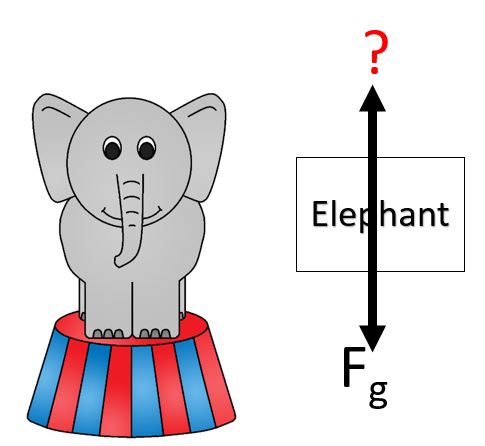
What is the net force of an object that is not moving?
a)
0N
b)
100N
c)
Upward force
16.
How will this object move? 
a)
It won't move. 
b)
It will move to the right. 
c)
It will move to the left. 
d)
It will move up. 
17.
During which interval is the object speeding up?
a)
A to B
b)
B to C
c)
D to E
d)
E to F
18.
Calculate the Acceleration.
a)
8
b)
1
c)
.125
d)
5
19.
Calculate the Acceleration.
a)
20
b)
5
c)
.2
d)
80
20.

What is this?

A car is traveling 50 mph.

a)

Speed

b)

Velocity

c)

Acceleration

21.

What is this?

"This airplane is traveling at 500 mph, West"

a)

Speed

b)

Velocity

c)

Acceleration

22.

What is this?

"Rocky is running 8mph North"

a)

Speed

b)

Velocity

c)

Acceleration

23.

What is velocity?

a)

Speed + Direction

b)

Speed Only

c)

Speed + Time

d)

Only Direction

24.

What is acceleration?

a)

A change in speed

b)

Speed + Direction

c)

Traveling at a constant speed

d)

Only time

25.
88 m/s
a)
Speed
b)
Velocity
c)
Acceleration
26.
88 m/s north
a)
Speed
b)
Velocity
c)
Acceleration
27.
88 m/s2
a)
Speed
b)
Velocity
c)
Acceleration
28.
A train that travels 100 kilometers in 4 hours is traveling at what average speed?
a)
50 km/h
b)
100 km/h
c)
2 km/h
d)
25 km/h
29.
If a bicyclist travels 30 km in 2 hours, her average speed is
a)
30 km/h
b)
60 km/h
c)
15 km/h
d)
2 km/h
30.
Shona cycles at an average speed of 8km/h. How far has she traveled if she cycles for 4 hours?
a)
55km
b)
32km
c)
43km
d)
32miles
31.
Find the velocity of a truck that travels 75 miles north in 2.5 hours.
a)
187.5 mph north
b)
30 mph north
c)
300 mph north
d)
200 mph north
32.
It took 3.5 hours for a train to travel the distance between two cities at a velocity of 120 miles/hr.  How many miles lie between the two cities? 
a)
34 miles 
b)
420 miles
c)
120 miles 
d)
360 miles 
33.
A car accelerates from 15 m/s to 60 m/s in 30 seconds.  What is its acceleration?
a)
2 m/s2
b)
3 m/s2
c)
1.5 m/s2
d)
0.75 m/s2
34.
A car accelerates from a standstill to 70 m/s in 10 seconds.  What is the acceleration?
a)
0.7m/s2
b)
7m/s2
c)
14m/s2
d)
none of the above
35.
A drag racer accelerated from rest ( 0 m/s ) to 195 m/s in 6.5 s.  What was the acceleration?
a)
10 m/s
b)
30 m/s2
c)
-3 m/s2
d)
26 m/s
36.
A ball rolls 144 cm in 12 sec. What is its speed in meters per second?
a)
12 cm/sec
b)
12 m/s
c)
1.2 m/s
d)
0.12 m/s
37.
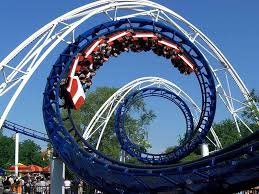
A roller coasters accelerates from an initial velocity of of 6.0 m/s to a final velocity of 70 m/s over 4 seconds.  What's the acceleration?
a)
24 m/s2
b)
18 m/s2
c)
16 m/s2
d)
16 m/s
38.
A car starts from rest at a stop light and reaches 20 m/s in 3.5 s. Determine the acceleration of the car.
a)
2.2m/s2
b)
7.0m/s2
c)
5.7m/s2
d)
70m/s2
39.

Colin skateboards down the sidewalk in front of the school, traveling at 24 km/h. How much time would it take him to travel 6.0 km?

a)

0.25 h

b)

0.4 h

c)

5.4 h

d)

12 h

40.

Andrew and Jennifer are in a 3-legged race at Fall Fair. How far could they run if they ran 0.36 km/min for 5 min?

a)

42.9 km

b)

1.8 km

c)

2.0 km

d)

0.2 km

41.

A little freshman moves down the hall at 3.2 m/s. When he sees Luke coming, he slows down. After 3.2 s, he is moving at 1.2 m/s. What is his acceleration?

a)

-0.25 m/s2

b)

-42.9 m/s2

c)

-0.625 m/s2

d)

-12 m/s2

42.

Calculate the speed the dog is moving at in section A of the graph.

a)

0.1 m/s

b)

1 m/s

c)

10m/s

d)

0.01 m/s

43.
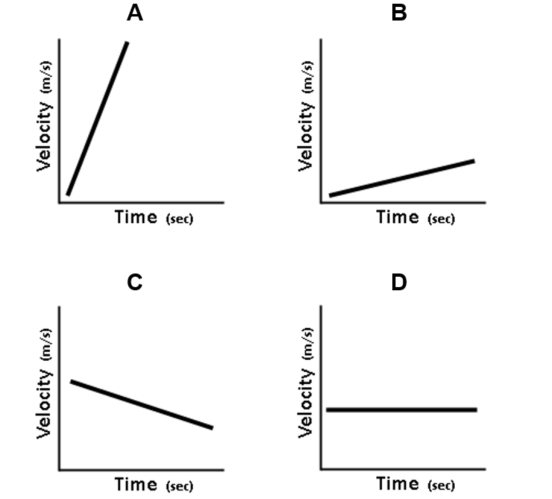
Which graph shows: A car travelling at a constant speed.
a)
A
b)
B
c)
C
d)
D
44.
Which graph shows: a car slowing down and coming to a stop.
a)
A
b)
B
c)
C
d)
D
45.
Which graph represents zero acceleration (constant velocity)?
a)
A
b)
B
c)
C
d)
D
46.
Which graph represents the greatest acceleration?
a)
A
b)
B
c)
C
d)
D
47.
What is Newton's First Law known as? The Law of
a)
Friction
b)
Mass
c)
Inertia
d)
Gravity
48.
What kind(s) of objects have inertia?
a)
all objects with mass
b)
only objects at rest
c)
only objects in motion
d)
only objects whose motion is being changed
49.
Which type of force(s) will cause a change in an object's motion?
a)
gravity
b)
zero net force
c)
balanced forces
d)
unbalanced forces
50.
What is the name for a push or pull?
a)
A movement
b)
A force
c)
Speed
d)
Density
51.
What is Newton's First Law
a)
F=ma
b)
Every action has an equal and opposite reaction
c)
An object at rest stays at rest, an object in motion stays in motion. 
d)
Friction 
52.
One object has twice as much mass as another object. The first object also has also twice as much...
a)
velocity
b)
gracitational acceleration
c)
inertia
d)
all of these
53.
Which has more Inertia? (and more force to move) 
a)
Truck
b)
Ant
54.
Why does an 18-wheeler have more inertia than a bicycle?
a)
it has more mass
b)
it has more volume
c)
it is not as aerodynamic
55.
Objects at rest resist...
a)
Motion
b)
Rest
c)
Mass
d)
Gravity
56.
The sum of all forces acting on an object and direction
a)
Contact Force
b)
Balanced Force
c)
Unbalanced Force
d)
Net Force
57.
Are forces balanced or unbalanced when a car is moving at a constant speed in a straight line?
a)
Balanced
b)
Unbalanced
58.
Balanced or unbalanced?
a)
balanced
b)
unbalanced
59.

Newton’s law states that for every action, there is an ________ reaction.

a)

unequal and opposite

b)

equal and similar

c)

stronger and opposite

d)

equal and opposite

60.

When a small car pushes a big truck, the truck applies an equal and opposite force on the car.

a)

False

b)

True

61.

When a cannon fires a cannonball we observe Newton's third law. Which is the reaction force?

a)

The cannon moving forward

b)

The cannon moving backwards

c)

The cannonball moving backwards

d)

The cannonball moving forward

62.

Action-reaction pairs can cause a change in motion.

a)

True

b)

False

63.

Force always come in________

a)

waves

b)

triplets

c)

pairs

64.

The forces in a force pair are in _______ direction

a)

opposite

b)

same

65.
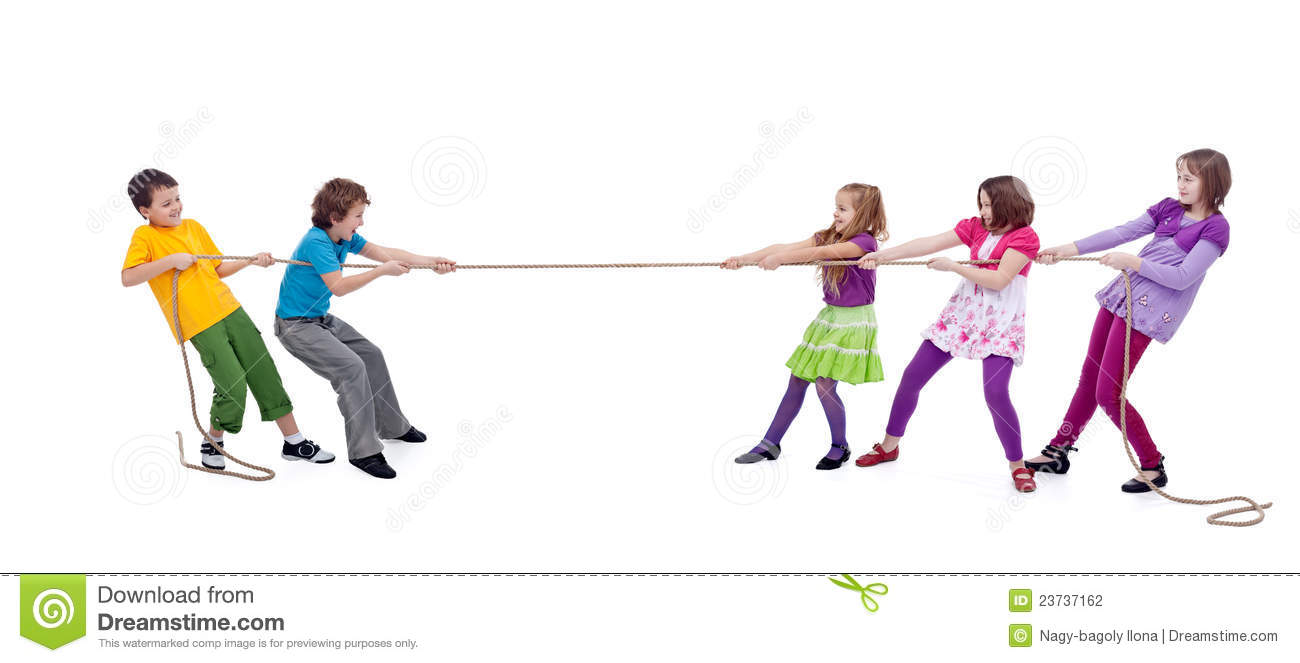
Why is the net force 0 in the image?
a)
Because the elephants are the same size
b)
Because they are both pulling the same amount of force in opposite directions
c)
Because they are elephants
d)
Because they are pulling away from each other.
66.

What will happen if the Action is greater than the Reaction?

a)

The man will fall

b)

The boat will sink

c)

Nothing will happen

67.

This picture shows .............

a)

Newton 2nd law of motion

b)

Newton 3rd law of motion

c)

Newton 1st law of motion

d)

I don't know

68.

The two paired forces in Newton's third law:

a)

act on different objects

b)

are equal in size

c)

are opposite in direction

d)

are the same type

e)

all of the above

69.

Resistance to an unbalanced force

a)

Mass

b)

Resistance

c)

Inertia

d)

Force

70.

A measure of how much matter is present in a substance

a)

Weight

b)

Mass

c)

Force

d)

Inertia

71.

Objects in motion tend to stay in motion

a)

Newtons 1st Law

b)

Newtons 2nd Law

c)

Newtons 3rd Law

d)

None

72.
a)

This is an Unbalanced Force

b)

This is a Balanced Force

73.
A player throws a ball. The action force is the player impact on the ball. The reaction force is...
a)
The force of the ball impact on the player
b)
The force of the grip of the ball
c)
The celebration the player is thinking of
74.
A player hits a ball with a bat. The action force is the impact of the bat against the ball. The reaction force is...
a)
The grip of the player's hands on the ball
b)
the air resistance of the ball
c)
the force of the ball against the bat
75.
An archer shoots an arrow. The action force is the bowstring against the arrow, the reaction force is...
a)
Air resistance against the bow
b)
the arrow's push against the bowstring
c)
the grip of the archer's hand on the bow
76.
According to Newton's Third law the strength or magnitude of forces will be...
a)
smaller
b)
equal
c)
larger
77.

When a heavy football player and a light one run into each other, who exerts more force? (pushes harder)

a)

The light one

b)

They exert the same force on each other

c)

The heavy one

78.

You can't exert a force on anything unless it also exert a force on you

a)

False

b)

True

79.

What happens to the balloon if the air is released ?

a)

Balloon goes right

b)

Balloon goes up

c)

Balloon goes down

d)

Balloon goes left

80.

A baseball player hits a ball with 400 N of force. How much force does the ball exert on the bat?

a)

300 N

b)

400 N

c)

500 N

d)

Not enough info to tell

81.
An object with a mass of 2.0 kg accelerates 2.0 m/s2 when an unknown force is applied to it. What is the amount of the force?
a)
4 N
b)
0.4 N
c)
1 N
d)
0.1 N
82.
An object with a mass of 5.0 kg accelerates 8.0 m/s2 when an unknown force is applied to it. What is the amount of the force?
a)
40 N
b)
4 N
c)
10 N
d)
0.1 N
83.
An object with a mass of 6.0 kg accelerates 4.0 m/s2 when an unknown force is applied to it. What is the amount of the force?
a)
240 N
b)
24 N
c)
2.4 N
d)
0.24 N
84.

An object accelerates 3.0 m/s2 when a force of 6.0 newtons is applied to it. What is the mass of the object?

a)

2 kg

b)

18 kg

c)

0.5 kg

d)

0.05 kg

85.

An object accelerates 12 m/s2 when a force of 6.0 newtons is applied to it. What is the mass of the object?

a)

2 kg

b)

18 kg

c)

0.5 kg

d)

0.05 kg

86.

An object accelerates 5 m/s2 when a force of 20 newtons is applied to it. What is the mass of the object?

a)

4 kg

b)

20 kg

c)

0.5 kg

d)

2 kg

87.

An object accelerates 5 m/s2 when a force of 20 newtons is applied to it. What is the mass of the object?

a)

4 kg

b)

20 kg

c)

0.5 kg

d)

2 kg

88.

An object with a mass of 2.0 kg has a force of 4.0 newtons applied to it. What is the resulting acceleration of the object?

a)

2 m/s2

b)

8 m/s2

c)

0.5 m/s2

d)

6 m/s2

89.

An object with a mass of 5 kg has a force of 40 newtons applied to it. What is the resulting acceleration of the object?

a)

2 m/s2

b)

8 m/s2

c)

0.5 m/s2

d)

6 m/s2

90.

An object with a mass of 5 kg has a force of 20 newtons applied to it. What is the resulting acceleration of the object?

a)

2 m/s2

b)

8 m/s2

c)

4 m/s2

d)

6 m/s2

91.
A car is 2000kg and accelerating at 20m/s2, what is the net force applied to it?
a)
40000 N
b)
100 N
c)
5 N
d)
200 N
92.
If a 10 kilogram object accelerates suddenly at 15 m/s2, how much force was applied to the object? (watch for proper units on this answer!)
a)
150 Newtons
b)
15 Newtons
c)
150 kilograms
d)
100 kilograms
93.

According to Newton's second Law, which would take more force to slow down?

a)

The silver car

b)

The green car

c)

They would both take the same force

94.

Which of these best states Newton's Second Law?

a)

The greater the mass of an object the greater the force needed to change its motion.

b)

The greater the mass of an object the less force needed to change its motion.

c)

The mass of an object does not effect the force needed to change its motion
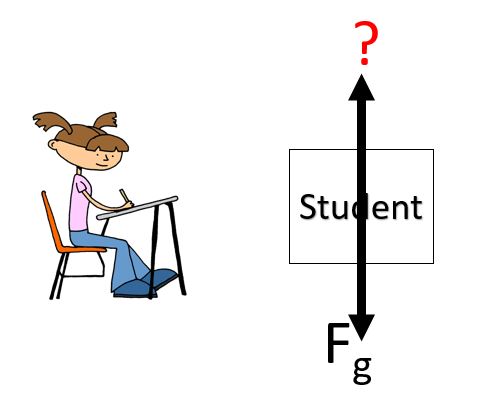
95.
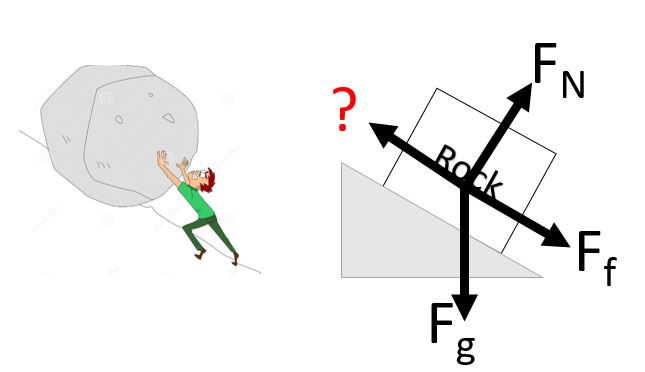
Name the missing force....
a)
weight force
b)
normal force
c)
frictional force
d)
tension force
96.
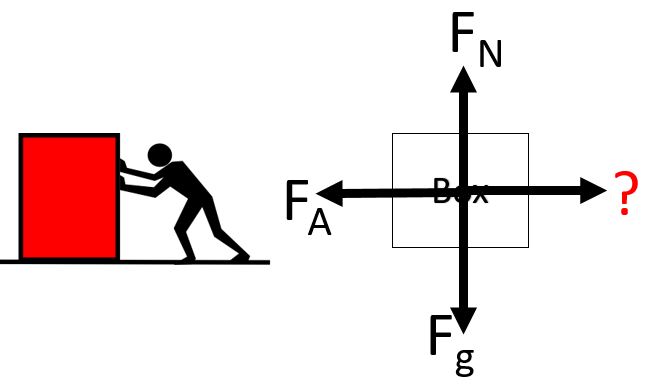
Name the missing force...
a)
applied force
b)
weight force
c)
lift
d)
normal force
97.
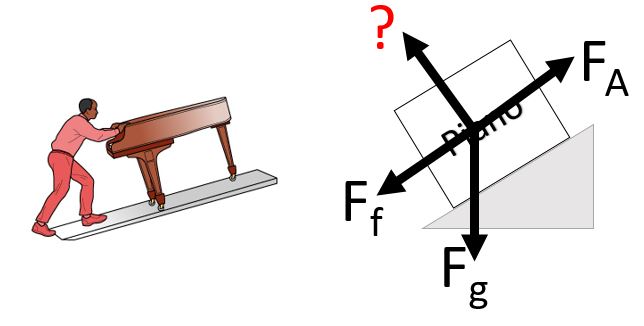
Name the missing force...
a)
tension force
b)
frictional force
c)
normal force
d)
spring force
98.
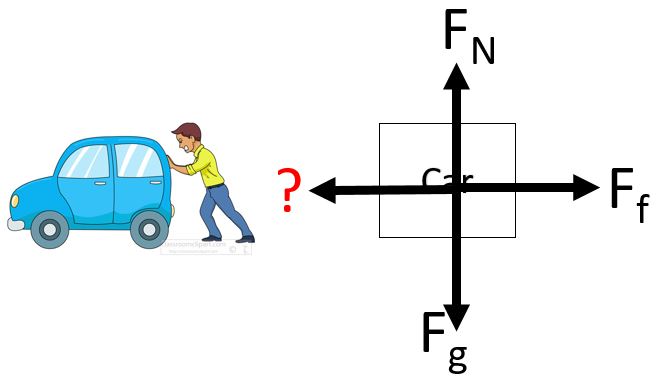
Name the missing force...
a)
frictional force
b)
weight force
c)
thrust
d)
buoyant force
99.
Name the missing force...
a)
normal force
b)
applied force
c)
frictional force
d)
tension force
100.
Name the missing force...
a)
applied force
b)
weight force
c)
tension force
d)
drag
101.
Name the missing force...
a)
tension force
b)
gravitational force
c)
normal force
d)
applied force
102.
Name the missing force...
a)
weight force
b)
normal force
c)
applied force
d)
frictional force
103.

The sum of all of the forces acting on an object is known as the (a)   force.

104.

Do directions matter with forces?

(a)  

105.

When forces are acting in the same direction they should be added together.

a)

True

b)

False

106.

Forces that are acting in opposite directions should be subtracted from each other.

a)

True

b)

False

107.

If the net force (Fnet) is 0, _____

a)

the forces are balanced.

b)

the forces are unbalanced

c)

the object maintains its same speed and direction.

d)

the object speeds up, slows down, or changes direction.

108.

The net force (Fnet) and the acceleration are always in the same direction.

a)

True

b)

False

109.

If the acceleration and the velocity are in opposite directions, the object will _____.

a)

speed up

b)

slow down

c)

turn

110.

If the acceleration and velocity are in the same direction the object will _____.

a)

speed up

b)

slow down

c)

turn

111.

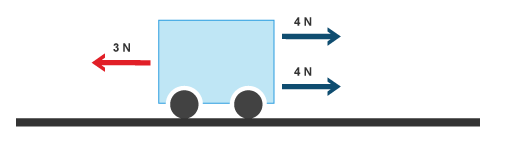
The net force acting on the object is acting _____.

a)

to the right

b)

to the left

c)

up

d)

down

112.

The net force (Fnet) acting on the object is (a)   N.

113.

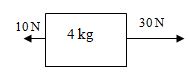
The net force acting on the block is (a)   N.
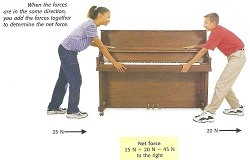
114.
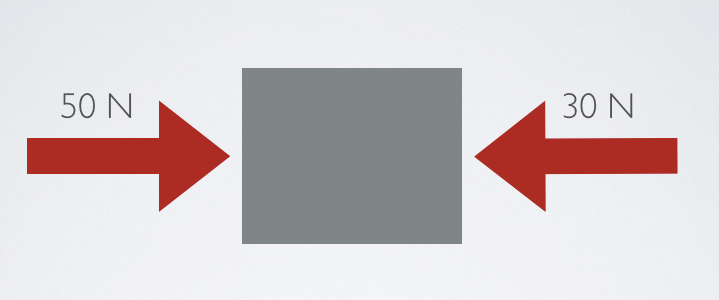
What is the net force?
a)
5 N
b)
45 N to the left
c)
5 N to the right
d)
45 N to the right
115.
Is it BALANCED? 
a)
Yes
b)
No
116.
This is an example of what kind of force?
a)
Balanced Force
b)
Pushing Force
c)
Gravity Force
d)
Unbalanced Force
117.
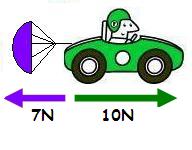
What is the net force?
a)
17 N Right
b)
3 N Right
c)
3 N Left
d)
17 N Left
118.
Which would fall with greater acceleration in a vacuum—a leaf or a stone?
a)
the leaf
b)
the stone
c)
They would accelerate at the same rate.
d)
It is difficult to determine without more information.
119.
Which would hit the ground first if dropped from the same height in a vacuum—a feather or a metal bolt?
a)
the feather
b)
the metal bolt
c)
They would hit the ground at the same time.
d)
They would be suspended in a vacuum.
120.

According to Galileo's observations gravity pulls on all objects equally regardless of _____________

a)

size

b)

shape

c)

mass

d)

time of day

121.

An object in free fall _________________ as it falls

a)

gets slower

b)

gets faster

c)

has a constant speed

122.

When the air resistance or drag is equal and opposite to the weight of the object you would call this

a)

terminal velocity

b)

gravitational weight

c)

flux capacitor

d)

rotational inertia

123.

To create the most air drag (resistance) , a parachute needs to

a)

have a small surface area

b)

be light

c)

have a lot of surface area

d)

be heavy

124.

If an object is falling under the influence of gravity alone, this is called________

a)

terminal velocity

b)

acceleration

c)

free fall

125.

If this graph were to show a parachutist jumping from a plane, how would you describe the forces acting at point B.

a)

His weight is bigger than air resistance

b)

Air resistance is bigger than his weight.

c)

His weight and air resistance are balanced.

126.

What causes an object to fall faster?

a)

Smaller surface area

b)

Larger surface area

c)

If it has a parachute

d)

If it is softer

127.

The larger the surface area of the moving object, the ___________ air resistance there is.

a)

Less

b)

More

c)

Longer

d)

Quicker

128.

A force which causes objects to fall is

a)

weight

b)

gravity

c)

air resistance

d)

absorbency

129.

________ acts to slow the rate at which objects fall.

a)

Thrust

b)

Barometer

c)

Air Resistance

d)

Gravity

130.

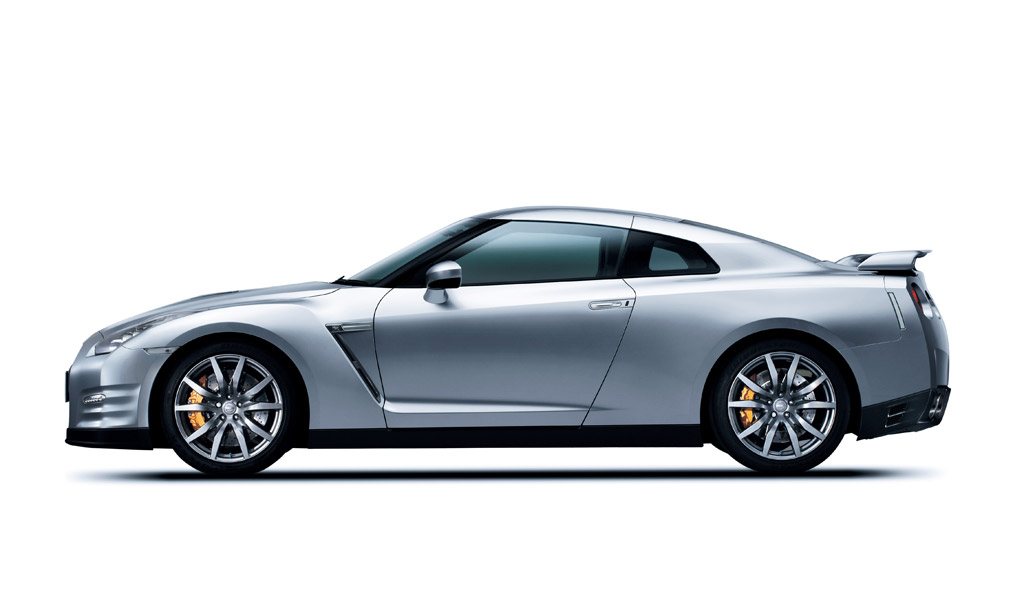
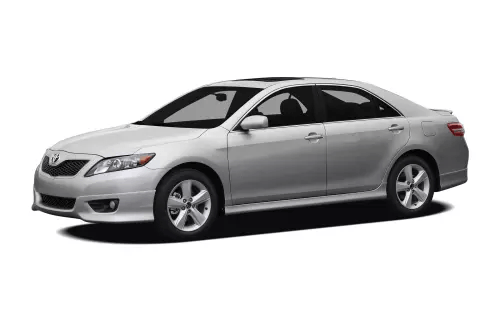
Look at the pictures of the cars. Which car will have the most air resistance force acting upon it? They will be moving at the same speed.
a)
b)
c)
d)

All will have equal air resistance force.

131.

Which best describes why a falling object will reach its terminal velocity?

a)

Gravity force is equal and opposite air resistance force.

b)

Air resistance force is equal and opposite the freefall velocity.

c)

Gravity force is equal and opposite the object's mass.

d)

The object's mass is equal and opposite the gravity force.
132.
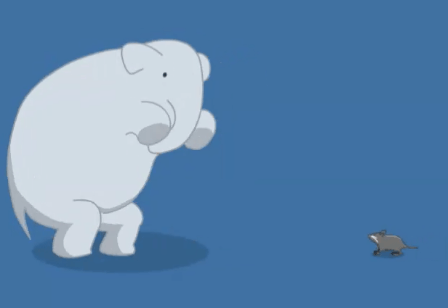
Which objects have a STRONG force of gravity?
a)
Objects with GREATER mass, like elephants
b)
Objects with LESS mass, like mice
133.
The force of gravity acting on an object is the object's ______.
a)
mass
b)
matter
c)
weight 
d)
friction 
134.
The amount of matter in an object is 
a)
pressure
b)
weight
c)
mass
d)
force
135.
Which of the following never changes no matter where in the universe?
a)
weight
b)
force
c)
mass
d)
pounds
136.
A person would weigh less on on the Moon than on the Earth because . . .
a)
Moon has more mass, and therefore more gravity
b)
Moon has less mass, and therefore more gravity
c)
Moon has more mass, and therefore less gravity
d)
Moon has less mass and therefore less gravity
137.
If Earth's mass was cut in half, what would happen to your mass?
a)
increase because gravitational force increases
b)
decrease because gravitational force decreases
c)
decrease because gravitational force increases
d)
nothing, mass is not affected by gravitational force
138.
As mass increases, what happens to gravitational force?
a)
increases
b)
decreases
c)
stays the same
139.
The force of gravity on Jupiter is a little more than 2 times the gravitational force on Earth. If an object has a mass of 50 kg and a weight of 490 N on Earth, what would be the object's approximate mass and weight on Jupiter?
a)
50 kg and 490 N
b)
100 kg and 490 N
c)
50 kg and 980 N
d)
100 kg and 980 N
140.
A child has a mass of 30 Kg on Earth. If the gravity on Moon is one sixth that of the Earth what is the mass of the child on Moon? 
a)
30 Kg
b)
180 Kg
c)
5 Kg
d)
0 Kg
141.

The astronaut floats in international space station. It proves that...

a)

His weight is less in space

b)

His mass is less in space

c)

His weight does not change

d)

His mass is more in space

142.

If the mass of an object is 1000 kg on Earth, what is it's mass on the moon?

a)

less than 1000 kg

b)

more than 1000 kg

c)

1000kg

143.
If the mass of an object on Earth is 18 grams, what would the mass of the same object be on the Moon?
a)
18 g
b)
4 g
c)
0 g 
d)
32 g 
144.
If an object mass =30 Kg on the Earth, what would be it's weight on Earth?
a)
30 N
b)
300 kg
c)
3000N
d)
300 N
145.
If the mass of an object is 1000 kg on Earth, what is it's mass on the moon?
a)
10kg
b)
100kg
c)
1000kg
d)
10,000kg
146.

A girl weighs 300 N what is her mass here on Earth?

a)

40.8 kg

b)

41 kg

c)

30 kg

d)

300 N

147.

You fly to Venus and research if life can exist there. Your mass is 100 kg and have a weight of 90 N what is the Gravitational strength of Venus?

a)

900 N/kg

b)

9 N/kg

c)

0.9 N/kg

d)

9000 N/ kg

148.

You fly to an unknown planet and research if life can exist there. A banana has a mass 0f 75g and have a weight of 50 N what is the Gravitational strength of this planet?

a)

0.67 N/kg

b)

66.7 N/kg

c)

666.7 N/kg

d)

9000 N/ kg

149.

If the mass of a rhino is 1,080 kilograms on Earth , what is its weight?

a)

2,400 Newtons

b)

10,800 kg

c)

10,800 Newtons

d)

10,584 kg

150.

Which planet would a 65 kg person weight the most on?

a)

Mars

b)

Jupiter

c)

Earth

d)

Venus