wayground logo

Free Printable Worksheets

Font size

S
M
L
XL
Worksheets

Evidence for Evolution Recap

Total questions: 89

Worksheet time: 2hrs 10mins

Name
Class
Date
1.

The cladogram shows the evolution of land plants as indicated by fossil records.

Which discovery would challenge the validity of this cladogram?

a)

A large aquatic vascular plant about 200 million years old

b)

A species of algae that has existed for less than one million years

c)

A moss species that has existed for less than 380 million years

d)

A fossil of a fern more than 425 million years old

2.

Scientists estimate that there are more than 20,000 species of ants. The species range in size from 1 mm long to 38 mm long and live in most environments. The diets of ants range from flowers and seeds to fluids from their own larvae. Ants have been able to successfully inhabit so many different environments because their populations have been able to --

a)

hybridize with other species of insects

b)

adapt to a variety of habitats and food sources

c)

fill niches usually occupied by mammals

d)

occupy habitats that have no other life-forms

3.

Two populations of mice living in the same forest are separated by a large water-filled ditch. After a rainstorm, flooding brings several mice from one population to the other population. When the mice from the first population reproduce with members of the second population, which of the following will likely occur?

a)

All of the offspring will die as a result of reproductive mutations.

b)

The offspring will be forced to leave the second population.

c)

The offspring will be genetically identical to their parent from the first population.

d)

The offspring in the second population will have greater genetic variety.

4.
Which of the following ideas is supported by Darwin’s observation of local variation among tortoises in the Galápagos Islands? 
a)
artificial selection
b)
adaptation
c)
acquired characteristics
d)
tendency towards perfection
5.
A change in the inherited characteristics of an organism over time is ________
a)
evolution.
b)
development.
c)
growth.
d)
ancestry.
6.
The most recent ancestral form or species from which two different species evolved is known as ________________________.
a)
a common ancestor.
b)
an embryonic stage.
c)
development.
d)
evolution.
7.
Common ancestry relates to evolution because
a)
evolution only happens when there are common ancestors.
b)
Common ancestors make evolution happen more quickly.
c)
evolution can never take place with common ancestors.
d)
the more two organisms have in common, the more recent is their common ancestor during their evolution.
8.
Which of the following pieces of evolution evidence deals with comparing similar structures in various species?
a)
fossil record
b)
comparing embryology
c)
comparing biochemistry
d)
comparing anatomy
9.
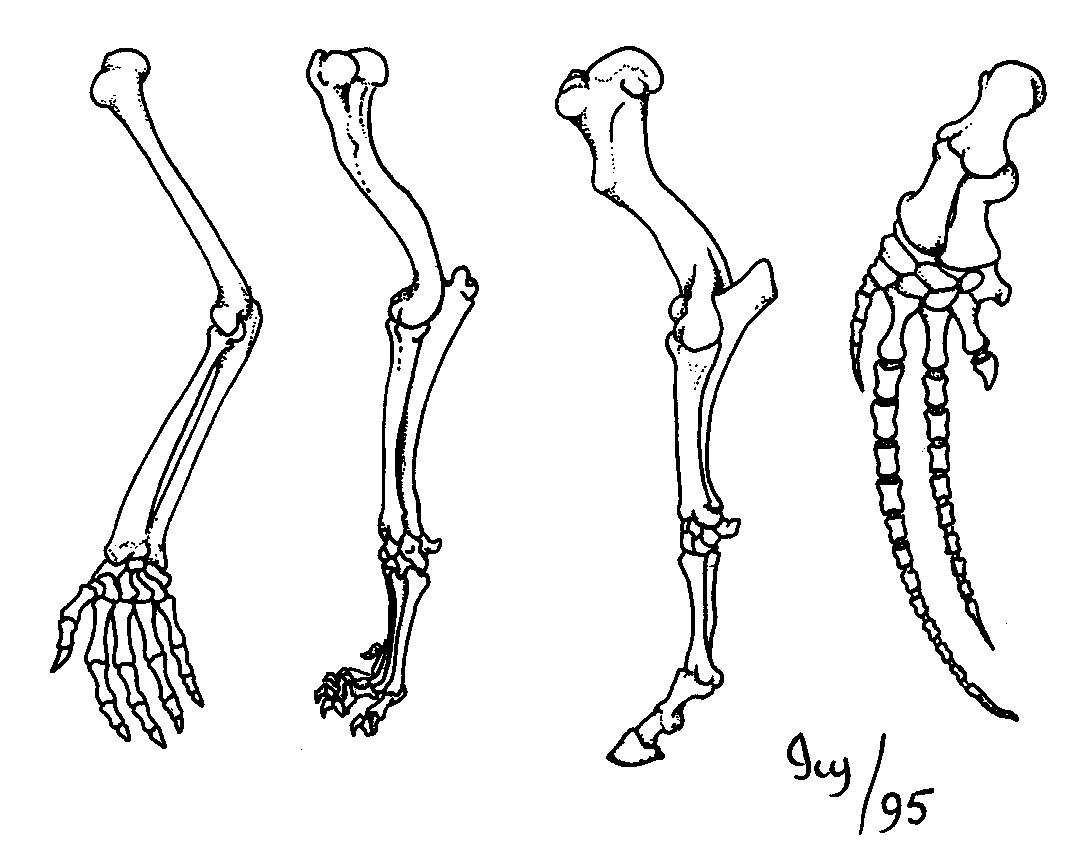
Humans, birds, whales, and lizards all have similar arm bones. What is the reason for this?
a)
The function of these bones is the same in all animals
b)
They live in similar environments
c)
They have a common ancestor
d)
All organisms resemble humans
10.

Does the presence of homologous structures in genetically different animals suggest common ancestry?

a)

Yes

b)

No

11.
The similarities of the bones in the diagram provide evidence that---
a)
The organisms shown lived in the same natural envionrment
b)
The organisms shown may have developed from a common ancestor
c)
The organisms shown have the same genetic diseases
d)
All vertebrate species have identical forelimbs
12.

What type of evidence are shown in the picture above?

a)

Fossils

b)

Embryology

c)

Homologous Structures

d)

Vestigial Structures

13.

_________________ show clear changes in an organism over time, the environment organisms lived in, the time period the organism lived in, and where the organism lived.

a)

DNA

b)

Vestigial structures

c)

Fossils

d)

Homologous structures

14.
The diagram shows fossils in different rock layers. Which of these statements about the age of these fossils is most likely correct?
a)
Fossil A and C are the same age
b)
Fossil B is older than fossil C
c)
Fossils A is older than fossil B
d)
Fossil D is older than fossil C
15.
A fossil of an extinct dinosaur is found and the anatomy of the fossil shows similarities to that of a bird. What could this mean?
a)
This is purely by chance and isn't significant
b)
The extinct dinosaur and modern bird share a common ancestor
c)
All dinosaurs evolved into birds and that's why there aren't any dinosaurs alive today
d)
Dinosaurs choose to fly, and evolved into birds to escape predation and capture food
16.

Recently, scientists have been able to use ___________to find common proteins and amino acids to determine how closely related species are.

a)

DNA

b)

Vestigial structures

c)

Fossils

d)

Homologous structures

17.

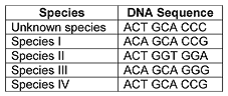
What type of evidence is shown in the image above?

a)

Fossils

b)

Vestigial structures

c)

Homologous Structures

d)

DNA

18.
According to this data, the unknown bacterial species is most closely related to: 
a)
Species I
b)
Species II
c)
Species III
d)
Species IV
19.
Two organisms that are closely related would have
a)
very similar DNA sequence
b)
exactly the same DNA sequences
c)
no proteins in common
d)
completely different DNA sequence
20.

Which IS NOT used as evidence for evolution?

a)

Fossils

b)

Natural Selection

c)

Early Development/Embryos

d)

Body Structure/Anatomy

e)

DNA/Proteins

21.

Because whales have a pelvis and femurs, it shows whales are descended from an ancestor that was able to _____________________.

a)

walk

b)

sing

c)

swim

d)

polka

22.
For evolution to happen, this has to occur first:
a)
an organism finds a new mate
b)
and organism's DNA changes
c)
The environment in which a species lives changes
d)
the population increases
23.
A scientist should look at one of the following to determine whether or not there is a common ancestor
a)
how organisms migrated
b)
how the organism reproduces
c)
what the organism eats
d)
the larval form of the organism
24.
Changes in species that allow that species to survive changes in the environment are called:
a)
ecosystems
b)
adaptations
c)
biomes
d)
alleles
25.
What type of beak would help a bird pick insects off a plant?
a)
a large thick beak
b)
a long thin beak
c)
a small short beak
d)
a large hooked beak
26.
Which scientist gets credit for developing the theory of natural selection
a)
Charles Darwin
b)
Gregor Mendel
c)
Benjamin Franklin
d)
Jean-Baptiste Lamarck
27.
Which of following in NOT a critial part of the theory of evolution?
a)
overproduction
b)
consistent environment
c)
genetic variation
d)
struggle to survive
28.
What is the most important factor that contributes to a species evolving? 
a)
environmental change
b)
how old a species is
c)
what the ancestors look like
d)
what time of year a species reproduces.
29.
Which of these does NOT provide evidence that evolution occured?
a)
the fossil record
b)
the physical differences between species
c)
similar structures between species
d)
where an organism lives
30.
A theory has significant evidence to support it.  True or False
a)
True
b)
False
31.
When organisms co-evolve, live far away but have similar characteristics, what must be true?
a)
The reproduced with each other a long time ago. 
b)
The organisms live in different environments.
c)
The organisms share a common ancestor.
d)
The organisms have traits from their environments. 
32.
Organisms that have different traits when developing but have similar traits as adults must have:
a)
acquired them due to similar environments
b)
shared a common ancestor
c)
same amount of time to evolve.
d)
happened to due a coincidence. 
33.

A category of body structures that are formed in similar ways during embryonic development and share similar patterns of bone structure.

a)

Homologous structures

b)

Analogous structures

c)

Vestigial structures

d)

Bone structures

34.

What type of structure does this image illustrate?

a)

Analogous structures

b)

Homologous structures

c)

Vestigial structures

35.

In this image, the yellow shaded bones all appear similar in structure. However, their functions differ. Which describes the function of the yellow bones in the bat?

a)

Fingers to grasp objects

b)

Leg to walk on

c)

Wing for flying

d)

Fin for swimming

36.

In this image, the yellow shaded bones all appear similar in structure. However, their functions differ. Which describes the function of the white bones in the whale?

a)

Fingers for grasping objects

b)

Leg for walking

c)

Wing for flying

d)

Fin for swimming

37.

Select the two most important characteristics that distinguish homologous structures.

a)

Similar bone structures

b)

Similar function

c)

Similar embryonic development

d)

Similar species

38.

A category of structures that have a similar function, but are structurally different.

a)

Homologous structures

b)

Analogous structures

c)

Vestigial structures

d)

Common core structures

39.

What type of structure does this image illustrate?

a)

Homologous structures

b)

Analogous structures

c)

Vestigial structures

40.

Select all that apply to the image displayed.

a)

Has wings

b)

Has feathers

c)

Has bones

d)

Can fly

e)

An example of analogous structures

41.

Which of the following is NOT true of analogous structures?

a)

Similar embryonic development

b)

Structures that perform the same function

c)

Different structural characteristics

d)

Different embryonic development

42.

What are the most important characteristics of analogous structures?

a)

Structures that perform the same function

b)

Structurally different

c)

Structurally the same

d)

Structures that perform different functions

43.

A type of structure that is physically present, but does not seem to serve a significant function for an organism.

a)

Homologous structure

b)

Analogous structure

c)

Vestigial structure

d)

Standard structure

44.

The appendix, tailbone, and wisdom teeth are all examples of what type of structure in humans?

a)

Homologous

b)

Analogous

c)

Vestigial

d)

Modern

45.

Observe the two fish in the image. The cave fish and minnow are genetically related to each other and are similar in many ways. The cave fish lives very deep in the ocean where there is no light. It has only the remnants of eyes and is blind. Minnows live in shallow waters where the water has light. Their eye sight is important for their survival. Which statement below best describes these two fish?

a)

The DNA of the cave fish has changed over time to differ from the minnow. Since there is no light where the cave fish lives, it was not necessary to have working eyes. Over time, mutations occurred which proved to improve the survival of the cave fish, which is why they are now blind and have only physical remnants of eyes.

b)

The DNA has not mutated over time and despite all of the evidence that suggests these two are genetically similar, one has eyes and the other does not so they must not be related.

c)

Cave fish must have been attacked by predators, which is why they only have the remnants of eyes.

46.

Does the presence of homologous structures in genetically different animals suggest common ancestry?

a)

Yes

b)

No

47.

Which of the following is NOT considered a vestigial structure in humans?

a)

Eye lashes

b)

Appendix

c)

Wisdom teeth

d)

Tail bone

48.
If an organism has a vestigial structure, that structure likely once had a function in a(n)
a)
close relative
b)
early ancestor
c)
unrelated organism
d)
embryological stage
49.
Whales are aquatic mammals that contain a pelvis bone.  Even though it does not aid in its movement, the function must have been used by a common ancestor of the whale.  Thus, the pelvis is referred to as a(n)
a)
vestigial structure
b)
analogous structure
c)
homologous structure
50.
Structures with the same parts have different functions; suggests that organisms share a common ancestry
a)
vestigial structures
b)
homologous structures
c)
adaptive radiation
d)
fossil
51.
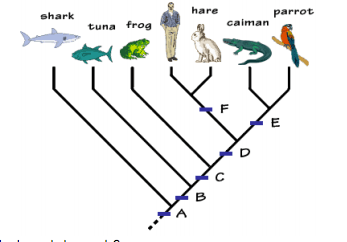
On the cladogram, which organism is the closest relative of the human?
a)
Frog
b)
Hare
c)
Caiman
d)
Parrot
52.
Which trait do only humans have, according to the cladogram?
a)
jaws
b)
mammary glands & hair
c)
terrestrial during all life stages
d)
opposable thumbs
53.
According to the cladogram, which organism is most distantly related to the human?
a)
crayfish
b)
rat
c)
perch
d)
frog
54.
Which of the following pieces of evolution evidence contain both homologous and vestigial structures?
a)
fossil record
b)
comparing embryology
c)
comparing biochemistry
d)
comparing anatomy
55.
Mutations are important because they bring about
a)
death of the organism in which they develop
b)
genetic variation needed for a population to evolve
c)
benefits for the individual, not for the population
d)
Hardey-Weinberg equilibrium within a population
56.
The forelimbs of vertebrates, like the ones pictured here, are similar in terms of number of bones and the orientation of bones. Which best describes how comparing homologous structures provides evidence of evolution?
a)
The genes for the body plan and forelimb layout were present in a common ancestral species vertebrates share, thus passed onto all vertebrates.
b)
Similar anatomical structures show how animals adapt to changing environments
c)
Homologous structures show that different species evolve at different rates
d)
Homologous structures don’t actually provide evidence for evolution
57.
Evolution is called a theory because
a)
we are not sure if it is true
b)
there's not enough evidence yet
c)
scientific theories are supported by a large amount of evidence
d)
none of these is true
58.

Oldest rocks and ancestors would be deeper in the ground

a)

Speciation

b)

Homologies

c)

Recessive Traits

d)

Fossil Record

59.

Species show very little evolutionary change in the fossil record

a)

Stasis

b)

Natural Selection

c)

Artificial Selection

d)

Darwinsim

60.

Evolution occurring gradually and slowly over long periods of time

a)

Homeostasis

b)

Stasis

c)

Punctuated Equilibrium

d)

Gradualism

61.

Evolution occurring quickly due to catastrophic events

a)

Homeostasis

b)

Gradualism

c)

Statsis

d)

Punctuated Equilibrim

62.

The idea that similar anatomy implies common ancestry

a)

Analogous Structures

b)

DNA Evidence

c)

Fossil Record

d)

Anatomical Homology

63.

Various species show similar developmental patterns as embryos.

a)

DNA similarities

b)

Anatomical Homology

c)

Embryology

d)

All of the above

64.

The idea that similar DNA or Amino Acid Sequences indicate common evolutionary ancestry

a)

Molecular Homology (DNA)

b)

Anatomical Homology

c)

Developmental Homology

d)

all of the above

65.

The hypothesis that physical structures with no known purpose are leftovers from an ancestor.

a)

Homologous Structure

b)

Vestigial Structure

c)

Anatomical Analogy

d)

Developmental Homology

66.

According to evolutionary theory, all living things have a common

a)

Purpose

b)

Function

c)

Ancestor

d)

Phone Number

67.

According to evolutionary theory, similar DNA would mean a common

a)

Ancestor

b)

Environment

c)

Interest

d)

Residency

68.

Since their DNA is so similar, evolutionary theory implies that whales descended from land animals that were also the common ancestor to

a)

Ants

b)

Dinosaurs

c)

the Hippopotamus

d)

Fish

69.
The diagram shows fossils in different rock layers. Which of these statements about the age of these fossils is most likely correct?
a)
Fossil A and C are the same age
b)
Fossil B is older than fossil C
c)
Fossils A is older than fossil B
d)
Fossil D is older than fossil C
70.
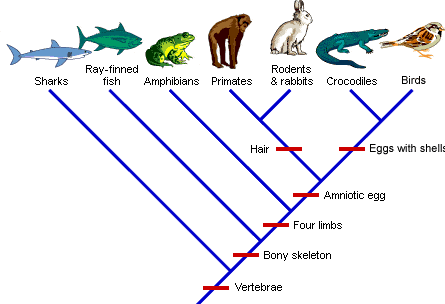
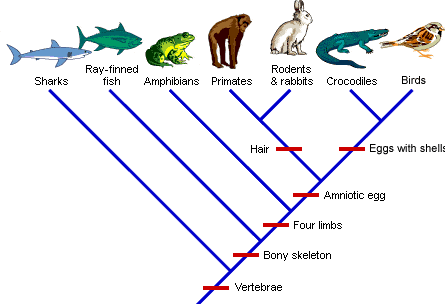
According to this cladogram, sharks are MOST closely related to which organism? 
a)
Amphibians
b)
Ray finned fish
c)
Crocodiles
d)
Birds
71.
Which two orgainsms have hair? 
a)
Sharks & Ray Finned Fish
b)
Primates & Rodents
c)
Birds & Crocodiles
d)
Rabbits & Birds
72.
Which species’ DNA is most similar to the DNA of the toothed whale? 
a)
Hippopotamus 
b)
Baleen Whale
c)
Grazing Mammals
d)
Camels
73.
A species is...
a)
a group of similar organisms that can breed 
b)
A group of organisms that live in the same place 
c)
A group of individuals that can breed and produce fertile offspring 
d)
A group of new offspring 
74.

A change in the inherited characteristics or traits of a population of species over time is ________

a)

evolution.

b)

development.

c)

growth.

d)

natural selection.

75.

Which animals have amniotic eggs?

a)

Turtle and Tuna

b)

Turtle and Leopard

c)

Lancelet and Lamprey

d)

Tuna and Slaamander

76.
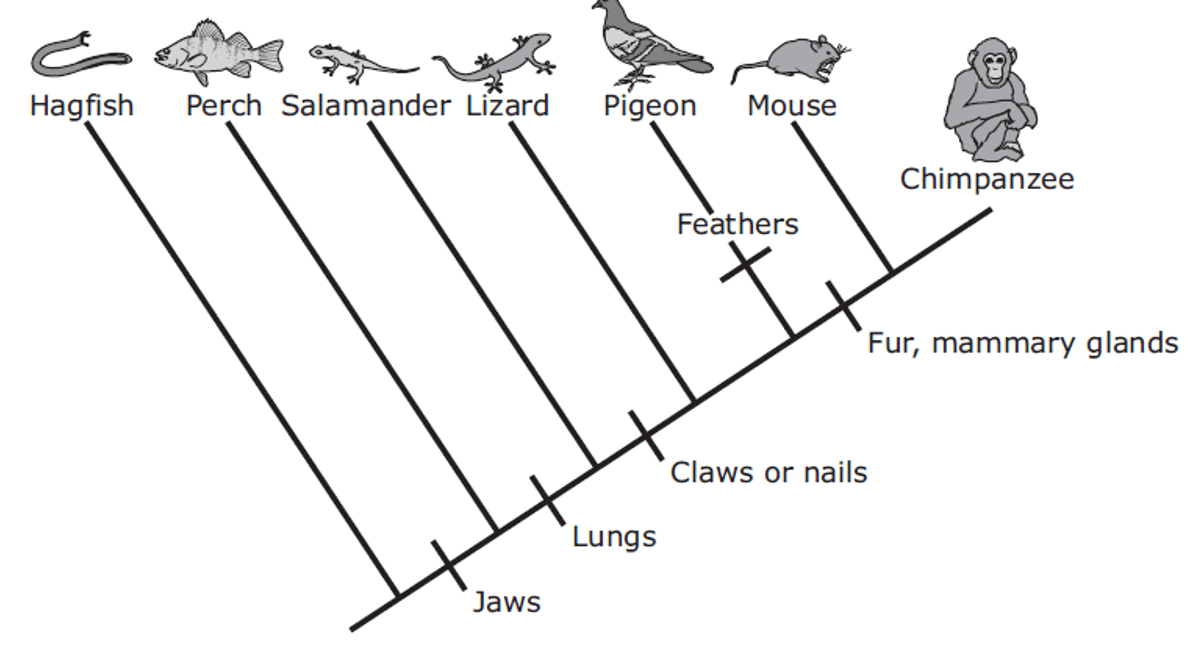
All the animals to the right of the hagfish would have the common characteristic of -
a)
Fur
b)
Claws or nails
c)
Lungs
d)
Jaws
77.
A common ancestor for both A and E could be at position __.
a)
1
b)
2
c)
3
d)
4
78.
Structures with the same parts have different functions; suggests that organisms share a common ancestry
a)
vestigial structures
b)
homologous structures
c)
adaptive radiation
d)
fossil
79.
A fossil of an extinct dinosaur is found and the anatomy of the fossil shows similarities to that of a bird. What could this mean?
a)
This is purely by chance and isn't significant
b)
The extinct dinosaur and modern bird share a common ancestor
c)
All dinosaurs evolved into birds and that's why there aren't any dinosaurs alive today
d)
Dinosaurs choose to fly, and evolved into birds to escape predation and capture food
80.
Relative dating of rock layers tells us that the deeper we dig, 
a)
the younger the rocks get.
b)
the simpler the rocks get.
c)
the harder the rocks get.
d)
the older the rocks get.
81.
DNA analysis from these organisms would show they have
a)
identical DNA sequences.
b)
the same number of bones.
c)
similar DNA sequences.
d)
the same number of chromosomes.
82.

What conclusion can you draw from the fact that many modern whale species have vestigial pelvic and leg bones?

a)

The ancestors of whales may have been land mammals

b)

Whales could walk if they wanted to

c)

Whales are preparing to evolve into land animals

d)

Someday whales will be able to walk and will have legs
83.

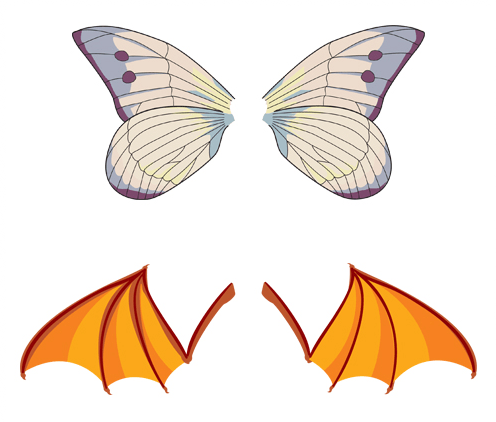
What is this an example of?

a)

Homologous structure

b)

Analogous structure

c)

Vestigial organs

d)

Functional adaption

84.

Which process of evolution is demonstrated below?

a)

Comparative anatomy

b)

Homologous structures

c)

Comparative embryology

d)

Vestigial structures

85.

Genome maps provide the DNA sequences of chromosomes. Some scientists have compared the genome maps of a hedgehog and a sloth. What do these genome maps allow the scientists to determine?

a)

The color patterns of the offspring of each species

b)

How much the size ranges of the two species differ

c)

The methods of protein synthesis that each species uses

d)

How closely related the two species are to each other.

86.

Scientists find the remains of an animal that has been extinct for a long time. What type of evidence is this?

a)

DNA analysis

b)

Comparative anatomy

c)

Fossil record

d)

Analogous anatomy

87.

Scientists tested a bat, a dog, a snake, and a human to see how their amino acids differed in a specific protein. This is a form of ...

a)

Evidence from molecular biology

b)

Analogous structure

c)

Fossil record evidence

d)

Evidence from vestigial structures

88.

Which list contains examples of vestigial structures in humans?

a)

None of the lists contain examples of vestigial structures in humans.

b)

Appendix, wisdom teeth, Coccyx (tail bones)

c)

Appendix, stomach, large intestine

d)

Brain, neurons, spinal cord

89.

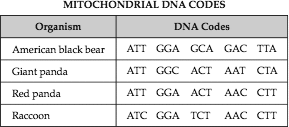
What conclusions can be made based on this table shown?

a)

the American black bear and the giant panda are most closely related

b)

the giant panda and the red panda are most closely related

c)

the red panda and the racoon are the most closely related

d)

the giant panda and the racoon are most closely related