wayground logo

Free Printable Worksheets

Font size

S
M
L
XL
Worksheets

ENHANCEMENT PHYSICS MIDTERM EXAMINATION 2022

Total questions: 80

Worksheet time: 2hrs 30mins
Name
Class
Date
1.
A car travels 90 meters due north in 15 seconds. Then the car turns around and travels 40 meters due south.  What is the magnitude and direction  of the car's resultant displacement?  
a)
40 metres, South
b)
50 metres, South
c)
50 metres, North
d)
40 metres, North 
2.
Which statement describes a vector?
a)
It has magnitude but no direction
b)
It has direction but no magnitude
c)
It has both direction and magnitude
d)
It has constant magnitude but no
 direction
3.
If a boomerang is thrown 20 m in a straight line and returns exactly to the spot it was thrown what is its displacement?
a)
20m
b)
40m
c)
0m
d)
-20m
4.
If a car moves 12 km North, 19 km East, and 12 km South, what is its displacement?
a)
12 km
b)
19 km, East
c)
31 km
d)
43 km, East
5.
Which of these is not a vector quantity? 
a)
displacement 
b)
time
c)
velocity 
d)
acceleration
6.
Which of the following quantities are vectors?
a)
speed, velocity, acceleration
b)
velocity, acceleration, force
c)
force, acceleration, mass
d)
length, mass, time
7.
What is the net force?
100 N        230 N
<------        --------->
a)
30 N to the right
b)
230 N to the right
c)
130 N to the right
d)
This is a balanced force
8.

Billy runs 400 meters to Andy's house, turns around, and runs 400 meters back home. What is Billy's distance?

a)

0 meters

b)

400 meters

c)

800 meters

d)

1600 meters

9.

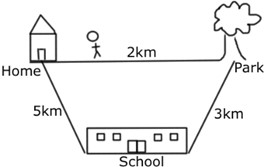
Jerry walked from home to school, then from the school to the park. What is his total displacement?

a)

2 km

b)

5 km

c)

8 km

d)

10 km

10.
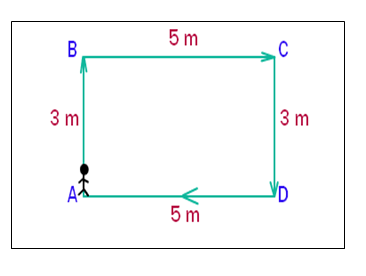
Sara walks from Point A to Point B. Which is true?
a)
Distance and displacement are EQUAL
b)
Distance is less than displacement
11.

The standard (SI) unit for measuring distance is the ________ .

a)

mile

b)

foot

c)

kilometer

d)

meter

12.
Liza is swimming laps from one end of a 50 meter pool to the other. Going from one end to the other is considered one lap. If she swims four complete laps, which statement is TRUE?
a)
Her distance and displacement are both zero.
b)
Her distance is zero, but her displacement is 200 meters.
c)
Her distance is 200 meters, but her displacement is zero.
d)
Her distance and displacement are both 200 meters.
13.

Two people walk across a parking lot. Their paths are shown in the image. Who traveled with a larger displacement?

a)

Person A

b)

Person B

c)

They both had the same displacement.

14.

In the diagram, which letter represents the vertical displacement dy\overrightarrow{d}_y  ?

a)

A

b)

B

c)

C

d)

D

15.

In the diagram, which letter represents the horizontal displacement dx\overrightarrow{d}_x ?

a)

A

b)

B

c)

C

d)

D

16.

A ball rolls off a table top and strikes the floor as shown. Given the measurements made, the time the projectile spent in the air is ---.

a)

17 s

b)

0.34 s

c)

0.58 s

d)

0.49 s

17.

At what point is vy= 0 m/s?

a)

A

b)

B

c)

C

d)

D

e)

None of these points

18.

At what point is vx= 0 m/s?

a)

A

b)

B

c)

C

d)

D

e)

None of these points

19.

In the absence of air resistance, the angle at which a thrown ball will go the farthest is?

a)

90°

b)

30°

c)

60°

d)

45°

20.

A package is dropped from an airplane, where will the package hit the ground?

a)

A

b)

B

c)

C

21.
What is a PUSH or PULL of an object?
a)
Motion
b)
Force
c)
Friction
d)
Gravity
22.
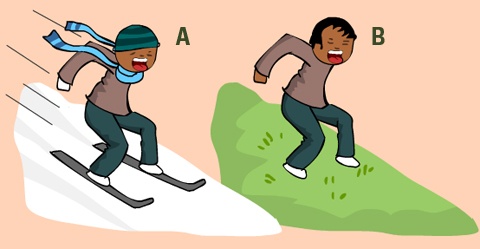
Why is it harder for the boy in Image B to get down the hill?
a)
Motion
b)
Friction
c)
Work
d)
Displacement
23.
It takes more force to accelerate the iron man on the left than the iron man on the right because the iron man on the left has more mass. This best describes
a)
Newton's first law, the law of inertia
b)
Newton's second law, the law of acceleration
c)
Newton's third law, the law of action reaction 
d)
The law of universal gravitation
24.
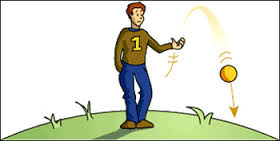
The formula 
? = mass x acceleration
or 
? = m x a 
is used to find 
a)
Force
b)
Velocity
c)
Momentum
d)
Gravity
25.
What is the attractive force that exists between all objects that have mass?
a)
Weight
b)
Mass 
c)
Gravity
d)
Viscosity
26.
If an object is stationary (not moving) the forces acting upon it are _____________
a)
unbalanced
b)
weak
c)
balanced
d)
Hulk Smash!
27.

What is the net force?

a)
10 N
b)
0 N
c)
25 N
d)
1 N
28.

Which is NOT an example of work?

a)

pushing a shopping trolley through the shop

b)

lifting a box from the table and putting it on the shelf

c)

throwing a ball

d)

holding a box in your arms

29.

If Mayram lifts a box with a weight of 10N over a distance of 10 m, how much work is she doing on the box?

a)

1 J

b)

10 J

c)

100 J

d)

100 N

30.

Which of the following is gravitational potential energy?

a)

the energy stored in an object that is 10m above the ground

b)

the energy of an electron moving through a wire

c)

the energy stored in the bonds of a carbohydrate molecule

d)

the energy stored in an uranium atom

31.

Two people shove on a wall with 100 N. The wall doesn’t move. How much work is done?

a)

100J

b)

100N

c)

0J

d)

0N

32.
Calculate work: A 100 Newton force is applied to move a 15 kg object a distance of 5 meters?
a)
20 Joules
b)
75 Joules
c)
500 Joules
d)
1500 J
33.

What is transferred from place to place by waves?

a)

matter

b)

energy

c)

particles

d)

light

34.

What does the arrow in the picture represent?

a)

amplitude

b)

wavelength

c)

frequency

d)

trough

35.

If the amplitude increases, the energy of the wave:

a)

increases

b)

decreases

c)

stays the same

36.

Waves that require a medium to travel are:

a)

mechanical waves

b)

transverse waves

c)

electromagnetic waves

d)

light waves

37.

What happens when you increase the amplitude of a sound?

a)

it makes the sound louder

b)

it makes the sound travel faster

c)

it makes the sound softer

d)

it changes the pitch or note of the sound

38.

What kind of wave is pictured below?

a)

compressional wave

b)

transverse wave

c)

longitudinal wave

d)

mechanical wave

39.

Which wave is pictured?

a)

Transverse

b)

Longitudinal

c)

Electromagnetic

d)

Light

40.

Which wave in the diagram has the greatest frequency?

a)

1

b)

2

c)

3

d)

4

41.

Which wave in the diagram has the longest wavelength?

a)

1

b)

2

c)

3

d)

4

42.

Which of the following can a mechanical wave travel through (select all that apply)?

a)

solid

b)

liquid

c)

gas

d)

empty space

43.

If a wave has a greater frequency, what happens to the wavelength?

a)

increases

b)

decreases

c)

stays the same

44.

The momentum of an object depends upon the object's ___________&_____________.

a)

size and shape

b)

mass and speed

c)

mass and veloctiy

d)

mass and energy

45.
The impulse-momentum theorem states that
a)
the impulse on an object is equal to the change in momentum it causes 
b)
the force on a moving object is equal to the magnitude of the impulse.
c)
the impulse on an object is greater than the change in momentum it causes 
d)
the impulse on an object is less than the change in momentum it causes
46.
A runner has a momentum of 670 kg m/s and is travelling at a velocity of 9 m/s. What is his mass?
a)
6030 kg
b)
0.0134 kg
c)
74.4 kg
d)
80 kg
47.

A boy kicks a football with a force of 20 N, the time the force acts for is 0.3 s.

Calculate the impulse on the ball.

a)

1 N·s

b)

6 N·s

c)

66 N·s

d)

None of these

48.
The difference between a car hitting a wall vs. a car hitting a hay stack is
a)
the Impulse on the car hitting the wall is greater
b)
the change in momentum of the car hitting the wall is greater
c)
the force on the car hitting the hay stack is greater
d)
the collision time of the car hitting the hay stack is greater
49.

When the speed of an object is doubled, its momentum...

a)

remains unchanged in accord with the conservation of momentum.

b)

doubles.

c)

quadruples.

d)

decreases.

50.
If two objects have the same mass, then the faster moving object has ____________ momentum.
a)
more 
b)
less
c)
the same
51.
Which takes more force  to catch, a bowling ball or a ping pong ball?
a)
bowling ball because it has more momentum
b)
ping pong ball because it has more momentum
c)
both require the same amount of force when catching
d)
bowling ball because it has less momentum
52.

Which has more momentum?

a)

A hummingbird zipping down the street (v = 1 m/s)

b)

A bus stopped at a stop sign

c)

A bus barreling down the road (v = 10 m/s)

d)

A hummingbird hovering at a feeder

53.

A bicycle has a momentum of 24 kg•m/s. What momentum would the bicycle have if it had the same mass and was moving with one-half the speed?

a)

twice the momentum; 48 kg*m/s

b)

1/2 the momentum; 12 kg*m/s

c)

4x the momentum; 96 kg*m/s

d)

1/4 the momentum; 6 kg*m/s

54.
What states that "every object in the universe attracts every other object"?
a)
Law of Universal Gravitation
b)
Newton's First Law of Motion
c)
My mother
d)
Inertia & gravity
55.
Two factors effecting the magnitude of the force of gravity between 2 objects are...
a)
mass and distance 
b)
mass and matter
c)
distance and weight 
d)
weight and mass
56.
Force of gravity is directly proportional to
a)
Mass
b)
Weight
c)
Distance
d)
Time
57.
The law of universal gravitation is credited to whom?
a)
Einstein
b)
Galileo
c)
Darwin
d)
Newton
58.

Calculate the gravitational force between two objects when they are 0.750m apart. Each object has a mass of 5.00kg.

a)

2.96x10⁻⁹N

b)

3.00x10⁻⁶N

c)

2.22x10⁻⁹N

d)

2.23x10⁻⁸N

59.

How is the gravitational force between to objects related to their mass

a)

They are directly proportional

b)

They are inversely proportional

c)

They do not affect each other

d)

They are equal

60.

Which of the following formulas is the correct equation for the law of Universal gravitation?

a)

F=GM1M2d2F=\frac{GM_1M_2}{d^2}

b)

F=mgF=mg

c)

F=Gd2m1m2F=\frac{Gd^2}{m_1m_2}

d)

F= F=KQ1Q2d2F=\frac{KQ_1Q_2}{d^2}

61.

Find the distance between two objects whose masses are m1 = 4,500 kg, and m2 = 8,700 kg; if the gravitational force between them is F = 2.0 x 10⁻⁸ N.

a)

130565.25 m

b)

361.34 m

c)

0.19575 m

d)

0.783 m

62.
Does a bridge anchored resting on two pillars have any torque?
a)
No, it isn't moving
b)
Yes, but it is at equilibrium
c)
Yes, but it will soon break because of the torque
d)
No, Bridges can't have torque
63.
The moment of inertia:
a)
is synonymous with mass
b)
does not depend on where the mass is located
c)
resistance to a change in rotational inertia
d)
more resistance to change = less inertia
64.
When an object is experiencing a net torque
a)
it is in dynamic equilibrium.
b)
it is in static equilibrium.
c)
it is rotating.
d)
it is translating.
65.
The figure shows scale drawings of four objects, each of the same mass and uniform thickness, with the mass distributed uniformly. Which one has the greatest moment of inertia when rotated about an axis perpendicular to the plane of the drawing at point P?
a)
A
b)
B
c)
C
d)
D
66.
A solid sphere, solid cylinder, and a hollow pipe all have equal masses and radii. If the three of them are released simultaneously at the top of an inclined plane and do not slip, which one will reach the bottom first?
a)
cylinder
b)
pipe
c)
sphere
d)
They all reach the bottom at the same time.
67.

if the same torque is applied on a hoop (I=MR2) and a solid disk (I=1/2MR2), after 5s which object will be moving faster?

a)

Hoop

b)

Solid Disk

68.
Suppose you are designing an engineless car for a downhill coasting race.  What type of wheels would be the best?
a)
Solid disks.
b)
Hoops.
c)
Hollow cylinders.
d)
Diamond encrusted triangles.
69.
Stars originate as large bodies of slowly rotating gas.  Because of gravity, these clumps of gas slowly decrease in size.  What happens to the angular speed of the start as it shrinks?
a)
It rotates faster.
b)
It rotates slower.
c)
It starts to accelerate in the forward direction.
d)
The rotation rate stays the same.
70.
As global warming occurs over the next century, the polar ice caps will start to melt ant the water will be distributed closer to the equator.  How will this change the Earth's moment of inertia?
a)
It would increase.
b)
It would decrease.
c)
It would stay the same.
71.
A merry-go-round spins freely when Diego moves quickly to the center along a radius of the merry-go-round. As he does this, it is true to say that
a)
the moment of inertia of the system increases and the angular speed increases.
b)
the moment of inertia of the system decreases and the angular speed remains the same.
c)
the moment of inertia of the system decreases and the angular speed decreases.
d)
the moment of inertia of the system decreases and the angular speed increases.
72.
Which has more momentum: a car stopped at a red light or a bike moving at 15 mph?
a)
car
b)
bike
c)
they are equal
d)
cannot determine using the info provided
73.
Which type of force(s) will cause a change in an object's motion?
a)
gravity
b)
zero net force
c)
balanced forces
d)
unbalanced forces
74.
A person is pushed forward into their seat belt when a car stops.  Which law is this?
a)
1st
b)
 2nd
c)

2nd & 3rd

d)
3rd 
75.
If a force of 50 Newton's was applied to an object with a mass of 500 grams, what will the object's acceleration be?
a)
10 m/s^2
b)
.1 m/s^2
c)
100 m/s^2
d)
1 m/s^2
76.

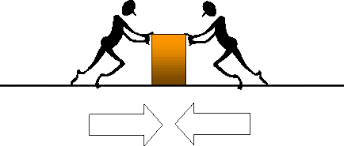
Looking at the image. Decide if this is balanced or unbalanced.

a)

Unbalanced

b)

Balanced

77.
What law of motion does this picture represent?
a)
Newtons 1st law
b)
Newtons 4th law 
c)
Newtons 3rd law 
d)
Newtons 2nd law
78.

What happens when two objects, such as a baseball and a bat, collide?

a)

They hit each other with the same force in the same direction.

b)

They hit each other with the same force in opposite directions.

c)

One remains still while the other one moves in the same direction.

d)

They hit each other with unequal force in opposite directions.

79.
According to Newton's second law, if you increase the force applied to an object :
a)
it accelerates more
b)
it doesn't move
c)
you get more inertia
d)
it decelerates
80.

If an object has a small mass, it wouldn't need as strong of a force to accelerate it. Which law does this describe?

a)

Newton's 1st Law

b)

Newton's 2nd Law

c)

Newton's 3rd Law

d)

Newton's 4th Law