
 Worksheets
Neurology
Total questions: 79
Worksheet time: 27mins

The cells in the brain that send and receive signals are called:
Glial cells
Neutrons
Neurons
Protons

This system consists of the brain and spinal cord.
PNS
ALS
CNS
NEU

These carry sensory information from PNS receptors to the CNS.
Efferent Nerves
Voluntary Nerves
Afferent Nerves
Involuntary Nerves
This carries sensory information from PNS receptors to the CNS.
Efferent Nerves
Voluntary Nerves
Afferent Nerves
Involuntary Nerves

Voluntary actions of the skeleton and muscles are controlled by this part of the nervous system.
Somatic Nervous System
Autonomic Nervous System

This division has a stimulating effect known as the "fight or flight" response.
Parasympathetic Division
Efferent Division
Afferent Division
Sympathetic Division

Motor neurons perform the following function:
Enable sensory processes
Enable communication between neurons
Enable movement
Enable communication

These cells form the myelin sheath around peripheral axons and allow for repair and regeneration.
Microglia
Satellite Cells
Schwann Cells
Dendrites

Contains genetic material, including information for cell development and protein synthesis.
Schwann Cells
Nucleus
Endoplasmic Reticulum
Axon Body

These are called "chemical messengers".
Neuroleptic Cells
Glial Cells
Neurotransmitters
Synaptic Gap

Abnormal, involuntary movements are called:
Dyskinesia
Ataxia
Dystonia
Axial Errors

Loss of coordination and muscle movement is called:
Dyskinesia
Ataxia
Myoclonic movements
Dystonia

What are the protective membranes that cover the entire central nervous system called?
Diencephalons
Forebrains
Viscera
Meninges

What is the major center for controlling respiration, cardiac activity, and vasomotor activity?
Medulla Oblongata
Diencephalon
Forebrain
Hypothalamus

Which of the following is not a symptom of stroke?
Facial Drooping
Slurred or Garbled Speech
Pallor
Confusion and Agitation

This is a temporary interruption of the blood supply to the brain.
Stroke
Aneurysm
Transient Ischemic Attacks
ALS

This disease is also called Lou Gehrig's disease and is characterized by the progressive degeneration of nerve cells that control motor movement.
Arteriovenous Malformations (AVM)
Multiple Sclerosis (MS)
Amyotrophic Lateral Sclerosis (ALS)

This part of the nervous system has a relaxing effect on the body and allows the body to calm down.
Sympathetic Division
Efferent Division
Autonomic Division
Parasympathetic Division
Which of the following is not a division of the nervous system?
Central Nervous System
Peripheral Nervous System
Ventral Nervous System
Which division of the nervous system includes the sympathetic and parasympathetic branches?
Somatic Nervous System
Autonomic Nervous System
Neurotransmitters are essential for:
The speed of our nervous system
Forming the blood-brain barrier
Keeping our nerve tracts in line
Carrying a nerve impulse across a synapse
Acetylcholine and dopamine are examples of:
Endorphins
Androgens
Neurotransmitters
Nerve Cells
Which nerve cell forms the blood-brain barrier?
Astrocyte
Ependymal cell
Glial cell
Oligodendrocyte
Which type of cell produces cerebrospinal fluid?
Ependymal cells
Astrocytes
Glial cells
Microglial cells
Which part of the brain is responsible for balance and coordination and is called the "mini brain"?
Thalamus
Cerebellum
Hypothalamus
Hippocampus
Which of the following membranes surrounds and protects the brain and spinal cord?
Meninges
Pericardial membranes
Pleural membranes
Peritoneal membranes
A brain disorder marked by gradual and progressive mental deterioration, personality changes, and impaired function.
Multiple Sclerosis
Alzheimer's
Cerebral Palsy
Meningitis
Which part of the brain acts as a relay station for information entering the brain?
Thalamus
Hypothalamus
Hypocretins
Orexins
Loss of memory is called:
Amnesia
Delusion
Hallucination
Autism
Which type of fluid is produced in the ventricles?
Aqueous Humor
Vitreous Humor
Peritoneal Fluid
Cerebrospinal Fluid
The connective tissues that protect the brain and spinal cord are called __________.
vertebrae
cranium
meninges
spinal nerves
The diencephalon is composed primarily of __________.
the cerebellum, brain stem, and cerebrum
the brain stem, hippocampus, and amygdala
the thalamus, hypothalamus, and pituitary gland
the midbrain, pons, and cerebrum
Part of the brainstem, it serves as a pathway for nerve impulses and also helps regulate the rate and depth of breathing.
midbrain
pons
medulla oblongata
hippocampus
Automatic reflex centers for heart rate, blood pressure, breathing, swallowing, and vomiting are located in which part of the brain?
Medulla Oblongata
Pons
Hypothalamus
Thalamus
What is the cerebrum? (This question has multiple correct answers.)
Largest part of the brain
Contains a left and right hemisphere
Has 4 lobes
Covered by the cerebral cortex
What are the grooves in the brain called?
Gyri
Sulci
Lobes
Fissures

Which letter represents the parietal lobe?
A
B
C
E

Which letter represents the temporal lobe?
B
C
D
F
The three layers of the meninges, from superficial to deep, are:
dura mater, arachnoid mater, pia mater
pia mater, arachnoid mater, dura mater
arachnoid mater, pia mater, dura mater
dura mater, pia mater, arachnoid mater
Sally has a brain injury; she knows what she wants to say but cannot vocalize the words. The part of her brain that deals with the ability to say words properly is the ________.
medulla
amygdala
central sulcus
Broca's area
This part helps control your emotions (associated with the limbic system) and has important autonomic functions, including cardiovascular, temperature, appetite, and gastrointestinal control.
thalamus
hemisphere
hypothalamus
cerebrum
Involved in emotional responses, such as recognizing facial expressions of fear.
amygdala
basal ganglia
brainstem
medulla oblongata
Cerebrospinal fluid is produced in the ventricles by a structure called the ________.
Cerebral aqueduct
Venous sinus
Arachnoid villus
Choroid plexus
Which structure separates the left and right hemispheres of the cerebrum?
Transverse cerebral fissure
Central sulcus
Longitudinal fissure
Pre-central gyrus
Which structure separates the frontal and parietal lobes of the cerebrum?
Transverse cerebral fissure
Central sulcus
Longitudinal fissure
Precentral gyrus
The "fight or flight" response during threatening situations is the role of the:
sympathetic nervous system
parasympathetic system
somatic nervous system
cerebellum
The part of the nervous system that consists of nerves branching out from the CNS (central nervous system) and connecting to other parts of the body.
Sympathetic
Parasympathetic
Autonomic
Peripheral
_____ neurons carry messages to the central nervous system.
Motor
Inter
Sensory
Fun
_____ neurons carry messages away from the central nervous system.
Motor
Inter
Sensory
Flower
The _____ part of the autonomic nervous system is active during resting.
sympathetic
parasympathetic
somatic
peripheral
Controls automatic functions such as breathing, heart rate, body temperature, wake and sleep cycles, etc.
cerebrum
cerebellum
basal ganglia
brainstem
Where does the message transfer from one neuron to another?
myelin sheath
Central nervous system
Synapse
Somatic Nervous Axon
Myelinated fibers (tracts) form ________ matter, while unmyelinated fibers form ________ matter.
sensory, motor
gray, white
motor, sensory
white, gray
What is NOT a part of the peripheral nervous system (PNS)?
axons
sensory receptors
spinal cord
motor neurons
Lack of salivation
sympathetic
parasympathetic
Which tissue is not innervated by the autonomic nervous system?
Glands
Skeletal Muscle
Cardiac Muscle
Smooth Muscle
The end of the spinal cord where nerves descend
coccygeal
cauda equina
lumbosacral
femoral
Part of the peripheral nervous system that controls conscious activities
autonomic
somatic
sympathetic
parasympathetic
There are 12 pairs of ____ nerves.
coccygeal
brachial
sacral
thoracic
There are 5 pairs of ___ nerves.
lumbar
cranial
coccygeal
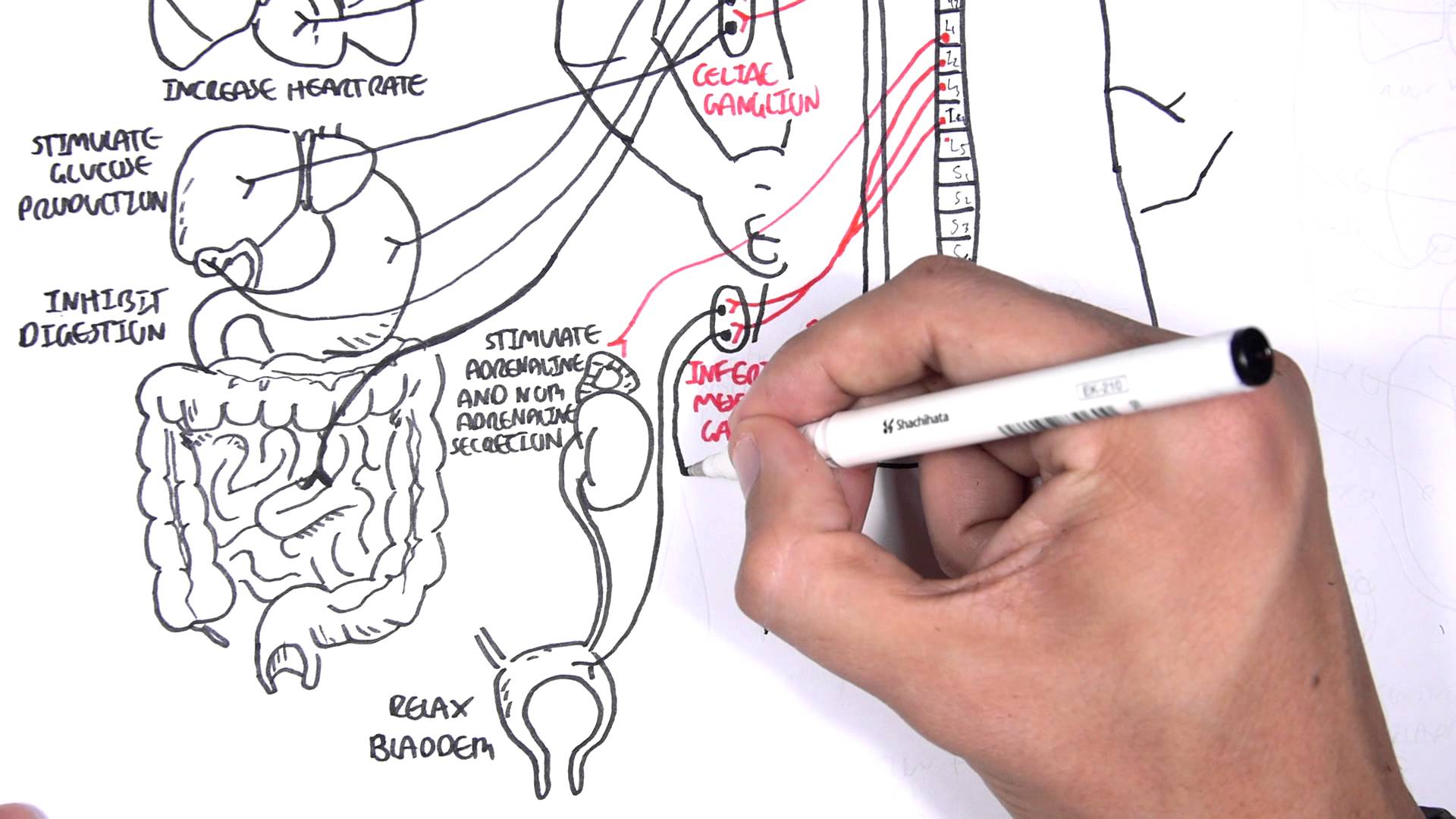
During sympathetic stimulation, digestive secretion is inhibited so that energy can be conserved for survival during a danger reaction.
True
False
is able to specifically target individual effectors
Sympathetic
Parasympathetic
Creates a "mass alert" to cause changes throughout the body simultaneously.
Sympathetic
Parasympathetic
Regulates daily homeostasis and maintenance
Sympathetic
Parasympathetic
Responds to stress and/or danger
Sympathetic
Parasympathetic
Which division of the autonomic nervous system is primarily responsible for 'rest and digest' activities?
Somatic
Parasympathetic
Cerebral
Sympathetic
Which part of the neuron receives incoming signals from other neurons?
Axon
Dendrite
Myelin sheath
Node of Ranvier
Which glial cells are responsible for forming the myelin sheath in the central nervous system?
Oligodendrocytes
Microglia
Astrocytes
Schwann cells
Which part of the neuron receives incoming signals from other neurons?
Cell body
Dendrite
Myelin sheath
Axon
Which division of the nervous system controls voluntary muscle movements?
Parasympathetic Nervous System
Autonomic Nervous System
Somatic Nervous System
Sympathetic Nervous System
Which neurotransmitter is most commonly associated with mood regulation?
Glutamate
Dopamine
Acetylcholine
Serotonin

