wayground logo

Free Printable Worksheets

NEW

Font size

S
M
L
XL
Worksheets

Chemical Bonds

Total questions: 54

Worksheet time: 41mins

Name
Class
Date
1.

Which of the following describes covalent bonds?

a)

Bonds form because of opposite charges

b)

electrons are shared to fill outer electron shells

c)

Electrons are transferred between atoms

d)

Covalent bonds are magical

2.

How many electrons should Nitrogen have around its Lewis (electron) dot model?

a)

1

b)

3

c)

4

d)

5

3.

For metals (groups 1-3), its easier to _____ electrons to have a full outer shell.

a)

gain

b)

lose

c)

share

4.

For nonmetals (groups 15-17), its easier to _____ electrons to have a full outer shell.

a)

gain

b)

lose

c)

share

5.
Ionic bonds form between metals and ____.
a)
metalloids
b)
metals
c)
nonmetals
6.
An ionic bond is the attraction between:
a)
oppositely charged ions
b)
similarly charged ions
c)
neutral ions
d)
neutral atoms
7.
What elements generally make a covalent bond?
a)
metal and nonmetal
b)
2 or more nonmetals
c)
metal
d)
none of the above
8.

The octet rules states that most elements want to have _____ valence electrons.

a)

2

b)

4

c)

6

d)

8

9.
Electronegativity is...
a)
how good an atom is at attracting electrons
b)
the ability of an atom to lose electrons
c)
the energy required to remove an electron from a specific atom
d)
how easy it is to make friends. 
10.

Which type of bond has an unequal sharing of electrons between two atoms?

a)

nonpolar covalent

b)

polar covalent

c)

ionic

d)

mettalic

11.
What is the basis of a metallic bond?
a)
the attraction of neutral metal atoms.
b)
the attraction between protons and neutrons.
c)
the attraction between positive metal ions and interlocking electrons.
d)
the attraction between positive metal ions and free floating electrons.
12.

Why do elements bond?

a)

To be friends

b)

To create a new element

c)

To become stable

d)

To get bigger

13.
What is a valence electron?
a)
The sum of neutrons and protons.
b)
The # of electrons in the last shell.
c)
A type of bond.
d)
A popular compound.
14.

Which of these is not a real bond in chemistry?

a)

James

b)

Ionic

c)

Covalent

d)

Metallic

15.
Ionic bonds are between...
a)
nonmetals and nonmetals
b)
carbon and oxygen
c)
metals and nonmentals
d)
hydrogen and chlorine
16.
Covalent bonds are between...
a)
two or more nonmetals
b)
sodium and chlorine
c)
metals and metals
d)
metals and nonmetals
17.
What is the name for an ion with a positive charge?
a)
cation
b)
anion
c)
onion
d)
union
18.
What is the name for an ion with a negative charge?
a)
cation
b)
anion
c)
onion
d)
union
19.
What kind of bond forms when atoms exchange electrons?
a)
ionic
b)
covalent
c)
artificial
d)
univalent
20.
If an atom loses two electrons what charge will it have?
a)
-2
b)
-1
c)
+1
d)
+2
21.
If an atom gains two electrons what charge will it have?
a)
-2
b)
-1
c)
+1
d)
+2
22.

Which of the following describes covalent bonds?

a)

Bonds form because of opposite charges

b)

electrons are shared to fill outer electron shells

c)

Electrons are transferred between atoms

d)

Covalent bonds are magical

23.
Predict the bond that will form between Be and F.
a)
Ionic
b)
Covalent
24.
Predict the bond that will form between Se and Cl.
a)
Ionic
b)
Covalent
25.
Predict the bond that will form between Sr and S.
a)
Ionic
b)
Covalent
26.

Which of the following atoms is most likely to bond with another atom?

a)
b)
c)
d)
27.

How many valence electrons does Oxygen (O) have?

a)

6

b)

8

c)

15

d)

16

28.
What kind of bond forms when atoms share electrons?
a)
ionic
b)
covalent
c)
artificial
d)
univalent
29.
What kind of bond forms when atoms exchange electrons?
a)
ionic
b)
covalent
c)
artificial
d)
univalent
30.
If an atom has 7 protons and 7 electrons what charge will it have?
a)
-2
b)
-1
c)
0
d)
+2
31.
An electron has what kind of charge?
a)
positive
b)
negative
c)
neutral
d)
none of these
32.
Some elements combine chemically and no longer have the same ________________ they did before forming a compound.
a)
valence electons
b)
energy
c)
properties
d)
group number
33.
A _________________ is composed of symbols and subscripts indicating the number of atoms of an element in a compound.
a)
Chemical Equation
b)
Chemical Reaction
c)
Synthesis Reaction
d)
Chemical Notation
34.

Atoms lose, gain, or ______ electrons to get a stable outer energy level.

a)
share
b)
split
c)
create
d)
destroy
35.
A ____________is the force that holds atoms together in a compound.
a)
Chemical Formula
b)
Chemical Reaction
c)
Chemical Bond
d)
Synthesis Reaction
36.
A _______ is a charged particle because it has more or fewer electrons than protons.  When an atom _____ an electron, it becomes a positively charged ion.  When an atom ____an electron, it becomes a negatively charged ion.
a)
isotope, gains, loses
b)
isotope, loses, gains
c)
ion, loses, gains
d)
ion, gains, loses
37.
The sum of the charges on the ions in a unit of the compound is ___________. 
a)
positive
b)
negative
c)
zero
d)
±1
38.
__________are neutral particles formed as  result of sharing electrons.
a)
Protons
b)
Electrons
c)
Molecules
d)
Ions
39.
Atoms can form double or triple ______depending on whether they share two or three pairs of electrons.
a)
Molecules
b)
Bonds
c)
Compounds
d)
Elements
40.
Electrons shared in a molecule are held ________to the atoms with the larger nucleus.
a)
more closely
b)
relative
c)
adjacent
d)
next
41.

If an atom gains an electron, what charge will it have?

a)

positive

b)

negative

c)

neutral

42.

How many total electrons can the 2nd shell or energy level hold?

a)

1

b)

2

c)

8

d)

18

43.

What happens to the valence electrons of an atom that uses an ionic bond?

a)

transfers electrons

b)

shares electrons

c)

nothing

44.

Which of the following is an ion?

a)

Na

b)

C

c)

O

d)

Na+1

45.

On the periodic table, carbon is in group 14, period 2. How many valence electrons does carbon have?

a)

6

b)

14

c)

2

d)

4

46.

A pure substance that contains 2 or more elements that are chemically bonded.

a)

an atom

b)

an ionic bond

c)

organic

d)

a compound

47.

What happens to electrons in an ionic bond?

a)

they are shared equally between atoms

b)

both atoms in the bond lose electrons

c)

both atoms in the bond gain electrons

d)

one atom gains electrons and the other atom loses electrons

48.

Dot diagrams represent ____.

a)

outer shell electrons

b)

protons

c)

neutrons

d)

all electrons

49.

What group will rarely form compounds because they are stable atoms?

a)

18

b)

1

c)

2

d)

17

50.

What is the octet rule?

a)

it states atoms need to be happy

b)

it states atoms need 8 valence electrons to be stable

c)

it states atoms need 6 valence electrons to be stable

d)

it states atoms need to share electrons to be stable

51.

Which element only needs 2 valence electrons to be stable?

a)

Oxygen

b)

Nitrogen

c)

Hydrogen

d)

Neon

52.
What do we call a covalent bond where electrons are shared UNEVENLY or UNEQUALLY?
a)
Ionic
b)
Polar Covalent
c)
Nonpolar Covalent
d)
Van der Waals Force
53.
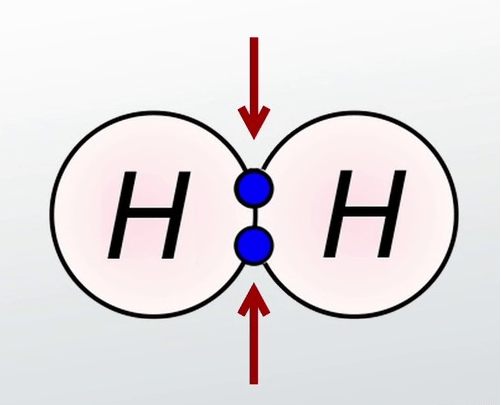
What type of bond is shown in this image?
a)
Ionic
b)
Polar Covalent
c)
Nonpolar Covalent
d)
Van der Waals Force
54.
Diatomic elements are defined as IDENTICAL elements that bond with each other (i.e. Oxygen with Oxygen).  What type of bond should they form?
a)
Ionic
b)
Polar Covalent
c)
Nonpolar Covalent
d)
Van der Waals force