
Font size
 Worksheets
Final Review Part 1
Total questions: 66
Worksheet time: 2hrs 16mins
Kinematic equation can only be used when you have a constant ....
Position
Velocity
Acceleration
Time
A car starts from rest and accelerates uniformly over a time of 5.21 seconds for a distance of 110 m. Determine the acceleration of the car. Choose the appropriate equation.
v=vo+at
d=vot+1/2at2
v2=vo2+2ad
d=1/2(v+vo)t
If Michael Jordan has a vertical leap of 1.29 m, then what is his takeoff speed if his acceleration is -9.8 m/s2 and his velocity at the top of his leap i 0 m/s?
v=vo+at
d=vot+1/2at2
v2=vo2+2ad
d=1/2(v+vo)t
An engineer is designing the runway for an airport. Of the planes that will use the airport, the lowest acceleration rate is likely to be 3 m/s2. The takeoff speed for this plane will be 65 m/s. All airplanes will start from rest. Assuming this minimum acceleration, what is the minimum allowed length for the runway?
v=vo+at
d=vot+1/2at2
v2=vo2+2ad
d=1/2(v+vo)t
A boat travels 12.0 m while it reduces its velocity from 9.5 m/s to 5.5 m/s. What is the magnitude of the boat’s acceleration while it travels the 12.0 m?
1.3 m/s2
2.5 m/s2
3.0 m/s2
7.5 m/s2
How long would it take a car, starting from rest and accelerating uniformly in a straight line at 5 m/s2, to cover a distance of 200 m?
9.0s
10.5s
12.0s
15.5s
direction
The initial horizontal velocity of a projectile is ____ its final horizontal velocity.
less than
equal to
greater than
What is true about the vertical velocity of a projectile launched horizontally?
It is initially at its maximum value.
It increases due to gravity as it falls.
It remains constant throughout its trajectory.
It decreases as it falls due to gravity.


What is the direction of the acceleration for any projectile?
The direction the projectile is traveling.
Down
Up
Sideways

A ball is thrown and follows the parabolic path shown above. Air friction is negligible. Point Q is the highest point on the path. Points P and R are the same height above the ground. How do the speeds of the ball at the three points compare?
vP < vQ < vR
vR < vQ < vP
vQ < vR < vP
vQ < vR = vP
vP = vQ < vR
A ball is thrown and follows the parabolic path shown above. Air friction is negligible. Point Q is the highest point on the path. Points P and R are the same height above the ground. Which of the following diagrams best shows the direction of the acceleration of the ball at point P?


The force that keeps objects on top of surfaces instead of letting them sink into the surface is known as:
normal
abnormal
static
inertia
The force exerted by ropes and chains is called
tension
normal
elastic
mechanical
In a force diagram, or free-body diagram, the size/length of the arrow tells you this about the force:
relative strength
relative distance
relative direction
In a force diagram, or free-body diagram, the pointy-end of the arrow tells you this about the force:
relative strength
relative distance
relative direction
When determining the NET force on an object you should (TWO correct answers)
subtract forces in opposite directions
add forces in the same direction
divide by velocity
multiply by acceleration
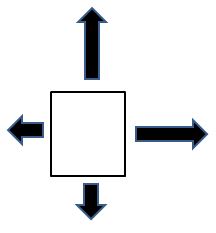
The down-arrow in this diagram is most-likely:
gravity
normal
a push or pull
friction
Which diagram best shows person pushing a couch (accelerating) across the floor?


A downward-moving skydiver is falling with constant speed.
What is the direction of the GRAVITIY force?


There's no gravity force
A downward-moving skydiver is falling with constant speed.
What is the direction of the NORMAL force?


There's no normal force
A small elevator is secured to a motor by a cable and is moving upward. Ignore air resistance.
What is the force pulling upward?
Friction force
Normal force
Applied force
Tension force
Gravity force

Which of the following is the best expression for the Normal Force?
FN = mg cos(ϴ)
FN = mg sin(ϴ)
FN = mg sin(180-ϴ)
FN = mg cos(90-ϴ)
A man weighing 800 Newtons is standing in an elevator. If the elevator rises with an acceleration of 0.5 meters per second2, the force exerted by the elevator on the man will be
400 N
800 N
1200 N
1000 N
A car travels up a hill at constant speed. Which of the following diagrams best represents the forces acting on the car at this instant?


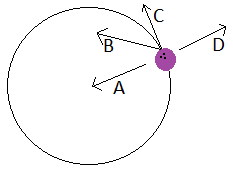
Which of the following depict the tangential velocity of the ball?
A
B
C
D

A toy car is following a circular path with a constant speed of v=3 m/s . If the radius of the circular path is 1 m, find The centripetal acceleration of the car
30 m/s2
3 m/s2
9 m/s2
6 m/s2
45 J of work were done on the object that moved 5 meters. How much force was applied to the object?
8 N
225 N
9 N
0 N
A 10.0 kg box is accelerated from 2.0 m/s to 4.0 m/s. What is the amount of work needed to accelerate the box?
50 J
60 J
20 J
45 J
Calculate the force necessary to move a 1000 kg car from rest to 25 m/s in 130 m.
19 N
25,0000 N
2400 N
3.3 x 10⁶ N
What are the units for Work?
Newtons
Kilograms
Joules
Moles
What is the equation for Kinetic Energy (KE)?
KE = 2mv2
KE = 2mv
KE = mv2
Work can also be shown as
W = ΔKEHow do you find ΔKE ?
KEi − KEf
KEf − KEi
KE + KPOP = BbyMtl
42?
A 80.0-kg fireman slides down a 3.00-m pole by applying a frictional force of 400. N against the pole with his hands. If he slides from rest, how fast is he moving once he reaches the ground?
2.1 m/s
4.2 m/s
5.5 m/s
8.0 m/s
Gravitational potential energy depends on which two factors?
mass and height above the ground
distance and speed
speed and height above the ground
mass and speed

You throw a ball into the air as shown in the diagram. At what point does the ball have the most potential energy?
W
X
Y
Z
A stretched rubber band represents what type of potential energy?
gravitational potential energy
elastic potential energy
chemical potential energy
kinetic potential energy
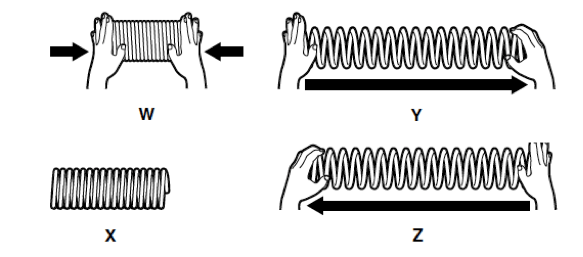
SELECT ALL POSTITIONS where the spring has STORED ELASTIC ENERGY
W
Y
X
Z

Elastic Potential Energy is _____________________________________.
the ability of a material to return to its original shape after it has been stretched or deformed.
potential energy that is stored due to the deformation of an elastic object, such as a stretched spring.
energy stored in the bonds of chemical compounds. Chemical energy is released during chemical reactions.
the energy contained within a system that is responsible for its temperature.
the flow of thermal energy.
What unit is used for the Potential Energy of a spring?
Newton
meter
Joule
m/s^2

What equation is used to calculate elastic potential energy?
Ep = m g h
Ep = 1/2 k x2
Ep = F / E d
What equation is used to calculate the elastic force used in changing the objects length?
F = mg
F = k x
F = EQ
F = PA

The spring constant of an object tells you?
What type of spring you are dealing with
How long the spring will stretch or compress
It gives you a value on how easy or hard it is to change the objects length.
A spring constant gives you a number which tells you what material the spring is made of.

Calculate the force that changes the spring length by 0.25m, when the spring's spring constant is 350Nm-1.
1400 N
14000 N
7.14 x 10⁻⁴ N
87.5 N
A force of 157 N acts on a spring with a spring constant of 350 Nm-1. Calculate the length the spring changed.
540 m
45 m
54950 m
0.45 m
A force 480 N of that changes the spring length by 0.25 m, calculate the spring constant.
120 N
1920 N
2000 N
20 N

Pick all of the scenarios below that are collisions.
A catcher catches a baseball.
A pitcher throws a baseball.
Two cars smash into each other.
Two students on roller skates push away from each other.
A bug smashes into a windshield.
Pick all of the scenarios that are explosions.
A cannon fires a cannon ball.
A spoon is shoved into a jar of peanut butter.
A linebacker tackles a member of the opposite team.
A swimmer jumps off a floating raft.
A figure skater throws a heavy ball.
Thrust is an excellent example of this law.
Every object persists in its state of rest or uniform motion in a straight line unless it is compelled to change that state by forces impressed on it.
For every action, there is an equal and opposite reaction.
Force is equal to the change in momentum (mV) per change in time.

