
 Worksheets
AP Bio Unit 9 Evolution and Natural Selection Review
Total questions: 50
Worksheet time: 57mins

______________ was a naturalist who presented natural selection as a driving force behind evolution.
Gregor Mendel
Louis Pasteur
Charles Darwin
Shah Rukh Khan
Which of the following conditions can influence the rate at which evolution takes place?
genetic drift
nonrandom mating
migration
All of the above
Gene flow describes the ________.
movement of genes from one generation to the next
movement of genes from one population to another
exchange of genes during recombination
movement of genes within a population because of interbreeding
Selection that splits a population into two groups
directional selection
disruptive selection
polygenic selection
stabilizing selection

Speciation can occur as a result of geographic isolation because _________.
members of a species can no longer find mates
populations that live in different environments may be exposed to different selection pressures
exchange of genes during recombination
movement of genes within a population because of interbreeding
The hypothesis that evolution occurs at a slow, constant rate is known as ______.
gradualism
slow motion
natural selection
adaptation
Speciation that occurs over relatively short periods of time, followed by long periods of little or no change ___.
directional evolution
directional equilibrium
punctuated equilibrium
punctuated evolution

_______________ occurs when a population declines to a very small number then goes back up but results in a permanent loss of genetic diversity in the population (example: the Cheetah population)
coevolution
bottleneck
archaeopteryz
mutation

The reduced functionless hind leg bones in some whale species and the wings of the flightless bird called the Kiwi are
both an example of _____________________.
vestigial structure
bottleneck
allopatric speciation
genetic drift

What type of structures are shown?
Homologous
Analogous
Vestigial
Heterologous

What type of structures are shown?
Homologous
Analogous
Vestigial
Heterologous


List the 4 closest human relatives based on this biochemical comparison.

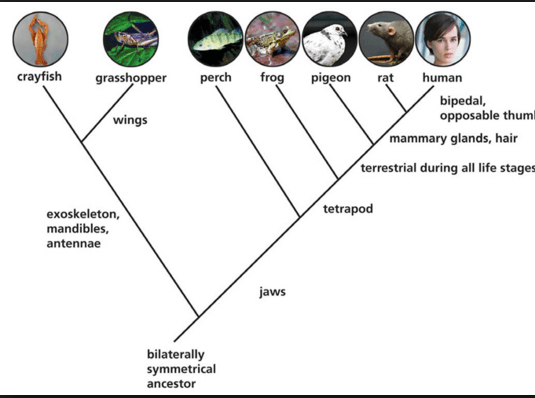


What number is the common ancestor of C and D
1
2
3
4
Which is true about allopatric and/or sympatric speciation?
In allopatric speciation, members of the population live in the same land
In sympatric speciation, members of the population live in the same land
Speciation takes longer in allopatric situations
There are very few examples of sympatric speciation
All of these are pre-zygotic barriers EXCEPT
Behavioral
Temporal
Mechanical
Hybrid Breakdown
Gametic
One species of flower blooms in the spring, the other blooms in the fall. They can not interbreed because of
Behavioral isolation
Temporal isolation
Mechanical isolation
Habitat isolation
Gametic isolation


Structures as different as human arms, bat wings, and dolphin flippers contain many of the same bones, these bones having developed from very similar embryonic tissues. How do biologists interpret these similarities?
By identifying the bones as being analogous
By the principle of convergent evolution
By proposing that humans, bats, and dolphins share a common ancestor
By looking at where the animals live
All of the following are part of Hardy Weinberg law for populations in equilibirum EXCEPT
Large population
No immigration or emigration
No natural selection
Non random mating
No genetic mutations
The allele frequency of p=.20 What is the percentage of recessive genotype?
.80
.04
.32
.64
If 98 out of 200 individuals in a population express the recessive phenotype, what percent of the population would you predict to be heterozygous?
70%
30%
42%
49%
In a population of humans, the frequency of no dimples is 0.36. If having no dimples is the recessive phenotype, what is the frequency of the recessive allele?
0.6
0.36
0.64
0.18
The large-scale events of speciation are called...
macroevolution
simplification
adaptation
microevolution
During microevolution, a(n) __________________ will become more or less common within a population.
species
allele
ribosome
fossil
Which of the following is required for a population to diverge into two separate species?
The two populations must have evolved different physical appearances.
The two populations must have mutated at least 10 times.
The two populations must have become reproductively isolated.
The two populations must have evolved analogous structures.
Which statement about natural selection is most correct?
Adaptations beneficial in one habitat should generally be beneficial in all other habitats as well.
Different species that occupy the same habitat will adapt to that habitat by undergoing the same genetic changes.
Adaptations beneficial at one time should generally be beneficial during all other times as well.
Well-adapted individuals leave more offspring, and thus contribute more to the next generationʹs gene pool, than do poorly adapted individuals.
During drought years on the Galapagos, small, easily eaten seeds become rare, leaving mostly large, hard-cased seeds that only birds with large beaks can eat. If a drought persists for several years, what should one expect to result from natural selection?
Small birds gaining larger beaks by exercising their mouth parts.
Small birds mutating their beak genes with the result that later-generation offspring have larger beaks.
Small birds anticipating the long drought and eating more to gain weight and, consequently, growing larger beaks.
More small-beaked birds dying than larger-beaked birds. The offspring produced in subsequent generations have a higher percentage of birds with large beaks.
Northern elephant seals were hunted by humans in the 1890s, reducing their population size to 20 individuals. Even though their population is now over 30,000, the seals still have reduced genetic variation. What’s the best explanation of this phenomenon?
Bottleneck effect
Founder effect
Hererozygote advantage
Relatice fitness
Identify the type of postzygotic barrier that each example represents:
A male donkey and a female horse can mate to produce a mule, but mules are sterile
Reduced hybrid fertility
Reduced hybrid viability
Hybrid breakdown
Natural selection is based on all of the following except
genetic variation exists within populations.
the best-adapted individuals tend to leave the most offspring.
individuals who survive longer tend to leave more offspring than those who die young.
populations tend to produce more individuals than the environment can support.
individuals adapt to their environments and, thereby, evolve.
What is the difference between allopatric and sympatric speciation?
Sympatric - populations are geographically separated ; Allopatric - populations live together but are reproductively isolated
Allopatric - populations are geographically separated ; Sympatric - populations live together but are reproductively isolated

The dolphin and the shark are similar because they have
Both adapted to a marine (ocean) environment and they both have a similar body shape but they do not share a recent common ancestor. This is known as ___________.
coevolution
ancestral breeding
artificial selection
convergent evolution

