wayground logo

Free Printable Worksheets

Font size

S
M
L
XL
Worksheets

2025 Spring Semester Exam Quizizz Review Set Part II

Total questions: 150

Worksheet time: 3hrs 8mins

Name
Class
Date
1.

IMF's in Water

a)

London Dispersion Forces

b)

Dipole-Dipole

c)

Hydrogen "Bonding"

d)

Ion-Dipole

2.

IMF's for Carbon Tetrachloride

a)

London Dispersion Forces

b)

Dipole-Dipole

c)

Hydrogen "Bonding"

d)

Ion-Dipole

3.

IMF's for Sulfur Dioxide

a)

London Dispersion Forces

b)

Dipole-Dipole

c)

Hydrogen "Bonding"

d)

Ion-Dipole

4.

IMF's for Phosphorus Trichloride

a)

London Dispersion Forces

b)

Dipole-Dipole

c)

Hydrogen "Bonding"

d)

Ion-Dipole

5.

which Intermolecular forces have the weakest electrostatic force?

a)

Ion - Dipole

b)

Dipole - Dipole

c)

Hydrogen Bond

d)

Dispersion Forces

6.

NaCl dissolved in water will exhibit what type of IMF?

a)

Dipole - Dipole

b)

Ion - Dipole

c)

Dispersion Forces

d)

Hydrogen Bond

7.

is the attractive forces between molecules

a)

Intramolecular forces

b)

Ionic

c)

Intermolecular forces

d)

Covalent

8.

Which among the following noble gases has the highest boiling point

a)

Rn

b)

He

c)

Ne

d)

Ar

9.
Which of the following has the highest boiling point?
a)
H2
b)
NH3
c)
N2
d)
O2
10.
Which of the following has the lowest boiling point?
a)
CaCl2
b)
PH3
c)
Cl2
d)
N2
11.
Intermolecular force present in HCl?
a)
dipole dipole
b)
dispersion
c)
H-bond
d)
ionic
12.
Which of these typically increases when IMF's increase?
a)
boiling point
b)
melting point
c)
viscosity
d)
all of these 
13.
Which of these is the strongest?
a)
hydrogen bonding
b)
dipole-dipole forces
c)
London dispersion forces
d)
ionic bonding
14.
What is point B?
a)
triple point
b)
critical point
c)
equilibrium point
d)
normal melting point
15.
What is point A?
a)
triple point
b)
critical point
c)
equilibrium point
d)
normal melting point
16.
What change occurs from C to D?
a)
condensation
b)
vaporization
c)
melting
d)
sublimation
17.
What change occurs from E to C?
a)
sublimation
b)
freezing
c)
melting
d)
boiling
18.
What state of matter is Y?
a)
solid 
b)
liquid
c)
gas
d)
supercritical fluid
19.
Phase change from a gas to a liquid.
a)
condensation
b)
evaporation
c)
melting
d)
deposition
20.
Phase change from a solid to a gas.
a)
sublimation
b)
deposition
c)
condensation
d)
evaporation
21.

Temperature is a measure of the average _____________ energy of the particles of a substance.

a)

potential

b)

kinetic

c)

gravitational

d)

heat

22.
The slower molecules move, 
a)
the higher the temperature
b)
the less temperature
c)
the same temperature
d)
I don't know
23.

Convert: 253 °C to K:

a)

526 K

b)

625 K

c)

0 K

d)

186 K

24.

Convert: 0 K to °C

a)

-273 °C

b)

-273 K

c)

273 °C

d)

273 K

25.

________________________ have the strongest intermolecular forces of attraction.

a)

Dipole- Dipole

b)

Dispersion

c)

Hydrogen Bonds

26.

Intermolecular forces for: CO2

a)

Dispersion Force

b)

Dipole dipole

c)

Hydrogen bonding

27.
Which of the following factors plays an important role in the identification of specific intermolecular forces in a molecule?
a)
bond type
b)
density
c)
solubility
d)
molecular polarity
28.
Intermolecular forces are the forces
a)
within molecules
b)
between molecules
29.
Which of the following has the lowest boiling point?
a)
CaCl2
b)
PH3
c)
Cl2
d)
N2
30.
What explains the very high melting and boiling point of water
a)
Strong dipole-dipole bonds between water molecules
b)
Strong hydrogen bonds between water molecules
c)
Dispersion forces which are present in all molecules
d)
Asymmetrical shape of the polar bonds.
31.
Hydrogen bonding occurs when hydrogen is bonded to N, O, or F.  Which of the following has hydrogen bonding?
a)
CBr4
b)
NO2
c)
H2S
d)
NH3
32.

The weaker the intermolecular forces of a substance the _____________ the boiling point

a)

higher

b)

lower

33.

Which substance has the weakest intermolecular forces?

a)

Substance A, boiling point of 75 °C

b)

Substance B, boiling point of 105 °C

c)

Substance C, boiling point of 25 °C

d)

Substance d, boiling point of 45 °C

34.
Rank these in order of strength:
covalent bond
London forces
hydrogen bond
dipole-dipole attraction
a)
dipole-dipole>covalent bond>hydrogen bond>London
b)
London>dipole-diple>hydrogen bond>covalent bond
c)
covalent bond>hydrogen bond>dipole-dipole>London
d)
hydrogen bond>dipole-dipole>London>covalent bond
35.

Which of the following will NOT have hydrogen bonding?

a)
b)
c)
d)
36.

BH3 molecules can form...

a)

London dispersion forces

b)

Dipole-dipole forces

c)

Hydrogen bonds

37.

HF molecules can form...

a)

London dispersion forces

b)

Dipole-dipole forces

c)

Hydrogen bonds

38.

760 mmHg is equal to

a)

1 torr

b)

760 atm

c)

760 torr

d)

101 Pa

39.

A gas is at a pressure of 95 kPa. What is its pressure in atmospheres?

a)

1.5 atm

b)

1.09 atm

c)

0.94 atm

d)

0.82 atm

40.

What does STP (standard temperature and pressure) stand for?

a)

0.0 degree Celcius and 1 atm

b)

1.0 mmHg and 273 degree Kelvin

c)

1.0 degree Celcius and 0 atm

d)

1.0 atm 273 degree Celcius

41.
What does Boyle's law relate to?
a)
Temperature and Volume
b)
Volume and Pressure
c)
Temperature and Pressure
42.
When the temperature of matter increases the particles...
a)
speed up and move closer
b)
speed up and move farther apart
c)
slow down and move closer together
d)
slow down and move farther apart
43.
How do gas molecules move? 
a)
in an orderly fashion 
b)
constantly and randomly
c)
in straight line paths
d)
in a circular motion
44.
In Charles' Law the pressure remains constant.
a)
True
b)
False
45.
What type of relationship is Charles' Law?
a)
Inverse
b)
Direct
c)
Not enough information
d)
#goals
46.
What is the formula for Boyle's Law?
a)
P1V1=P2V2
b)
P1V1/P2V2
c)
P1V2=P2V1
d)
P1/V1=P2/V2
47.
When Volume increases then Pressure must...
a)
Increase
b)
Decrease
48.
What type of relationship to pressure and volume have?
a)
direct
b)
inverse
c)
no relationship
d)
I don't know
49.
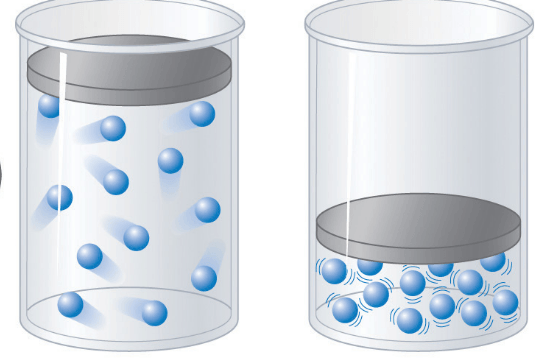
Which container will have a lower pressure?
a)
left
b)
right
c)
they both have the same pressure
d)
I don't know
50.
The relationship of which two variables are compared in Boyle's Law?
a)
pressure & volume
b)
volume & temperature
c)
temperature & pressure
d)
volume & moles (amount of gas)
51.
Boyle's law : When _______ is held constant, the pressure and volume of a gas are ________  proportional
a)
temperature,  equally
b)
mass, inversely
c)
temperature, inversely
d)
mass, equally
52.
What is the formula Charles' Law?
a)
V = T
b)
VT = VT
c)
T1 / V1 = T2 / V2
d)
V1 / T1 = V2 / T2
53.
Which law?
a)
Charles 
b)
Boyle
c)
Hooke
d)
Peter Pan 
54.
Which law?
a)
Charles 
b)
Boyle
c)
Hunsecker
d)
Newton
55.

Which law?

a)

Boyle

b)

Charles

c)

Landis

d)

Boykin

56.

Which law?

a)

Govea

b)

Doyle

c)

Boyle

d)

Charles

57.

If I have 5.6 liters of gas in a piston at a pressure of 1.5 atm and compress the gas until its volume is 4.8 L, what will the new pressure inside the piston be?

a)

1.8 atm

b)

3.27 atm

c)

1.8 L

d)

3.27 atm

58.

I’ve got a car with an internal volume of 12,000 L. If I drive my car into the river and it implodes, what will be the volume of the gas when the pressure goes from 1.0 atm to 1.4 atm?

a)

8571.43 L

b)

3210.26 L

c)

8669.0 atm

d)

3905.33 atm

59.
Gases have...
a)
A definite shape and volume
b)
A definite shape but no definite volume
c)
No definite shape but a definite volume
d)
No definite shape or volume
60.
PV=nRT
a)
Charles Law
b)
Boyle's Law
c)
Combined Gas Law
d)
Ideal Gas Law
61.
Which law helps us find the moles of gas in a sample?
a)
Charles Law
b)
Boyle's Law
c)
Combined Gas Law
d)
Ideal Gas Law
62.
Calculate the volume that a 0.323-mol sample of a gas will occupy at 265 K and a pressure of 0.900 atm.
a)
7.18 L 
b)
7.81 L
c)
4.63 L
d)
4.36 L
63.
Determine the Kelvin temperature required for 0.0470 mol of gas to fill a balloon to 1.20 L under .998 atm pressure. 
a)
0 K 
b)
107 K 
c)
207 K 
d)
307 K 
64.

What does R stand for

a)

Ideal gas constant

b)

Real gas constant

c)

Temperature constant

d)

Ideal gas law

65.
What pressure, in atm, is exerted by 2.50 L of gas containing 1.35 mol at 320 K?
PV=nRT
a)
14.19 atm
b)
16.53 atm
c)
18.42 atm
d)
22.54 atm
66.
What volume of hydrogen will be produced at STP by the reaction 67.3 g of magnesium with excfess water according to the following reaction?
1Mg + 2H2O --> Mg(OH)2 + H2
a)
62L
b)
65L
c)
31L
d)
124L
67.
How do I move from grams to moles
a)
multiply by molar mass
b)
divide by molar mass
c)
multiply by Avo number
d)
divided by Avo number
68.
How do I change from moles to liters?
a)
divide by 22.4
b)
multiple by Avo number
c)
multiply by 22.4
d)
multiply by molar mass
69.
Mg3N2(s) + 3H2O(l) ––> 3 MgO + 2NH3(g)
If 10.3 g of magnesium nitride is used, what volume of ammonia gas would be collected at 20˚C and 0.989 atm?
a)
27.1 L H2
b)
4.96 L H2
c)
0.204 L H2
d)
10.3 L H2
70.
What does it mean to be "Soluble" ?
a)
Capable of being a solid.
b)
To have soul.
c)
Capable of being dissolved.
d)
To sink.
71.
What is the unit for molarity?
a)
mass/liters
b)
moles
c)
liters
d)
moles/liter
72.
A measure of the amount of solute in a given amount of solvent or solution is...
a)
saturated
b)
solubility
c)
concentration
d)
miscible
73.
A saturated solution is one that....
a)
contains the maximum amount of dissolved solute.
b)
contains less solute than a saturated solution.
c)
contains more solute than a saturated solution.
d)
is the amount of a substance required to form a saturated solution.
74.
A supersaturated solution is one that....
a)
contains the maximum amount of dissolved solute.
b)
contains less solute than a saturated solution.
c)
contains more solute than a saturated solution.
d)
is the amount of a substance required to form a saturated solution.
75.
An unsaturated solution is one that....
a)
contains the maximum amount of dissolved solute.
b)
contains less solute than a saturated solution.
c)
contains more solute than a saturated solution.
d)
is the amount of a substance required to form a saturated solution.
76.
An electrolyte is...
a)
The rapid, random movement of particles in colloidal dispersion.
b)
A substance that dissolves in water and conducts electric current.
c)
A substance that dissolves in water and does not conduct electric current.
d)
The solution process when water is the solvent.
77.
A nonelectrolyte is...
a)
The rapid, random movement of particles in colloidal dispersion.
b)
A substance that dissolves in water and conducts electric current.
c)
A substance that dissolves in water and does not conduct electric current.
d)
The solution process when water is the solvent.
78.
The dissolving medium in a solution is called ... 
a)
colloid
b)
solution
c)
solute
d)
solvent
79.
The substance dissolved in a solution is called ... 
a)
colloid
b)
solution
c)
solute
d)
solvent
80.
What is the molarity of a 2 liter solution containing 5 moles of NaCl?
a)
2.5
b)
0.4
c)
2.5 moles/liter
d)
10 moles/liter
81.
How many moles of NaCl are present in 6000. ml a 1.5 M NaCl solution?
a)
9 moles NaCl
b)
9000
c)
9
d)
4000  moles NaCl
82.
Solutions are composed of __________ .
a)
salts and solutes
b)
solvents and salts
c)
solutes and alloys
d)
solutes and solvents
83.

Identify the solute Lemonade - it contains Water, lemon juice, and sugar

a)

water

b)

lemon juice

c)

sugar and lemon juice

84.

If we heat a sample of water, then the amount of oxygen dissolved will increase

a)

true

b)

false

85.

If I want more sugar to dissolve in water, I should heat the water

a)

true

b)

false

86.

If I want more sugar to dissolve in water, I should stir the water

a)

true

b)

false

87.

How can a scientist safely tell whether an unknown solution is salt in water or sugar in water?

a)

taste the solution

b)

smell the solution

c)

test the electrical conductivity of the solution

d)

filter the solution

88.
What is it about the water molecule that makes it a great solvent?
a)
water demonstrates polarity; a partial charge on each side of the molecule
b)
due to its molecular formula
c)
it has a liner molecular shape
d)
due to it's non-polar molecular structure
89.
Which solute is the most soluble at 10 ⁰C?
a)
KI
b)
KClO3
c)
NH4Cl
d)
NH3
90.
Which solute is the least soluble at 90 ⁰C?
a)
SO2
b)
KClO3
c)
KI
d)
HCl
91.
Which solute does not increase in solubility as temperature rises?
a)
NH3
b)
NaNO3
c)
KNO3
d)
NaCl
92.
How many grams of SOcan dissolve at 50 ⁰C?
a)
5 g
b)
10 g
c)
20 g
d)
39 g
93.
How many more grams of KNOdissolve at 50 ⁰C compared to 0 ⁰C?
a)
85 g
b)
15 g
c)
70 g
d)
100 g
94.
What is the minimum temperature needed to dissolve at least 10 g of KClO3?
a)
25 ⁰C
b)
10 ⁰C
c)
5 ⁰C
d)
100 ⁰C
95.
Which of the following substances increase solubility at the slowest rate with increasing temperature?
a)
SO2
b)
NaCl
c)
KCl
d)
KNO3
96.
Using your solubility graph, identify which compound is LEAST affected by temperature change.
a)
NH3
b)
Ce2(SO4)3
c)
NaCl
d)
KClO3
97.
Which compounds show a decrease in solubility as temperature increases?
a)
NaCl, NH4Cl
b)
NaNO3, NH3
c)
NH3, KCl,
d)
NH3, Ce2(SO4)3
98.
The amount of solute that can be dissolved in a specific volume of solvent at a specific temperature.
a)
Solution
b)

Solubility

c)
Solvent
99.
When 50 grams of KCl is dissolved in 100 grams of water at 50 ºC, the solution can be correctly described as:
a)
supersaturated
b)
unsaturated
c)
saturated
100.
Describe a solute.
a)
part of solution present in largest amount
b)
the substance that gets dissolved
c)
the substance that does the dissolving
d)
surrounds and breaks apart
101.
Which of the following usually makes a substance dissolve faster in a solvent?
a)
agitating the solution
b)
increasing the particle size of the solute
c)
lowering the temperature
d)
decreasing the number of particles
102.

Which solution is more concentrated?

Solution 1:

500 mL of water

100 g of salt


Solution 2:

500 mL of water

90 g of salt

a)

Solution 1

b)

Solution 2

c)

They have the same concentration

d)

I have no idea

103.

In order to dilute a solution, you need to

a)

add more of the solid

b)

add more water

c)

find the mass

d)

find the volume

104.

Calculate the mass percent of solution, if there is 100 g of sugar and 400 g of water

a)

30

b)

25

c)

20

d)

15

105.
How many liters would you need to make a 1 M solution if you have 6 mol of Sodium Hydroxide? 
a)
2
b)
3
c)
4
d)
106.
What is the molarity of 4 g of NaCl (MM=58.45) in 3,800 mL of solution?
a)
0.018 M
b)
0.0011 M
c)
1.052 M
d)
0.062 M
107.

As we dilute a solution.....

a)

The volume increases and the molarity (M) increases

b)

The volume increases and the molarity (M) decreases

c)

The volume decreases and the molarity (M) increases

d)

The volume decreases and the molarity (M) decreases

108.

How many mL of stock solution of 2M NaCl do you need to prepare 100 mL of 0.150M NaCl?

a)

7.5 mL

b)

15 mL

c)

1333 mL

d)

200 mL

109.

Molarity is ...

a)

grams of solute/deciliters of solvent.

b)

grams of solute/liters of solution.

c)

moles of solute/liters of solution.

d)

moles of solute/milliliters of solvent.

110.
What is the molarity of a solution made by diluting 26.5 mL of 6.00M HNO3 to a volume of 250 mL?
a)
15.9 M
b)
0.636 M
c)
0.642 M
d)
1.59 M
111.

Do acids and bases conduct electricity?

a)

Only acids conduct electricity

b)

Only bases conduct electricity

c)

Bases and acids conduct electricity

d)

Neither conduct electricity

112.

Which of the following values would represent the pH of a strong base?

a)

1

b)

8

c)

7

d)

13

113.

Which of the following are the characteristics of a BASE?

a)

Very bitter in taste

b)

Liberate OH- ions when dissolved in water

c)

Have pH of less than 7

d)

Turns blue litmus red

114.

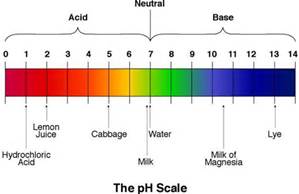
According to the pH range given in the image,which substance is more acidic than lemon juice?

a)

Hydrochloric acid

b)

Cabbage

c)

Milk

d)

Milk Of Magnesia

115.

Base change red litmus paper to blue.

a)

True

b)

False

116.

Character of acid is having sour taste.

a)

True

b)

False

117.

Acid change blue litmus paper to red.

a)

True

b)

False

118.

How do acids taste compared to bases?

a)

Acid is sweet and base is sour

b)

Acid is bitter and base is sour

c)

Acid is sour and base is bitter

119.

Which of the following statements is correct?

a)

Blue litmus paper turns red when placed in a base.

b)

Red litmus paper turns blue when placed in a base.

c)

Blue litmus paper stays blue when placed in an acid.

d)

Red litmus paper stays red when placed in a base.

120.

An increase in the amount of hydrogen ions in a solution ____ the pH.

a)

raises

b)

lowers

c)

does not affect

d)

doubles

121.

Human blood has a pH of between 7.38 and 7.42. This means that the blood is ________.

a)

very acidic

b)

slightly acidic

c)

very basic

d)

slightly basic

122.

An increase in the amount of hydroxide ions in a solution ____ the pH.

a)

raises

b)

lowers

c)

does not effect

d)

doubles

123.

Acids have a range of ________.

a)

0-6.9

b)

7.1-14

c)

0-14

124.
Neutralization reactions
a)
formed from joining positive and negative ions 
b)
increases OH ions
c)
froms a salt and water
d)
increases H2O ions
125.

What range of values on the pH scale represent solutions with a higher ratio of hydroxide (OH-) ions?

a)

below 7

b)

7

c)

above 7

d)

0-14

126.
Which of these solutions is an acid?
a)
Dish Soap: pH of 12
b)
Tomato Soup: pH of 4
c)
Baking Soda: pH of 9
d)
Drain Cleaner: pH of 14
127.
According to which theory is a base a substance which produces OH- ions in water?
a)
Arrhenius
b)
Bronsted-Lowry
c)
Lewis
128.
According to Bronsted-Lowry acid base theory, an acid is a.....
a)
Proton donor
b)
Proton acceptor
c)
Produces H+ when added to water
d)
Made of H+
129.
According to Arrhenius acid-base theory, an acid is....
a)
an H+ acceptor
b)
a H+ donor
c)
a substance that produces H+ in water
d)
anything with an H+
130.
According to which acid-base theory is a base a proton acceptor?
a)
Arrhenius
b)
Bronsted-Lowry
c)
Lewis
131.
Which reactant in the following equation is a Bronsted acid?
a)
ammonium
b)
ammonia
c)
hydroxide
d)
water
132.
Which reactant in the following equation is a Bronsted acid?
a)
Water
b)
Hydrogen chloride
c)
Hydronium
d)
Chloride
133.
What might happen if you mixed a strong acid with an equally strong base?
a)
You would see an explosive chemical reaction.
b)
The acid would destroy the base.
c)
The base would destroy the acid.
d)
You'd wind up with a pH-neutral substance.
134.
HSO4-(aq)+H2O(l)             H3O+(aq)+SO42-(aq)
Identify the Acid in the above reaction.
a)
HSO4-
b)
H2O
c)
H3O+
d)
SO42-
135.
CO32-(aq)+H2O(l)      →              HCO3-(aq)+OH-(aq)
Using the above reaction, which compound is the conjugate base?
a)
CO32-
b)
H2O
c)
HCO3-
d)
OH-
136.

Scale that ranges from 1- 14

a)

acid

b)

base

c)

salt

d)

pH

137.

The reaction of perchloric acid (HClO4) with lithium hydroxide (KOH) is described by the equation

HClO4 + KOH → KClO4 + H2O

Suppose 100 mL of perchloric acid is neutralized by exactly 50,0 mL of 1.0 M of Potassium hydroxide. What is the concentration of the perchloric acid?

a)

0.5M

b)

50M

c)

2.0M

d)

1.0M

138.
What is the conjugate base of HCO3-?
a)
HCO3-
b)
H2CO3-
c)
H2CO3
d)
CO32-
139.
What is the pH of a solution that has an [H3O+] =1x10⁻⁴?
a)
4
b)
-4
c)
2
d)
3
140.
The pH of a solution is 2.0.  What is the [OH-] concentration?
a)
1x10-12M
b)
12 M
c)
1x10⁻²M
d)
2 M
141.
The pH of a 0.001 M solution of HCl is 
a)
11
b)
3
c)
-3
d)
-11
142.
The pH scale measures...
a)
...the strength of an acid.
b)
...the strength of hydrogen ions.
c)
...the concentration of hydrogen ions.
d)
...the concentration of an acid
143.
Which is the stronger acid?
a)
pH 1
b)
pH 4
c)
pH 8
d)
pH 13
144.
A solution with a pH of 7 is________
a)
increasing
b)
neutral
c)
decreasing
d)
apple juice
145.
hydrobromic acid
a)
strong acid
b)
weak acid
c)
strong base
d)
weak base
146.
cesium hydroxide
a)
strong acid
b)
weak acid
c)
strong base
d)
weak base
147.
KOH
a)
strong acid
b)
weak acid
c)
strong base
d)
weak base
148.
perchloric acid
a)
strong acid
b)
weak acid
c)
strong base
d)
weak base
149.
hydrochloric acid
a)
strong acid
b)
weak acid
c)
strong base
d)
weak base
150.
H2CO3
a)
strong acid
b)
weak acid
c)
strong base
d)
weak base