wayground logo

Free Printable Worksheets

Font size

S
M
L
XL
Worksheets

Second Semester Biology Final Review 2021-22

Total questions: 80

Worksheet time: 1hrs 20mins
Name
Class
Date
1.
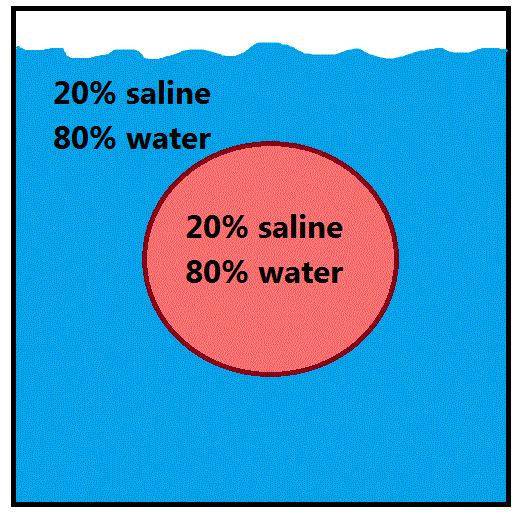
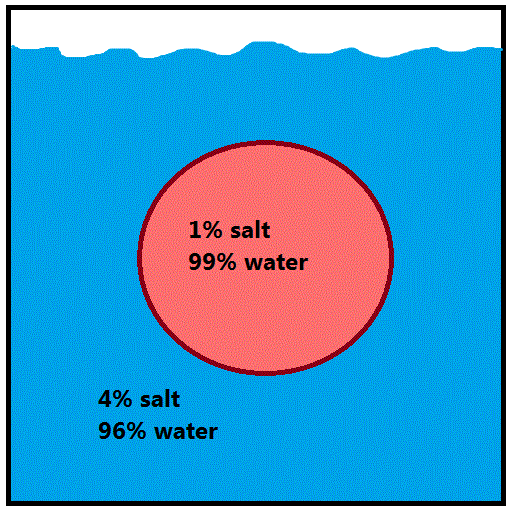
Where will the water go?
a)
Into the cell
b)
Out of the cell
c)
Equally in & out - it's isotonic
d)
There is no water
2.
What is the type of solute we mainly talked about in our examples?
a)
Salt
b)
Sugar
c)
Calcium
d)
Mercury
3.
A blood cell is placed into the jar, as seen. Where will the water go?
a)
Into the cell
b)
Out of the cell
c)
Equally in & out - it's isotonic
d)
The water is a lie
4.
Osmosis is the movement of _____ across a membrane.
a)
food
b)
energy
c)
oxygen
d)
water
5.
 If a cell containing 5% salt is placed into a glass of water with 20% salt, the water is _______ compared to the cell.
a)
hypertonic
b)
hypotonic
c)
isotonic
6.
 An animal cell placed in a hypertonic (salty) solution will
a)
Stay the same
b)
Shrink- get smaller
c)
Swell- get bigger
7.
During osmosis
a)
water moves from high to low concentration
b)
large or oddly shaped molecules move across a cell membrane
c)
water moves when energy is used
d)
proteins are built
8.
ISO means...
a)
Low
b)
A lot
c)
Equal
d)
Mammal
9.
Why can't you drink salt water?
a)
It's hypertonic to your cells
b)
It's hypotonic to your cells
c)
It's isotonic to your cells
d)
It's paratonic to your cells
10.
What is diffusion?
a)
when molecules move 
b)
when molecules move from a high concentration to a low.
c)
no movement 
d)
molecules move everywhere
11.
What is the definition of  Selective Permeability?
a)
The movement of materials across the cell membrane that requires NO ENERGY from the cell.
b)
The movement of materials through (or across) the cell membrane
c)
The ability of the cell membrane to allow some things to pass through while preventing other things from passing through.
d)
The movement of molecules from an area of high concentration to a area of low concentration 
12.
When both inside and outside of a cell have the same amount of water it is said that the cell has reached a state of
a)
Osmosis
b)
Diffusion
c)
Equilibrium
13.
T - tall and t = short
In the punnett square below, what belongs in the missing square
a)
tt
b)
Tt
c)
Bb
d)
TT
14.
What is the probability of heterozygous offspring?
a)
25%
b)
50%
c)
0%
d)
100%
15.
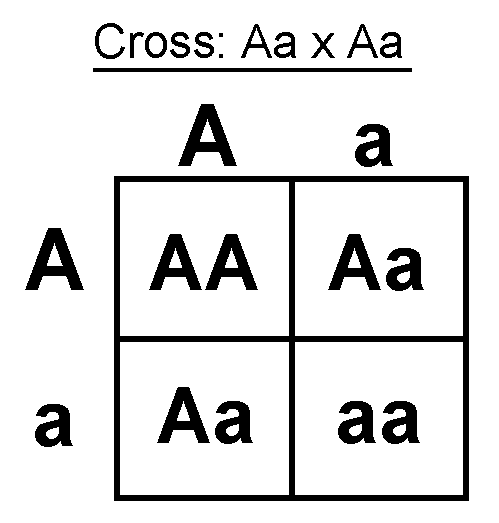
What allele combination should go in the missing box?
a)
AA
b)
Aa
c)
aa
d)
none of these
16.
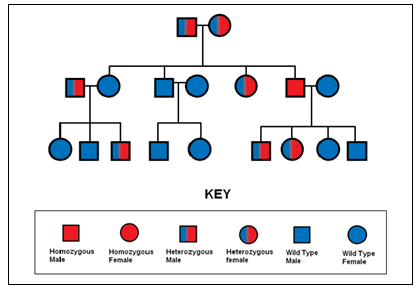
In a pedigree, what shape represents a male?
a)
circle
b)
square
c)
triangle
d)
diamond
17.
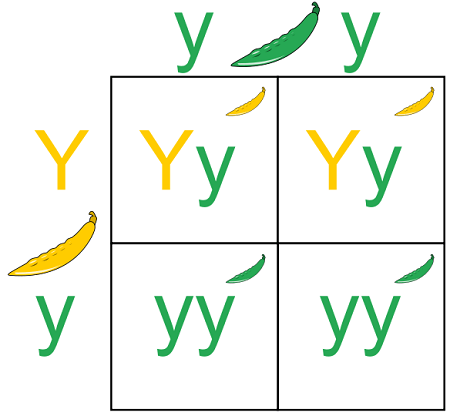
Which choice best represents the genotype of this cross?
a)
1 Yy: 2 yy: 0 YY
b)
2 Yy: 2 yy: 0 YY
c)
3 Yy: 1 yy: 0 YY
d)
1 Yy: 3 yy: 0 YY
18.
What is the phenotype of the offspring? (A-Brown hair; a-blond hair) 
a)
50 % Brown Hair and 50% Blond Hair 
b)
25 % Brown Hair and 75% Blond Hair 
c)
75 % Brown Hair and 25% Blond Hair 
d)
0% Brown Hair and 100% Blond Hair 
19.
Which of the following genotypes is homozygous dominant?
a)
A
b)
Aa
c)
AA
d)
aa
20.
Which of the following genotypes is heterozygous?
a)
Bb
b)
BB
c)
bb
d)
B
21.
Which of the following is homozygous recessive?
a)
Tt
b)
tt
c)
TT
d)
T
22.
How many generations are shown in this pedigree?
a)
1
b)
2
c)
3
d)
4
23.
How many kids did the mother and father from the first generation have?
a)
2
b)
4
c)
5
d)
6
24.
What does an open circle represent?
a)
Not Affected Male
b)
Not Affected Female
c)
Affected Male
d)
Affected Female
25.

Objective #13

On a pedigree how do we know if they have the trait?

a)

Not shaded

b)

Shaded

26.

Objective #13

This is a pedigree that follows blue eyes which is a recessive trait. What is the phenotype of the mother (circle) in generation 1?

a)

Brown

b)

Blue

c)

1 blue, 1 brown

27.

This is a recessive disease pedigree. What is the genotype of the female in generation II?

a)

Rr

b)

RR

c)

rr

d)

R?

28.

This is a recessive disease pedigree. What is the genotype of the male in generation I?

a)

Rr

b)

RR

c)

R?

d)

rr

29.

This is the recessive disease pedigree. What is the genotype of the oldest male in generation II? (oldest is on the left)

a)

Rr

b)

RR

c)

rr

d)

R?

30.

This pedigree shows affected people with the recessive trait. What is the genotype of individual I-2?

a)

AA

b)

Aa

c)

A?

d)

aa

31.

This pedigree shows affected people with the recessive trait. What is the genotype of individual IV-3?

a)

AA

b)

Aa

c)

A?

d)

aa

32.

Traveling away from the equator, what happens in general to the amount of UV intensity?

a)

The intensity decreases.

b)

The intensity increases

c)

The intensity stays the same.

d)

It is impossible to predict.

33.
What is melanin?
a)
A protein pigment that absorbs and reflects light
b)
A protein that is waterproof and tough
c)
A cell found in the epidermis
d)
A vitamin that helps you sleep
34.
What kind of cells create melanin?
a)
Keratinocyte
b)
Melanocyte
c)
Leukocyte
d)
Erythrocyte
35.
Different tones of human skin color evolved 
a)
in response to varying levels of UV radiation in the environment
b)
Randomly and for no reason at all
36.
If a person lives in an environment with low radiation what kind of skin color would be the best adapted
a)
Darker skin tones to increase production of Vitamin D Synthesis
b)
Darker skin tones to protect DNA and Folate
c)
Lighter Skin tones to increase production of Vitamin D
d)
Lighter Skin tones to protect DNA and Folate
37.

How does melanin protect cell's DNA from the damaging effects of Ultraviolet light?

a)

It relies on folate

b)

It doesn't you must use sunscreen

c)

it activates vitamin D3 production which takes care of that

d)

Forms a protective cap over the nucleus of skin cells

38.
What is the evolutionary benefit for dark skin near the equator?
a)
Skin cancer protection
b)
Folate Protection
c)
It has no evolutionary relationship
d)
Easier vitamin D production
39.
The graph in Figure 2 summarizes the age at which people are diagnosed with melanoma, the most serious form of skin cancer. When would you see the most likely chance of developing skin cancer?
a)
35-44
b)
45-54
c)
55-64
d)
65-74
40.
What is the evolutionary benefit of light skin in the northern latitude.
a)
Skin cancer protection
b)
Folate Protection
c)
It has no evolutionary relationship
d)
Easier vitamin D production
41.

Folate is:

a)

a B-Vitamin

b)

used to make DNA and other genetic material

c)

important for pregnancy

d)

all of the above

42.

In what process is mRNA synthesized?

a)

Transcription

b)

Translation

c)

DNA Replication

d)

Mitosis

43.

Where does TRANSCRIPTION occur?

a)

Nucleus

b)

Ribosome

c)

Cytoplasm

d)

Mitochondria

44.

TRANSCRIBE this DNA sequence: TACGTTACT

a)

AUGCAAUGA

b)

ATGCAATGA

c)

AUGGATUGA

d)

TACGTTACT

45.

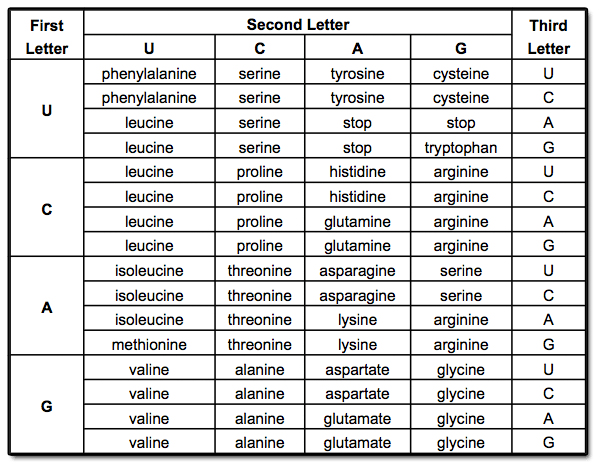
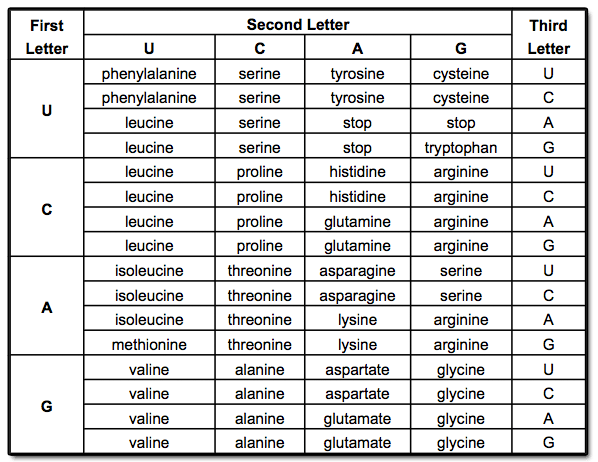
TRANSLATE this RNA sequence: AUGCAAUGA

a)

Met-Glu-Stop

b)

Met-His-Stop

c)

Thr-Glu-Stop

d)

Thr-Pro-Stop

46.
A sugar, a phosphate group, and a nitrogen base form the building blocks of which organic compound?
a)
carbohydrates
b)
nucleic acids
c)
lipids
d)
proteins
47.
Which of the following is the template for the production of RNA within a cell?
a)
DNA
b)
protein
c)
ATO
d)
carbohydrate
48.
The DNA sequence ATCAGCGCTGGC is part of a gene. how many amino acids are coded for by this message?
a)
4
b)
8
c)
12
d)
20
49.
Choose the nucleotide sequence of the RNA strand that would be complementary to the following strand: 
GTAGTCA
a)
UATUAGA
b)
ACGACTG
c)
CAUCAGU
d)
CATCAGT
50.
What amino acid is represented by the codon UUA?
a)
Phenylalanine
b)
Tyrosine
c)
Leucine
d)
Stop codon
51.
What are the backbones (sides) of the DNA structure made up of?
a)
repeating phosphates and sugars
b)
nitrogen bases
c)
nucleotides
d)
adenine and thymine
52.
Which is the mRNA molecule that would be transcribed from this DNA template:
TGGCAAGTACGT
a)
ACCGTTCATGCA
b)
UGGCAAGUACGU
c)
UCCGUUCUUGCU
d)
ACCGUUCAUGCA
53.
What is the correct amino acid sequence for the mRNA code AUGCCAGUAUGA
a)
Met-Pro-Ala-Val
b)
Met-Pro-Val
c)
Tyr-Gly-His
d)
Tyr-Gly-Arg-His
54.
Fruit fly body cells have 8 chromosomes. After mitosis, you would expect a resulting fruit fly daughter cell to have ...
a)
16 chromosomes.
b)
46 chromosomes.
c)
8 chromosomes.
d)
4 chromosomes.
55.
Name the phase:
a)
Prophase
b)
Metaphase
c)
Anaphase
d)
Telophase
56.

In human beings, mitosis is necessary for:

a)

growth and repair of tissues

b)

formation of the gametes, or sex cells

c)

reproduction of another individual

d)

reducing the number of chromosomes

57.

Interphase:

a)

occupies the majority of the cell cycle

b)

includes DNA replication

c)

includes growth of cell

d)

all are correct

58.

If a cell is undergoing mitosis and a microtubule is not bound to one side of the sister chromatid during metaphase, as shown in figure E, predict what would occur:

a)

One of the daughter cells would have one extra chromosome, the other daughter cell would be missing one chromosome.

b)

One of the daughter cells would have two extra chromosomes, the other daughter cell would be missing two chromosomes.

c)

One of the daughter cells would have the correct number of chromosomes, the other daughter cell would be missing all the chromosomes.

d)

One of the daughter cells would have an extra chromosome, the other daughter cell would have the correct number of chromosomes.

59.
What is cancer?
a)
The heart does not receive enough blood.
b)
Sudden disruption of blood flow to part of the brain.
c)
Blood filled weak spot.
d)
Uncontrolled growth and spread of abnormal cells.
60.

What is a mutation?

a)

A mistake in DNA which can lead to cancer

b)

A complete copy of DNA

c)

A change in DNA which doesn't cause an issue

d)

A mistake in your body that is caught and removed

61.
Another name for a sex cell is a:
a)
gamete
b)
embryo
c)
bone cell
d)
muscle cell
62.
After meiosis is complete, the new cells:
a)
are all identical
b)
are all different
c)
are half identical and half different
d)
are all stretched out
63.
If the message never gets through for a cell to stop dividing and it just keeps dividing over and over again, what can form?
a)
tumor
b)
freckle
c)
goosebump
d)
scab
64.
The process on the left is:
The process on the right is:
a)
Left: meiosis
Right: meiosis
b)
Left: meiosis
Right: cloning
c)
Left: mitosis
Right: meiosis
d)
Left: mitosis
Right: mitosis
65.
Normal cells become cancer cells when 
a)
gene mutations cause uncontrolled mitotic division
b)
cells do not respond normally to control mechanisms
c)
regulation of cell growth and division is lost
d)
all of these reasons
66.
As a result of mitosis, each of the two new cells produced from the parent cell during cytokinesis
a)
receives a few chromosomes from the parent cell
b)
receives an exact copy of all the chromosomes present in the parent cell
c)
donates a chromosome to the parent cell
d)
receives exactly half the chromosomes from the parent cell.
67.
Domestic cats have 38 chromosomes in their skin cells. How many chromosomes are in the gamete of a domestic cat?
a)
76
b)
38
c)
19
d)
9
68.
The diagram below shows homologous chromosome during phase 1 of meiosis. Which of the following correctly describes the process being illustrated? 
a)
Mutation in which DNA content of the genes is altered. 
b)
segregation of sister chromatids
c)
condensation and segregation of alleles
d)
crossing-over in which alleles are exchanged
69.
Name the process in the diagram. 
a)
Meiosis 
b)
Mitosis 
c)
Endocytosis 
d)
Phagocytosis 
70.

Cells spend most of their lives in which phase?

a)

Interphase

b)

Prophase

c)

Telophase

d)

Metaphase

71.
Which enzyme has the job of unzipping the double helix?
a)
Helicase
b)
Polymerase
c)
Ligase
d)
Primerase
72.
Which enzyme fixes the Okazaki fragments in the lagging strand?
a)
Helicase
b)
Polymerase
c)
Ligase
d)
Primerase
73.
What are the gaps between the newly synthesized DNA on the lagging strand called?
a)
Okazaki fragments
b)
Polymer gaps
c)
Helicase fragments
d)
Acidic gaps
74.
Polymerase is able to replicate the new DNA ______ along the leading strand.
a)
continuously
b)
only in short fragments
c)
very slowly
d)
prokaryotically
75.
What is the shape of DNA?
a)
Double helix
b)
Triple helix
c)
Flat, bilayer
d)
Three-pronged rigid ladder
76.
DNA replication turns one strand of DNA into two new strands of DNA. What percent of each new strand is the old strand?
a)
Half of each new DNA is the old DNA
b)
The old strand of DNA was digested, so none
c)
The new DNA is entirely made up of the old DNA
d)
About every sixth base comes from the old DNA
77.
Sometimes, DNA is called "semi-conservative." Why might this be?
a)
The old strand is "conserved" and used to make the new strands
b)
Uracil is "conserved" in that it is only used to make the new strands
c)
ATP is "conserved" via the usage of facilitated diffusion
d)
Ligase is "conserved" in that it is denatured by the process
78.
Which sequence of DNA bases would pair with this partial strand
CAT TCA CTG
a)
ATG TGA CAG
b)
TAC ACT GTC
c)
GTA AGT GAC
d)
CAT TCA CTG
79.
A process in which DNA has the unique ability to make an exact copy of itself.
a)
Replication
b)
Translation
c)
Transcription
80.
Why does DNA replicate?
a)
To create another copy for the new cell
b)
To create a duplicate copy in case the original gets damaged
c)
To create a new copy to replace the damaged original