Wayground logo

Free Printable Worksheets

Font size

S
M
L
XL
Worksheets

Evolution Display Overview

Total questions: 59

Worksheet time: 44mins

Name
Class
Date
1.
Natural selection can also be referred to as:
a)
Survival of the weakest
b)
Survival
c)
Survival of the fittest
d)
Artificial selection
2.
Studies of the finches of the Galapagos Islands have shown that 
a)
DNA will change to produce structures needed by birds to survive intense competition 
b)
a bird’s beak changes annually in response to the type of food that is most abundant each year 
c)
natural selection occurs when there are scarce resources and intense competition 
d)
the beak of a finch will change if the environment of the bird remains stable 
3.

What islands did Darwin do most of his research on?

a)

Hawaiian Islands

b)

Malta Islands

c)

Galapagos Islands

d)

Indonesia Archipelagos

4.

What did Darwin find on the island that was of particular importance when theorizing about the origin of life?

a)

He discovered fossils of extinct animals with strong similarities with living creatures (mastodon for example).

b)

He discovered new plant species that were alive when the dinosaurs were alive.

c)

He found a subspecies that changed the evolutionary tree.

d)

He realized that humans and chimps are closely related.

5.

What was the name of the book Darwin published?

a)

How it is we evolved.

b)

What is evolution?

c)

The Origin of Species.

d)

The Starting Point of All Life.

6.

Which statement best describes Natural selection?

a)

The best adapted organisms survive and reproduce.

b)

There are a set amount of organisms.

c)

Organisms only change through genetic engineering.

d)

Organisms slowly adapt to their surroundings over a lifetime.

7.

The preserved remains of physical evidence of an organism that lived in the past are called...

a)

Variations

b)

Fossils

c)

Mutations

d)

Vestigial traits

8.

A characteristic that improves an organism's ability to survive is...

a)

an adaptation

b)

reproduction

c)

an inherited variation

d)

breeding

9.

Slight differences (like the color of fur or height) observed in members of the same species are called...

a)

cloning

b)

fossils

c)

genetic variation

d)

replication

10.
Similar structures that are found in different species are called _____________. 
a)
Homologous Structures
b)
Vestigial Structures 
c)
Identical Structures
d)
Necessary Structures
11.
Wisdom teeth in humans would be an example of what? 
a)
Homologous Structures
b)
Mandatory Structures
c)
Ancestry Structures
d)
Vestigial Structures
12.
Looking at the similarities in development between different organisms would be an example of which piece of evidence?
a)
Palentology
b)
Embryology
c)
Cytology
d)
Structure Analysis
13.
When analyzing fossils, where would the oldest fossils be found?
a)
Closest to the surface
b)
The lowest level 
c)
In the middle
14.

Darwin's ship?

a)

HMS Finch

b)

HMS Beagle

15.

Do populations or individuals evolve?

a)

Individuals

b)

Populations

16.

Populations are controlled by war, disease & famine.

a)

Malthus

b)

Hutton

c)

Lyell

d)

Lamarck

e)

Wallace

17.

Sent Darwin and essay with similar ideas as what Darwin proposed.

a)

Malthus

b)

Hutton

c)

Lyell

d)

Lamarck

e)

Wallace

18.

Wrote "Principles of Geology". Geologic events that occurred in the past will continue to occur in the future.

a)

Malthus

b)

Hutton

c)

Lyell

d)

Lamarck

e)

Wallace

19.

One of the first theories of evolution. Organisms can acquire traits over their lifetime.

a)

Malthus

b)

Hutton

c)

Lyell

d)

Lamarck

e)

Wallace

20.

Refer to the picture. This is representing

a)

Directional selection

b)

Disruptive selection

c)

Stabilizing selection

d)

Artificial selection

21.

Refer to the picture. This is representing

a)

Directional selection

b)

Disruptive selection

c)

Stabilizing selection

d)

Artificial selection

22.

Refer to the picture. This is representing

a)

Directional selection

b)

Disruptive selection

c)

Stabilizing selection

d)

Artificial selection

23.
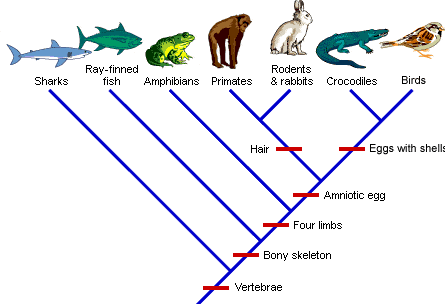
According to this cladogram, sharks are MOST closely related to which organism? 
a)
Amphibians
b)
Ray finned fish
c)
Crocodiles
d)
Birds
24.
Which species’ DNA is most similar to the DNA of the toothed whale? 
a)
Hippopotamus 
b)
Baleen Whale
c)
Grazing Mammals
d)
Camels
25.

Which trait (adaptation) was developed most recently?

a)

tetrapod limbs

b)

feathers

c)

amnion

d)

They developed at the same time

26.
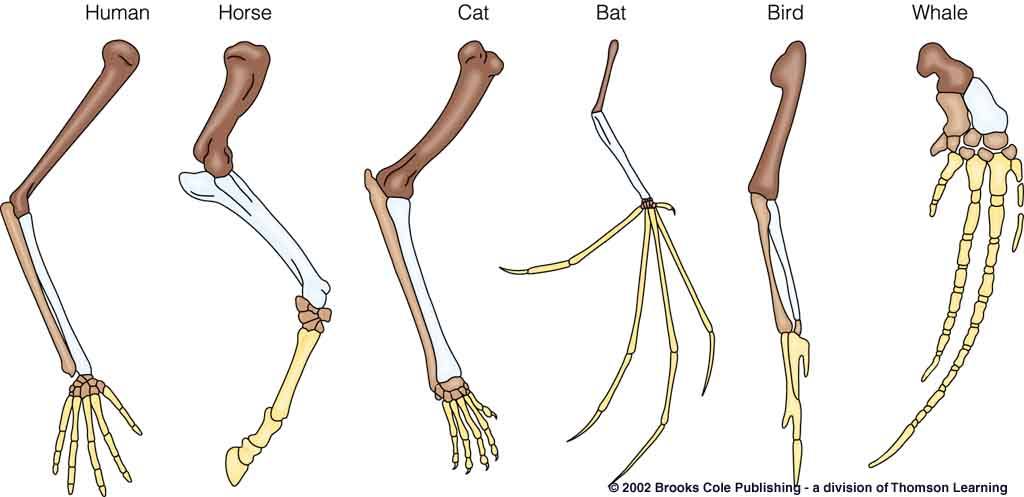
The structures shown are_________
a)
homologous
b)
heterologous
c)
analogous
d)
vestigial
27.

What comparative anatomy structure has similar form/structure but different function?

a)

Analogous Structures

b)

Homologous Structures

c)

Vestigial Structures

28.

What comparative anatomy structure is a result from left over traits that are no longer needed for survival and no longer serve a purpose?

a)

Analogous Structures

b)

Homologous Structures

c)

Vestigial Structures

29.

_____________ Evolution occurs when unrelated organisms evolve traits, structures, or morphologies that carry out the same function. An example is insect flight and bird flight.

a)

Convergent

b)

Parallel

c)

Divergent

30.

___________Evolution occurs when similar organisms become more dissimilar in order to adapt to their environments. The organisms' still retain features with similar structure but different function.

a)

Convergent

b)

Parallel

c)

Divergent

31.

A random change in allele frequencies over generations brought about by chance.

a)

genetic drift

b)

gene flow

32.

When allele frequencies change due to individuals leaving a population

a)

genetic drift

b)

gene flow

33.

In the Hardy Weinberg equations the recessive phenotype frequency is represented by

a)

p

b)

q

c)

2pq

d)

q2

34.

If a population has 64% recessive phenotypes, what is the recessive allele frequency?

a)

8%

b)

36%

c)

64%

d)

80%

35.

Microevolution happens in

a)

species

b)

individuals

c)

populations

d)

households

36.
A bumble bee has just enough weight to open up the snapdragon flower and get the nectar/pollen inside.  Other insects cannot do this. This adaption is an example of........
a)
convergent evolution
b)
co-evolution
c)
divergent evolution
d)
speciation
37.

The large-scale events of speciation are called...

a)

macroevolution

b)

simplification

c)

adaptation

d)

microevolution

38.

A new river forms and splits two populations, causing ______________ speciation

a)

Sympatric

b)

Allopatric

c)

Extreme

d)

Convergent

39.

A speciation in which new species evolve from a single ancestral species while inhabiting the SAME geographic region.

a)

Sympatric speciation

b)

Allopatric speciation

c)

Complex speciation

d)

Divergent speciation

40.
Which is necessary for speciation to occur?
a)
adaptation
b)
mass extinction
c)
isolation
d)
acquired traits
41.
Bats are common in Texas, especially in rocky regions. Bats with longer hang claws have demonstrated higher fitness because of their ability to cling to rock while resting.
a)
Adaptation
b)
Non-random mating
c)
Gene Flow
d)
Mutation
42.
What does the image represent?
a)
Founder effect
b)
Bottleneck effect
c)
Mutation
d)
Natural Selection
43.
What does the image represent?
a)
Founder effect
b)
Bottleneck effect
c)
Natural Selection
d)
Mutations
44.
What does the image represent?
a)
Gene flow
b)
Gene drift
c)
Mutation
d)
Adaptation
45.
What does the picture represent?
a)
Founder Effect
b)
Mutations
c)
Bottleneck effect
d)
Gene Flow
46.
Two species of frogs belonging to the same genus occasionally mate, but the offspring fail to develop and hatch. What is the mechanism for keeping the two frog species separate?
a)
the postzygotic barrier called hybrid inviability
b)
the postzygotic barrier called hybrid breakdown
c)
the prezygotic barrier called hybrid sterility
d)
gametic isolation
47.
The genitalia of the male damselfly varies in shape. Certain males can only hold onto & mate with females whose genitalia fit.  What type of reproductive barrier is this?
a)
behavioral isolation
b)
temporal isolation 
c)
gametic isolation
d)
mechanical isolation 
48.
The flowers of pink tulips open in the morning, while the flowers of lavender tulips open in the early afternoon. The bees that pollinate these tulips cannot carry pollen back & forth between the two types of tulips because of their flowers being closed at different times of day. What type of reproductive barrier is this?
a)
behavioral isolation
b)
hybrid sterility 
c)
temporal isolation
d)
mechanical isolation 
49.

The Western Skunk mates in the fall and the Eastern Skunk mates in the spring. This is a type of

a)

prezygotic barrier

b)

postzygotic barrier

c)

allopatric barrier

d)

polyploidy

50.

Reduced Hybrid Viability means:

a)

The offspring cannot reproduce

b)

The offspring cannot hear or see

c)

The offspring will most likely die due to complications

d)

The offs ping will be part of a new species

51.

When a population grows past the ecosystem's carrying capacity, what happens to the population?

a)

Continues to grow

b)

The population starts to die off to return to carrying capcity

c)

The population will go extinct due to lack of resources

d)

The population grows then finds a new carrying capacity

52.

What is a Predator?

a)

An animal that eats another animal

b)

An animal that is being hunted by another animal

53.

What is a Prey?

a)

An animal that is being hunted by another animal

b)

An animal that eats another animal

54.

Which Hardy-Weinberg factor represents the frequency of heterozygous individuals in a population?

a)

p2

b)

2pq

c)

q2

d)

p2 + 2pq

55.
What do you call all of the genes in a population?
a)
Gene pool
b)
Relative Frequency
c)
Genetic Drift
d)
Allele pool
56.
What does the Hardy-Weinberg equilibrium measure?
a)
changes in allele frequencies
b)
numbers of mutations
c)
goodness of fit
d)
genetic diversity
57.
In the Hardy-Weinberg Equation, q2 is the frequency of what?
a)
The recessive allele 
b)
the dominant allele
c)
the recessive genotype
d)
the dominant genotype
58.
A population of 150 individuals has an allele frequency of 0.3 for the dominant allele (B) and a frequency of 0.7 for the recessive allele (b). Use the Hardy-Weinberg equation to determine the frequency of the genotype (bb).
a)
0.09
b)
0.42
c)
0.49
d)
0.21
59.
When a population is in Hardy-Weinberg equilibrium,  what is NOT happening to the species?
a)
Survival
b)
Reproduction
c)
Death
d)
Evolution