Wayground logo

Free Printable Worksheets

Font size

S
M
L
XL
Worksheets

Before the EOC (Part 2)

Total questions: 65

Worksheet time: 1hrs 5mins

Name
Class
Date
1.
Which question were the scientists trying to answer with this experiment?
a)
Where do cells come from?
b)
How did prokaryotes form cell membranes?
c)
How are biomolecules formed?
d)
What gave rise to the Eukaryotic cell?
2.
The apparatus in the experiment was used to mimic what?
a)
Proteins
b)
Present Earth conditions
c)
Early Earth conditions
d)
Nucleic acids (DNA/RNA)
3.
The gas in the apparatus mimicked? 
a)
Early oceans
b)
The void of space
c)
Fusion reactions of stars
d)
Early Earth's atmosphere
4.
What was the product of the Miller-Urey Experiment?
a)
Simple amino acids
b)
Simple nucleotides
c)
Simple lipids
d)
Simple monosaccarides
5.
Miller/Urey and other scientists have shown that:
a)
 Life on early Earth required material from space
b)
Cells survived in the primitive atmosphere
c)
Amino acids could be produced from inorganic molecules 
d)
Simple cells can be produced in a laboratory
6.
Which of the following was probably not present in the atmosphere of the primitive Earth? 
a)
Methane
b)
Oxygen
c)
Water
d)
Carbon dioxide
7.
Which type of cell came first?
a)
Eukaryotic
b)
Prokaryotic
c)
Plant
d)
Both Eukaryotic and Prokaryotic cells evolved around the same time
8.
Based upon the conditions of the early Earth, which forms of live most likely appeared first?
a)
Prokaryotic and aerobic
b)
Prokaryotic and anaerobic 
c)
Eukaryotic and aerobic
d)
Eukaryotic and anaerobic
9.

Which of the following is an example of COHESION?

a)

water sticking to water

b)

water sticking to glass

c)

oil sticking to plastic

d)

hydrogen sticking to oxygen

10.

Water is polar. What does that mean?

a)

it is a molecule with opposite charges on opposite ends

b)

it is a molecule with no charge

c)

it is a molecule with identical charges on opposite ends

d)

it is a molecule with too many protons

11.

Water sticks well to many materials. What term relates to this property of water?

a)

cohesion

b)

adhesion

c)

density

d)

surface tension

12.

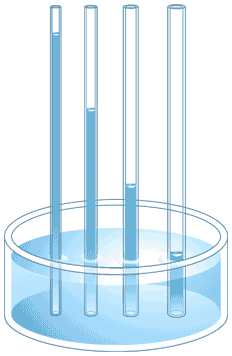
What is the term for water's ability to defy gravity and climb up a tube?

a)

Capillary Action

b)

Specific Heat

c)

Universal Solvent

d)

Magic

13.
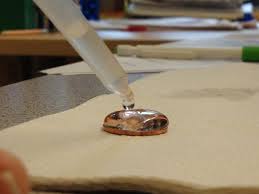
Which characteristic of water will allow a paperclip to remain floating on water when the paperclip is gently placed on top of the water?
a)
adhesion
b)
surface tension
c)
solvent properties
d)
nonpolar
14.
The attraction that causes water and other liquids to form drops on thin films is called ________________. This is also water’s ability to be attraction to other water molecules.
a)
adhesion
b)
capillary action
c)
cohesion
d)
surface tension
15.

A disease reduces the number of young salmon in a river. Which population will MOST likely increase as a result?

a)

trout and eagle

b)

algae and trout

c)

sculpin and algae

16.
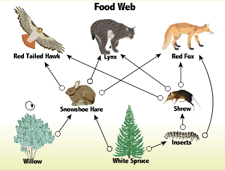
The fox in this food web would be considered a:
a)
Tertiary Consumer
b)
Producer
c)
Secondary Consumer
d)
Primary Consumer
17.
The rabbit in this food web would be considered a:
a)
Decomposer
b)
Producer
c)
Secondary Consumer
d)
Primary Consumer
18.
What may happen if the snowshoe hare was removed from the food web pictured?
a)
The insects in the habitat would increase.
b)
The shrew population would decrease due to being only hawk food source.
c)
The willow tree population would decrease.
d)
Foxes would dies due to no food source. 
19.
Which of the animals in this food web is a secondary consumer?
a)
Hawk
b)
Lizard
c)
Mouse
d)
Snake
20.
A student is planning an experiment to find out how the height from which he drops a ball affects how high the ball bounces. The dependent variable is the _____.
a)
Diameter of the ball
b)
Force acting on the ball
c)
Height that the ball bounces
d)
Height from which the ball is dropped
21.
An experiment is performed on plants to see how different liquids affect plant growth. Each plant in the experiment is given a different liquid; water, apple juice, or milk. Each plant has the same amount of soil, sunlight, and listens to the same music. In this investigation, what is the dependent variable?
a)
Type of plant
b)
Water, apple juice, milk
c)
Plant growth
d)
Color of the plant's leaves
22.

Scenario: You want to test whether water helps to improve plant growth. What is the Independent Variable? (Remember: Independent Variables are what "I"change in the experiment.

a)

The growth of the plant

b)

Amount of Sunlight

c)

Amount of Water

23.

Scenario: You want to test whether growth hormone helps to create bigger cows. What is the Dependent Variable? (Remember: Dependent Variables are what is being measured or observed.)

a)

Growth Hormone

b)

How much the cows eat

c)

The weight of the cows

24.

Scenario: You want to test whether growth hormone helps to create bigger cows. What is the Independent Variable? (Remember: Independent Variables are what "I"change in the experiment.

a)

How much the cows weigh

b)

The amount of growth hormone

c)

How much the cows eat.

25.

A student wants to test how different amounts of UV light affect the growth of the bacteria, Staphylococcus aureus. She wants to grow the bacteria in petri dishes for her experiment. Which of the following variables should NOT be held constant in this experiment?

a)

amount of UV light bacteria is exposed to

b)

amount of time to grow bacteria

c)

location of petri dishes while growing bacteria

d)

type of bacteria (Staphylococcus aureus)

26.

A student performed an experiment that tested how many days it takes different types of grass seed to grow to a height of two inches. Four types of grass seed were tested, and the student recorded the number of days for each type to grow. Use this information to answer the next question.


What should be held constant in this experiment?

a)

amount of sunlight, amount of water, and type of soil

b)

amount of sunlight

c)

amount of water and type of soil

d)

amount of water

27.

A student is studying the effect of sunlight on plants. The student developed this hypothesis: Plants need light to make food and to grow properly. To conduct a controlled experiment, which method should she use?

a)

Choose two identical plants; put one in the dark and one near sunlight; use the same amount of water; water both regularly

b)

Choose a healthy plant; put it in a dark place; use clean water; water the plant regularly.

c)

Choose two identical plants; put each in the dark for 12 hours and then light for 12 hours; use the same amount of water; water both regularly.

d)

Choose three identical plants; put one in the dark, one near sunlight, and one in the shade, water only the plant in light.
28.
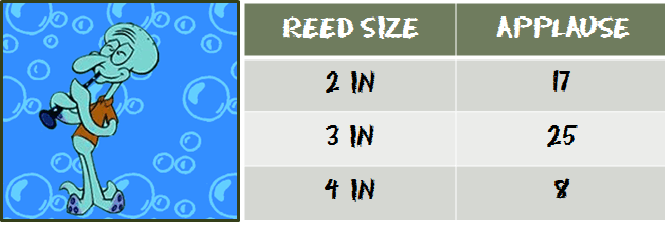
Squidward found new reeds to tryout for his clarinet.  He used an APPLAUSOMETER to measure applause after playing  Under the Sea with each reed.  The results were put in the table.
What was the dependent variable?
a)
The Song
b)
The Reed
c)
The Applause
29.
What is ecological succession?
a)
A slow change in an environment
b)
A change that takes days in an environment
c)
No change
d)
Abiotic change
30.
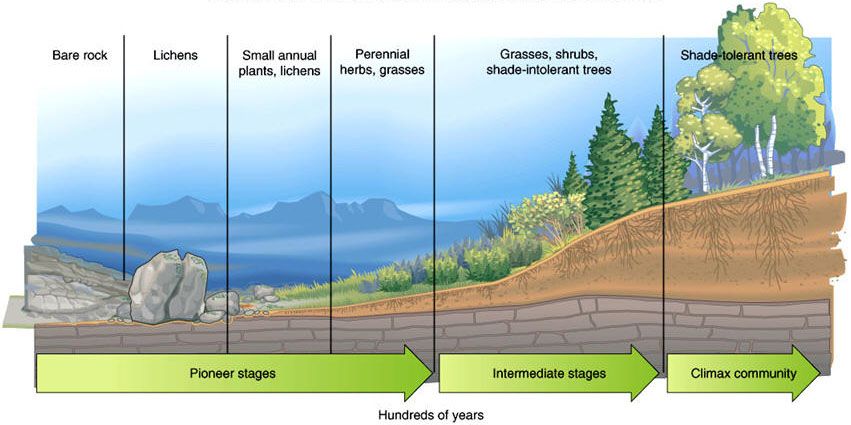
What is the most important function of pioneer species?
a)
To create rocks
b)
To create soil and add nutrients to the environment 
c)
To look nice
d)
Food for animals 
31.
A climax community is ….
a)
the beginning of a new ecological succession.
b)
the rocks in a new environment.
c)
the fire that will cause destruction.
d)
an area that reaches its greatest growing potential.
32.
What is the difference between primary and secondary succession?
a)
Primary succession already has soil.
b)
Primary has soil and secondary does not
c)
soil is present in both
d)
primary has no soil and secondary has soil
33.
Why does primary succession take longer to reach climax community?
a)
Because trees do not perform photosyntheses.
b)
Because climax community is in a forrest.
c)
Because primary succession already has soil
d)
Because primary succession does not have soil
34.
Which is the correct order in primary succession?
a)
Rocks, Lichens & Mosses, Bushes & Shrubs, Trees
b)
Lichens & Mosses, Rocks, Trees, Bushes & Shrubs 
c)
Trees, Bushes and Shrubs, Lichens & Mosses, Lichens & Mosses
d)
Rocks, Grass, Trees, Bushes & Shrubs
35.
First species occuring in areas of primary succession are mosses and
a)
grasses
b)
wildflowers
c)
trees
d)
lichens
36.
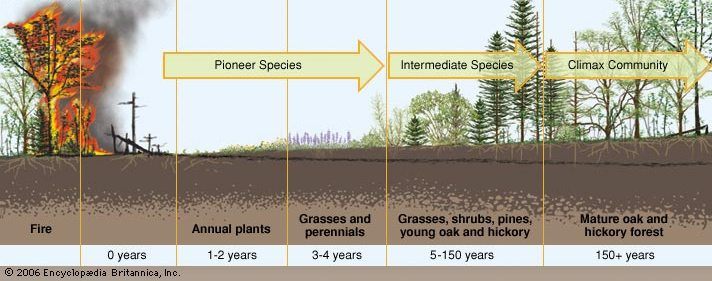
The picture shows what type of succession?
a)
primary
b)
secondary
c)
tertiary
d)
quadanary
37.
The picture shows what type of succession?
a)
primary
b)
secondary
c)
tertiary
d)
quadanary
38.
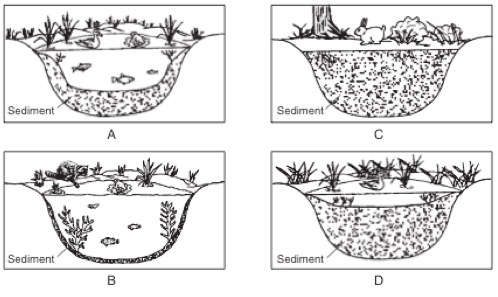
What is the correct order from oldest (happened first) to youngest (happened last) in this pond succession?
a)
A, B, C, D
b)
D, C, B, A
c)
B, A, D, C
d)
C, D, A, B
39.
How do invasive plants damage the environment?
a)
Compete with native species
b)
Change plant community
c)
Alter diversity
d)
All of these
40.

Which of the following is NOT a threat to biodiversity?

a)

Pollution

b)

Deforestation

c)

Invasive Species

d)

Ecological Succession

41.
What is deforestation?
a)
Clearing Earth's forests on a massive scale
b)
Eating too much vegetables
c)
Going to a forest and pulling weeds
d)
Clearing the five trees in my backyard
42.

The threat to biodiversity that occurs when the homes of different species are destroyed

a)

pollution

b)

habitat destruction

c)

overexploitation

d)

climate change

43.

When human-made chemicals and garbage find their way into nature and harm the air, soil, and water it is called

a)

pollution

b)

habitat destruction

c)

overexploitation

d)

climate change

44.

The largest threat to biodiversity is

a)

bacteria

b)

fungi

c)

humans

d)

plants

45.
What does conserving resources mean?
a)
Use as much of the resources as you can
b)
Only use the resources at school
c)
Protecting the resource so it does not run out
46.
Which group includes ALL renewable resources?
a)
Coal, trees, water, oil
b)
Water, wind, sun, plants
c)
Minerals, sun, natural gas, water
47.
What is the major cause for air pollution? 
a)
factories and cars
b)
cigarretes 
c)
deforestation
d)
oil spills
48.
Salt water is an abundant resource but unusable for irrigation and drinking. As demands on freshwater sources increase, the use of desalination processes to remove salt from ocean water is increasing. A concern of desalinating water is the large amounts of recovered salts that are returned to the ocean. Which of the following describes the most likely impact of desalination on the surrounding ocean environment? 
a)
Methane gas would pollute the ocean environment as shoreline organisms begin to die and decay.
b)
Alteration in ocean salt levels would cause loss of species and unbalanced populations in marine food webs.
c)
Nonrenewable resources in the ocean environment would become depleted and upset the ecosystem's balance.
d)
Increased levels of salts and minerals in the ocean would result in overpopulation of marine bivalves due to strengthened shells
49.
New fuels are being produced by converting corn and grasses into compounds containing alcohols that can be broken down for energy in various engines. The purpose of this research is to
a)
 reduce the use of nonrenewable resources.
b)
increase the rate of air pollution.
c)
reduce the rate of homeostasis in organisms.
d)
 cause a loss of biodiversity in the rain forests.
50.
The presence of wastes, such as plastic bags and motor oil, in lakes and streams miles away from developed areas suggests that
a)
. ecosystems are interconnected and human action can alter ecosystem equilibrium.
b)
recycling programs have failed to conserve biotic resources.
c)
natural processes can alter ecosystem stability.
d)
 direct harvesting practices have led to irreversible destruction of ecosystems.
51.
DDT and other pesticides used over 50 years ago are still affecting the environment today. Scientists have found these substances in recent glacier runoff. Glacier runoff occurs during the summer, when precipitation that has fallen on glaciers during the winter is released. Ice layers from existing glaciers have been analyzed. The results of this analysis show that the concentrations of DDT and other pesticides were highest about 10 years after the use of these substances was banned. This information shows that
a)
DDT and other pesticides cause glacier runoff during the summer.
b)
it takes humans over 50 years to analyze a glacier.
c)
precipitation helps to break down pesticides.
d)
the decision of one human generation may have an impact on future generations.
52.
The northern elephant seal was almost hunted to extinction in the 1800s. By the late 1890s, approximately one hundred seals were left, reducing the gene pool of the population. What will be the consequence of this reduction?
a)
 Competition within the population will increase.
b)
The surviving elephant seals will be better able to adapt.
c)
 Inbreeding will be less frequent among the remaining population.
d)
The elephant seals will be more vulnerable to environmental change. 
53.
A community is concerned about the water quality of a nearby lake. Increased sedimentation in the lake is endangering the native habitat. The increased sedimentation is most likely caused by which of the following?
a)
trees planted along the shore of the lake
b)
construction of homes along the lake
c)
the amount of sunlight on the lake
d)
the amount of fish in the lake
54.
When fertilizers run off farmland into streams and ponds, the nitrogen content of the water increases. This can lead to rapid growth of algae in a process called eutrophication. How can this process affect other organisms in the water?
a)
Oxygen is used up as algae is decomposed, reducing the amount available to other organisms.
b)
The water becomes better able to support aerobic organisms.
c)
The algae provide food for fishes and other organisms, leading to decreased algae populations.
d)
The extra nitrogen provides additional food for the other organisms, increasing their population.
55.
A strip mining company wants to lease some land that is currently part of a national park. They promise to reclaim the land should any minerals be mined from the area, and they are willing to pay top dollar for the rights. As an ecologist, what factors would you raise with the local government?
a)
the threat to local biodiversity
b)
management of the land after the company leaves
c)
the new jobs that would be created
d)
the increased traffic in the area
56.
Whaling was a very profitable profession until whale populations crashed. The global community came together to enact a ban on whaling. However, Japan and Norway have not agreed to stop whaling. Which of the following is the most likely consequence of their decision?
a)
The whale populations are bouncing back very successfully and are unaffected by Japan and Norway continuing to whale.
b)
The whale populations are not rebounding as quickly as they might if all of the countries agreed not to hunt whales. 
c)
The whale populations have mutated into new kinds of organisms.
d)
The whales are getting better at avoiding capture. 
57.
The diagram shows the carbon cycle.  If many trees are removed from a forest by logging, what is the most immediate effect on the carbon cycle in that forest?
a)
 increase in the rates of decomposition
b)
increase in the rates of atmospheric carbon dioxide
c)
decreased combustion of fossil fuel
d)
 increase production of organic compounds
58.
Which one of these does not add CO2 to the atmosphere?
a)
cooking with gas
b)
planting trees
c)
burning wood
d)
riding in a bus
59.
What does not produce carbon dioxide?
a)
Photosynthesis
b)
Burning Fossil Fuels
c)
Animal respiration
d)
Plants decaying
60.

If the plant population decreased, the amount of carbon in the atmosphere would _________.

a)

Stay the same

b)

Increase

c)

Decrease

61.
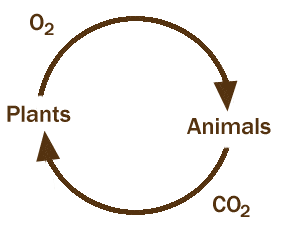
Which statement is true about the carbon dioxide-oxygen cycle?
a)
animals breathe in nitrogen and release oxygen which is used by plants
b)
animals breathe in oxygen and release carbon dioxide which is used by plants
c)
animals breathe in nitrogen and release carbon dioxide which is used by plants
d)
animals breathe in carbon dioxide and release oxygen which is used by plants
62.
Carbon exist in many forms on Earth.
a)
True
b)
False
63.
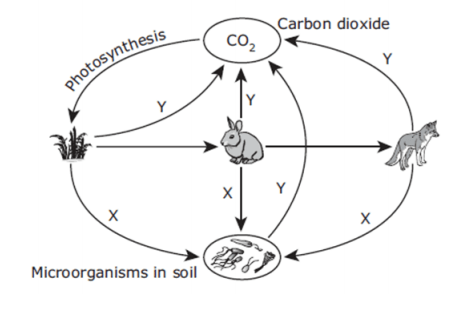
The diagram shows the flow of organic molecules through an ecosystem. What two processes are identified by the labels X and Y?
a)
X : Respiration
Y : Predation
b)
X : Adaptation
Y : Decomposition
c)
X : Fermentation
Y : Nitrogen Fixation
d)
X : Decomposition
Y : Respiration
64.
Which process takes carbon dioxide out of the atmosphere?
a)
respiration
b)
combustion
c)
decomposition
d)
photosynthesis
65.

Why does too much carbon dioxide in the atmosphere cause climate change?

a)

It cools our planet.

b)

Blocks out UV rays.

c)

Lets light escape.

d)

Traps heat and warms the planet.