wayground logo

Free Printable Worksheets

Font size

S
M
L
XL
Worksheets

FARLINATOR: EOC SCIENCE REVIEW 2026

Total questions: 72

Worksheet time: 1hrs 13mins

Name
Class
Date
1.

What is the first step in the scientific method?

a)

Ask a question

b)

Hypothesis

c)

Conclusion

d)

Analyze data

2.

A student wants to perform a science experiment about plants. He wants to know if a certain type of soil will make plants grow taller. Each pot will receive a different type of soil, but will get the same type of seed, water amount, and sunlight amount.What is the Independent Variable in this story?

a)

Amount of sunlight

b)

How tall the plant will grow

c)

Amount of water

d)

Type of material the plant is growing in

3.

What do you measure for results (outcome)?

a)

Dependent variable

b)

Hypothesis

c)

Experimental Group

d)

Constants

4.

If an animal shelter wants to see if a certain dog food causes a dog to gain weight, which of the following would NOT be a constant?

a)

Type of dog food given

b)

Amount of dog good given

c)

Time of day food is given

d)

Amount of exercise dog is given

5.

Why is it important to have constants in an experiment?

a)

To make sure the experiment is fair

b)

Constants are not needed for experiments.

c)

To measure the dependent variables all at once

d)

To test many variables at a time

6.

This bar graph shows the number of cheeseburgers sold at McYummies drive thru last week. Study the graph and answer the following question. (remove s from questions)

What was the maximum number of burgers sold, and on which day was this?

a)

30 burgers on Tuesday

b)

60 Burgers on Thursday

c)

20 Burgers on Thursday

d)

25 Burgers on Monday

7.

Which of the following is not an example of quantitative data?

a)

Temperature

b)

Speed

c)

Height

d)

Texture

8.

Anna is in charge of studying how the amount of plant food (fertilizer) affects the height of a plant at a local garden. Which testable statement does she investigate?

a)

There is no way to test this hypothesis.

b)

If a plant receives two cups of food per day, then the height of the plant will increase

c)

If a plant gets different amounts of water and two cups of food per day, the height of the plant will increase

d)

If a plant receives more sunlight, the height of the plant will decrease

9.

Why do many experiments include several trials instead of a single trial?

a)

Repetition of trials increases the accuracy of the results

b)

Repetition of trials decreases the sample size of the experiment.

c)

Repetition of trials makes data easier to analyze.

d)

It is not necessary to repeat trials

10.

1. Aside from repeating a scientific experiment, what else must a scientist do to increase the accuracy of the results?

a)

Change the hypothesis

b)

Share data with other scientists for them to repeat or replicate

c)

Analyze the data faster

d)

Keep the data for themselves

11.

Quantitative data can be

a)

seen

b)

measured

c)

manipulated

d)

heard

12.

How is a hypothesis different from a theory?

a)

A theory has evidence to back it up and a hypothesis is an educated guess as to what is going to happen.

b)

They are both the same. They both are guesses as to what happens in the natural world.

c)

A theory is an opinion about how something works but a hypothesis has scientific evidence to support it.

d)

A hypothesis is used in science and a theory is used in society.

13.
Which part of the cell allows certain materials to enter the cell and other materials to exit?
a)
cell membrane
b)
cytoplasm
c)
vacuole
d)
nucleus
14.
Which process do most cells use to get energy?
a)
photosynthesis
b)
digestion
c)
respiration
d)
excretion
15.
In which body part would you find cells with hair-like structures?
a)
heart
b)
brain
c)
lungs
d)
mouth
16.
What makes up muscle tissue?
a)
groups of muscle organs
b)
a group of muscle organs and nerve cells
c)
a single muscle cell
d)
a group of muscle cells
17.
Which two organ systems work together to move the body?
a)
muscle system and skeletal system
b)
muscle system and digestive system
c)
nervous and digestive system
d)
respiratory and nervous system
18.
Which of the following statements is true about all cells in plants and animals?
a)
All cells have a tough cell wall
b)
all cells have the same shape
c)
all cells have chloroplasts
d)
all cells have a cell membrane that can be compared to your skin
19.
To adjust to a changing environment
a)
Mutation
b)
Adapt
20.
Darwin wrote that organisms with traits that are best suited to the environment will ________________
a)
increase in number
b)
become extinct
21.
Which term refers to the process by which individuals that are better suited to the environment survive and reproduce therefore passing down their genes to their offspring? 
a)
Evolution 
b)
Variation 
c)
Adaptation
d)
Natural Selection 
22.
The variable the is changed on purpose is..
a)
Constant
b)
Control
c)
Independent Variable
d)
Dependent Variable
23.
The variable that is being tested, counted, or measured and is responding to the independent variable is known as 
a)
Control
b)
Constant
c)
Independent Variable
d)
Dependent Variable
24.
Mrs. Goodwyn wants to see if studying time affects test scores...She gives all 6 classes the same assignment but assigns different study times. What is the independent variable?
a)
Study time
b)
Test score
c)
Same assignment
25.
Mrs. Goodwyn wants to see if studying time affects test scores...She gives all 6 classes the same assignment but assigns different study times. What is the dependent variable?
a)
Study  time
b)
Test Score
c)
Same Assignment
26.
Dr. Smith has been reading about another scientist’s research in a physics journal. He plans to do these experiments himself and see if he gets the same result.
a)
repetition
b)
replication
27.
Josue goes to Silver River each week for 4 weeks and collects 5 samples of water to test the pH.
a)
repetition
b)
replication
28.
Scientists frequently repeat the experiments of others scientists. Why is this important in science?
a)
Scientists often ask each other for help in performing experiments.
b)
Replication of experiments helps to confirm and verify results.
c)
Scientists frequently perform other scientists’ experiments in order to practice their technique.
d)
Repeating experiments is an effective way to make sure a laboratory is in optimal condition.
29.

Theory or Law? _________ of Thermodynamics: Matter can never be created or destroyed. Tells what happens with matter.

a)

Theory

b)

Law

30.

Theory or Law? Big Bang _______: the universe came from one minute particle and expanded over billions of years to what we see today. Tries to explain how the universe was created.

a)

Theory

b)

Law

31.

Theory or law? The cell _________ of living things: living things are made of cells, which explains how things grow and live.

a)

Theory

b)

Law

32.

The theory of Plate Tectonics is the idea that the Earth's crust has many plates that move because of changes in temperature deep below the Earth's surface. It has changed over time. What would cause the theory to change?

a)

The addition of new empirical evidence.

b)

It was a bad theory to begin with.

c)

If the news ran a story about why it should be changed.

d)

If a famous scientist said it should be changed.

33.
The definition of weathering is _______________________.
a)
the carrying away of rock
b)
the leaching of rock
c)
the breaking down of rock
d)
the permeability of rock
34.

A cliff formed near the ocean. Which statement best describes how this cliff formed?

a)

Warm air melted the rock.

b)

Sun rays evaporated the rock.

c)

Ocean waves washed away rock.

d)

Plant roots pushed away the rock.

35.
What is the process that picks up and moves weathered rocks?
a)
Deposition
b)
Landslide
c)
Weathering
d)
Erosion
36.

What causes the greatest erosion effect on our beaches?

a)

Waves

b)

Gravity

c)

Glaciers

d)

Wind

37.
What causes tectonic plates to move along the Earth's surface?
a)
wind
b)
ocean currents
c)
convection in the mantle
d)
expansion of the Earth
38.
What type of boundary occurs when two plates move away from each other?
a)
transform
b)
subduction
c)
convergent
d)
divergent
39.
What type of boundary occurs when two plates move toward each other?
a)
convergent
b)
divergent
c)
transform
d)
lateral
40.
What forms at a convergent boundary between a continental plate and an oceanic plate?
a)
volcanoes
b)
rift valleys
c)
faults
d)
mid-ocean ridges
41.
A rift valley occurs at a ____________ boundary.
a)
divergent
b)
convergent
c)
transform
d)
horizontal
42.
An offspring will receive how many alleles from each parent to determine a specific trait?
a)
one
b)
two
c)
three
d)
five
43.
Which of the following is a phenotype?
a)
BB
b)
Bb
c)
bb
d)
Blue eyes
44.
Which of the following is a phenotype?
a)
BB
b)
Bb
c)
bb
d)
Blue eyes
45.
B = brown fur  b = white fur
In the punnett square, what is the probability for white fur? 
a)
0%
b)
25%
c)
50%
d)
75%
46.
What allele combination should go in the missing box?
a)
AA
b)
Aa
c)
aa
d)
none of these
47.
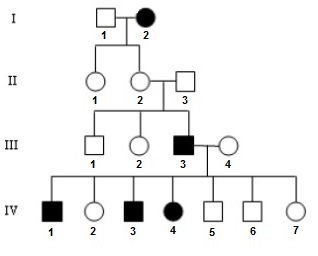
This pedigree represents the inheritance of hemophilia in this family. How many of the females have the hemophilia trait?
a)
8
b)
5
c)
2
d)
3
48.
What do half colored symbols represent?
a)
The individual is a carrier (heterozygous).
b)
The individual expresses the trait.
c)
The individual has both recessive alleles.
d)
The individual has both dominant alleles.
49.
what kind of heat is happening when the sun heats your body
a)
conduction
b)
convection
c)
density
d)
radiation
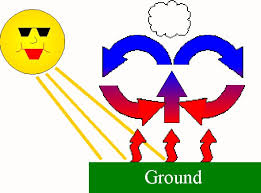
50.
Warm air rises and the cool air sinks.
a)
conduction
b)
convection
c)
radiation
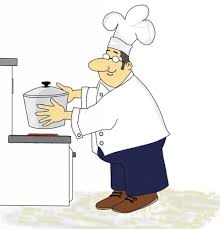
51.
The man goes to take the hot pot off the stove with his bare hands.
a)
conduction
b)
convection
c)
radiation
52.
The faster an object moves, the ________ kinetic energy it has. 
a)
more
b)
less
c)
none of the above
d)
all of the above 
53.
When you stretch a rubber band, you are storing __________ energy. 
a)
kinetic 
b)
potential
c)
none of the above
d)
all of the above 
54.
What kind of energy is in a rock at the edge of a cliff?
a)
Potential
b)
Kinetic
55.
Light waves travel fastest in ________ 
a)
solid
b)
liquid
c)
gas
d)
vacuum
56.
Which type of visible light has the highest energy?
a)
Red
b)
Yellow
c)
Green
d)
Violet
57.

What does reflection mean?

a)

Soaks up light

b)

Passes through

c)

light bounces off

58.
What does refract mean?
a)
To shrink
b)
To bend
c)
To widen
d)
To enlarge
59.
Which has the LONGEST wavelength and, therefore, the lowest frequency/energy
a)
Gamma Rays
b)
Radio Waves
c)
Visible Light
d)
Infrared rays
60.
In mitosis, the two resulting cells are
a)
different from the starting cell and identical to each other.
b)
different from the starting cell and different from each other.
c)
identical to the starting cell and different from each other.
d)
identical to the starting cell and identical to each other.
61.
After meiosis is complete, the new cells:
a)
are all identical
b)
are all different
c)
are half identical and half different
d)
are all stretched out
62.
A relationship between two organisms in which one organism benefits and the other is unharmed...
a)
Mutualism 
b)
Competition
c)
Parasitsm 
d)
Commensalism 
63.
A relationship between two organisms in which both organisms benefit. 
a)
Mutualism 
b)
Competition
c)
Parasitsm 
d)
Commensalism 
64.
An organism that needs to eat other organisms to obtain energy is known as a:
a)
Autotroph
b)
Producer
c)
Consumer
d)
Mutualist
65.
An organism that uses sunlight to create its own food is known as a:
a)
Producer
b)
Heterotroph
c)
Consumer
d)
Decomposer
66.
A student placed a pencil in a cup of water.  The pencil appears broken because light-
a)
always travels in a straight line
b)
bends when it passes through water
c)
makes the water in the glass evaporate
d)
reflects the pencil on the water's surface
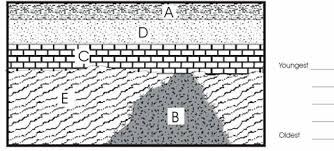
67.
What is the oldest layer in the outcrop?
a)
B
b)
C
c)
D
d)
E
68.
The length of time required for half of the radioactive atoms in a sample to decay is its...
a)
era
b)
age
c)
half-life
d)
eon
69.
Scientists use radioactive decay to measure...
a)
relative time
b)
absolute time
c)
half-lives
d)
time of day
70.

What is the primary function of the cell nucleus?

a)

To protect the cell

b)

To store nutrients

c)

To control cell activities

d)

To produce energy

71.

Which process is responsible for the breakdown of rocks into smaller pieces?

a)

Sedimentation

b)

Deposition

c)

Weathering

d)

Erosion

72.

What is the role of chlorophyll in plants?

a)

To transport nutrients

b)

To store energy

c)

To absorb sunlight

d)

To absorb water