
 Worksheets
Sustainability unit review
Total questions: 51
Worksheet time: 49mins
What is the definition of the tragedy of the commons?
when humans overuse a natural resource
when the short-term, positive effects go to the individual, while the long-term, negative effects are spread out to the group
when humans act selfishly, thinking of the own interest
when plants and animals compete for space, resources, and/or food
Which of the following are both examples of the tragedy of the commons?
overfishing and earthquakes
flooding and tsunamis
pollution and overpopulation
super-germs and virus outbreaks
Which of the following is an example of a solution to the tragedy of the commons?
Improving literacy among urban populations
Inventing stronger antibiotics
Raising taxes for large corporations
Passing laws to prevent overharvesting
Which of the following is NOT an example of a commons?
air
oceans
private beach
forests
Sustainability is
the process of maintaining resources so they are not depleted or permanently damaged
the ability to use resources faster than they are renewed
they ability to save resources for years and years
the process of using resources for one's own benefit without regard for others
As populations grow, the tragedy of the commons will become more of a problem?
True
False
If the total number of species decline from 700 to 200, what can be said about the biodiversity?
Biodiversity would not change because extinction has been eliminated.
Biodiversity is increasing.
Biodiversity is decreasing.
Biodiversity is constant and stable.
What does ecological footprint measure?
How quantity of natural resources humans need compared to the earth's capacity to provide those resources
The size of cities across the world
The amount of fossil fuels that are burned for energy
The shoe size of the average human
How is ecological footprint measured?
In terms hectares of land required by each person in a selected area for food, water, transport, housing and waste management
In terms of number of years it would take before resources ran out
In terms of the average life expectancy of a nation
In terms of shoe size, e.g. women's 9

Which one of the following are Greenhouse Gases
Carbon dioxide
Oxygen
Hydrogen
Helium
What kinds of resources make up your ecological footprint?
waste production
water and energy use
food and shelter
clothing and transportation
All of the above

According to this image, in which continent does the ecological footprint exceed capacity by the largest amount?
Europe
North America
South America
Australia
Coal, oil, and natural gas are fossil fuels.
FACT
BLUFF


A group of compounds that are able to trap heat in the atmosphere, keeping the Earth's surface warmer than it would be if they were not present.
CO2 emissions
greenhouse gases
climate change
Which 2 greenhouse gases contribute the MOST to global warming of Earth?
N2O and H2O
O3 and H2O
CO2 and CH4
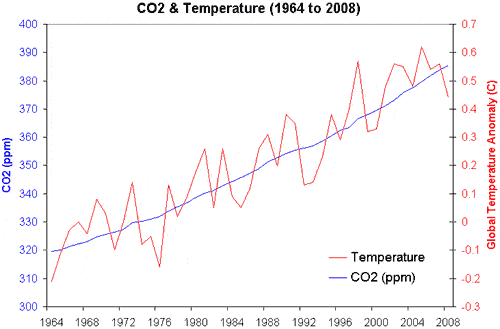
The graph below shows CO2 emissions and temperatures from 1909 to 1949. What conclusion is best supported by the graph?
There is no relationship between carbon dioxide concentrations and temperatures
As carbon dioxide concentrations increase, temperatures increase
As carbon dioxide concentrations increase, temperatures decrease
As carbon dioxide concentrations decrease, temperatures increase

How is the greenhouse effect produced?
When solar energy trespasses the atmosphere.
When some energy is reflected back to earth.
When the green house is burned.
When the sun doesn't emit radiation.
How are greenhouse gasses harming our environment?
They aren't
Less heat is able to escape causing the Earth to cool down
Less heat is able to escape causing the Earth to warm up
More heat is able to escape
The phenomenon by which toxins concentrate in the organisms at higher trophic levels within an ecosystem is known as...
Biotoxicity
Biomagnification
Eutrophication
Predation

What makes a species invasive?
Moving to a new ecosystem and taking resources from natives
Not having papers
Species that can't adapt
Plants that take up too much space

A species that does not belong in a balanced ecosystem, comes in, and changes it (usually for the worse).
flagnship
umbrella
invasive
predator

A species that plays a critical role in the health, maintenance, growth, or definition of an ecosystem.
keystone
invasive
engineer
predator

The phenomenon by which toxins concentrate in the organisms at higher trophic levels within an ecosystem is known as...
Biotoxicity
Biomagnification
Eutrophication
Predation

Which organism would have the most bioaccumulation?
eucalyptus tree
wombats
kookaburras
What is bioaccumulation?
buildup of toxins in an organism
the total mass/amount of organisms in a given area
the number of different species in an area
If a population grows larger than its environmental carrying capacity, then
death rate may rise.
death rate may fall significantly.
birth rate may rise significantly.
immigration rate may increase.

Which correctly describes the term demographic transition?
The transition from low birth rates and death rates to high birth rates and death rates as a country develops.
The transition from high birth rates and death rates to low birth rates and death rates as a country develops.
The transition from high birth rates to low death rates as a country develops.
The transition from low birth rates to high death rates as a country develops.

VOCAB: The average number of children a female member of a population has during her lifetime
total fertility rate
replacement fertility rate
growth rate
death rate
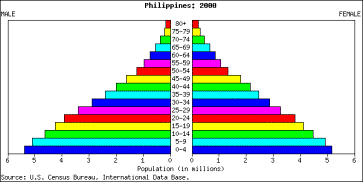

Which of the following leads to a decrease in birthrates among women?
Higher Education
High Infant Mortality Rate
No Prenatal Care
No contraceptives

What is the very next thing that happens after fertilisers enter a river in eutrophication?
Fish die due to a lack of oxygen
Plants below the surface die due to a lack of sunlight
The number of aerobic bacteria increases
Fast growth of plants
The ozone layer protects us from
Increased atmospheric heat
CFCs
UV rays
Decreased atmospheric heat

