
 Worksheets
A&P Sem2 Final Review
Total questions: 102
Worksheet time: 1hrs 14mins
Which Cranial Nerve is for smell?
glossalpharyngeal
olfactory
vagus
trochlear
Which Cranial Nerve is for moving eye up and down?
glossalpharyngeal
olfactory
vagus
trochlear
Which Cranial Nerve is for taste and swallowing?
glossalpharyngeal
olfactory
vagus
trochlear
Which of the following ar the functions of the Nervous System
Sensory
motor
secretion
integration
What is the space between nuerons called?
receptor
effector
synapse
cell body
Which subdivision of the Nervous System is for "Fight or Flight"?
sympathetic
parasympathetic
somatic
Autonomic
Which subdivision of the Nervous System controls you involuntary muscles and glands?
sympathetic
parasympathetic
somatic
Autonomic
What organs make up the CNS
brain
spinal cord
cranial nerves
spinal nerves
What cells are the conduction cells of the nervous tissue?
neurons
neuroglia
schwann cells
fibroblasts
What cells secrete mylin in the PNS?
neurons
neuroglia
schwann cells
fibroblasts
What step of nerve impulse involves the Na+ outside the cell and K+ inside the cell?
resting
depolarization
repolarization
refractory period
What step of nerve impulse involves the K+ moving outside the cell?
resting
depolarization
repolarization
refractory period
What step of nerve impulse involves the Na+/K+ pump?
resting
depolarization
repolarization
refractory period
A photopupillary Reflex is an example of a:
cranial reflex
spinal reflex
somatic reflex
autonomic reflex
What sensory receptor reacts to light?
Chemoreceptor
Nociceptor
Photoreceptor
Gravoreceptor
What receptor reacts to physical forces?
Chemoreceptor
Mechanoreceptor
Electroreceptor
Thermoreceptor
What receptor indicates change in body positions? (Hint: helps us with balance.)
Geogravity receptors
Proprioreceptors
Chemoreceptors
Photoreceptors
What receptor helps us identify changes in smell and taste?
Thermoreceptors
Proprioreceptors
Electroreceptors
Chemoreceptors
What receptor allows you to see a rainbow?
Photoreceptor
Thermoreceptor
Mechanoreceptor
Gravitonreceptor
Which part of the eye gives the eye its color?
cornea
iris
retina
pupil

The nerves associated with smell are referred to as the:
olfactory receptor cells
smell cells
gustatory receptor cells
umami cells
The ear has three parts
outer ear, outer ear and midle ear
middle ear, inner ear and ear
outer ear, middle ear and inner ear
The part of ear that provides equilibrium
cochlea
round window
semicircular canals
labyrinth

The ________is the area for hearing.
malleus
incus
stapes
cochlea
Which receptor in the skin is not for touch?
Krause's
Merkel's
Meisner's
Pacinian's

What vission pathology involves the light focusing before the retina and not being able to see far away
emmatropic
myopic
hyperopic
prsbyopia

What attaches to oxygen as you breathe and carries oxygen on red blood cells?
plasma
hemoglobin
platelets
bone marrow

What are the most common blood cells?
red blood cells
white blood cells
platelets
plasma
Which cell releases antibodies to the blood?
phagocytes
lymphocytes
platelets
Which cell engulfs and digests bacteria/pathogens?
lymphocytes
phagocytes
platelets

What is plasma?
only white blood cells
only red blood cells
fluid part of blood
hemoglobin
What is the function (job) of the platelets?
To form clots (i.e. scabs) when you have cuts and grazes.
To transport oxygen to the muscles
To carry dissolved sugars.
To produce antibodies


Which side of the heart pumps oxygen-rich blood to the rest of the body?
Right
Left
Top
Bottom
Which side of the heart pumps blood into the lungs?
Right
Left
Top
Bottom
Blood travels TO the heart through the ______.
lungs
veins
arteries
oxygen


What portion of the heart is supposed to be the most muscular?
Atriums
Ventricles
Septum
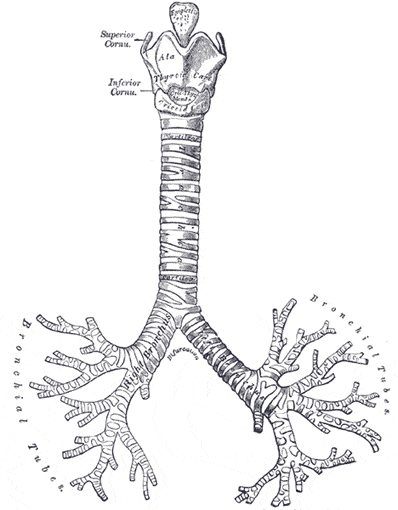
1. larynx
2. nasal cavity
3. pharynx
4. trachea
Which of the following is the correct order that air would flow during inhalation.

The diagram below represents a demonstration of the breathing process in humans. The balloons represent lungs.
The change in the balloons is brought about by
a change in air composition outside the bell jar
a change in air pressure inside the bell jar
an expansion of the balloons, which pulls the rubber sheet into the bell jar
a contraction of the balloons, which forces air into the bell jar
What is pulmonary ventilation?
A pneumothorax (collapsed lung)
Both inspiration and expiration
Another term for asthma attack
The volume of air in one breath
What is the maximum amount of air your lungs can hold?
Tidal volume, and is 500 mL
Inspiratory reserve volume, and is 3,100 mL
Vital capacity volume, and is 4,800 mL
Total lung capacity, and is 6,000 mL
Which term describes the additional amount of air you would take IN after a tidal volume amount of air, in order to blow out your birthday candles?
Residual volume, and is 1,200 mL of air
Inspiratory reserve volume, and is 3,100 mL of air
Inspiratory reserve volume, and is about 4,800 mL of air
Vital capacity volume, and is about 3,100 mL of air
The maximum volume of air that can be "exchanged" through inspiration and expiration with your environment is
Tidal volume, and is 1,000 mL
Respiratory reserve volume, and is 3,100 mL
Vital capacity volume, and is 4,800 mL
Total lung capacity volume, and is 6,000 mL
What is the amount of air that you can force out after a normal breath?
inspiratory reserve volume
expiratory reserve volume
tidal volume
vital capacity
What is the amount of air that stays in our lungs, and cannot be expelled. This is to keep them from collapsing.
vital capacity
total lung capacity
residual volume
tidal volume
An increase in breathing rate can be triggered by an increase in the
carbon dioxide content of the blood
oxygen content of the atmosphere
number of platelets in the blood
number of red blood cells

The passage of nutrients from the digestive tract into the blood stream:
INGESTION
DIGESTION
ABSORPTION
DEFECATION
THE MOVEMENT OF FOOD THROUGH THE BODY:
INGESTION
PERISTALYSIS
DIGESTION
ABSORPTION
Where is bile produced?
Kidney
Pancreas
Liver
Small intestine

The teeth and tongue of the oral cavity break foodstuff down physically. This is an example of
mechanical digestion
chemical digestion
absorption
peristalsis
Which of the following answers correctly sequences the pathway food takes from the beginning to end?
mouth, esophagus, stomach, small intestine, large intestine
mouth, esophagus, stomach, large intestine, small intestine
mouth, stomach, esophagus, small intestine, large intestine
mouth, stomach, esophagus, large intestine, small intestine
What organ is responsible for the absorption of water and movement of waste?
large intestine
small intestine
stomach
oral cavity

Atherosclerosis is a leading cause of other cardiovascular disease (CVD) and it happens when arteries become clogged by _______
sugar
plaque
blood pressure
insulin
HIGH BLOOD PRESSURE IS ALSO KNOWN AS
HYPOTENSION
HYPERGLYCEMIA
HYPERTENSION
HYPONATREMIA
HARDENING OR THICKENING OF THE ARTERIAL WALLS, RESULTING IN LOSS OF ELASTICITY AND CONTRACTILITY
ATHEROSCLEROSIS
ARTERIOSCLEROSIS
ACUTE CORONARY SYNDROME
ANGIOPLASTY
BLOCKAGE IN CORONARY ARTERIES CUTS OFF BLOOD FLOW TO HEART
ANGINA PECTORIS
CHF
MYOCARDIAL INFARCTION
STROKE
LDL Cholesterol is ____
good cholesterol
bad cholesterol
LDL Cholesterol ______
carries cholesterol from the liver to the arteries
carries cholesterol from the arteries to the liver
carries cholesterol to the heart
HDL cholesterol _______
carries cholesterol from the liver to the arteries
carries cholesterol from the arteries to the liver
carries cholesterol towards the heart
HDL Cholesterol is _______
good cholesterol
bad cholesterol
FOREIGN SUBSTANCE CIRCULATING IN THE BLOODSTREAM
ANEURYSM
EMBOLUS
CHF
HEMOPHILIA
ABNORMAL, CRESCENT-SHAPED ERYTHROCYTES THAT CARRY LESS OXYGEN, BREAK EASILY, AND BLOCK BLOOD VESSELS
IRON DEFICIENCY ANEMIA
PERNICIOUS ANEMIA
APLASTIC ANEMIA
SICKLE CELL ANEMIA
BALLOONING OUT OF THE WALL OF A BLOOD VESSEL
ATHEROSCLEROSIS
ARTERIOSCLEROSIS
BLOCKAGE
ANEURYSM
LACK OF PLASMA PROTEIN REQUIRED FOR CLOTTING
THROMBOCYTIC ANEMIA
HEMOPHILIA
PHLEBITIS
DEEP VEIN THROMBOIS
The 120 in the reading 120/80 represents the:
systolic pressure
arterial pulse
diastolic pressure
hypertension
Indicates how much pressure the blood is exerting against the artery walls when the ventricles are contracting:
systolic pressure
arterial pulse
diastolic pressure
Indicates how much pressure the blood is exerting against the artery walls when the ventricles are in the state of relaxation:
systolic pressure
arterial pulse
diastolic pressure
Blood pressure is recorded as
Hydrostatic /diastolic
Diastolic/ hydrostatic
Systolic/diastolic
Diastolic/systolic

Blood Volume and Blood Pressure are related.
What happens to Blood Pressure and the Heart Rate when there's an increase in Blood Volume?
Increase in Volume leads to a Decrease in HR and BP.
Increase in Volume leads to a Decrease in HR and an Increase in BP.
Increase in Volume leads to a Increase in HR and an Increase in BP.
Increase in Volume leads to a Increase in HR and BP.
An Athlete comes in Dehydrated from the Field because his body lacks ALOT of Fluids.
How does Dehydration affect the Flow and Viscosity of Blood?
Dehydration will Increase the Flow and Decrease the Viscosity
Dehydration will Decrease the Flow and Increase the Viscosity
Dehydration will Increase the Flow and the Viscosity
Dehydration will Decrease the Flow and the Viscosity
Select ALL of the Following Factors that CAN affect Blood Flow.
Blood Pressure
Heart Rate
Respiratory Rate
Viscosity
Blood Sugar

