wayground logo

Free Printable Worksheets

Font size

S
M
L
XL
Worksheets

8th Grade Physical Science Review

Total questions: 173

Worksheet time: 2hrs 14mins

Name
Class
Date
1.

What makes mass and weight different?

a)

Mass is the amount of matter meanwhile weight is expressed in kg, lbs. and g.

b)

Mass and weight are expressed in g, kg and lbs.

c)

Mass is the amount of matter meanwhile weight is the force of gravity on an object's mass.

d)

none of the choices

2.

Vaporization/ evaporation is the change of physical state from _______ to _______.

a)

gas to liquid

b)

liquid to gas

c)

solid to gas

d)

gas to solid

3.
Which of the following is a unit of mass?
a)
kilogram
b)
liter
c)
meter
d)
pound
4.
Anything made of matter must _____________________.
a)
take up space and have mass
b)
have mass and be a solid
c)
be a solid and not move
d)
take up space and be a liquid
5.
The mass of an object ___________________________.
a)
changes, depending on where it is located
b)
changes randomly
c)
changes, depending on temperature
d)
does not change
6.
John measures a rock and finds it to be 16 grams.  What does John know about the rock?
a)
its mass
b)
its weight
c)
its volume
d)
its momentum
7.
Mass is a property of ___________.
a)
waves
b)
energy
c)
matter
d)
light
8.
Mass is expressed in what type of units?
a)
meters and kilometers
b)
grams and kilograms
c)
liters and milliliters
d)
ounces and pounds
9.

All matter consists of particles called

a)

Units

b)

Atoms

c)

Cubes

d)

Pints

10.

Atoms consist of parts called protons, neutrons, and

a)

Electons

b)

Haptons

c)

Neptons

d)

Wontons

11.

Each protons has a _______________ electrical charge

a)

Positive

b)

Negative

c)

Neutral

d)

Shocking

12.

Each electron has a _________________ electrical charge

a)

Positive

b)

Negative

c)

Neutral

d)

Shocking

13.

Each neutron has an electrically_________________charge

a)

Positive

b)

Negative

c)

Neutral

d)

Shocking

14.

The nucleus of an atom contains protons and_______________

a)

Electrons

b)

Haptons

c)

Neutrons

d)

Wontons

15.

Electrons move around_________________the nucleus

a)

Inside

b)

Outside

c)

On top of

d)

Without

16.
During which interval is the object not moving?
a)
B to C
b)
C to D
c)
D to E
d)
only at point A
17.
During which interval is the object traveling at a constant velocity?
a)
B to C
b)
D to E
c)
F to G
d)
it traveling at a constant velocity during all of the intervals shown.
18.
During which interval is the object speeding up?
a)
A to B
b)
B to C
c)
D to E
d)
E to F
19.
During which interval is the object slowing down?
a)
A to B
b)
D to E
c)
E to F
d)
G to H
20.
Acceleration occurs when an object changes its speed or ______.
a)
direction
b)
force
c)
inertia
d)
mass
21.
Which runner stopped for a rest?
a)
Albert
b)
Bob
c)
Charlie
22.
Which runner won the race?
a)
Albert
b)
Bob
c)
Charlie
23.
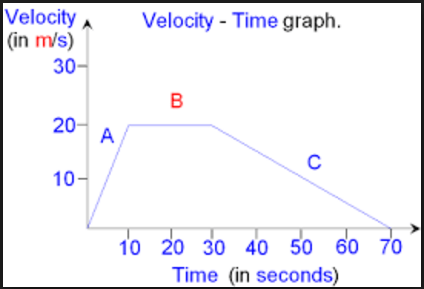
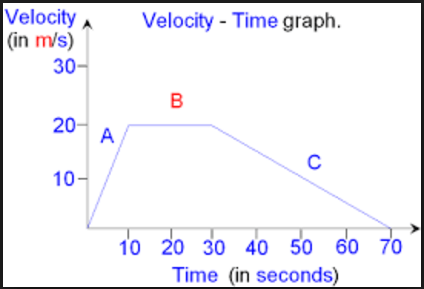
This is a velocity-time graph.  What is the object doing in segment A?
a)
Positive acceleration
b)
Negative acceleration
c)
Constant Velocity
d)
Not moving
24.
This is a velocity-time graph.  What is the object doing in segment C?
a)
Positive acceleration
b)
Negative acceleration
c)
Constant Velocity
d)
Not moving
25.
Calculate the acceleration for segment A.
a)
2 m/s2
b)
20 m/s2
c)
-2 m/s2
d)
0 m/s2
26.
A car driving at 50 miles per hour drives for 2 hours. What distance did it cover?
a)
50 miles
b)
25 miles
c)
100 miles
d)
75 miles
27.
A truck driving at 60 miles per hour travels 150 miles. How long is it driving for?
a)
9000 hours
b)
0.4 hours
c)
210 hours
d)
2.5 hours
28.
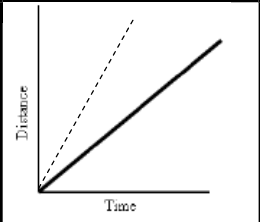
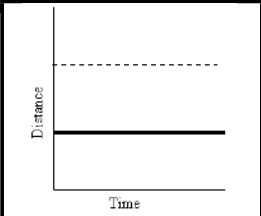
What does this graph represent?
a)
Constant speed
b)
Acceleration
c)
Not moving
29.
What does this graph represent?
a)
Constant Speed
b)
Acceleration
c)
Not moving
30.
What does this graph represent?
a)
Constant speed
b)
Acceleration
c)
Not moving
31.
According to the graph how fast does the person travel in the first 5 seconds?
a)
2 m/s
b)
10 m/s
c)
12.5 m/s
d)
1 m/s
32.
The speed of the vehicle between points A-B is...
a)
12m/s
b)
8m/s
c)
10m/s
d)
16m/s
33.
Acceleration of an object happens when things ________
a)
slow down
b)
go faster
c)
change direction (turn)
d)
All of the above
34.
The SI unit for acceleration is
a)
mph
b)
m/s
c)
m/s2
35.
Acceleration: is the rate of change in ___________.
a)
speed
b)
distance
c)
velocity 
d)
displacement 
36.
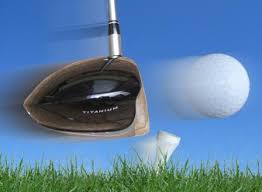
A golf ball accelerates off a tee at 15m/s2, changing its velocity from 0m/s to 50 m/s down the fairway. How long did it take the golf ball to accelerate?
a)
750 seconds
b)
35 seconds
c)
0.3 seconds
d)
3.3 seconds
37.
A box sliding down an inclined plane attains a velocity of 27 m/s in 3 seconds from rest.  Find the acceleration.
a)
30 m/s
b)
24 m/s2
c)
9 m/s2
d)
81 km/hr
38.
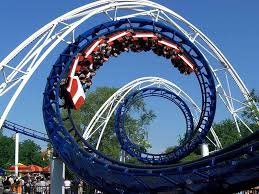
A roller coasters accelerates from an initial velocity of of 6.0 m/s to a final velocity of 70 m/s over 4 seconds.  What's the acceleration?
a)
24 m/s2
b)
18 m/s2
c)
16 m/s2
d)
16 m/s
39.
How fast is the car traveling at 30 seconds?
a)
5m/s
b)
10m/s
c)
20m/s
d)
30m/s
40.
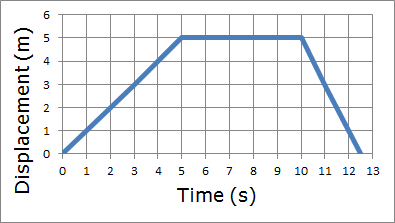
The picture of the position vs. time graph shows an object that is...
a)
accelerating/speeding up
b)
moving at a constant speed 
c)
not moving 
d)
accelerating/slowing down. 
41.
What is the net force?
a)
20 N 
b)
0 N 
c)
400 N 
d)
40 N 
42.

A ____________ is a push or a pull on an object.

a)

friction

b)

force

c)

magnet

d)

gravity

43.
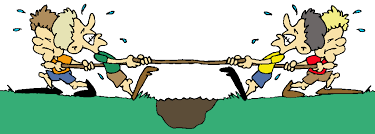
If these teams are pulling with the same amount of force what will happen?
a)
The boy in blue will win.
b)
They will not move at all.
c)
The boy in red will win.
d)
Both will fall down.
44.
What will cause an object to move?
a)
Applied forces
b)
Balanced forces
c)
Unbalanced forces
45.
With unbalanced forces, the object will move in the direction of the _______ force.
a)
larger 
b)
smaller 
c)
equal 
46.
A force is a push or pull measured in what units? 
a)
Meters per second, squared
b)
Kilograms 
c)
Newtons 
47.
Friction is a force that acts in an ___________ direction of movement.
a)
similar
b)
opposite
c)
parallel
d)
west
48.
The amount of friction depends on the weight of the objects pressing together.
a)
True
b)
False
49.
What type of friction is not moving?
a)
static
b)
sliding
c)
fluid
d)
rolling
50.
How can friction be reduced?
a)
reduce the force acting between the 2 surfaces
b)
reduce the roughness of the 2 surfaces coming in contact
c)
use wax, grease or oil
d)
all of the above are ways of reducing friction
51.
A type of friction that occurs when air pushes against a moving object causing it to decelerate.
a)
surface area
b)
air resistance
c)
velocity
d)
gravity 
52.
Which of the following is an example of friction that is helpful?
a)
Brakes used on a bike
b)
Tires from a car on the road
c)
Tread on the bottom of your shoes
d)
All are examples that are helpful
53.
Which of the following is an example of friction that is harmful?
a)
Pencil marking on paper
b)
Engine parts wearing out
c)
sand placed on ice in the winter
d)
Using an eraser to erase marks
54.
Rougher surfaces have ...
a)
greater friction
b)
less friction
c)
the same level of friction
55.
How does friction affect speed?
a)
more friction decreases speed
b)
more friction increases speed
c)
less friction decreases speed
d)
less friction doesn't affect speed
56.

without friction, an object in motion would never stop

a)

true

b)

false

57.
 What is the unit called that measures force?
a)
weight
b)
meter
c)
Newton
d)
kilogram
58.

What is rolling friction?

a)

friction between two surfaces that aren't moving relatively to each other

b)

friction between a rolling object and the surface that it is rolling on

c)

friction where an object rubs against another surface

d)

friction of something going through any type of liquid or air

59.

What is fluid friction?

a)

friction is friction between two surfaces that aren't moving relatively to each other

b)

friction between a rolling object and the surface that it is rolling on

c)

friction where an object slides rubs against another surface

d)

friction of something going through any type of liquid or air

60.

What is sliding friction?

a)

friction between two surfaces that aren't moving relatively to each other

b)

friction between a rolling object and the surface that it is rolling on

c)

friction where an object rubs against another surface

d)

friction of something going through any type of liquid or air

61.
What is Newtons 1st law of motion?
a)
Force= Mass multiplied by acceleration 
b)
An object at rest stays at rest unless acted on an unbalanced force. (inertia)
c)
For every action there is a equal and opposite  re-action.
d)
law of gravity 
62.
What law of motion does this picture represent?
a)
Newtons 3rd law
b)
Newtons 4th law
c)
Newtons 1st law
d)
Newtons 2nd law 
63.
What is Newtons 2nd law of motion?
a)
Pancakes 
b)
Force= Mass multiplied by acceleration
c)
For every action there is a equal and opposite  re-action.
d)
Law of gravity 
64.
What law of motion does this picture represent?
a)
Newtons 1st law
b)
law of gravity 
c)
Newtons 4th law 
d)
Newtons 2nd law
65.
What law of motion does this picture represent?
a)
Newtons 1st law
b)
Newtons 4th law 
c)
Newtons 3rd law 
d)
Newtons 2nd law
66.
For every action there is a equal and opposite...
a)
action
b)
movement 
c)
re-action 
d)
Newtons law of inertia 
67.
What Newtons law does this picture represent
a)
Newtons 2nd law 
b)
Law of gravity 
c)
Newtons 1st law
d)
Newtons 5th law
68.
Mass is a measure of an object's inertia. Objects with greater mass have a greater inertia; objects with less mass have less inertia.
a)
true 
b)
false 
69.
What is the tendency of an object to resist a change in motion?
a)
coffee
b)
motion
c)
inertia
d)
gravity
70.
According to Newton’s first law of motion, a moving object that is not acted on by an unbalanced force will
a)
remain in motion.
b)
eventually come to a stop.
c)
change its momentum.
d)
accelerate.
71.
A sled sliding on a flat, icy surface with a constant velocity is best described by
a)
Newton’s first law of motion for objects at rest.
b)
Newton’s first law of motion for objects in motion.
c)
Newton’s second law of motion.
d)
Newton’s third law of motion.
72.
Which law explains when a magician pulls a tablecloth out from under dishes and glasses on a table without disturbing them.
a)
Law 1
b)
Law 3
73.
A person steps out of the boat and onto the dock.  As the person moves forward onto the dock, the boat moves backward.  Which statement best describes the backward motion of the boat as the person steps forward?
a)
For every action there is an equal and opposite reaction.
b)
Every mass exerts a force on every other mass.
c)
An object at rest tends to stay at rest.
d)
Friction opposes the motion of an object.
74.
A person in car  slides to the right when going through a very sharp left turn on the highway. 
a)
1st Law
b)
2nd Law
c)
3rd Law
75.
An empty truck and a fully loaded truck are next to each other at a traffic light. When the light turns green, the lighter truck increases speed more quickly. Which of these best explains this situations
a)
Newton's first law
b)
Newton's second law
c)
Newton's third law
d)
Conservation of momentum
76.

The force that causes objects with mass to attract one another.

a)

Weight

b)

Gravity

c)

Mass

d)

Magnetism

77.

The gravitational attraction between two objects would increase if both masses are –

a)

increased, and the distance between them is increased.

b)

increased, and the distance between them is decreased.

c)

decreased, and the distance between them is decreased.

d)

decreased, and the distance between them is increased.

78.

Why do planets orbit the Sun?

a)

The Sun is the only celestial object that has a gravitational pull.

b)

The Sun’s chemical composition makes it attract planets.

c)

Only celestial bodies that emit light, like the Sun, can be at the center of an orbit.

d)

The Sun is the most massive object in our solar system, so it exerts the greatest gravitational pull.

79.

If the distance between Mercury and the Sun were increased, what could be done to maintain the same gravitational force of attraction between Mercury and the Sun?

a)

Decrease the masses of Mercury and the Sun.

b)

Decrease Mercury’s speed of orbit around the Sun.

c)

Increase the masses of Mercury and the Sun.

d)

Increase Mercury’s speed of orbit around the Sun.

80.

Which of the following would have the smallest gravitational attraction between the two masses?

a)
b)
c)
d)
81.

In which example is the gravitational force of attraction between the two objects the greatest?

a)

Example 1

b)

Example 2

c)

Example 3

d)

Example 4

82.
The more mass an object has, the faster it will fall.
a)
True
b)
False
83.

What is the direction of the acceleration for any projectile?

a)

The direction the projectile is traveling.

b)

Down

c)

Up

d)

Sideways

84.

It is the distance traveled per unit time.

a)

force

b)

speed

c)

velocity

d)

gravity

85.

It is the rate of change of the velocity of an object with time.

a)

velocity

b)

acceleration

c)

motion

d)

inertia

86.

It is the speed of an object in one direction.

a)

velocity

b)

inertia

c)

gravity

d)

acceleration

87.

What is energy?

a)

moving energy

b)

stored energy

c)

renewable energy

d)

The ability to do work.

88.

What is potential energy?

a)

moving energy

b)

stored energy

c)

renewable energy

d)

non renewable energy

89.

What is kinetic energy?

a)

moving energy

b)

potential energy

c)

stored energy

d)

renewable energy

90.

units for work are

a)

newtons

b)

joules

c)

meters

d)

seconds

91.
A particle that carries a negative electric charge is called a(n) ______.
a)
neutron
b)
atom
c)
proton
d)
electron
92.
An example of a voltage source is a _____.
a)
voltmeter
b)
battery
c)
resistance
d)
switch
93.
A circuit that is connected to Earth is said to be _____.
a)
series
b)
parallel
c)
grounded
d)
discharged
94.
Your hair might be attracted to your comb as your hair and the combe become oppositely charged.
a)
true
b)
false
95.
Electrical resistance is low in a good conductor.
a)
true
b)
false
96.
A circuit breaker contains a thin strip of metal that melts if too much current passes through it.
a)
true
b)
false
97.
What is an electrical circuit?
a)
lets you turn the energy on and off
b)
a closed path where where electricity flows
c)
stop electricity from flowing through
98.
A complete circuit has .......
a)
a motor in it
b)
a switch in it
c)
two bulbs in it
d)
no breaks in it
99.
An incomplete circuit is shown.
To complete the circuit, a wire should be placed from —
a)
Point D to Point C
b)
Point B to Point C
c)
Point A to Point D
d)
Point B to Point D
100.
What kind of circuit is this?
a)
Series
b)
Consecutive
c)
Parallel
d)
Training
101.
What kind of circuit is this?
a)
Series
b)
Consecutive
c)
Parallel
d)
Training
102.
Which bulbs will light?
a)
1 and 2
b)
2 and 3
c)
3 and 4
d)
4 and 2
103.
Lightbulbs use electricity to make light. What else do lightbulbs often give off?
a)
Food energy
b)
Heat Energy
c)
Solar Energy
d)
Wind Energy
104.
Which is NOT true of a series circuit
a)
One light bulb can be broken and other lights will still work.
b)
All loads are a single loop
c)
Adding more loads will lessen the current in the loop
105.
The type of circuit used in your home is a _______ circuit.
a)
series
b)
parallel
106.
Magnetism is generated by moving
a)
protons.
b)
electrons.
c)
neutrons.
d)
elements.
107.
What do the lines around this magnet represent?
a)
North Pole
b)
South Pole
c)
Magnetic Declination
d)
Magnetic Field
108.
As the distance between two magnets increases (they get farther apart), the force between them:
a)
Increases
b)
Decreases
c)
Stays the Same
109.
If you cut a magnet in half, what happens to the poles?
a)
One half gets the North Pole, the other half gets the South Pole
b)
Both halves get only a North Pole
c)
Both halves get only a South Pole
d)
Both halves get a North pole and a South Pole
110.
What is responsible for the Magnetic Field around Earth?
a)
The Earth's crust
b)
The Earth's molton iron core
c)
The Earth's mantel
d)
The Sun
111.
An electromagnet's poles may be reversed by:
a)
decreasing the voltage of the coil
b)
increasing the number of coils
c)
changing the direction of current flow
d)
altering the material used to make the coils
112.
What kind of magnet can be turned on and off?
a)
refridgerator magnet
b)
electromagnet
c)
magnetite
d)
iron
113.
The strongest part of a magnet is...
a)
the bars.
b)
the force field.
c)
the poles. 
d)
the middle.
114.

If a glass plate is placed over a magnet and iron filings are sprinkled over the glass, a pattern will be visible. What does this pattern indicate?

a)

The magnetic field

b)

The electrostatic field

c)

The piezoelectric effect

d)

The chemical reaction of the magnet and the filings

115.

What causes magnetism?

a)

the sun

b)

moving neutrons

c)

moving charges

d)

friction

116.

How can a wire become magnetic?

a)

point it north

b)

add a resistor

c)

heat it up

d)

run a current through it

117.

What happens to the current in a series circuit?

a)

The current stays the same

b)

The current is added

c)

The current is reduced

d)

The current is split between the light bulbs

118.

What happens to the current in a parallel circuit?

a)

The current stays the same

b)

The current is added

c)

The current is reduced

d)

The current is split between the light bulbs

119.

What is resistor?

a)

Electrical component that is specially made to have a specific resistance

b)

The measure of the difference in how much energy the electrons receive to move around at different points in a circuit

c)

The flow of electrical charges

d)

The movement or presence of electrons

120.

Why voltage is important?

a)

Because it is the pressure that causes the electrons to move around in a circuit and make the current flow and make appliances work

b)

To supply energy to be able to make the current flow in electric circuit and make appliances work

c)

To control the resistance in the circuit

d)

To reduce the current in the circuit

121.
What is current measured in?
a)
Ω (Ohms)
b)
V (Volts)
c)
A (Amps)
d)
W (Watts)
122.
What is resistance measured in?
a)
Ω (Ohms)
b)
V (Volts)
c)
A (Amps)
d)
W (Watts)
123.
What is Resistance?
a)
The flow of electrons
b)
Electric potential difference
c)
A battery
d)
The ability to reduce the flow of electrons
124.
The mathematical relationship among Voltage, Current, and Resistance
a)
Faraday's Law
b)
Tesla's Law
c)
Edison's Law
d)
Ohm's Law
125.
what is this symbol for?
a)
light bulb
b)
cell
c)
battery
d)
resistor
126.
This is the symbol for a ...
a)
Bulb
b)
Battery
c)
Horn
d)
Fuse
127.
This is the symbol for a ...
a)
Wire
b)
Battery
c)
Buzzer
d)
Fuse
128.
a)
Closed switch
b)
Push switch
c)
Trap door
d)
AC Power supply
129.

What is the following symbol represent?

a)

Wire

b)

Resistor

c)

Battery

d)

Switch

130.

What do all waves transfer?

a)

Matter

b)

Heat

c)

Electricity

d)

Energy

131.

Which of the following can waves transfer energy through?

a)

solid

b)

liquid

c)

gas

d)

empty space

e)

all of the above

132.

What are the two types of waves?

a)

longitudinal and transverse

b)

sound and light

133.

What is the number of complete waves passing a fixed point in a given amount of time?

a)

Amplitude

b)

Intensity

c)

Wavelength

d)

Frequency

134.

What is the frequency of this wave? You must count the number of complete waves.

a)

1 Hz

b)

5 Hz

c)

10 Hz

135.

What is frequency measured in?

a)

Milliseconds

b)

Miles

c)

Hertz

d)

Kilograms

136.

Period of a wave refers to...

a)

how long it takes for the event to repeat.

b)

how strong a wave is.

c)

how long a wave is.

d)

how much energy a wave has.

137.

Which type of waves have the longest wavelength?

a)

Visible light

b)

Radio waves

c)

X-rays

d)

Gamma-Rays

138.

Wavelengths are usually measured in ....

a)

seconds

b)

Hz

c)

inches

d)

meters

139.

What is the distance between the calm sea and the highest wave called?

a)

Wave

b)

Frequency

c)

Amplitude

d)

Magnitude

140.

What does #1 represent?

a)

Period

b)

Frequency

c)

Wavelength

d)

Amplitude

141.

What does #2 represent?

a)

Period

b)

Frequency

c)

Wavelength

d)

Amplitude

142.

Isaac Newton found that sunlight is a mix of different wavelengths Which evidence supports this?

a)

light is white.

b)

light is found all over the universe

c)

light separates into colors in a prism

d)

light can travel very rapidly through space

143.

A wave is traveling in one medium. Then it begins traveling through another medium and changes direction. What happened?

a)

The wave was absorbed

b)

The wave was transmitted

c)

The wave was refracted

d)

The wave was reflected

144.

Which wave has the most energy?

a)

Wave 1

b)

Wave 2

c)

Wave 3

d)

Wave 4

145.

Which of these waves would be the dimmest?

a)

Wave 1

b)

Wave 2

c)

Wave 3

d)

Wave 4

146.

Identify B

a)

Wavelength

b)

Crest

c)

Amplitude

d)

Trough

147.

What wave has particles that move perpendicularly to the direction of the wave?

a)

Transverse waves

b)

Longitudinal waves

c)

Sound waves

d)

Light waves

148.

What part of a sound wave measures LOUDness?

a)

wavelength

b)

magnitude

c)

amplitude

d)

frequency

149.

A light wave travels through the air, passes into this glass and then travels back into the air as seen in the picture. Which best describes what is happening.

a)

The light wave is

refracted

b)

The light wave is diffused

c)

The light is reflected.

d)

The light is diffracted.

150.

A __________ is a substance through which a wave travels.

a)

Medium

b)

Longitudinal wave

c)

Transverse Wave

d)

Wave speed

151.

The height of a wave is called it's ______________.

a)

frequency

b)

amplitude

c)

wavelength

d)

rest position

152.

___________ waves NEED a medium.

a)

Mechanical

b)

Transverse

c)

Crest

d)

frequency

153.

Review: What is it called when a wave bounces off an object?

a)

Reflection

b)

Refraction

c)

Diffraction

154.

What is a general definition of wave interference?

a)

When a wave bounces off an object

b)

When more than on wave meet and interact in the same medium

c)

When a wave bends around a corner

d)

When a wave creates static

155.
measures how bright a star would be in relation to the sun if all stars were the same distance from the observer
a)
Brightness
b)
Luminosity
c)
Apparent Magnitude
d)
Photic Strength
156.
An exploding massive star. These explosions are responsible for forming all atoms heavier than iron.
a)
Novas
b)
Big bangs
c)
Supernova
d)
Thermonuclear detonation
157.

All stars shine by (a)   fusion.

158.
What Are The Two Main Classes of Black holes
a)
Stellar and Supermassive
b)
Micro and Intermediate
c)
Stellar and Intermediate
d)
Intermediate and Supermassive
159.
When Your Body Goes Inside A Black Hole The Stretching effect is called what
a)
spaghettification
b)
stretchification 
c)
longification
d)
sausageification
160.
A ________ black hole can make a worm hole
a)
spinning
b)
moving
c)
decaying
d)
radioactive
161.
How Does A Star Collapse
a)
The Core of the star has a greater gravity than the surface
b)
The Surface of the star has a greater gravity than the core
c)
A massive explosion occurs in the core which collapses the star
162.
Where are the most supermassive black holes
a)
In most constellations
b)
It is unkown
c)
In the center of most galaxies
d)
Right next to large stars
163.
Supermassive black holes are so powerful they can bend, warp and shatter time
a)
True
b)
False
164.
When Our Sun Dies It Will Make a Black Hole
a)
True
b)
False
165.

How are black holes created?

a)

When a massive star implodes

b)

From a gamma ray burst

c)

From a nebula of gas and dust in space

d)

From nothing in interstellar space

166.

Check all that are true about black holes

a)

They can swallow entire stars

b)

We can see black holes

c)

Not even light can escape their gravity

d)

They're at the center of most galaxies

167.

What's the most massive object in the universe?

a)

moon

b)

planet

c)

star

d)

black hole

168.

Which is the largest type of black hole?

a)

Stellar black holes

b)

Massive black holes

c)

Supermassive black holes

d)

Ridiculously supermassive black holes

169.

What's the boundary of a black hole called?

a)

The outside

b)

The point of singularity

c)

The event horizon

d)

The encasing

170.

What is dark matter?

a)

chicken thigh meat

b)

hair dye

c)

we don't know enough about it to say for sure

d)

all of the dark parts of space

171.

What is the edge of a black hole called?

a)

The Ring

b)

The Verge

c)

The Outside

d)

The Event Horizon

172.

Are there black holes in our solar system?

a)

Yes

b)

No

173.

Whose theory of relativity is tested by Black Holes?

a)

Stephen Hawking

b)

Plato

c)

Galileo

d)

Albert Einstein