
 Worksheets
Unit 15 and 16 review
Total questions: 51
Worksheet time: 1hrs 16mins
CuCl2 + NaOH → Cu(OH)2 + NaCl
Which product is insoluble?
CuCl2(aq) + NaOH(aq) → Cu(OH)2(s) + NaCl(aq)
Which is the correct net ionic equation for the reaction of:
AgNO3 (aq) + CaCl2 (aq) -> AgCl (s) + Ca(NO3)2 (aq)
What is the net ionic equation for the reaction between K3PO4 (aq) and CuSO4 (aq) that produces K2SO4 (aq) and Cu3(PO4)2 (s)?
2 K+(aq) + SO42-(aq) → K2SO4 (s)
K+(aq) + SO42-(aq) → KSO4 (s)
2 Cu2+(aq) + 3 PO43-(aq) → Cu3(PO4)2 (s)
Cu2+(aq) + PO43-(aq) → CuPO4 (s)

What are the spectator ions in this reaction?
NaCl(aq) + AgNO3(aq) → AgCl(s) + NaNO3(aq)
Ag+ and NO3-
Na+ and Cl-
Na+ and NO3-
Ag+ and Cl-
Which is the correct net ionic equation for this reaction?
3KOH(aq) + FeCl3(aq) → 3KCl(aq) + Fe(OH)3(s)
3K+ (aq) + 3Cl- (aq) → 3KCl (s)
Fe3+ (aq) + 3OH- (aq) → Fe(OH)3 (s)
Fe3+ (aq) + Cl- (aq) → Fe(OH)3 (s)
3K+ (aq) + 3OH- (aq) + Fe3+ (aq) + 3Cl- (aq) → Fe(OH)3 (s)
NaCl
Fe2O3
Which of the following are properties of acids but not bases? Select all that apply.
Changes the color of an indicator
Sour taste
Reacts with metals to produce hydrogen gas
Feels slippery
Neutralization is the process of an acid and a base reacting to form what? Select all that apply
An ionic salt
Hydronium ions
NaCl
Water
An oxyacid is made up of hydrogen, _________, and a third element
nitrogen
oxygen
carbon
hydroxide
What is the formula for nitrous acid?
HNO2
H3N
HNO3
HNO
What is the formula for hydrosulfuric acid
H2S
H2SO2
H2SO3
H2SO4
An arrhenius acid
produces hydroxide ions in a solution
is a proton donor
produces hydrogen ions in a solution
is a proton acceptor
An arrhenius base
produces hydroxide ions in a solution
is a proton donor
produces hydrogen ions in a solution
is a proton acceptor
Which of the following statements is true concerning acids and bases?
acids and bases don't react with each other
acids mixed with bases neutralize each other
acids mixed with bases make stronger bases
acids mixed with bases make stronger acids
True or false: bases are sometimes called alkaline.
True
False
Neutral solutions have a pH of:
0
1
7
14
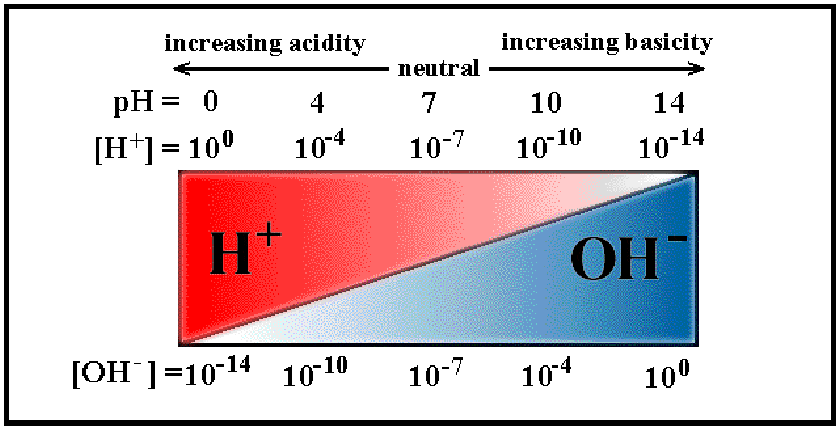
True or false: a neutral solution has equal amounts of H+ and OH-.
True
False
Which is true?
pH of less than 7 is basic; pH of more than 7 is acidic
pH of less than 7 is acidic; pH of more than 7 is basic
NaOH may be found in drain cleaners and as a component of soaps. Is NaOH an acid or a base?
Acid
Base
Neither (Neutral)

The picture below shows the relative concentrations of H+ and OH- in a solution. Is the solution an acid or a base?
acid
base
For a solution, pH + pOH =
7
14
1.0 x 10⁻¹⁴
-log (1.0 x 10 -14)
If the pH of a solution is 4.0, what is the pOH?
4.0
10.0
1.0 x 10 -4
cannot be determined from the information
The pH of a solution is 8.43. What is the [H+]concentration?
3.7 x 10 -9
1.0 x 10-8.43
2.7 x 10⁻⁶
1.0 x 10⁻¹⁴
If the [OH-] of a solution is 2.7 x 10⁻⁴ M, the pOH of the solution is
10.44
1.00
3.57
-4.43
If the [H+] of a solution is 6.8 x 10⁻⁸ M, the pH is
7.17
3.2 x 10⁻⁵
7.2
7.62
If the [H+] of a solution is 9.3 x 10⁻³ M, the pOH of the solution will be
2.03
1.02
11.97
12.98
If a solution has a pOH of 3.7 the [OH-] of the solution is
5.0 x 10⁻¹¹
2.0 x 10⁻⁴
10.3
14
Oranges have a [H+] of 1.7 x 10⁻² M. Their pOH is
1.77
12.23
10.91
3.09
Ammonia has a pOH of 2. Ammonia is a(n) __________.
acid
base
neutral
metal
Find the pH of a solution with [OH-] = 8.41 x 10⁻⁴.
3.08
10.92
9.88
11.23
What is the [OH-] if the [H+] is 1.0 x 10⁻³M?
1.0 x 10⁻³ M
1.0 x 10⁻¹⁴ M
6.02 x 10⁻²³ M
1.0 x 10⁻¹¹ M
If a solution has a [OH-] of 2.3x10⁻⁴, it must be a(n)...
Acid
Base
Neutral
If the pOH is 11.0, the pH will be _____ and the solution will be ______.
11.0, acidic
11.0, basic
3.0, acidic
3.0, basic
If a solution has a pH of 1 what is the pOH? Is it an acid or base? (pick 2)
acid
base
13
15
neutral

