
 Worksheets
Forces and Motion HMH Review
Total questions: 123
Worksheet time: 2hrs 32mins


The illustration shows the forces in Newtons (N) acting on three different blocks. Which boxes will move under these conditions?
Blocks 1 and 2
Blocks 2 and 3
Blocks 1 and 3
Blocks 1, 2 and 3
According to Newton’s Third Law, if someone jumps off a skateboard, the skateboard will roll backwards because -
the mass of the skateboard is the same as the mass of the person jumping off.
the pull of gravity on the person is the same as on the skateboard, regardless of size.
the air resistance on the person is great and the friction on the skateboard is small.
for the force that sent the person forward, there is an equal force pushing back on the skateboard.

The nozzle of a rocket is pointed downward so that as fuel is ignited, the exhaust pushes downward. Why is this arrangement necessary for a rocket to function properly?
The rocket is protected from the heat of the exhaust.
Burned fuel can be collected on the ground.
As fuel is combusted, the rocket pushes the gases backward and the gases push the rocket forward.
This allows the rocket to be steered properly.

Newton's third law describes action and reaction forces. A table of four scenarios is provided. Which of the scenarios described in the table show equal and opposite reaction forces?
The rocket and balloon
The rocket and train
The balloon and girl
The train and girl

The head of a hammer is often made of steel. This makes the head heavy,which helps create a strong force for driving nails. Steel is also strong. The head of a hammer must be strong to resist what force?
The force of the air resistance on the moving hammer
The force of the person using the hammer
The force of gravity pulling down on the hammer
The force of the nail pushing in the opposite direction

The illustration shows all the forces in Newtons (N) acting on a box.In what direction will the box move and how much NET FORCE moved the box?
to the right with a strength of 11 N
to the left with a strength of 7 N
to the right with a strength of 25 N
to the left with a strength of 6 N

Which of the following changes to the setup would result in a larger force reading on the spring scale?
Sliding the block 60cm
Using a 50g mass
Using a circular block of wood

In order to vary the amount of force acting on the rocket, which of the following should the students change in each trial?
The length of the hose attached to the pump
The distance traveled by the rocket
The amount of air pumped into the rocket
The height of the rocket from fins to cone

Which of the following graphs shows how the mass of an object affects the amount of force needed to move it?
A
B
C
D
A baseball bat hits a baseball with a force of 100 Newtons. What is the force and direction exerted by the ball on the bat?
100 Newtons, same direction
100 Newtons, opposite direction
200 Newtons, same direction
200 Newtons, opposite direction
There is a 100g rock and a 150g rock. You want to push them both 10m. Which one will require more force? Why?
The 100 g rocker because it is lighter
The 150g rock because it is heavier
A boulder sits not moving on top of a mountain. Are the forces acting on the boulder balanced or unbalanced?
Balanced
Unbalanced
which law of motion is demonstrated by a ball rolling to a wall and then stopping?
1st law
2nd law
3rd law
none of this apply to the situation
which of these can represent the 3rd law of newton??


none of the shown above
True or False: Your weight would be the same on the Moon as it is on the Earth.
true
none
false
Four boxes are sliding with constant speed before each box experiences an unbalanced force of 8 N. Which box would experience the greatest acceleration when the unbalanced force is applied?
The box with a mass of 2 kg
The box with a mass of 4 kg
The box with a mass of 6 kg
The box with a mass of 8 kg
the more mass an object has, the more...
intertia
gravity
acceleration
distance
How much force is required to get a 1000kg car to accelerate 2 m/s/s?
F=m*a
2000N
1000N
500N
25N
How much force is does a 5kg ball have when dropped (the acceleration due to gravity is 9.8 m/s/s)
98N
49N
142N
2.2N
Earth's acceleration due to gravity is...
2.2 m/s/s
29.2 m/s/s
0.28 m/s/s
9.8 m/s/s
Is the change in position with respect to a reference point.
Speed
Force
Motion
What keeps the planets in orbit around the sun?
gravity
friction
density
distance
Gravity is a...
Superhero
Force
Place in Alaska
Force:
push in one direction
pull in one direction
push or pull in one direction
none of the above
Force:
push in one direction
pull in one direction
push or pull in one direction
none of the above
The sum of all the forces acting on an object is:
Newton
Net Force
N
0
In a balanced force, the net force is
N
0
425
infinite
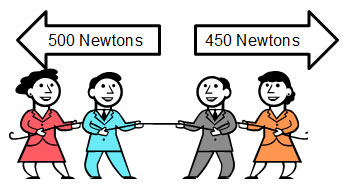
Describe the photo.
Forces are unbalanced
Forces are balanced
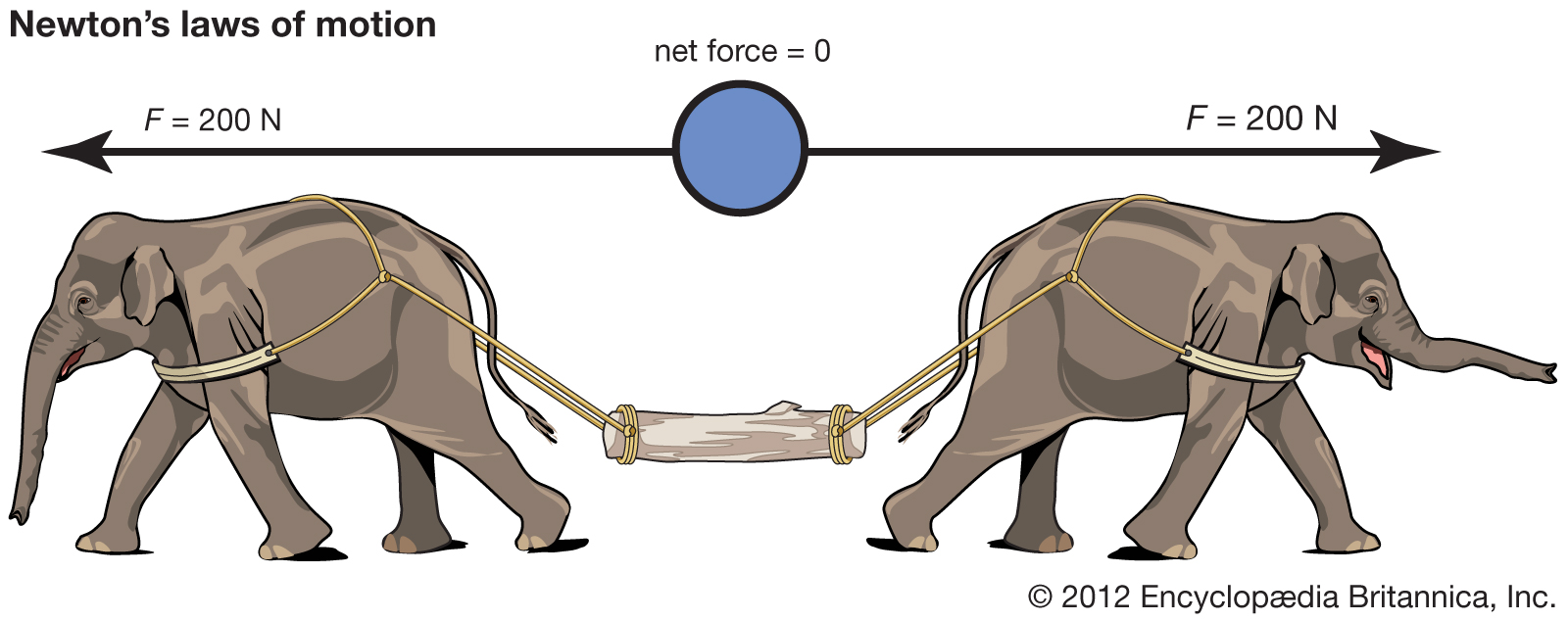
Which is the most likely result of the forces on the rope shown in the image?
The rope will not move because the forces are unbalanced.
The rope will not move because the forces are balanced.
The rope will move to the left because the forces are balanced.
The rope will move to right because the forces unbalanced.
We are pulled to Earth because of magnet force.
True
False
Our weight is the result of
magnets
the moon
gravitational pull
mass


The main reason a baseball comes down when a boy tosses it up into the air is —
magnetism is pulling the ball down
the boy cannot see to catch it
gravity is pulling down on the ball
gravity pushes the ball in the air


After the swing is released, what causes the swing to move toward you again?
Magnetism
Air
Resistance
Gravity

The magnet will attract all of the following EXCEPT ―
nail
another magnet
scissors
a penny

The boy's brother comes up to the other end of the wagon and pushes it forward.
What happens to the motion of the wagon?
It will slow down.
It will stop.
It will speed up.
It will move backwards.

The boy's brother comes up to the other end of the wagon and pulls it gently backward. What happens to the motion of the wagon?
It will speed up.
It will turn to the side.
it will slow down.

When a person pulls down on the rope, how will the box move.
The box will move down.
The box will not move at all.
The box will move up.

A student released a tennis ball at the top of a ramp and it rolled straight into another tennis ball at the bottom of the ramp, as shown below.
Which arrow shows the direction the ball at the bottom of the ramp will move?


How does friction affect the motion of an object?
Friction causes the object to move faster.
Friction causes the object to move slower.
Friction causes the object to not move.
Friction causes the object to spin.

A student is conducting an investigation to see how close different types of magnets need to get to a metal paperclip before the paperclip is attracted to the magnet. Use the results of her investigation to answer the following question.
Why did the student test each of the magnets three times?AShe had extra time in class.BMagnets are fun to play with.CIt makes her answers more reliable.DShe was collecting data for a friend.
She had extra time in class.
Magnets are fun to play with.
It makes answers more reliable.
She was collecting data for a friend.
Imagine you had to lift a heavy box into the back of a truck.What could you use to make the job easier? Explain how your choice of objects would make the job easier.
A ramp. This would allow you to push the box up the ramp without having to physically pick it up.
A pulley. This would allow you to lift things into the air.
A lever. This would allow you to lift one side.
Is the change in position with respect to a reference point.
Speed
Force
Motion
The position of an object and its motion depends on the:
Force point
Reference point
Speed point
From the point of view of an observer sitting on a moving bus:
(select the correct answer)
The bus seats are moving.
If a person walks down the aisle on the bus is not moving.
The trees and mountains the observer can see outside the bus are moving.
From the point of view of an observer sitting on a moving bus:
(select the correct answer)
A car traveling beside the bus at a faster speed isn't moving.
A car traveling beside the bus at exactly the same speed isn't moving.
A car traveling beside the bus at a slower speed isn't moving.

A train is moving at 30 miles per hour to the north. A person on that train is walking 5 mile per hour to the north. To Dominick watching this OUTSIDE OF THE TRAIN, the person walking on the train is moving
25 miles per hour to the north
30 miles per hour to the north
35 miles per hour to the north
no way to tell
A train is moving at 30 miles per hour to the north. A person on that train is walking 5 mile per hour to the north. To Jessica watching this ON THE TRAIN, the person walking is moving
5 miles per hour to the north
30 miles per hour to the north
35 miles per hour to the north
the person is not moving at all
Newton has...
One Law of Motion
Two Laws of motion
Three Laws of Motion
So many Laws of Motion
80 km / 4 hours =
10 km/hr
20 km/hr
40 km/hr
80 km/hr
What keeps the planets in orbit around the sun?
gravity
friction
density
distance
A brick and a pencil are dropped at the same time from the same height. Which one would hit the ground first?
brick
pencil
both would hit at the same time
What two things determine the gravity of an object?
mass & weight
mass & distance
density & mass
volume & distance
When will the forces of gravity between two objects be the GREATEST?
when the masses of both objects are small and the objects are far apart
when the masses of both objects are large and the objects are close together
when the masses of both objects are small and the objects are close together
when the masses of both objects are large and the objects are far apart
When will the gravity between two objects be the LEAST?
when the masses of both objects is small and the objects are close together
when the masses of both objects is small and the objects are far apart
when the masses of both objects is large and the objects are close together
when the masses of both objects is large and the objects are far apart
When you drop a hammer and a feather, why does the feather fall slower?
air resistance causes the feather to slow down
gravity pulls harder on the hammer than the feather
gravity pulls harder on the feather than the hammer
air resistance causes the hammer to fall slower
Which statement about gravity is true?
gravity causes objects to pull towards one another
gravity causes objects to push away from each other
gravity only takes place between planets
the moon doesn't have any gravity
The acceleration due to gravity is...
9.8 m/ s2
20 m/ s2
0.0m/ s2
24 m/ s2
What is the equation for force?
Force = mass / acceleration
Force = mass / volume
Force = speed / acceleration
Force = density / shape
What is the equation for weight?
Weight = mass / speed
Weight = mass * gravity
Weight = mass * volume
Weight = mass / pounds
Units for weight
Newtons
Kilograms
Grams
meters / second
Units for mass
meters per second
meters
kilograms
mass/mass

Which two of these forces act on parachutes?
Air Resistance
Gravity
Thrust
Kinetic Energy
What causes an object to fall faster?
Smaller surface area
Larger surface area
If it has a parachute
If it is softer
Another name for air resistance is...
Buoyancy
Streamline
Gravity
Drag

The larger the surface area of the moving object, the ___________ air resistance there is.
Less
More
Longer
Quicker
Air resistance pushes against falling
objects and __________________.
Speeds them up
Keeps them afloat
Slows them down
Spins them
The larger the parachute the ____________
Less air resistance
More surface tension
Less drag
More drag
Which has more air resistance?


When dropped from the same distance, which will fall to the floor faster?


Gravity is a...
Superhero
Force
Place in Alaska


Which of the following will NOT change in different gravities?

Which of the following WILL change with different gravitational forces?
the mass of an object
the amount of matter in an object
the weight of an object
the kilograms of an object

The force of gravity on Jupiter is a about 2 times the gravitational force on Earth. If an object has a mass of 50 kg and a weight of 490 N on Earth, what would be the object's approximate mass and weight on Jupiter?

Scientists measure weight and force using which unit?
Meters/Second
Kilograms

Weight = mass (kg) X gravity (9.8 m/s/s)
What is the weight, in Newtons, of a person with a mass of 80kg on Earth?
784 N
78.4 N
2,000 kg
80 m/s

If all three balls have the same mass and size, which statement is true?
Gravity exerts almost the same exact force on all three balls
Each ball is equally attracted by gravity to the other balls and Earth
If all three balls have the same mass and size, which statement is true?
Gravity is acting on the two balls highest in the air, but not one one closest to the person's hand
All the balls experience similar amounts of air resistance as they move
Say the juggler shown replaces the balls with neck scarves. How would the motion of the scarves be different than the balls?
The scarves would fall slower because they are lighter than the balls
The scarves would fall slower because they experience more air resistance than the balls
The scarves will fall at the same time as the balls
What TWO ways can you increase gravitational attraction between two objects?
Give the objects more mass
Make the objects closer to each other
Give the objects less mass
Make the objects further to each other
If someone has a mass of 200 N on Earth and they go to a planet that has a gravitational attraction THREE TIMES stronger than Earth's, what is the person's weight on the new planet?
200 N
400 N
600 N
800 N
If air resistance and friction were removed, a hammer and a feather would fall
at different rates
the same rate

On what planet will this rover have the greatest MASS?
Mars
Earth
Jupiter
they are all the same
On what planet will this rover have the greatest WEIGHT?
Mercury
Venus
Saturn
they are all the same

