wayground logo

Free Printable Worksheets

Font size

S
M
L
XL
Worksheets

Meteorology SOL Review

Total questions: 124

Worksheet time: 2hrs 31mins

Name
Class
Date
1.

Which layer of the atmosphere contains the ionosphere?

a)

troposphere

b)

stratosphere

c)

mesosphere

d)

thermosphere

2.

Which layer of the atmosphere contains the ozone?

a)

troposphere

b)

stratosphere

c)

mesosphere

d)

thermosphere

3.

Temperature increases with height in the ______ due to the ozone trapping heat.

a)

troposphere

b)

stratosphere

c)

mesosphere

d)

thermosphere

4.

Which prevailing wind can be found between 30 and 60 degrees latitude?

a)

trade winds

b)

horse winds

c)

eaterlies

d)

westerlies

5.

Which prevailing wind can be found between 60 and 90 degrees latitude?

a)

trade winds

b)

horse winds

c)

eaterlies

d)

westerlies

6.

Which prevailing wind can be found between 0 and 30 degrees latitude?

a)

trade winds

b)

horse winds

c)

eaterlies

d)

westerlies

7.

Which gas makes up the largest portion of air?

a)

oxygen

b)

nitrogen

c)

carbon dioxide

d)

methane

8.

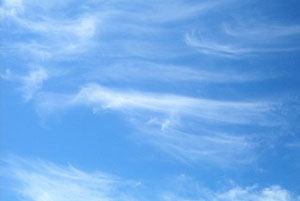
Which type of cloud is this?

a)

cirrus

b)

stratus

c)

cumulus

9.

Which type of cloud is this?

a)

cirrus

b)

stratus

c)

cumulus

10.

Which type of cloud is this?

a)

cirrus

b)

stratus

c)

cumulus

11.

Which process will increase the levels of CO2 in the atmosphere?

a)

cellular respiration by plants and animals

b)

Factory emissions

c)

Photosynthesis

d)

Sunlight

12.

Greenhouse gases include which of the following? (multiple answers)

a)

methane

b)

water vapor

c)

oxygen

d)

carbon dioxide

13.

If we were to suddenly have twice as many trees on the planet as we do now, what do you hypothesize might happen?

a)

oxygen levels would decrease due to more photosynthesis

b)

oxygen levels would stay the same

c)

carbon dioxide would decrease due to more photosynthesis

d)

carbon dioxide would increase due to trees using up all the water

14.
The layers of the atmosphere in order from bottom to top are
a)
troposphere, stratosphere, mesosphere, thermosphere, exosphere
b)
troposphere, mesosphere, atmosphere, thermosphere
c)
mesosphere, thermosphere, troposphere, stratosphere, exosphere
d)
thermosphere, stratosphere, mesosphere, troposphere, exosphere
15.
A lava lamp with putty which heats, flows to the top, cools, then flows to the bottom is an example of:
a)
conduction
b)
convection
c)
radiation
16.
Thermal energy ALWAYS moves from _____ to _____.
a)
solid to liquid
b)
ice to water
c)
hot to cold
d)
solid to gas
17.
Heat from the sun travels to Earth by _____.
a)
conduction
b)
convection
c)
insulation
d)
radiation
18.
A measure of the amount of water vapor in the air is called what?
a)
Rigidity
b)
Moisture
c)
Humidity
d)
Fog
19.

According to the diagram, what can happen when solar energy hits clouds in Earth's atmosphere?

a)

it can be reflected or absorbed

b)

it can only be absorbed

c)

it can only be reflected

d)

it is neither reflected nor absorbed

20.

True or False:

An unbalanced energy budget can increase or decrease global temperatures and disrupt the balance of energy in Earth's system.

a)

True

b)

False

21.

What 2 things can disturb the Earth's energy budget?

a)

decrease in greenhouse gases

b)

increase in polar ice caps

c)

increase in greenhouse gases

d)

decrease in polar ice caps

22.

What amount of incoming solar energy is absorbed by Earth's surface?

a)

23%

b)

51%

c)

49%

d)

15%

23.
A force applied by the weight of air
a)
cold front
b)
air pressure
c)
barometer
d)
humidity
24.
An instrument that measures air pressure
a)
thermometer
b)
barometer
c)
rain guage
d)
wind sock
25.

this tool measures wind speed

a)

baromter

b)

thermometer

c)

hygometer

d)

anemometer

26.

What instrument measures the humidity?

a)

anemometer

b)

rain gauge

c)

barometer

d)

hygrometer

27.

The rotation of the Earth causes winds to bend due to the...

a)

coriolis effect

b)

doldrums

c)

trade winds

d)

westerlies

28.

Cooler air sinks at 300 latitude causing a windless area known as...

a)

doldrums

b)

horse latitudes

c)

polar easterlies

d)

westerlies

29.

Earth's rain-forests are located along these areas of low pressure at the equator and 600

a)

Horse Latitudes

b)

Doldrums

c)

Westerlies

d)

Easterlies

30.

Warm rising air causes___________ pressure, resulting in ___________.

a)

high, rain

b)

low, rain

c)

high, clear skies

d)

low, clear skies

31.

Cool sinking air causes___________ pressure, resulting in ___________.

a)

high, rain

b)

low, rain

c)

high, clear skies

d)

low, clear skies

32.

Winds always blow from areas of _________ pressure to areas of _________ pressure.

a)

high, high

b)

low, low

c)

low, high

d)

high, low

33.

Most of Earth's largest deserts are located at...

a)

0 degrees latitude

b)

30 degrees latitude

c)

60 degrees latitude

d)

90 degrees latitude

34.

Which heats up and cools more quickly?

a)

Land

b)

Sea

c)

They heat and cool equally

35.

Warm air going from the land to the water during night

Example: Cool air over the land sinks, warm air over the water rises

a)

Land Breeze

b)

Sea Breeze

36.

Warm air going from the water to land during the day

Example: Cool air over the water sinks, warm air over the land rises

a)

Land Breeze

b)

Sea Breeze

37.

Air in a low pressure system moves

a)

clockwise

b)

counterclockwise

38.

Air in a low pressure system moves

a)

outward

b)

inward

39.

Air in a high pressure system moves...

a)

clockwise

b)

counterclockwise

40.

Air in a high pressure system moves...

a)

outward

b)

inward

41.

If the air pressure reading is falling

a)

a storm is approaching

b)

the weather is improving

42.

heavier, sinking air

a)

high pressure

b)

low pressure

43.

Warm air can hold ______________________ moisture (water) than cool air.

a)

more

b)

less

c)

the same amount of

44.

Cold air can hold ______________ moisture (water) than warm air.

a)

more

b)

less

c)

the same amount of

45.

What is the name of the person who studies the weather?

a)

astronomer

b)

meteorologist

c)

hurricanologist

d)

geologist

46.
What front is about to move through the NW part of the US?
a)
Stationary
b)
Warm
c)
Occluded
d)
Cold
47.
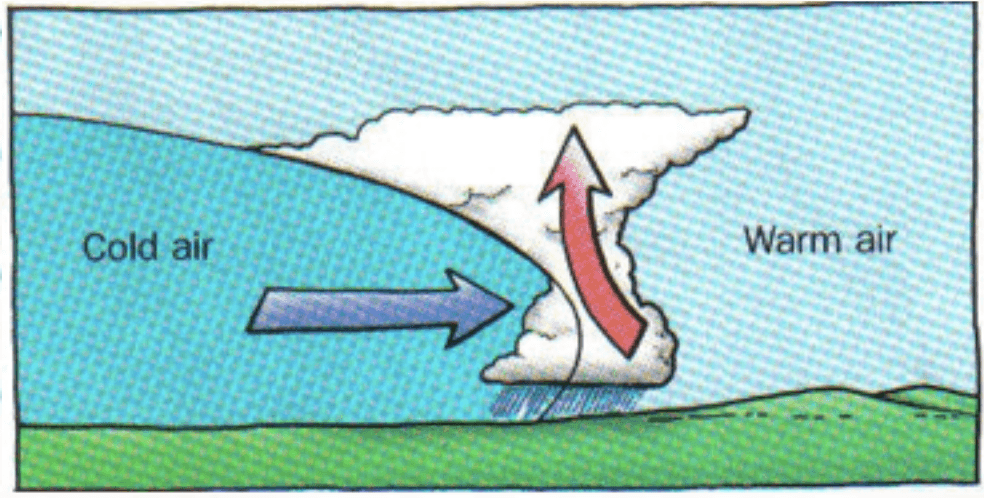
Name the front.
a)
cold front
b)
occluded front
c)
stationary front
d)
warm front
48.
What does the and stand for on the weather map?
a)
high and low pressure systems
b)
heat and land regions
c)
heavy and local winds
d)
high and long distances
49.
What type of weather will central Texas have in the next couple of hours?
a)
Low pressure with cool and dry weather
b)
Low pressure with stormy weather.
c)
High pressure with cold clear skys
50.
The polar jet stream is a strong wind current that travels through Canada and the United States. The average winter temperature in Dallas, Texas, is 19°C. Why would the temperature measure 5°C for Dallas, Texas, on this day in January?
a)
The polar jet stream dipped south of Dallas, bringing cold air from the Arctic region.
b)
The polar jet stream dipped east of Dallas, bringing cold air from the Pacific ocean.
c)
The polar jet stream got faster and rose, bringing warm air up into the atmosphere,lowering the ground temperature.
d)
The polar jet stream got slower and sank, bringing cold air down from the upperatmosphere, lowering the ground temperature.
51.
Thunderstorms are more common in some areas than in others. The map shows the average number of lightning strikes in different pars of the US. Why are there significantly more lightning strikes in Florida than California?
a)
Florida is smaller
b)
Air in Florida is more stable
c)
Air above Florida holds less moisture
d)
ocean currents near Florida are warmer
52.
What area is experiencing clear skies and calm air
a)
Great Lakes
b)
West Coast
c)
Gulf of Mexico
d)
Plains States
53.
Which direction does weather generally move across the US?
a)
N to S
b)
W to E
c)
S to E
d)
E to W
54.

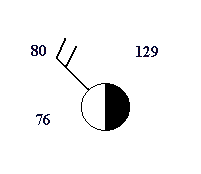
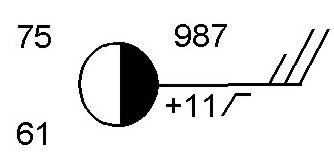
What is the temperature for the following station model?

a)

4 ºF

b)

76 ºF

c)

80 ºF

d)

129 ºF

55.

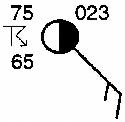
What is the dewpoint for the following station model?

a)

10 ºF

b)

23 ºF

c)

65 ºF

d)

75 ºF

56.

What is the present weather for the following station model?

a)

rain

b)

thunderstorms

c)

drizzle

d)

fog

57.

What is the wind direction for the following station model?

a)

north

b)

east

c)

northwest

d)

northeast

58.

What is the barometric pressure for the following station model?

a)

987 mb

b)

998.7 mb

c)

1098.7 mb

d)

1098 mb

59.

What is the amount of cloud cover for the following station model?

a)

25%

b)

50%

c)

75%

d)

100%

60.

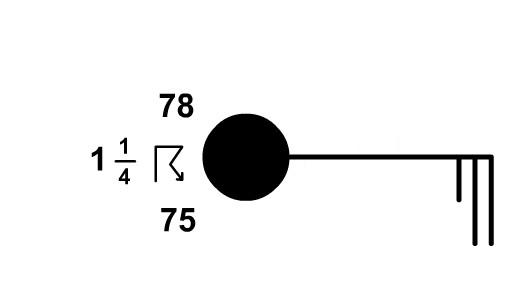
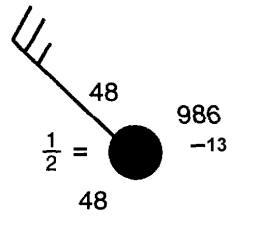
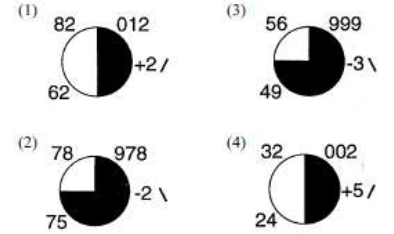
Which weather station shows the highest relative humidity?

a)

1

b)

2

c)

3

d)

4

61.

Where do MARITIME air masses form?

a)

Over water

b)

Over land

62.

Where do CONTINENTAL air masses form?

a)

Over water

b)

Over land

63.

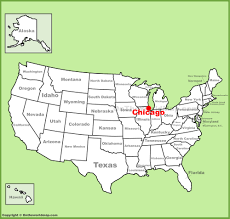
What type of air mass is found over CHICAGO?

a)

Maritime Polar

b)

Maritime Tropical

c)

Continental Polar

d)

Continental Tropical

64.

What type of air mass is found over the UNITED KINGDOM?

a)

Maritime Polar

b)

Maritime Tropical

c)

Continental Polar

d)

Continental Tropical

65.

What type of air mass is found over EGYPT?

a)

Maritime Polar

b)

Maritime Tropical

c)

Continental Polar

d)

Continental Tropical

66.

Air masses have properties from where they...

a)

were formed

b)

end up

67.

An air mass is a portion of the atmosphere that has similar...

a)

Water and temperature

b)

Air pressure and wind speed

c)

Humidity and temperature

d)

Humidity and air pressure

68.

Which air mass would be classified as Maritime Polar (mP)?

a)

purple

b)

green

c)

blue

d)

yellow

e)

red

69.

Which air mass is higher in humidity?

a)

purple

b)

blue

70.

Which air mass is warmer?

a)

red

b)

yellow

71.

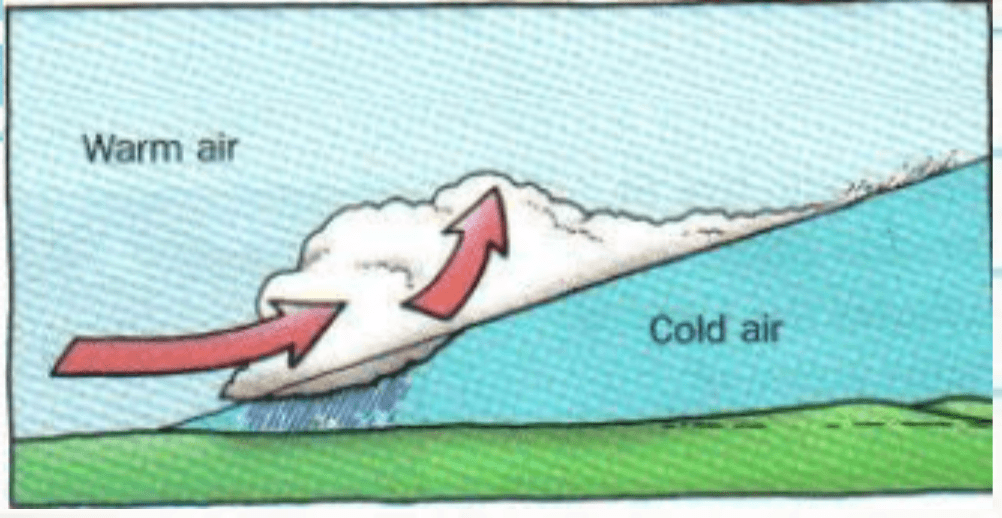
Name that front.

a)

Cold Front

b)

Warm Front

c)

Stationary Front

d)

Occluded Front

72.

Name that front.

a)

Cold Front

b)

Warm Front

c)

Stationary Front

d)

Occluded Front

73.
In a high pressure systems
a)
there are few clouds because the air in moving downward
b)
there are many clouds because the air is very humid
c)
there are few clouds because the air is moving outward
d)
there are many clouds because the air is moving upward
74.
A front is
a)
where warm air is cooling at earth's surface
b)
a line where hot and cold air are separating
c)
a line where two different air masses meet
d)
where cold air is rising and forming rain clouds
75.
This is the symbol for which type of front?
a)
cold front
b)
warm front
c)
stationary front
d)
occluded front
76.
This is the symbol for which type of front?
a)
cold front
b)
warm front
c)
occluded front
d)
stationary front
77.
Located at the leading edge of a temperature drop off. Bring heavy thunderstorms, rain, and hail. Cool, fair weather is likely to follow.  
a)
Warm Front
b)
Cold Front
c)
Occluded Front
d)
Stationary Front 
78.
Located at the leading edge of a warm air mass. Brings gentle rain or light snow, followed by warmer, milder weather.  
a)
Warm Front
b)
Cold Front 
c)
Occluded Front 
d)
Stationary Front 
79.
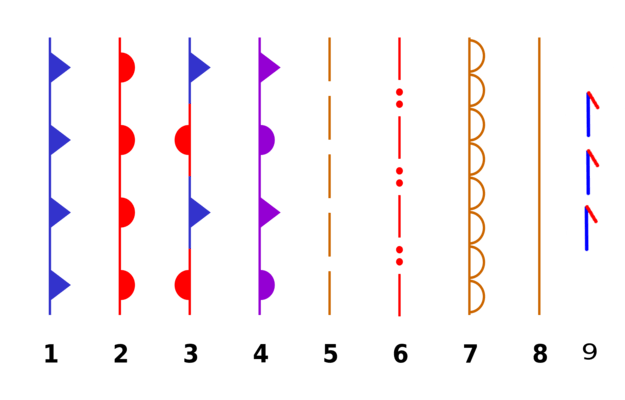
What does symbol # 3 mean?
a)
stationary front
b)
occluded front
c)
warm front
d)
cold front
80.
Which type of front is associated with purple humps and triangles facing the same direction?
a)
Cold
b)
Warm
c)
Stationary
d)
Occluded
81.
This type of cloud is thin, wispy, and made of ice crystals
a)
cumulus cloud
b)
stratus cloud
c)
cirrus cloud
d)
cumulonimbus cloud
82.
What type of clouds are called "fair weather clouds" and look like floating cotton?
a)
Cumulus
b)
Stratus
c)
Nimbus
d)
Cumulonimbus
83.
Name the two types of low level clouds
a)
Altostratus and Altocumulus
b)
Cirrus and Cumulus
c)
Cirrocumulus and Cumulonimbus
d)
Stratus and Nimbostratus
84.

What are clouds made out of?

a)

Molecules of pure oxygen

b)

ozone and carbon dioxide

c)

water droplets, dust, and smoke particles

d)

78% nitrogen, 21% oxygen, and 1% other gases

85.

The dew point is

a)

the point at which water vapor evaporates.

b)

the point at which water vapor condenses.

c)

the point at which hail starts.

d)

the point that water vapor becomes saturated.

86.
Nimbostratus and cumulonimbus clouds can signal what type of upcoming weather?
a)
fair skies
b)
hot, sunny weather
c)
windy weather
d)
rainy weather
87.
Which of the following is an example of a cloud of vertical development?
a)
nimbostratus cloud
b)
cumulonimbus cloud
c)
cirrus cloud
d)
stratus cloud
88.
What type of cloud is fog an example of?
a)
Nimbus
b)
Stratus
c)
Cirrus
d)
Cumulus
89.

What scale is used to categorize hurricanes?

a)

metric scale

b)

numeric scale

c)

Saffir-Simpson Scale

d)

Fujita F Scale

90.

In which type of storm does a storm surge occur?

a)

hurricanes

b)

flash floods

c)

water spouts

d)

thunderstorms

91.

A typhoon is another name for a....

a)

hurricane

b)

tsunami

c)

earthquake

d)

flash flood

92.

Excess rain or a dam failure can cause a...

a)

flash flood

b)

hurricane

c)

dust storm

d)

water spout

93.

What causes a dust storm?

a)

being in a desert

b)

strong winds blowing over loose topsoil

c)

earthquakes

d)

land slides

94.

What is Tornado Alley?

a)

a popular restaurant

b)

a ride at Disney

c)

where most of America's tornadoes occur

d)

a valley where most of America's tornadoes occur

95.

Moisture, lift, and unstable air cause...

a)

tornadoes

b)

thunderstorms

c)

blizzards

d)

hurricanes

96.

A strong, severe thunderstorm is called a...

a)

Mega Storm

b)

Super Storm

c)

Super cell

97.

A blizzard is caused by...

a)

warm air going over cold air

b)

cold air going over warm air

c)

the polar vortex

98.

Cold front and warm front meet over land. Cold air pushes warm air up quickly in a rotating motion. This can create a...

a)

tornado.

b)

hurricane.

c)

winter storm.

d)

drought.

99.

Hurricanes usually form over _____________ water.

a)

cold

b)

warm

c)

freezing

d)

no

100.

Which type of cloud and front is associated with a thunderstorm?

a)

cumulonimbus clouds and a stationary front

b)

cumulus clouds and a warm front

c)

cumulonimbus clouds and a cold front

d)

cirrus clouds and an occluded front

101.

Which type of air mass and water temperature would cause a strong hurricane?

a)

continental polar

b)

maritime polar

c)

maritime tropical

d)

continental tropical

102.

What causes the air of a tropical storm to rotate?

a)

the Coriolis effect

b)

supercells

c)

funnel clouds

d)

strong downwinds

103.

What causes thunder?

a)

falling precipitation

b)

the expansion and contraction of the air heated by lightning

c)

friction between updrafts and downdrafts in a cumulonimbus cloud

d)

condensation of updrafts

104.

What is the calm center of a hurricane called?

a)

funnel cloud

b)

downburst

c)

eyewall

d)

eye

105.

What type of weather phenomenon is shown in the figure?

a)

a supercell

b)

a conduction cell

c)

a sea breeze

d)

a cyclone

106.

Which is NOT a characteristic of the Fujita tornado intensity scale?

a)

wind speed

b)

duration

c)

size of funnel cloud

d)

destruction

107.
a)
hurricane
b)
tornado
c)
thunderstorm
108.
a)
hurricane
b)
tornado
c)
thunderstorm
109.
a)
hurricane
b)
tornado
c)
thunderstorm
110.
In which position is it Spring in the Northern Hemisphere?
a)
1
b)
2
c)
3
d)
4
111.
In which position is it summer in the Northern Hemisphere?
a)
1
b)
2
c)
3
d)
4
112.
Which of the following does NOT have an affect on a region's climate?
a)
Large bodies of water
b)
Latitude
c)
Mountains
d)
Longitude
113.
Which of the following is NOT a natural cause of climate change?
a)
pollution
b)
meteorite collisions
c)
solar spots
d)
Volcanic eruptions
114.
How does latitude influence climate?
a)
The closer you are to the equator the higher the temp
b)
Winds bring rain to the coast from the seas
c)
The higher the altitude the colder the temperature
d)
Ocean Currents affect precipitation
115.
The height of an object or point in relation to sea level or ground level.
a)
Proximity
b)
Altitude
c)
Distribution
d)
Latitude
116.
How do ocean currents influence climate?
a)
Ocean currents influence the waves of the Ocean
b)
Ocean
c)
Ocean currents influence precipitation
117.
When the altitude increases; the temperature decreases
a)
True
b)
False
118.
What is the best explanation for these two statements?
1. Some mountains located near the Earth's Equator have snow-covered peaks. 
2. Icecaps exist at the Earth's poles.
a)
High elevation and high latitude have a similar effect on climate. 
b)
Both mountain and polar regions have arid climates.
c)
Mountain and polar regions receive more energy from the Sun than other regions.
d)
An increase in snowfall and an increase in temperature have a similar effect on climate. 
119.
What effect does a large body of water usually have on a nearby landmass?
a)
The water causes cooler summers and colder winters. 
b)
The water causes cooler summers and warmer winters. 
c)
The water causes hotter summers and warmer winters. 
d)
The water causes warmer summers and colder winters. 
120.
Large bodies of water affect climate of the land next to them because
a)
water heats up and cools more slowly than land
b)
water heats up and cools faster than land
c)
water and land cool at the same time
d)
water and land heat at the same rate
121.
Two factors to determine climate are
a)
precipitation and temperature
b)
hurricanes and tornadoes
c)
humidity and pressure
122.

The _______ of a mountain range is the side that receives a lot of precipitation.

a)

windward side

b)

leeward side

123.
What are the 3 major climate zones in order from equator to the poles?
a)
polar, temperate, tropical
b)
tropical, temperate, polar
c)
temperate, polar, tropical
d)
temperate, tropical, polar
124.

Name the warming ocean current that passes west of the British Isles.

a)

the Gulf of Mexico

b)

the Atlantic current

c)

the Gulf Stream

d)

the convection current