
 Worksheets
Physics Sound and Light Review
Total questions: 61
Worksheet time: 15hrs 15mins
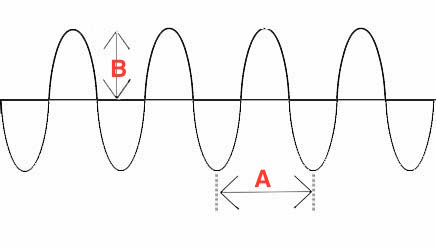
What property of this wave is represented by the letter "A"
amplitude
crest
trough
wavelength
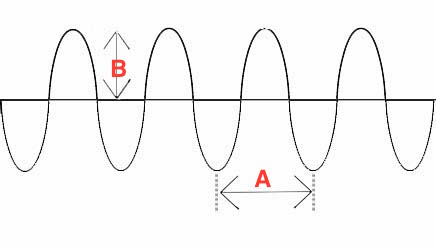
What property of the wave is represented by the letter "B"?
amplitude
crest
trough
wavelength
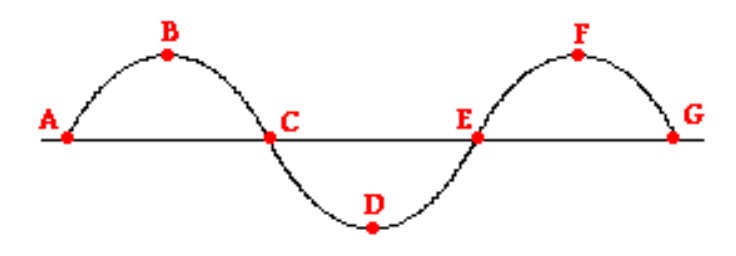
Which material does sound travel the fastest?
solid
liquid
gases

What is the approximate speed of sound at room temperature?
331 m/s
343 m/s
360 m/s
750 m/s
What is the decibels of a sound with an intensity of 0.006 W/m^2?
97.78 dB
6 x 10^9 dB
2.058 dB
1.7 x 10^-5 dB
If a sound was made at 120 dB, then what is the intensity of the sound? _____W/m^2
0
120
1
0.349
The threshold of hearing is 1.0 x 10^-12 W/m^2, what is the decibel level of this intensity?
1 dB
120 dB
0 dB
-1 dB
Given the loudness of the juniors at a pep rally is 20 dB, what is the intensity of the sound of the juniors?
2 x 10^13 W/m^2
100 W/m^2
1.0 x 10^-10 W/m^2
Cannot be determined
The harmonics which are present in a pipe ,open at one end are
odd harmonics
even harmonics
even as well as odd harmonics
no harmonics
A 1.5 m string is vibrating at its fundamental frequency of 440 Hz. What is the speed of the standing wave on the string? (treat as open pipe)
An open pipe of length 50.0 m has standing waves formed in it. What is the fundamental frequency of the waves?
0.583 Hz
0.291 Hz
3,43 Hz
1.715 Hz
An closed pipe of length 50.0 m has standing waves formed in it. What is the fundamental frequency of the waves?
0.583 Hz
0.291 Hz
3,43 Hz
1.715 Hz
The second harmonic of a guitar string has a frequency of 60 Hz. If the speed of waves on the string is 120 m/s, what is the string’s length? Treat as an open pipe
1.0 m
2.0 m
3.0 m
4.0 m

A lightyear is:
How much light the Sun gives off in one year.
A year in which very little happens.
The time it take light to travel the distance from the Sun to the Earth.
The distance light travels in one year.

The speed of light is:
300,000 km/sec
343 m/s
3.00e10 m/s
3,000,000 m/s

Which electromagnetic wave has the highest ENERGY?
Sound
Microwaves
X Rays
Gamma radiation

Different colors of light correspond to different light:
Wavelengths
Intensities
Amplitudes
Velocities
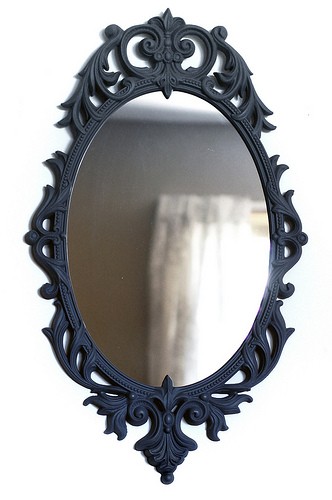

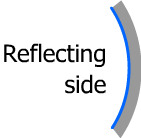
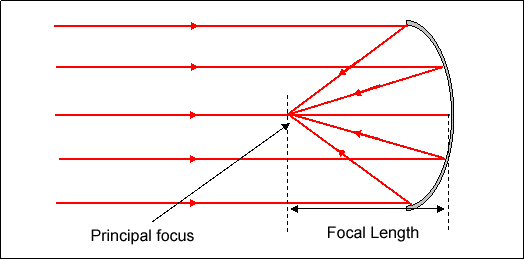
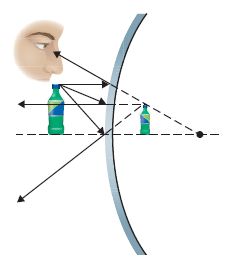
A dentist uses a small dental mirror to help magnify teeth in your mouth. What type of mirror is this?
a convex mirror
a concave mirror
a convex lens
a concave lens

An object is located 35.0 cm from a diverging lens. The lens forms an image at a distance of 15.0 cm. What is the focal length?
26.25 cm
10.5 cm
-26.25 cm
-10.5 cm
An object is located 35.0 cm from a converging lens. The lens forms a real image at a distance of 15.0 cm. What is the focal length?
0.0953 cm
10.5 cm
26.2 cm
0.0678 cm
the bending of light
refraction
reflection
absorption
transparent

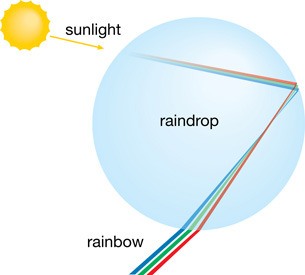
When will total internal reflection occur?
When light travels from a less dense to a more dense medium
When the angle of incidence is smaller than the critical angle
When the angle of incidence is greater than the critical angle
When the light cannot pass through a medium

The focal length of this lens is _______.
negative because it can form real images
positive because it can form real images
negative because it can form virtual images
could be positive or negative depending on the image formed

A person standing in front of a lens creates an image that is both smaller than the original and closer to the lens. Classify the image formed in this scenario.
real, inverted
real, upright
virtual, inverted
virtual, upright

Classify the image formed in this scenario.
real, inverted, larger than original
real, inverted, smaller than original
virtual, upright, larger than original
virtual, upright, smaller than original
If light travels from a higher to a lower index of refraction medium the light will
bend away from the vertical axis or may not refract
bend closer to the vertical axis
not bend
answer is not here
If light travels from a lower to a higher index of refraction medium the light will
bend away from the vertical axis
bend closer to the vertical axis
not bend
answer is not here

Light travels from air (n = 1.00) into a second material. The incident ray of light hits the surface at angle of 64o and the refracted ray enters the second material at an angle of 32o. What is the index of refraction of the second material? n1sin(Θ1) = n2sin(Θ2)
1.4
0.90
0.53
1.7
If a material has an index of refraction of 2.3, how fast will light travel through that material?
2.3 x 10⁸ m/s
6.9 x 10⁸ m/s
3.0 x 10⁸ m/s
1.3 x 10⁸ m/s
What is the speed of light in a material that has an index of refraction of 1.88?
3.0 x 10⁸ m/s
1.88 x 10⁸ m/s
1.6 x 10⁸ m/s
5.64 x 10⁸ m/s
What is the speed of light in a vacuum?
3.0 x 10⁸ m/s
1.0 x 10⁸ m/s
10 m/s
5.0 x 10⁸ m/s
There are certain angles of incidence for which the angle of refraction is close to 90°. What is this angle called?
Total internal angle
Critical angle
Reflection angle
Refracted angle

