
Font size
 Worksheets
Phys Spring Semester Final Exam Review
Total questions: 100
Worksheet time: 3hrs 43mins

As the angle of the incline increases, what happens to the normal force?
The normal force increases
The normal force decreases
The normal force is not affected by the incline
The normal force is only dependent on the force due to gravity

Given the free body diagram, which of the following must be true?
The frictional force must be accelerating the system to the left.
The box must be accelerating to the right.
The box must be moving to the right.
The FBD is incorrectly drawn. This situation isn't possible

Camille launches has a catapult that changes the velocity of a ball (m= 2 kg) from 0 to 10 m/s in one sec. What is the average force that is exerted on the ball during launch?
20 N
5 N
8 N
0.2 N

Which of the following statements is true about the image above?
The accelerations of the blocks will vary according to their mass
The net force acting on each block is the same
The blocks will experience the same acceleration
The 3m box will eat the 2m and the m boxes

Sam is hover boarding down they hall at a constant velocity. Assuming there is friction, which of the following must be true?
The force applied by the board must be greater than the frictional force
The frictional force must equal the force applied by the board
The force applied must equal zero
There is not enough information

If μk = 0.65 and μs = 0.7, acceleration would be equal to
0 m/s/s
9.8 m/s/s
3.35 m/s/s
-2.63 m/s/s


Three forces of equal magnitude act on the box shown. One force is upward, one downward, and one rightward. Which of the following statements must be true based on this information? Select two answers.
The box must have a rightward component of velocity.
The box has no vertical component of velocity.
The acceleration of the box is directed to the right.
The velocity of the box is changing with time.

A waitperson carrying a tray with a platter on it tips the tray at an angle of 12° below the horizontal. If the gravitational force on the platter is 5.0 N, what is the magnitude of the force parallel to the tray that tends to cause the platter to slide down the tray? (Disregard friction.)
0.42 N
4.9 N
1.0 N
5.0 N
Which of the following is the tendency of an object to maintain its state of motion?
acceleration
force
inertia
velocity
What causes a moving object to change direction?
acceleration
inertia
velocity
force
What happens to the mass of an object if you double the force pushing on it?
acceleration decreases
Mass will decrease
Mass will increase.
Mass will remain the same.
Pushing a child on a swing is easier than pushing an adult on the same swing would be an example of which law of motion?
1st law of motion
2nd law of motion
3rd law of motion
none of the above
What is the equation to find the normal force?
add all the forces together
Fn=logxy
Fn=ma
Fn=mgcosθ
What is the magnitude of the force of gravity on an object with a mass of 42.8 kg?
390 N
420 N
435 N
365 N
A rolling ball will move in a straight line at constant speed until an outside force causes it to move faster or slow down. Which of Newton's Laws of Motion applies?
1st Law of Motion
2nd Law of Motion
3rd Law of Motion
None of the Above
What is the tendency of an object to resist changing its state of motion?
Force
Inertia
Motion
Gravity
Inertia is proportional to the ______ of an object.
mass
acceleration
force
gravity
Which one of Newton's Laws says that for every action, there is an equal and opposite reaction?
1st law of motion
2nd law of motion
3rd law of motion
none of the above
What force is produced by a rope?
normal force
applied force
tension force
frictional force
Which type of surface will have the LEAST amount of friction?
Ice
Glass
Rubber
Sand paper
There are two type of friction: static friction and kinetic friction. Which best describes the type of friction being observed by the following object?
An table is being pushed, but remains at rest.
Static Friction
Kinetic Friction
What variable changes will cause an increase in friction force? Select TWO answers.
Moving an object from ice to rubber.
Decreasing the mass of the object.
Moving an object from rubber to ice.
Increasing the mass of the object.
A student wearing inline skates on a horizontal surface is pushed by a friend with a constant force of 45N. How far must the student be pushed, starting from rest, so that her final kinetic energy is 352 J?
7.8 m
51m
57m
6.4m


This bag is being pulled up without being moved. Which equation describes the forces?
Fg = Fhand - FN
FN = Fg + Fhand
Fhand = FN - Fg
Fg= FN + Fhand

Three boxes with given masses are resting on top of each other and they are all on the floor of a cupboard. The normal force acting on the blue box is ......
34.3 N
73.5 N
73.5 Kg
38.2 N

As the angle of the incline increases, what happens to the normal force?
The normal force increases
The normal force decreases
The normal force is not affected by the incline
The normal force is only dependent on the force due to gravity
If a system is isolated, the total energy of the system
Increases constantly.
Decreases constantly.
Is constant.
Depends on the work done on the system.
Depends on the work done by the system.
Which of the following is defined as an energy transfer?
kinetic energy
work
potential energy
chemical energy
The unit of work is
watt
hertz
joule
pascal

A light plastic cart and a heavy steel cart are both pushed with the same force for a distance of 1.0 m, starting from rest. After the force is removed, the kinetic energy of the light plastic cart is ________ that of the heavy steel cart.
greater than
equal to
less than
can't say unless we know how big the force is

Each of the boxes shown is pulled for 10 m across a level, frictionless floor by the force given. Which box experiences the greatest change in its kinetic energy?
A
B
C
D
E

Rank in order, from largest to smallest, the gravitational potential energies of the balls.
1 > 2 = 4 > 3
1 > 2 > 3 > 4
3 > 2 = 4 > 1
3 > 2 > 4 > 1

A small child slides down the four frictionless slides A–D. Rank in order, from largest to smallest, her speeds at the bottom.
vD > vA > vB > vC
vD > vA = vB > vC
vC > vA > vB > vD
vA = vB = vC = vD
You are traveling along a freeway at 65 mi/h; your car has kinetic energy. You suddenly skid to a stop because of congested traffic. What happened to the kinetic energy your car just had?
It is all in internal energy in the road
It is all in internal energy in the tires
Some of it has transformed to internal energy for the tires and the road, and some of it transferred away by sound energy and thermal energy into the air.
It was destroyed
A major league pitcher can throw a baseball with a kinetic energy of 150 J. How much work must the pitcher do to the ball to give it that much KE?
150 J
0
Can’t tell without knowing the mass of the ball
A rock has 10 J of potential energy on top of a roof. If it is dropped and lands with only 8 joules of kinetic energy, how much work did air resistance do on the rock?
-18 J
-10 J
-8 J
-2 J
In the equation PE = mgh, what does the “g” mean?
Acceleration due to gravity
Force of gravity
Weight of the object
Which requires more work – a person walking up stairs or a person running up stairs?
walking
running
they require equal work
no work is required for either because the movement is vertical
A basketball that is dropped bounces back up to its original height. Pick the correct energy transformation from the point when it was dropped until it returns to the original height.
KE --> PE --> Elastic
PE --> KE --> Elastic --> KE --> PE
KE --> PE --> Elastic --> PE --> KE
Elastic --> PE --> KE --> Elastic
How much work is done on a 200-kg crate that is hoisted 2 m in a time of 4 s?
400 J
1000 J
1600 J
4000 J
A person is lifted 24 meters by the elevator in a building. If the person has a mass of 74 kg, what is the
gravitational potential energy gained by the person?
15,465 J
12,436 J
17,423 J
14,235 J
14,086 J
Sara goes to her apartment on the fifth floor by elevator from the ground floor. The whole journey is 18.0
meters. If Sara has mass 60 kg, what is the gravitational potential energy gained by her? Estimate g as
9.81m/s2.
23985 J
10700 J
12365 J
10595 J
16745 J
Suppose that the potential energy of a body at a certain height is 200 J. If the body falls, what is its kinetic energy just as it reaches the ground?
O J
10O J
200 J
400 J
None of these
A roller coaster of mass 2000 kg is rolling down a track with an instantaneous speed 10 m/s. What is its kinetic
energy in Joules?
100,000 J
10,000 J
1,000 J
None of these
KE = 1080 J
KE = 810 J
A 290-N force is used to compress a spring. The spring constant of the spring is 5,880 N/m. How far is the spring compressed?
0.0050 m
0.049 m
0.31 m
20. m
A force of 50 N is required to hold an ideal spring stationary after the spring has been stretched 0.1 m from its equilibrium position. How much potential energy is stored in the stretched spring?
50 J
25 J
5.0 J
2.5 J
What forms of energy are involved in throwing a football?
kinetic energy
elastic potential energy
gravitational potential energy and elastic potential energy
kinetic energy and gravitational potential energy
What forms of energy are involved in winding a manual clock?
kinetic energy
elastic potential energy
gravitational potential energy and elastic potential energy
kinetic energy and gravitational potential energy
A student slides a 0.75 kg textbook across a table, and it comes to rest after traveling 1.2 m. Given that the coefficient of kinetic friction between the book and the table is 0.34, use the work-kinetic energy theorem to find the book's initial velocity.
2.8 m/s
4.12 m/s
3.7 m/s
1.9 m/s
Is work done by a crane lifting a bucket of concrete? If so, is the work positive or negative?
No work is done because gravity is pulling down on the bucket while lifting.
Yes, work is done and is positive because it is moving in the direction of displacement.
Yes, work is done but it is negative because gravity is pulling down on the bucket while lifting.
No work is done.
Is work done by a crane lifting a bucket of concrete? If so, is the work positive or negative?
No work is done because gravity is pulling down on the bucket while lifting.
Yes, work is done and is positive because it is moving in the direction of displacement.
Yes, work is done but it is negative because gravity is pulling down on the bucket while lifting.
No work is done.
Is work done by the force of gravity on a crane lifting a bucket of concrete? If so, is the work positive or negative?
No work is done because gravity is pulling down on the bucket while lifting.
Yes, work is done and is positive because it is moving in the direction of displacement.
Yes, work is done but it is negative because gravity is pulling down on the bucket while lifting.
No work is done.
A pendulum swings back and forth. Does the force of gravity do work on the bob?
The component of the bob's weight that is perpendicular to the bob's motion does work on the bob.
The component of the bob's weight that is in the direction of the bob's motion does work on the bob.
Only the tension force does work on the bob.
There is no work done in a swinging pendulum.
Heat necessary to change the phase or state of matter of a substance is called __.
internal energy
latent heat
kinetic energy
none of the above
Find the energy released by a 1 kg copper block when it is cooled from 100°C to 20°C. Given that the heat capacity of the block is 770 J/kg x°C-1.
7.70x10⁴ J
8.61x10⁴ J
6.16x10⁴ J
5.02x10⁴ J
Gas is trapped in a closed container. There exists gas pressure inside the container because gas molecules
move randomly.
move with equal speed.
collide with one another.
collide constantly with the walls of container.
If 5.0 x 10⁵ J of energy is absorbed by a block of ice when it is heated from -5oC to 0oC, find the mass of the ice.
Given that the specific heat capacity of ice is 2.05 x 10³ J kg-1 oC-1 and the specific latent heat of fusion of ice is 3.34 x 10⁵ J kg-1.
1.45 kg
2.56 kg
3.01 kg
3.27 kg
Latent heat is
the heat absorbed or released at a boiling process during a change of phase
the heat absorbed or released at a constant temperature during a change of phase
the heat absorbed or released at a constant temperature during a change of phase of 1 kg object
the heat absorbed or released by an object to increase or decrease its temperature by 1 degree Celcius
The heat absorbed by melting a solid is known as
latent heat of fusion
latent heat of solid
latent heat of liquid
latent heat of vaporisation
the symbol for specific latent heat is
c
l
Q
m

The graph shows the cooling curve of a substance. At which stages the specific latent heat released?
AB and CD
BC and DE
AB and EF
BC and CD
How much energy is required to melt down a 2000 g of mercury?(latent heat of fusion is 1.14 x 10⁴ J/kg)
2.55 x 10⁴J
2.28 x 10³J
2,280 x 103J
3.28 x 10⁴J

The graph shows the cooling curve of a substance. The specific heat of a liquid is released at what stage(s)?
CD and FG
DE and EF
EF
CD and EF
Water molecules have the greatest kinetic energy in
Ice at 0 ⁰C
Water at 90 ⁰C
Water at 373 K
Steam at 150 ⁰C
Which of the following best explains why the sand at the beach is hotter than the water?
Sand has a higher specific heat than water.
Sand has a lower specific heat than water.
There is more water than sand at the beach.
There is more sand than water at the beach.


This formula is used to find the amount of heat (energy) neccesary when there's a phase change
Q= (h)(ΔT)
Q=(m)(L)
Q=(m)(c)(ΔT)
Q=(k)(A)(dT)
What is the formula to calculate specific latent heat of vaporization?
L = Q/m
c = Q/(mΔƟ)
Q = mcΔƟ
Q = 2mL
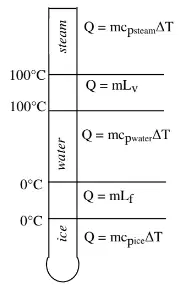
18 kg of water at -15oC is raised to 130oC. Calculate the individual heat of water. (Cpwater= 4186 J/kgoC)
2.5 x 10⁶ J
7.5 x 10⁶ J
7.5 x 10³ J
2.5 x 10³ J
Which of the following statements is correct?
The unit of heat capacity is J/m x °C-1.
Specific heat capacity measures the temperature variations when 1J of energy is absorbed.
The unit of specific heat capacity is J/kg x °C.
Specific heat capacity equals to the heat content of an object.
In order to make a cup of milk coffee at 78°C, 200 g of coffee is mixed up with 40 g of milk. If the original temperature of the coffee is 80°C, find the original temperature of the milk. Assume that there is no heat lost to the surroundings. Given that the specific heat capacity of coffee and milk is 4000 J/kg x °C. and 3900 J/kg x °C respectively.
10.3°C
20.7°C
45.2°C
67.7°C
What is the equation for specific heat capacity?
Q=mcΔT
Q=ΔTmc
Q=mcΔT
Q=mcΔT
Q=mΔcT
A certian type of decorative lamp contains colored liquids. These liquids form globs that break off and rise to the top of the liquid. The globs rise due to ...
Conduction
Radiation
Convection
A college student holds the back of his hand near an iron to see if it is hot. Heat is transferred to his hand by ..
Conduction
Radiation
Convection
A thermodynamic system where no exchange of heat takes place between system and surrounding is...
Isothermal process
Adiabatic process
Isobaric process
Isochoric process
Which of the following equations is the equation for calculating the work done by a gas in a piston?
W=Fd
W=PΔV
ΔV=Ad
A=πr2

