
 Worksheets
5th grade final '22
Total questions: 116
Worksheet time: 1hrs 24mins
What is an observation?
A scientific statement based on ideas
Using your senses to notice what is going on around you
To be unaware of your surroundings
The question that you want an answer to.
conclusion
What's the dependent variable?

It must travel 3 meters
It must drive in a straight line and stay in the 24" wide lane.
1. A tire company is creating a new tire for a motorcycle to drive off-road in sandy and rocky conditions as well as on roads. Engineers developed three different tread patterns. Based on the engineering design process, the next step the company should take is to:
Send out a questionnaire about tires to the public
Select which tread design will be best
Research the properties of rubber
See which tire is the most expensive
1. Rob and his team have been chosen to build a wind turbine at a local ski resort that needs to generate electrical energy and withstand the harsh environment of the mountains. Rob and his team have done their research on the problem. What would be the next step for the team?
Create a prototype of the wind turbine
Develop possible solutions(s) for the turbine and how it will fit the criteria needed
Test the wind turbine on the mountains during the harsh winter months
Redesign a new solution for this turbine

Which step does #3 represent
Evaluate the solution
Identify the problem
Construct and test Prototype
Develope a Solution
When you are gathering information for the Engineering Design Process you are ____________.
doing research
building a prototype
designing a solution
testing a solution
After your research is done you begin to _____________.
test and evalutate
imagine and plan
ask questions
improve
Which word best describes a prototype?
model
problem
step
solution

What is used to measure (but not precisely), heat, and mix large amounts of liquids?
beaker
flask
test tube
graduated cylinder

What equipment allows you to measure liquid's volume and measures in milliliters?
test tube
beaker
flask
graduated cylinder

Which equipment holds, measures, and mixes liquids (not a precise measurement), and measures in milliliters?
flask
test tube
beaker
graduated cylinder
A graduated cylinder contains exactly 60 mL of water. A rock was dropped into the cylinder of water. The water level rose to 86 mL. What is the volume of the rock?
86 mL
60 mL
146 mL
26 mL
What is the basic unit of liquid volume in the metric system?
gram
meter
Liter
cm3
What is the basic unit of length in the metric system?
gram
meter
Liter
cm3
What is the basic unit of mass in the metric system?
gram
meter
Liter
cm3
What tool measures length?
graduated cylinder
metric ruler
triple-beam balance
thermometer
What tool measures mass?
graduated cylinder
metric ruler
triple-beam balance
thermometer

What is the measurement on the graduated cylinder shown?
10.9 mL
20 mL
19 mL
18 mL

What is the measurement on the triple-beam balance shown?
335g
35g
3.5g
305g

What is the measurement on the triple-beam balance shown?
27g
28g
27.7g
2.7g
What is the correct order from smallest to largest?
milliliter, liter, kiloliter
liter, milliliter, kiloliter
kiloliter, milliliter, liter
liter, kiloliter, milliliter
How many milliliters are in a liter?
10
100
1,000
10,000
How many centimeters are in a meter?
10
100
1,000
10,000
Which is shorter: a meter or a kilometer?
meter
kilometer
How many milliliters are in 2 liters?
200
10
20
2,000

Which plant grew the most?
plant 1
plant 2
plant 3
plant 4
What does the U in the SULTAN Graphing Method stand for?
units
universal
utility
What are graphs used for?
To show data in an understandable way
To keep track of things so you don't forget
To catch the eye and look colorful
To draw pictures on

Bar graphs represent what kind of data
comparison of amounts
shows change over time
shows parts of a whole
spread of the data

Line graphs represent what kind of data
comparison of amounts
shows change over time
shows parts of a whole
spread of the data

Which graph has the X axis and Y axis labeled correctly?
A
B
It depends on the data, either could be correct.
Neither are correct.

Which best decribes the line graph data of Chickcharney sightings?
The population has steadily declined over the last 300 years.
Since 1600, the population of Chickcharney has declined.
The population of Chickcharney in 2000 was 0.
Data of the Chickcharney was collected for 2000 years.

What is wrong with this graph?
The dependent variable is not labeled.
The data that is graphed is incorrect and a different graph should have been used.
The intervals on the x and y axis are written incorrectly.
The color of the graph is not appropriate or professional

What is the independent variable in this graph?
Tadpoles
Year
Frogs
Number of tadpoles in the pond
Why are graphs and charts important to analyze data?
Graphs and charts are important to analyze data because we would never be able to know what is going on with the data.
Graphs and charts are important to analyze data because teachers say they are important.
Charts and graphs is something good to do because they are nice to look at.
Charts and graphs allow a person to visualize data and find patterns and trends in the data.

What part of this data table will be graphed on the Y-AXIS?
The food cooked
Type of barbecue
The time
The temperature

What would most likely be the temperature at 2 1/2 minutes?
58
62
78
88

Which country had the greatest number of travelers to Australia?
New Zealand
China
United Kingdom
Canada
When writing a hypothesis, ___.
always write it as a question
write it after the experiment is done
only include the dependent variable in the question
write it as an if...then statement
Which item below do producers most use to get energy?
consumers
decomposers
wind
sunlight
Which organism below is a consumer?
spruce tree
tulip
bald eagle
dogwood flower
How would you classify a crab in community?
as a producer
as a consumer
as a decomposer
as a food chain
How would you best summarize the difference between a consumer and a producer?
Producers are small and consumers are large.
Producers make food and consumers eat food.
Consumers make food and producers eat food.
Producers are always green and consumers are multicolored.
What are all the organisms of ONE species called (for example, all of the rattlesnakes in the desert) that live in an area at the same time?
population
community
ecosystem
habitat
What are all the living and nonliving things in an area that interact with one another called?
population
community
ecosystem
habitat
What is the area in which an organism lives? It provides food, water, and a place to live.
population
community
ecosystem
habitat
Which best explains why producers are an important part of an ecosystem?
They pass the Sun's energy on to other organisms.
They pass energy from consumers to decomposers.
They make their own energy and pass it on to other producers.
They pass energy from first level consumers to second level consumers.
When an animal dies in an ecosystem a mushroom will sometimes grow on the remains of the animal. Which best describes the role of the mushroom in the ecosystem?
producer
consumer
decomposer
scavenger
Which best explains how producers use photosynthesis to make their own food?
Producers receive energy form the rain and use it to produce water for their food.
Producers receive energy from rain and use it to produce gases for food.
Producers receive energy form the sun and use it to produce water for their food.
Producers receive energy from the sun and produce sugars for food.
A crow eats the remains of a dead animal. What type of consumer does the crow prove to be?
decomposer
herbivore
predator
scavenger
In a meadow ecosystem, a population of rabbits increases. What populations are most likely to increase as a result?
foxes, hawks, and other predators of the rabbits
leafy plants that rabbits eat
rabbits that live elsewhere
worms that live in the meadow soil
Arrows in a food web represent...
eating
sunlight
energy
matter
In photosynthesis, which are the products?
carbon dioxide, water
oxygen, glucose
sunlight, oxygen
water, soil
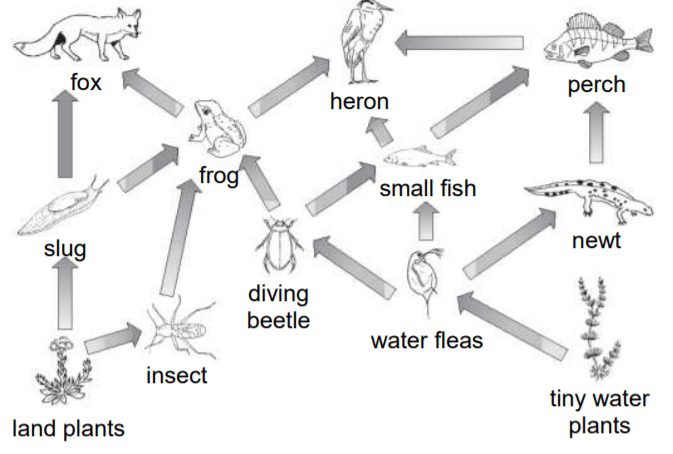
This is a food chain
This is a food web
This is an energy pyramid
The original source of energy for a food web is...
plants
sun
producers
decomposers
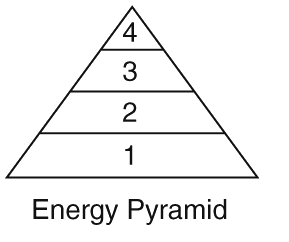
Level 1 on the pyramid
Producers
Primary Consumer
Secondary Consumer
Tertiary Consumer
Level 2 on the pyramid
Producers
Primary Consumer
Secondary Consumer
Tertiary Consumer
Level 4 on the pyramid
Producers
Primary Consumer
Secondary Consumer
Tertiary Consumer
Which section of the pyramid has the most energy?
1
2
3
4
How much energy moves up each level of the energy pyramid?
5%
10%
50%
90%

Which of the following gets it's energy directly from a producer?
Sun
Plants
Deer
Snake
Green plants are producers that begin the flow of energy between organisms in a food web when they-
reproduce by generating seeds
absorb water and nutrients through the soil
release oxygen into the air
make their own food using sunlight

The diagram shows a pond food web. What two organisms get their energy directly from insect larvae?
algae and minnows
sunfish and bass
minnows and sunfish
snails and snapping turtles

If a disease strikes the snakes the rabbits will
increase
decrease
not be affected
If a disease strikes the snakes the grass will
increase
decrease
not be affected
What is the green pigment that gives plants their color?
photosynthesis
phloem
chlorophyll
choloplast
What are the small openings in leaves called?
xylem
phloem
producer
stomata
What do consumers use for their energy source?
oxygen
glucose
sunlight
stomata
How do water and minerals enter a plant? Through the....
leaves
stomata
stem
roots
What is the smallest basic unit of a living thing?
oxygen
stomata
cell
carbon dioxid
What are three substances are needed for photosynthesis?
water
sunlight
carbon dioxide
oxygen
Lungs of human are comparable to _____________ of a plant.
leaf
stem
stomata
roots
What THREE things are needed for photosynthesis to occur?
6CO2 (carbon dioxide)
6H20 (water)
O2 (oxygen)
sunlight
True or False: Animals can make their own food inside themselves.
True
False
What is the waste product of photosynthesis?
oxygen
glucose
carbon dioxide
chlorophyll
What time of day (24 hour period) do plants photosynthesize?
nighttime only
daytime only
daytime and nighttime
only in the summer months
REVIEW QUESTION: What does a graduated cylinder measure?
mass
weight
density
volume
The International System of Units is also known as
Customary System
Metric System
A measure of the amount of matter of an object
Volume
Mass
Buoyancy
Weight
54 mL is measuring _______
volume of a liquid
mass
length
temperature

What is the most important thing in science?
evidence
discoveries
experiments
explosions

The scientist gathered all of the _______ before making a _______.
particles - concept
data - guess
concepts - guess
data - conclusion
Which of these contains the steps of the scientific method in the correct order?
Question -- Hypothesis -- Experiment -- Data -- Conclusion
Hypothesis -- Conclusion --Experiment -- Question -- Data
Question -- Experiment -- Data -- Hypothesis -- Conclusion
On your way to school, you see a puddle of rain water on the sidewalk. On your way home from school, the puddle is almost gone. Is the second statement a hypothesis or an observation. (a)
Using any of your 5 senses to describe the world around you.
Observation
Inference
Quantitative Observation
Logical Theory
An observation that has to do with adjectives like heavy.
Centimeters
Inference
Qualitative Observation
Quantitative Observation
An observation that has to do with numbers and labels like 3.5 cm.
Observation
Touch, Taste, Sight, Hearing, Smell
Qualitative Observation
Quantitative Observation

Observation or Inference: I think the weather is cold.
Observation
Inference
Observation or Inference: I notice the tree by the pond has no leaves on it.
Observation
Inference

Qualitative or Quantitative: There is 300 mL of liquid in this beaker.
Qualitative Observation
Quantitative Observation
Which statement is not a function of the skeletal system?
Protects organs
stores minerals
circulates blood in the body
helps with movement

The job of the heart is to . . .
pump blood around the body.
send food to the small intestines.
break down food.
give energy to the body.

The circulatory system works with the ___________ system to provide our body with oxygen.
respiratory
digestive
muscular
skeletal

