Wayground logo

Free Printable Worksheets

Font size

S
M
L
XL
Worksheets

LE: Human Impact Review

Total questions: 50

Worksheet time: 49mins

Name
Class
Date
1.
Which human activity would preserve nonrenewable resources?
a)

Deforestation

b)

Removing carnivores from a forest 

c)

Recycling

d)

Heating homes with fossil fuels  

2.
Which human activity would most likely deplete nonrenewable resources?
a)
use of natural enemies to eliminate insect pests
b)
development of wildlife refuges 
c)
governmental restriction of industrial pollution 
d)
increased use of fossil fuels
3.

Approximately 75 percent of the Earth's surface is covered in water. Why is water considered such a precious resource?

a)
The greenhouse effect is causing most of the world's freshwater to be trapped in the atmosphere
b)
Only a small fraction of the Earth's water is freshwater available for drinking and irrigation
c)
Each year, more freshwater is being trapped in icecaps located at the North and South Poles
d)
Global warming caused by greenhouse gas emissions will likely cause Earth's oceans to evaporate
4.
Many common products, such as wooden furniture, paper, and books, are made from trees. Which of the following is a likely consequence of humans cutting down a forest in order to make use of the natural resources there? 
a)
the decrease of chemical runoff into the oceans
b)
increased acid rain
c)
the increase of light pollution in cities
d)
the destruction of habitats
5.
Which of the following historical events most likely triggered the largest increase in the human population? 
a)
the Black Death plague, which occurred in the mid-1300s
b)
the domestication of wheat crops, which began around 8000 B.C
c)
the fall of the Roman Empire, which occurred around A.D. 800
d)
the Industrial Revolution, which began in the late 1700s
6.
What causes smog?
a)
The burning of particulates
b)
The formation of ozone
c)
Acid Rain
d)

The interaction of sunlight with pollutants produced by fossil fuels

7.
Global warming has been linked to a decrease in 
a)
the size of the polar ice caps 
b)
the temperature of Earth 
c)
the rate of species extinction 
d)
the rate of carbon dioxide production
8.

What affect does logging have on the forest ecosystem?

a)
It increases soil erosion and water runoff.
b)
It decreases soil erosion and water runoff.
c)
It increases soil erosion and decreases water runoff.
9.

When certain chemicals such as CFC (chlorofluorocarbons) react with Ozone (O3), ozone breaks down to O2 (oxygen gas). Why would this have a negative impact on the climate?

a)

More oxygen causes more storms

b)

More oxygen in the atmosphere increases plant growth

c)

Ozone is part of what protects us from harmful UV radiation.

d)

More oxygen leads to increased human overpopulation and desertification

10.

The ozone hole is actually an area of depleted ozone in Earth’s atmosphere. Which of the following human activities has the greatest contribution to the development of the ozone hole?

a)

The use of oil in automobile engines

b)

The use of airplanes in the atmosphere

c)

The increase in factory emissions

d)

The use of chlorofluorocarbons in refrigeration

11.

In the 1800s rabbits were introduced for the first time into Australia. Here they had no natural predators and a plentiful food supply. What happened several years after the rabbit was introduced into Australia?

a)

The rabbits began to overpopulate greatly.

b)

Populations of animals competing with rabbits grew.

c)

The rabbit population declined sharply.

d)

New rabbit predators evolved.

12.

The design of air conditioners and aerosol cans has been changed in the last few years in an attempt to reverse which ecological problem?

a)

deforestation

b)

freshwater pollution

c)

hole in the ozone layer

d)

acid rain

13.

Poisons such as DDT build up in lakes and streams due to runoff. Then they enter the food chain. Once in living organisms, the poisons are not broken down and their concentrations increase as they are passed along the food chain.

Which term best describes this ecological phenomenon?

a)

global warming

b)

loss of biodiversity

c)

biological magnification

d)

loss of genetic diversity

14.

The burning of coal releases sulfur dioxide gas. How might the burning of coal lead to damaged plant life?

a)

Sulfur dioxide can combine with drops of water to form acid rain.

b)

Sulfur dioxide causes the remains of animals to decompose at a faster rate.

c)

Sulfur dioxide gives off heat that raises the temperature of bodies of water.

d)

Sulfur dioxide is a radioactive material that is dangerous for many years.

15.
Which of the following is NOT a greenhouse gas?
a)
Carbon dioxide CO2
b)
Methane CH4
c)
Water vapor
d)
Nitrogen N2
16.
Which human activity contributes the MOST carbon dioxide to the atmosphere?
a)
Fishing
b)
Breathing
c)
Burning Fossil Fuels
d)
Farming
17.

How are greenhouse gasses harming our environment?

a)

They aren't

b)

Less heat is able to escape causing the Earth to cool down

c)

Less heat is able to escape causing the Earth to warm up

d)

More heat is able to escape

18.
Which of the following is a finite resource?  
a)
solar energy 
b)
wind energy
c)
trees
d)
fossil fuels 
19.
Increased industrialization will most likely
a)
decrease available habitats 
b)
increase environmental carrying capacity 
c)
increase the stability of ecosystems 
d)
decrease global warming
20.
Pollution can cause harm to the ___________.  
a)
air
b)
land
c)
water
d)
all of the above
21.
Conservation is the act of conserving, or protecting the environment, plants, and animals. What are some things you can do to help conserve our environment? 
a)
leave water on, leave TV on, run dishwasher with 1 plate
b)
run the washing machine with 1 shirt
c)
leave the refrigerator door open
d)
turn off water, turn off lights, turn off TV
22.

What evidence is there to support that Global Warming is occurring?

a)

Rising ocean temperatures

b)

Declining arctic sea glacers

c)

Sea levels rising

d)

Increase in carbon dioxide in the atmosphere

23.

Which organism shown in the food chain has the highest concentration of pollutants?

a)

plankton

b)

small fish

c)

large fish

d)

shore bird

24.

Today the human population of Earth is

a)

more than 10 billion

b)

more than 6.7 billion

c)

less than 7 million

d)

less than 9.9 million

25.

Drawbacks of solar energy are:

a)

it is not always available

b)

it is polluting

c)

it is still quite expensive

d)

all ot the other options

26.

What is a disadvantage of wind turbines?

a)

They pollute the air.

b)

They do not pollute

c)

They produce noise and may harm some animals

d)

They are "green" energy

27.
The water turbine drives the generator which converts  ................
a)
The mechanical energy to electrical energy
b)
The electrical energy to electrical energy
c)
None
28.

Geothermal resource extraction and its power plant operation emits zero CO2.

a)

True

b)

False

29.
All of the following are problems of nuclear energy except ---
a)
storage of radioactive fuel
b)
air pollution
c)
security concerns
d)
natural disasters (tsunamis, earthquakes, etc.)
30.

Biomass can converted into fuel such as biodiesel and bioethanol

a)

True

b)

False

31.

What do you call the process of drilling and injecting fluid into a ground at a high pressure in order to break or fracture the shale rocks to release natural gas inside?

a)

Drilling

b)

Fracking

c)

Perforation

d)

Sedimentation

32.

a species that is not native to a particular region and has no natural predators and little competition

a)

consumer species

b)

producer species

c)

invasive species

d)

adapted species

33.
A small marine area has phytoplankton as its only producer.  Should the marine biologist be concerned about this ecosystem?
a)
No the fish do not need the phytoplanton. Since there are so many fish, there is high biodiversity.
b)
Yes, this ecosystem has low biodiversity.  Without a producer the herbivores will die out leaving no food.
c)
Yes, this system has high biodiversity; however the fish can adapt and get food from another source.
d)
Yes, the fish will overate to get all of the phytoplankton that is left, then they will die.
34.
How do biodiversity and sustainability work together?
a)
The lower the biodiversity the greater the sustainability.
b)
The higher the biodiversity, the less sustainable the ecosystem
c)
The higher the biodiversity, the greater the sustainability.
d)
Biodiversity has nothing to do with sustainability.
35.

Forest clearing, farming, and road building are all examples of

a)

Biodiversity

b)

Population distribution

c)

Habitat loss

d)

Climate Change

36.

The greatest cause of biodiversity loss today is

a)

Pollution

b)

Habitat loss and change

c)

Climate Change

d)

Invasive species

37.

The ability of an organism to remain unaffected by a harmful agent in the environment

a)

chronic toxicity

b)

acute toxicity

c)

resistance

d)

monoculture

38.
Kudzu has overgrown many parts of southern Missouri and native ground plants have disappeared from the area. This is an example of:
a)
Parasitism between kudzu and the native plants
b)
A predator prey relationship between ground plants and kudzu
c)
Competition occurring between the native and invasive species
d)
Commesalism occurring between the kudzo and native plants
39.
How did the zebra mussels end up in the Great Lakes?
a)
In ballast tanks of ships
b)
They were intentionally released
c)
They have always been in the Great Lakes
d)
That's not a zebra mussel
40.
1. What makes a species invasive?
a)
Moving to a new ecosystem and taking resources from natives 
b)
Not having papers
c)
Species that can't adapt
d)
Plants that take up too much space
41.
What kind of organisms can become invasive? 
a)
Lions, Tigers, Bears
b)
Plants, Animals, or Pathogens 
c)
Animals
d)
Plants
42.
Invasive species have a negative impact on...
a)
the ecosystem
b)
the economy
c)
Both the ecosystem and the economy
d)
None of these
43.
The ozone layer protects us from
a)
UV rays
b)
CFCs
c)
Increased atmospheric heat
d)
Decreased atmospheric heat
44.
The ozone layer is damaged by
a)
CFCs
b)
Increase in greenhouse gases
c)
Increased global temperatures
d)
Sulfuric and nitric acids
45.

How can we help to reduce plastic pollution?

a)

We should use paper/cloth bags.

b)

We should use less plastic.

c)

We should refill our drinking bottles not buy new ones.

d)

We should avoid (unikać) plastic or styrofoam containers.

e)

All answers are correct.

46.

There are plastic trash islands floating (dryfujące) on oceans.

a)

True (prawda)

b)

False (fałsz)

47.
Acid rain can damage
a)
Drinking water sources
b)
Aquatic life
c)
Architecture/buildings
d)
All options are correct
48.
Global warming is due to 
a)
Greenhouse gases
b)
Nitric and sulfuric acids
c)
CFCs
d)
Ozone depletion
49.
Which of the following are greenhouse gases?
a)
Carbon dioxide
b)
Methane
c)
Water vapor
d)
All answers are correct
50.
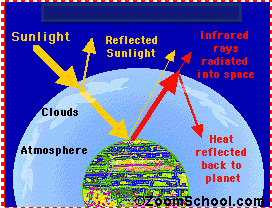
What does this diagram illustrate?
a)
Ozone Layer
b)
The Greenhouse Effect
c)
Ultraviolet Radiation
d)
Layers of the atmosphere