Wayground logo

Free Printable Worksheets

Font size

S
M
L
XL
Worksheets

Final Exam Review

Total questions: 118

Worksheet time: 48mins

Name
Class
Date
1.
The changes to water when it cycles the earth is called
a)
the moon cycle
b)
the sun cycle
c)
the water cycle
d)
the wind cycle
2.
When water vapor s cooled and forms droplets-
a)
Condensation
b)
Evaportation
c)
Transpiration
d)
Run-off
3.
Forms of precipitation are-
a)
only sleet and snow
b)
rain, sleet, hail, and snow
c)
only dew and rain 
d)
only snow and rain
4.
What is it called when plants give off water vapor as a waste product?
a)
condensation
b)
evaporation
c)
sublimation
d)
transpiration
5.
What is precipitation?
a)
The part of the water cycle when the sun heats up water, turning it from a liquid into water vapor or steam. It rises from the ground into the air.
b)
The part of the water cycle when the water vapor in the air gets cold. The water turns back into a liquid and forms clouds.
c)
The part of the water cycle when clouds get heavy and can no longer hold the liquid water. This causes the water to fall from the sky to the earth as rain, snow, sleet, or hail.
6.
On which kind of day would you expect the most evaporation from the surface of a pond?
a)
cold, rainy
b)
cold, sunny
c)
warm, rainy
d)
warm, sunny
7.
What is water vapor?
a)
Water on the land (geosphere)
b)
Water in the air (atmosphere)
c)
Water in plants
d)
Water in the water (hydrosphere)
8.

What is the role of the sun in the water cycle?

a)

provide heat energy for evaporation

b)

provide heat energy for condensation

c)

dry out the soil for runoff to occur

d)

provide thermal energy for accumulation

9.

What do we call water in its gas state?

a)

rain

b)

snow

c)

ice

d)

water vapor

10.
When water _________, dew forms.
a)
Melts
b)
Evaporates
c)
Condenses
d)
Precipitates
11.
Which box has a higher density?  
a)
Box A
b)
Box B
c)
cannot be determined
d)
they are the same
12.
Why do ice cubes float in a  glass of water?
a)
the ice cubes are more dense than the water
b)
the water is more dense than the ice cubes
c)
the water is more dense than the glass
d)
the ice is more dense than the glass
13.
What is the primary source of energy that generates most ocean waves?
a)
earthquakes
b)
wind
c)
asteriods falling in the ocean
d)
volcanic eruptions
14.
Which of the following is not a cause of a tsunami? 
a)
Volcanic eruption
b)
Tornado
c)
Underwater earthquakes
d)
Landslide
15.
Stronger winds create __________ waves.
a)
larger
b)
smaller
16.
Deep currents are caused by differences in the _______________ ocean water.
a)
 eutrophication of
b)
sun's effect on
c)
density of
d)
 salinity of 
17.
Ocean water is more dense than fresh water at the same temperature due to differences in:  
a)
Wind patterns
b)
 Lifeforms
c)
Currents
d)
Salinity
18.
What are two factors that affect the density differences in the ocean.
a)
Density and temperature
b)
Density and Pressure
c)
Pressure and Temperature
d)
Salinity and El Nino
19.

Which body has the greater effect on Earth's tides?

a)

Sun

b)

Saturn

c)

Moon

d)

Venus

20.
What is a difference between spring and neap tides?
a)
Spring tides occur when the earth and sun are IN LINE with the new or full moon. 
b)
Spring tides occur when moon in 3rd or 1st quarter phases
c)
Spring tides are LOWER than neap tides
21.
Wha type of tide would this arrangement of earth-moon-sun create?
a)
full moon tide
b)
new moon tide
c)
neap tide
d)
spring tide
22.
What type of tides would this arrangement of earth-moon-sun create?
a)
neap tide
b)
spring tide
c)
new moon tide
d)
full moon tide
23.
What are tides?
a)
More water filling up the ocean
b)
The rising and falling of the water on the earth surface
c)
Jupiter orbiting the moon
d)
Waves in the oceans 
24.
There is about 2% of the Earth's freshwater frozen in icebergs.
a)
True
b)
False
25.
What happens to pressure as you go deeper into the ocean? 
a)
increases
b)
decreases
c)
stays the same
d)
doubles
26.
As we go deeper into the ocean, salinity ___________. 
a)
Doubles
b)
Decreases 
c)
Increases
d)
Remains the same 
27.
Which of the following is a way of conserving water?
a)
Leave the tap running while brushing teeth
b)
Use a hose to wash the car
c)
Use the washing machine at full load
d)
Leave the shower running while soaping
28.
Why do we need to conserve water?
a)
It is an unlimited resource. 
b)
It is a limited resource. 
c)
There is a lot of water. 
d)
There is no need to conserve water.
29.
When is the best time of day to water your lawn?
a)
Early morning or late evening
b)
In the afternoon
c)
All day long
d)
At night
30.

What should you do if you see or hear a leaky faucet in your house?

a)

Ignore it—drips are no big deal

b)

Do nothing—there is no way to fix a drippy faucet

c)

Ask your parents to fix it

31.
A front is
a)
where warm air is cooling at earth's surface
b)
a line where hot and cold air are separating
c)
a line where two different air masses meet
d)
where cold air is rising and forming rain clouds
32.
_____________ air is more dense and tends to sink
a)
cold
b)
warm
c)
moist
d)
dry
33.
Winds are caused by differences in 
a)
precipitation
b)
humidity
c)
air pressure
d)
turbulance
34.

What causes differences in air pressure?

a)

even heating of the Earth

b)

Even cooling of the earth

c)

uneven heating of the earth

d)

global warming

35.
Which storm forms over water?
a)
tornado
b)
hurricane
c)
thunderstorm
36.
Which storm would most likely form over Florida because it is a coastal state?
a)
hurricane
b)
tornado
c)
thunderstorm
37.

Why does a hurricane slow down when it hits land?

a)

The wind stops it

b)

It stops raining

c)

It loses its energy source

d)

The air is different

38.
In order for a hurricane to form, the water must be ________.
a)
Cool
b)
Warm
c)
Cold
d)
Hot
39.

In what layer of the atmosphere do all weather events occur?

a)

Stratosphere

b)

Exosphere

c)

Mesosphere

d)

Troposphere

40.
What is the transfer of heat by movement of liquids or gases?
a)
Radiation
b)
Convection
c)
Conduction
d)
Heat
41.
What is a transfer of heat energy by electromagnetic waves?
a)
Radiation
b)
Convection
c)
Conduction
d)
Heat
42.
What is the transfer of heat by direct contact?
a)
Convection
b)
Electromagnetic waves
c)
Radiation
d)
Conduction
43.
Do land breezes typically happen during the day or night?
a)
Day
b)
Night
44.
Do sea breezes typically happen during the day or night?
a)
Day
b)
Night
45.
During a sea breeze which way does the wind blow?
a)
from the land to the sea
b)
from the sea to the land
46.
During a land breeze which way does the wind blow?
a)
from the sea to the land
b)
from the land to the sea
47.
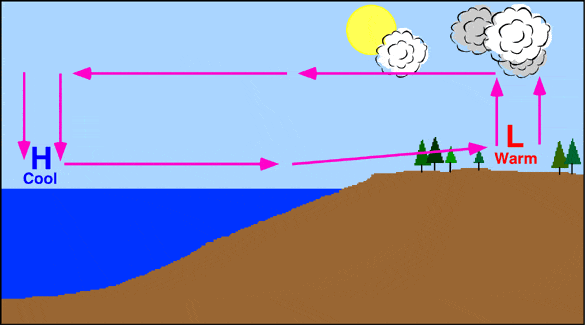
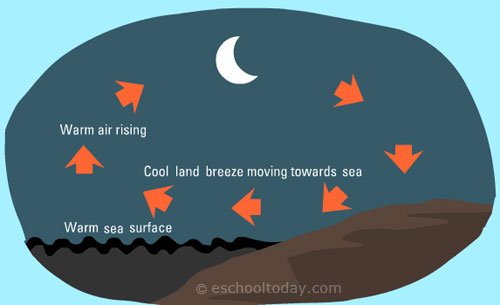
Is this a land or a sea breeze?
a)
land breeze
b)
sea breeze
48.
Is this a land or a sea breeze?
a)
land breeze
b)
sea breeze
49.
The strength of a sea breeze depends on
a)
the heat of the day
b)
the difference between the temperature of the sea and the land
c)
the wind speed
d)
the amount of precipitation that day
50.
Why do land breezes occur at night?
a)
Land cools off slower than water, so the air above water is cooler.
b)
Water cools off faster than land, so the air above land is warmer.
c)
Land heats up slower than water, so the air stays cooler during the day.
d)
Water cools off slower than land, so the air above water is warmer.
51.
Which best describes why winds at the beach change direction between day and night? **
a)
because the temperatures over land and over water change 
b)
because warm air over land sinks and stays in place over land
c)
because cool air rises and is replaced by warm air from the ocean 
d)
because cool air sinks and stays in place over land 
52.

Why does Earth receive unequal heating?

a)

Different location receive different amounts of direct sunlight

b)

Earth moves closer and farther away from the sun.

c)

The core of the earth heats different parts of the Earth.

53.

Hurricanes will begin to die out once they

a)

are over land or warm water

b)

are over land or cold water

c)

once it gets tired

d)

only if they are over warm water

54.
What season is it in the Northern Hemisphere?
a)
Winter
b)
Summer
c)
Spring
d)
Fall
55.
In the waxing phase, the moon appears to
a)
get bigger
b)
get smaller
56.
In the waning phase, the moon appears to
a)
get bigger
b)
grow smaller
57.

Why do we have seasons?

a)

The earth's rotation on its axis only

b)

The earth's revolution around the sun only

c)

The moon's gravity pull on the earth

d)

The Earth's tilt and its revolution around the sun

58.
What causes day and night?
a)
The sun rises and sets
b)
The Earth rotating on its axis
c)
The Earth revolves around the sun
d)
The tilt of the Earth
59.
What moon phase is shown in the picture?
a)
waxing gibbous
b)
waxing crescent
c)
waning gibbous
d)
waning crescent
60.
In a solar eclipse the moon is...
a)
between the sun and earth
b)
directly behind the earth
61.
What is this diagram showing?
a)
tides
b)
lunar eclipse
c)
revolution
d)
solar eclipse
62.
What is this diagram showing?
a)
tides
b)
solar eclipse
c)
lunar eclipse
d)
rotation
63.
What moon phase is shown in the picture?
a)
waxing gibbous
b)
waxing crescent
c)
waning gibbous
d)
waning crescent
64.
What season is it in the southern hemisphere?
a)
Winter
b)
Spring
c)
Summer
d)
Fall
65.

What is the difference between rotation and revolution?

a)

Rotation is the way Earth spins. Revolution is how Earth moves around the sun

b)

Revolution is the way Earth spins. Rotation is how Earth moves around the sun

c)

Rotation is the way Earth spins. Revolution is how Earth moves around other planets

d)

Rotation is the way Earth moves around the moon. Revolution is how Earth moves around the sun

66.

How long does it take Earth to revolve around the sun?

a)

24 hours

b)

12 days

c)

29 days

d)

365 days

67.

how long does it take the Earth to rotate on its axis?

a)

24 hours

b)

12 days

c)

29 days

d)

365 days

68.

The days that there are equal hours of daylight and nighttime are called __________.

a)

equinoxes

b)

solstices

c)

seasons

d)

phases

69.

The longest day of the year is called the _________________.

a)

winter solstice

b)

summer solstice

c)

vernal equinox

d)

autumnal equinox

70.

the shortest day of the year is called the _____________.

a)

winter solstice

b)

summer solstice

c)

vernal equinox

d)

autumnal equinox

71.

A solar eclipse can only occur during what moon phase?

a)

New Moon

b)

Full Moon

c)

1st Quarter

d)

3rd Quarter

72.

A lunar eclipse can only occur during what moon phase?

a)

New Moon

b)

Full Moon

c)

1st Quarter

d)

3rd Quarter

73.

During the vernal equinox, there are ___________________.

a)

equal hours of day and night.

b)

more than 12 hours of daylight.

c)

less than 12 hours of daylight.

74.

During the summer solstice, there are ___________________.

a)

equal hours of day and night.

b)

more than 12 hours of daylight.

c)

less than 12 hours of daylight.

75.
Gravity attracts all objects towards one another.
a)
False
b)
True
c)
It depends
76.
Because of inertia, a moving object will keep ________.
a)
at rest
b)
moving
c)
in one spot
d)
inertia 
77.
Because of inertia, a resting object will remain at ________.
a)
rest
b)
a constant speed
c)
school
d)
inertia 
78.

A force which tries to pull two objects towards each other is

a)

gravity

b)

inertia

c)

mass

d)

speed

79.

Anything with ____________ also has a gravitational pull.

a)

mass

b)

size

c)

depth

d)

light

80.

Gravity is based on an object's

a)

mass

b)

size

c)

roundness

d)

brightness

81.

What keeps the planets in orbit around the sun?

a)

gravity and inertia together

b)

gravity

c)

inertia

d)

neither gravity or inertia

82.

Why do the planets in our solar system orbit the sun?

a)

because the sun is the brightest object

b)

because the sun was there first

c)

because the sun has the most mass

d)

because nothing can orbit planets

83.

What would happen to Earth if there were no inertia?

a)

Earth would crash into the sun

b)

Earth would fly out to space

c)

Earth would collapse

d)

Earth would orbit the moon

84.

What would happen to Earth if there were no gravity?

a)

Earth would crash into the sun

b)

Earth would fly out to space

c)

Earth would collapse

d)

Earth would orbit the moon

85.

What planet is closest to the sun?

a)

Mars

b)

Earth

c)

Venus

d)

Mercury

86.

What are the four inner planets?

a)

Earth, Uranus, Mercury, Venus

b)

Mercury Venus Earth Saturn

c)

Mars, Earth , Mercury, Venus

d)

Mars, Earth, Neptune, Mercury

87.

Which planet is farthest from the sun?

a)

Neptune

b)

Jupiter

c)

Mercury

d)

Uranus

88.

What are the outer planets?

a)

Jupiter, Saturn, Earth, Neptune

b)

Saturn, Neptune, Mars, Uranus

c)

Uranus, Saturn, Neptune, Jupiter

d)

Mercury, Venus, Earth, Mars

89.

What is at the center of our solar system?

a)

asteroid belt

b)

Earth

c)

sun

d)

moon

90.

What is at the middle of a Heliocentric system?

a)

Mars

b)

Moon

c)

Sun

d)

Earth

91.

What is at the middle of a Geocentric system?

a)

Sun

b)

Neptune

c)

Earth

d)

The Universe

92.

What is the biggest difference between the Geocentric Model and the Heliocentric Model?

a)

the shape of the planets' orbits

b)

the movement of the moon

c)

the center of the solar system

93.
The shape of our Milky Way galaxy can be classified as ____________.
a)
Spiral
b)
Elliptical
c)
Irregular
d)
French
94.
What is a light year?
a)
A unit of time
b)
The time light takes to travel though a vacuum in one year.
c)
10 thousand meters
d)
How far light travels through the vacuum in one year.
95.
What kind of heat transfer happens when the sun is heating your body?
a)
Conduction
b)
Radiation
c)
Convection
d)
Density
96.
What heat transfer happens when you burn your hand by touching a fire?
a)
Radiation
b)
Conduction
c)
Convection
d)
I don't know!!!!!!!!!!!
97.
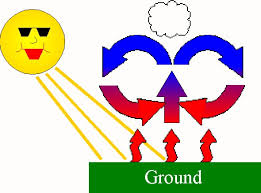
Warm air rises and the cool air sinks demonstrates this type of heat transfer. 
a)
conduction
b)
convection
c)
radiation
d)
Insolation 
98.
Ironing a shirt is an example of...
a)
condensation
b)
conduction
c)
convection
d)
radiation
99.
Warm air is __________ dense than cold air and rises creating convection currents.
a)
more
b)
less
100.
What happens when ice cubes melt in a glass?
a)
Heat travels from the ice to the warmer water.
b)
No energy is transferred.
c)
Heat is transferred from the warmer water to the ice cubes.
d)
The water warms up due to the humidity
101.
Johnny accidentally grabbed the handle of the hot pot.
a)
conduction
b)
convection
c)
radiation
102.
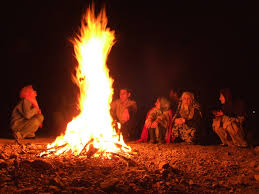
A group of friends gather around a fire to stay warm.
a)
conduction
b)
convection
c)
radiation
103.
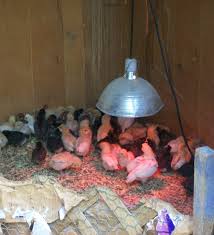
The baby chickens are kept warm from the heat lamps demonstrates this type of heat transfer. 
a)
conduction
b)
convection
c)
radiation
104.
An aluminum plate and a plastic plate have been in the freezer all night long.  When you remove them the next morning, 
a)
the plates have the same temperature.
b)
the plastic plate has a higher temperature.
c)
the plastic plate has a lower temperature.
d)
the aluminum plate has a lower temperature.
105.
Why do we wear sweaters in cold weather?
a)
To keep cold out.
b)
To generate heat.
c)
To reduce heat loss.
d)
All of the above.
106.
Near the ceiling of a room the air is warmer; the warm air rises because of
a)
conduction
b)
convection
c)
radiation
107.

What are volcanic islands?

a)

Gently sloping, shallow area

b)

Mountains that reach the ocean surface

c)

A geyser on the ocean floor

d)

Underwater inactive volcanic mountains

108.

What is a seamount?

a)

Continuous underwater mountain range

b)

A geyser on the ocean floor

c)

At the edge of the shelf, the ocean floor drops down an incline

d)

Underwater, inactive volcanic mountains

109.

What is a trench?

a)

Gently sloping, shallow area

b)

A deep, steep-sided canyon at a subduction zone

c)

A smooth and flat area on the ocean floor

d)

At the edge of the shelf, the ocean floor drops down an incline

110.

What is the Mid-Ocean Ridge?

a)

Continuous underwater mountain range

b)

A geyser on the ocean floor

c)

Mountains that reach the ocean surface

d)

Underwater, inactive volcanoes

111.

What is an abyssal plain?

a)

A smooth, flat area on the ocean

b)

Mountains that reach the ocean surface

c)

Gently sloping, shallow area

d)

At the edge of the shelf, the ocean floor drops down an incline

112.

What is a continental shelf?

a)

Gently sloping, shallow area

b)

Underwater, inactive volcanic mountains

c)

A smooth, flat area on the ocean floor

d)

A geyser on the ocean floor

113.

What is a continental slope?

a)

A gently sloping, shallow area

b)

A continuous underwater mountain range

c)

At the edge of the shelf, the ocean floor drops down an incline

d)

Underwater, inactive volcanic mountains

114.

What causes tsunamis?

a)

Earthquakes

b)

Typhoons

c)

Hurricanes

d)

Weather

115.

Certain places in the United States occasionally experience weather events caused by violently rotating columns of air stretching from a cloud to the ground. What are such weather events called?

a)

tornadoes

b)

hurricanes

c)

storm surges

d)

thunderstorms

116.

The following are all types of severe weather except

a)

Thunderstorms

b)

Heavy Rain

c)

Hurricanes

d)

Tornadoes

117.

_____ is an intense local storm with strong winds, heavy rain, frequent cloud to ground lightning, thunder and sometimes hail.

a)

tornadoes

b)

hurricanes

c)

storm surges

d)

thunderstorms

118.

_____ is an electrical discharge that happens between positive and negative charged particles. 

a)

tornadoes

b)

hurricanes

c)

lightning

d)

thunderstorms