wayground logo

Free Printable Worksheets

Font size

S
M
L
XL
Worksheets

Biology SOL Review Units 1, 2, 3, 4, & 5

Total questions: 62

Worksheet time: 40mins

Name
Class
Date
1.

You decide to clean your bedroom. You notice that your floor is covered with clothes. You decide to try to get rid of the clothes by throwing the clothes into the air. You throw clothes from a 1/3 of the room into the closet and a second 1/3 of the room straight up in the air. The last 1/3 of the room you leave the clothes on the floor. After 30 minutes of "cleaning", the floor of the room is now visible. WHAT IS THE INDEPENDENT VARIABLE?

a)

The bedroom

b)

How clean the bedroom is

c)

The amount of clothes

d)

Throwing the clothes

2.

You decide to clean your bedroom. You notice that your floor is covered with clothes. You decide to try to get rid of the clothes by throwing the clothes into the air. You throw clothes from a 1/3 of the room into the closet and a second 1/3 of the room straight up in the air. The last 1/3 of the room you leave the clothes on the floor. After 30 minutes of "cleaning", the floor of the room is now visible. WHAT ARE TWO CONTROLLED VARIABLES?

a)

The amount of clothes

b)

The direction you are throwing the clothes

c)

The bedroom

d)

How clean the bedroom is

3.

I am doing a test to see if there is a connection between how long you run and how fast your heart beats. I will be performing an experiment where a person will run for a 1 minute and I will check their heartbeat. Then they will run for 2 minutes and I will check their heart rate. I will do this up to 6 minutes and see if there is a connection. WHAT IS THE DEPENDENT VARIABLE?

a)

Heart Rate

b)

6 minute time limit

c)

How long they run

d)

The person

4.
A summary of the experiment that includes whether hypothesis was right or wrong
a)
Hypothesis
b)
Results
c)
Conclusion
d)
Independent Variable
5.
The part of the experiment that does not contain the independent variable. Used for comparison.
a)
Control Group
b)
Experimental Group
c)
Results
d)
Data
6.
What is the part of the experiment that contains the independent variable?
a)
control group
b)
experimental group
c)
hypothesis
d)
dependent variable
7.
An explanation of why something occurs in the natural world
a)
theory
b)
law
c)
hypothesis
d)
predicition
8.

Water is a _ molecule.

a)

nonpolar

b)

polar

9.

Water _ heat when it evaporates.

a)

absorbs

b)

releases

10.

Which pair is incorrect?

a)

carbohydrates - provide energy

b)

lipids - provide insulation

c)

nucleic acids - store hereditary information

d)

proteins - provide energy

11.

Which is the strongest acid?

a)

ph of 1

b)

ph of 4

c)

ph of 7

d)

ph of 9

12.

Which is false?

a)

Enzymes bind to a substrate.

b)

Enzymes slow down chemical reactions.

c)

Enzymes lower the activation energy.

d)

Enzymes are affected by temperature and pH.

13.

Because enzymes speed up chemical reactions, they are called

a)

catalysts

b)

metabolism

c)

viruses

d)

living

14.

Which is the wrong polymer/monomer pair?

a)

nucleic acids : nucleotides

b)

lipids: monosaccharides

c)

carbohydrates: monosaccharides

d)

proteins : amino acids

15.

What is the function of the cell membrane?

a)

To control what comes in and out of the cell

b)

To break down food inside the cell

c)

to serve as a barrier

d)

to eat the cells food

16.

Which organelle produces the energy a cell needs to carry out its function

a)

Mitochondria

b)

Golgi Bodies

c)

Cytoplasm

d)

Nucleus

17.

Which organelle is found inside the nucleus and produces ribosomes

a)

Nucleolus

b)

Cell Membrane

c)

Lysosome

d)

Golgi Bodies

18.
When particles move from areas of high concentration to areas less concentrated, this has taken place.
a)
diffusion
b)
mitosis
c)
endocytosis
d)
photosynthesis
19.
Which diagram best shows the end result of diffusion?
a)
F
b)
G
c)
H
d)
J
20.

Why are diffusion and osmosis important to cells?

a)

It allows them to take in materials/substances without using energy.

b)

It allows them to reproduce.

c)

It allows them to absorb sunlight.

d)

It allows cells to use all energy.

21.
When both inside and outside of a cell have the same amount of water it is said that the cell has reached a state of ___________.
a)
osmosis
b)
equilibrium
c)
diffusion
d)
hypertonic
22.
Which way will the water molecules move during osmosis?
a)
Out of the cell, so the cell shrinks.
b)
Out of the cell, so the cell swells.
c)
Into the cell, so the cell shrinks.
d)
Into the cell, so the cell swells.
23.
In mitosis, the end product is...
a)
2 haploid cells
b)
2 diploid cells
c)
4 haploid cells
d)
4 diploid cells
24.
In meiosis, the end product is...
a)
2 haploid cells
b)
2 diploid cells
c)
4 haploid cells
d)
4 diploid cells
25.
If an organism has a diploid (2n) number of 6, what is its haploid (n) number?
a)
2
b)
3
c)
6
d)
12
26.
What phase of mitosis is shown here?
a)
Cytokinesis
b)
Interphase
c)
Anaphase
d)
Metaphase
27.
Another name for a sex cell is a:
a)
Gamete
b)
Embryo
c)
Somatic cell
d)
Muscle cell
28.
Meiosis occurs in _____ cells.
a)
somatic
b)
sex
c)
body
29.
During which phase of the cell cycle is the cell growing and preparing for cellular division?
a)
cytokinesis
b)
prophase
c)
anaphase
d)
interphase
30.
the process of making a copy of DNA
a)
transcription
b)
double helix
c)
DNA replication
d)
replication fork
31.
Nitrogen base that pairs with adenine
a)
cytosine
b)
DNA polymerase
c)
deoxyribose
d)
thymine
32.
Which shows the correct complementary base pairing for DNA?
a)
C-A, T-G
b)
A-G, C-T
c)
C-G, U-A
d)
T-A, G-C
33.
If we think of DNA as a ladder, which parts are the steps of the ladder?
a)
the nitrogenous base pairs
b)
the phosphate-sugar backbone
c)
the genes
d)
the phospholipid bilayer
34.
Which enzyme has the job of unzipping the double helix?
a)
Helicase
b)
Polymerase
c)
Ligase
d)
Primerase
35.
DNA replication turns one strand of DNA into two new strands of DNA. What percent of each new strand is the old strand?
a)
Half of each new DNA is the old DNA
b)
The old strand of DNA was digested, so none
c)
The new DNA is entirely made up of the old DNA
d)
About every sixth base comes from the old DNA
36.

Which letter in the picture below depicts the lagging strand in DNA replication?

a)

A

b)

C

c)

B

d)

None of the above

37.

Which letter in the picture below depicts the replication fork in DNA replication?

a)

A

b)

C

c)

B

d)

None of the above

38.
What do we call the process of turning DNA into mRNA?
a)
Translation
b)
Transcription 
c)
Replication
39.
When DNA is transcribed to RNA.... 
a)
A pairs with U
b)
C pairs with U
c)
A pairs with T
d)
C pairs with T
40.
One difference between DNA and RNA is that....
a)
Only RNA has the base Uracil
b)
only RNA contains the base Thymine
c)
only RNA contains the base Cytocine
d)
only RNA contained the base Guanine
41.
True or false:  RNA is double-stranded.
a)
true
b)
false
c)
it depends on the type
42.
_______ is made during transcription and ________ is made during translation.
a)
mRNA / a protein
b)
a protein / mRNA
c)
Ribosome / Nucleus
d)
mRNA / tRNA
43.
Codons contain ______ bases
a)
1
b)
3
c)
6
d)
9
44.

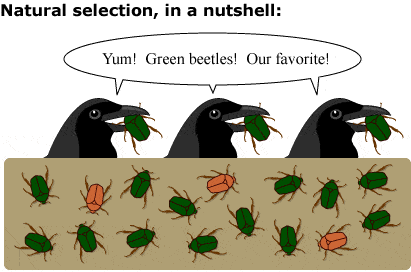
Natural selection results in change in a population's _____________ traits over time.

a)

inherited

b)

acquired

45.

Over generations of time apart on different islands with different food sources, the separated populations of Galapagos finches accumulated genetic differences until each group had different beaks. This is an example of _____.

a)

natural selection

b)

genetic drift

c)

adaptation

d)

speciation

46.

A phenotype that improves an organism’s chance of survival in their environment is considered a(n) ____________.

a)

natural selection

b)

adaption

c)

speciation

47.

Which of the following is NOT an example of natural selection?

a)

People selectively breeding hamsters for size.

b)

Insect populations developing resistance to certain pesticides.

c)

Bacteria becoming resistant to antibiotics.

d)

Male birds of certain species inheriting colorful feathers that are more attractive to females.

48.

The pelvic bone of whales is not needed for movement within the water. This is an example of a(n) ______________ structure.

a)

vestigial

b)

analogous

c)

homologous

49.

The forelimbs of mammals have similar anatomy because these groups descended from a recent common ancestor. Their bone structure is an example of a(n) ______________ structure.

a)

vestigial

b)

analogous

c)

homologous

50.

Many different groups of organisms have wings, even though they do not share a recent common ancestor. This is because they evolved in environments with similar selective pressures. Wings are an example of a(n) ______________ structure.

a)

vestigial

b)

analogous

c)

homologous

51.
Which of the following is a factor in natural selection?
a)
Individuals of species compete with one another to survive.
b)
All species are genetically diverse.
c)
Individuals better able to adapt to changes leave more offspring.
d)
All are correct 
52.
The fossil record provides evidence that 
a)
Fossils cannot be dated.
b)
All species were formed during Earth’s formation and have changed little since then.
c)
The fossilized species have no connection to today’s species.
d)
Older species gave rise to more-recent species.
53.
Individuals that are better able to cope with the challenges of their environment tend to  
a)
Decrease in population over time.
b)
Leave more offspring than those less suited to the environment.
c)
Leave fewer offspring than those less suited to the environment.
54.
The process in which organisms with traits well suited to an environment are more likely to survive and to produce offspring is
a)
Natural Selection
b)
Origin of Species
c)
Genetic Principles
d)
Trait Mechanism
55.
Comparing human hemoglobin of chimpanzees, horses, kangaroos, and chickens, reveal that humans have the fewest amino acid differences with 
a)
Kangaroos
b)
Horses
c)
chickens
d)
chimpanzees
56.
The hypothesis that evolution of a species occurs in periods of rapid change separated by periods of little or no change is called
a)
divergence
b)
gradualism
c)
punctuated equilibrium
d)
isolation
57.
The hypothesis that evolution of a species occurs gradually over time as a slow and constant process is known as
a)
speciation
b)
punctuated equilibrium
c)
gradualism
d)
microevolution
58.
Which of the following statements best reflects the evolutionary importance of the figures pictured?
a)
New genetic instructions have been disregarded in the evolution of vertebrates.
b)
Early in development, vertebrate embryos show no evidence of common ancestry.
c)
All adult vertebrates retain pharyngeal pouches (gills).
d)
The evolutionary history of organisms is seen in the way embryos develop.
59.
All the individuals of a species that live in a particular area are called a
a)
variation
b)
population
c)
fossil
d)
group
60.
Mutations are a change in what?
a)
DNA
b)
tRNA
c)
genotype
d)
phenotype
61.
If an organism can't adapt fast enough, this might happen.
a)
hibernate
b)
stay the same
c)
live longer
d)
become extinct
62.
Darwin said that within a species there will be _________________________
a)
nothing different
b)
variation/differences