wayground logo

Free Printable Worksheets

Font size

S
M
L
XL
Worksheets

phy. sem.2 exam

Total questions: 88

Worksheet time: 3hrs 30mins

Name
Class
Date
1.

Find the magnitude of the torque formula if produced by a 22.0 N force applied to a door at a 30 degree from the perpendicular distance of .005 km from the hinge.

a)

T=Frsin𝞡

b)

T=Frcos𝞡

c)

Tnet=0

d)

T/r=F

2.

which states the Law of Conservation of Energy?

a)

Energy can be created or destroyed along with changing from form to form.

b)

Energy can't be created, destroyed, or changed from one form into another.

c)

Energy can't be created nor destroyed, but only change from one form to another.

3.

A measure of the average kinetic energy of particles in a substance

a)

temperature

b)

heat energy

c)

heat transfer

d)

conduction

4.

The total energy of all the particles in a substance is called

a)

temperature

b)

thermal energy

c)

degrees

d)

mass

5.

The movement of thermal energy from a warmer object to a cooler object is called

a)

heat

b)

temperatur

c)

motion

d)

momentum

6.
Which of the following is not an example of work?
a)
an ice hockey puck laying on an ice rink
b)
ship movement that causes ripples in the water
c)
a man pushing a heavy box across the floor
d)
a magnet repelling a compass needle
7.
Which has kinetic energy?
a)
a compressed spring
b)
a book on the bookshelf
c)
an avalanche
d)
a case of dynamite
8.
Mechanical advantage is expressed ...
a)
in newtons squared
b)
in joules
c)
without any units
d)
in joules squared
9.
The unit for power is the ...
a)
watt
b)
joule
c)
newton
d)
dyne
10.
The transfer of energy by electromagnetic waves is called
a)
conduction
b)
convection
c)
radiation
d)
insulation
11.
When distance increases, electrostatic force ____________; we call this relationship ____________ proportional
a)
decreases;directly
b)
decreases;inversely
c)
increases;inversely
d)
increases;directly
12.
What variable is a Coulomb the unit for?
a)
Charge
b)
Force
c)
Distance
d)
Mass
13.
What happens to the force between two charged objects when you double the distance between them?
a)
2X
b)
1/2X
c)
4X
d)
1/4X
14.
What happens to the force between two charged objects if you double the distance between them and double the magnitude of one charge?
a)
4X
b)
6X
c)
1/2X
d)
1/6X
15.

The graph shows the relationship between the force of interaction and the magnitude of charge. What type of relationship is this?

a)

Direct

b)

Indirect

c)

Inverse

d)

Reverse

16.

A 5 C and 8 C are 8 m apart. What is the force between them?

a)

5.6 x 10⁹ N

b)

5.6 x 10⁻⁹ N

c)

4.5 x 10¹⁰ N

d)

4.5 x 10⁻¹⁰ N

17.

What unit is used to measure voltage?

a)

Ohms

b)

Omega

c)

Volts

d)

Amperes

18.

What unit is used to measure current?

a)

Ohms

b)

Omega

c)

Volts

d)

Amperes

19.

What is the current in a circuit with 6 ohms of resistance and a battery containing 24 Volts?

a)

0.25 A

b)

144 A

c)

4 A

d)

0.4 A

20.

What is the difference between potential energy and kinetic energy?

a)

A. Potential energy is the energy of an object due to its position, while kinetic energy is energy due to its motion.

b)

B. Potential energy is the energy of an object due to its motion, while kinetic energy is energy due to its position.

c)

C. Potential energy is the energy of an object due to an applied force, while kinetic energy is energy stored after the applied force

d)

D. Potential energy is the energy stored after an applied force, while kinetic energy is the energy used from the applied force.

21.

4. Which are the two types of mechanical energy?

a)

A. thermal and kinetic

b)

B. potential and kinetic

c)

C. potential and thermal

d)

D. kinetic and electromagnetic

22.

The electric field inside a spherical shell of uniform surface charge density is

a)

zero

b)

constant, less than zero

c)

directly proportional to the distance from the center

d)

none of these

23.

This is what happens to an object when the gravitational force is greater than the buoyant force.

a)

sinks

b)

floats

c)

neutrally buyant

d)

volume must be known to correctly answer this question

24.

Which liquid is the least dense?

a)

oil

b)

water

c)

syrup

d)

plastic bottle

25.

What is the equation for density?

a)

density = mass x volume

b)

density = mass / volume

c)

density = mass + volume

d)

density = mass - volume

26.

 Whose principle says buoyant force = the weight of the fluid an object displaces 

a)

Archimedes

b)

Pascal

c)

Bernoulli

d)

Einstein 

27.

Convert 35⁰F to Celsius (5/9 x (0F - 32))

a)

1.6⁰

b)

1.7⁰C

c)

2.0⁰

d)

16.6⁰C

28.
Convert: 25.0 oC to oF:
a)
77 F
b)
77 C
c)
100 F
d)
100 C
29.
Convert: 150 oF to oC:
a)
65.5 C
b)
65.5 F
c)
338.5 C
d)
338.5 F
30.
A converging lens is also known as a ____ lens.
a)
convex
b)
concave
c)
double
d)
refracted
31.
A converging lens produces an image twice the size of the original. If the object is placed 0.40 m from the lens, and the image produced is 0.80 m from the lens. What is the focal length of the lens? 
a)
0.351 m
b)
0.267 m
c)
0.416 m
d)
0.112 m
32.
When an object is placed on the focal point in front of a convex lens, the image produced is ___.
a)
real, reduced, and inverted
b)
real, enlarged, and inverted
c)
real, true, and inverted
d)
There is no image
33.

What type of image is formed?

a)

virtual and inverted

b)

virtual and upright

c)

real and upright

d)

real and inverted

34.
___ is when light travels through a material and bends.
a)
Diffraction
b)
Dispersion
c)
Mirage
d)
Refraction
35.

An image behind the mirror is...

a)

virtual

b)

real

c)

inverted

d)

upright

36.

An image that points below the principal axis is (choose 2)...

a)

virtual

b)

real

c)

upright

d)

inverted

37.

This ray diagram is for which mirror?

a)

concave

b)

convex

c)

plane

d)

window

38.
Concave mirrors can create virtual and real images.
a)
True
b)
False
39.
Convex mirrors can create real images.
a)
True
b)
False
40.

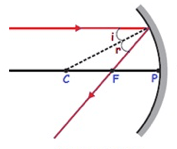
Which is the angle of Incidence?

a)

A

b)

B

c)

C

d)

D

41.

The normal is ____ to the mirror

a)

Perpendicular

b)

Parallel

c)

Perpendicular and Parallel

d)

None of the above

42.

In the given figure, which of the following statement is correct?

a)

The angle of incidence is 10°.

b)

The angle of incidence is 80°.

c)

The angle of reflection is 10°.

d)

The angle of reflection is 90°.

43.

The period of oscillation of a pendulum depends on how much mass you hang on it

a)

true

b)

false

44.

The period of oscillation of a spring depends on how much mass you attach to it.

a)

true

b)

false

45.
What is the period on Earth of a pendulum with a length of 2.4 m?
a)
3.1 sec
b)
1.9 sec
c)
9.3 sec
d)
5.1 sec
46.
Which of the following is a requirement for work to be done?
a)
Force is exerted.
b)
Object is carried.
c)
Force moves an object.
d)
Machine is used.
47.
A quantity that is has magnitude and  direction is referred to as a
a)
vector quantity
b)
scalar quantity
48.
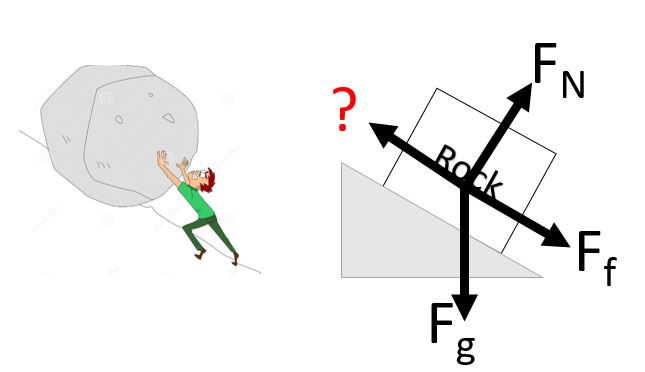
Name the missing force....
a)
Weight force
b)
Normal force
c)
Frictional force
d)
Tension force
49.
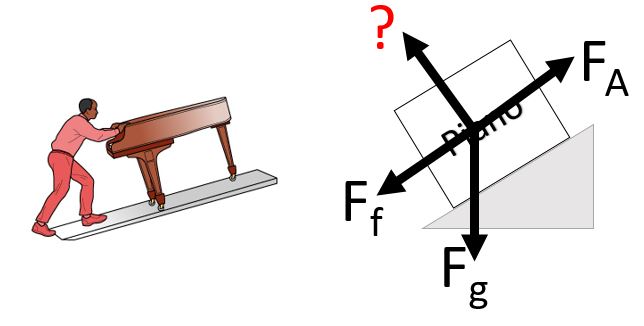
Name the missing force...
a)
applied force
b)
weight force
c)
lift
d)
normal force
50.
Name the missing force...
a)
normal force
b)
applied force
c)
frictional force
d)
tension force
51.

Whenever an object is moving, there is always this force opposing the motion:

a)

inertia

b)

momentum

c)

friction

d)

applied force

52.

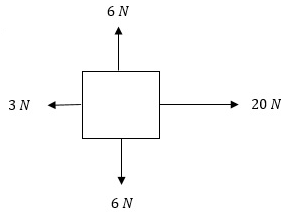
What is the NET FORCE of this diagram?

a)

17 N, right

b)

17 N, left

c)

23 N, right

d)

12 N, up

53.
A wrench is used to tighten a nut. A 15N perpendicular force is applied 50cm away from the axis of rotation, and moves a distance of 10 cm as it turns. What is the torque applied to the wrench?
a)
7.5 Nm
b)
1.5 Nm
c)
750 Nm
d)
150 Nm
54.
What is the Unit for Torque
a)
Nm
b)
N
c)
W
d)
J
55.
A centripetal force causes an acceleration.
a)
True
b)
False
56.
Speed is a __________ quantity and velocity is a __________ quantity.
a)
scalar, vector
b)
vector, scalar
57.
A car slows down from +32 m/s to +8 m/s in 4 s. The acceleration is 
a)
6 m/s/s opposite the motion
b)
2m/s/s in the direction of motion
c)
8 m/s/s opposite the motion
58.
An airplane accelerates down a runway at 3.20 m/s/s
for 8 s until it finally lifts off the ground.
Determine the velocity at take-off.
a)
0.4 m/s
b)
25.6 m/s
c)
2.5 m/s
59.
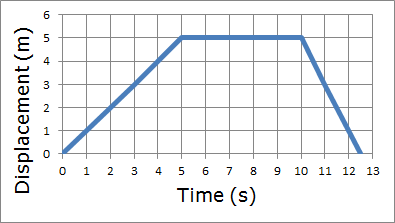
What is this graph representing?
a)
Constant Speed
b)
Acceleration (speeding up)
c)
Deceleration (slowing down)
d)
No motion
60.
What is the person doing from 5 seconds to 10 seconds?
a)
Walking 
b)
Running
c)
Standing Still 
d)
Walking Fast
61.
If you throw a baseball straight up, what is its velocity at the highest point?
a)
9.8 m/s2
b)
9.8 m/s
c)
0 m/s2
d)
0 m/s
62.
Does the vertical velocity have any effect on the horizontal velocity?
a)
yes
b)
no
63.
For every action, there is an equal and opposite reaction.
a)
Newton's
1st
Law of Motion
b)
Newton's
2nd
Law of Motion
c)
Newton's
3rd
Law of Motion
64.
Determine the accelerations that result when a 12-N net force is applied to a 3-kg object. 
a)
3 m/s
b)
4 ft/s 
c)
13 m/s
d)
4 m/s 
65.
What is the net force?
a)
40 N left
b)
0 N Balalnced
c)
400 N right
d)
40 N right
66.
The acceleration produced by a net force on an object is
a)
inversely proportional to the mass of the object.
b)
directly proportional to the magnitude of the net force.
c)
in the same direction as the net force.
d)
 all of the above
67.

A 135kg sled encounters a net force of 569N. What is the acceleration of the sled?

a)

76,815m/s/s

b)

0.24m/s/s

c)

4.21m/s/s

d)

not enough information.

68.

A forklift exerts an upward force of 3.60 x 10³ N to lift a crate 1.50 m in 5.20 s. What power does the forklift produce in kilowatts?

a)

1.04 kW

b)

10.4 kW

c)

104 kW

d)

1040 kW

69.

How much time does it take for a 520 N student, generating 289 W of power, to climb 3.0 m in the school's staircase?

a)

3.6 s

b)

5.4 s

c)

6.3 s

d)

7.4 s

70.
The units for Impulse are
a)
N/s
b)
N.s
c)
N
d)
m/s
71.
A boy kicks a football with a force of 20 N, the time the force acts for is 0.3 s.
Calculate the impulse on the ball.
a)
1 N.s
b)
6 N.s
c)
66 N.s 
d)
None of these
72.
When the speed of an object is doubled, its momentum
a)
remains unchanged in accord with the conservation of momentum.
b)
doubles
c)
quadruples
d)
decreases
73.
In this type of collision, objects tend to "stick" together.
a)
elastic
b)
inelastic 
c)
They "stick" together in both types of collisions
74.

SI unit of length

a)

cm

b)

m

c)

foot

d)

mm

75.
What is the correct SI unit for mass?
a)
Kilograms
b)
newtons
c)
pounds
d)
grams
76.
Which graph shows the object standing still?
a)
A
b)
B
c)
C
d)
D
77.
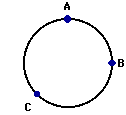
What is the direction of the velocity at point B, if the ball is revolving clockwise?
a)
up
b)
right
c)
down
d)
left
78.

What is the SI unit for force?

a)

N - Newton

b)

lb - Pound

c)

kg - Kilogram

d)

n - Nexus

79.

Units of acceleration (a)

a)

m/s

b)

kg

c)

m/s2

d)

N

80.

What is the total resistance of the circuit?

a)

100Ω

b)

200Ω

c)

.063Ω

d)

15.8Ω

81.

What type of circuit?

a)

Series

b)

Cereal

c)

Parallel

d)

Complex

82.

The number of wavelengths that pass a point each per second is:

a)

frequency

b)

period

c)

longitudinal

d)

transverse wave

83.
The bouncing back of a light ray after hitting a surface is known as...
a)
diffraction
b)
refraction
c)
rebounding
d)
reflection
84.

Sound waves are which type of waves?

a)

transverse

b)

seismic

c)

longitudinal

d)

frequency

85.
Energy due to motion is ____________ energy. 
a)
Potential 
b)
Energy
c)
Kinetic
d)
Friction
86.
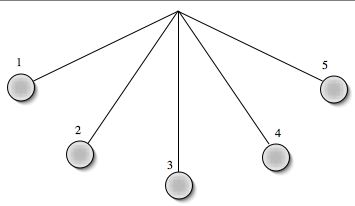
When a pendulum swings, at which point is potential energy at its greatest?
a)
1
b)
2
c)
3
d)
4
87.
The frequency of a wave is measured in __________________. 
a)
inches
b)
hertz
c)
periods
d)
eras
88.
What number represents the wavelength?
a)
1
b)
2
c)
3
d)
4