
 Worksheets
Mills- Chapter 12 DNA
Total questions: 84
Worksheet time: 2hrs 46mins
Name
Class
Date
1.
Which sequence of DNA bases would pair with this partial strand
ATG TGA CAG
ATG TGA CAG
a)
ATG TGA CAG
b)
TAC ACT GTC
c)
GTA AGT GAC
d)
CAT TCA CTG
2.
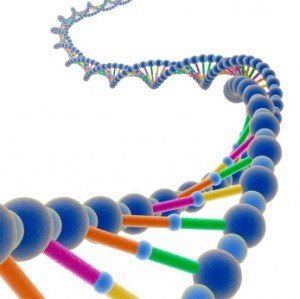
Which of the following best describes a DNA molecule?
a)
double helix
b)
contains ribose
c)
made of amino acids
d)
contains Uracil
3.
Which of the following units are repeatedly joined together to form a strand of DNA?
a)
amino acids
b)
nucleotides
c)
fatty acids
d)
polysaccharides
4.

In a molecule of double-stranded DNA, the amount of Adenine present is always equal to the amount of
a)
cytosine
b)
guanine
c)
thymine
d)
uracil
5.
Adenine bonds with ______________.
a)
Guanine
b)
Thymine
c)
Cytosine
d)
Adenine
6.
Guanine bonds with ______________.
a)
Adenine
b)
Guanine
c)
Cytosine
d)
Thymine
7.
Why is DNA important?
a)
it is very small and very complicated
b)
it's in everything
c)
it serves as the blueprint for traits of all living things
d)
because we eat it every day for energy
8.
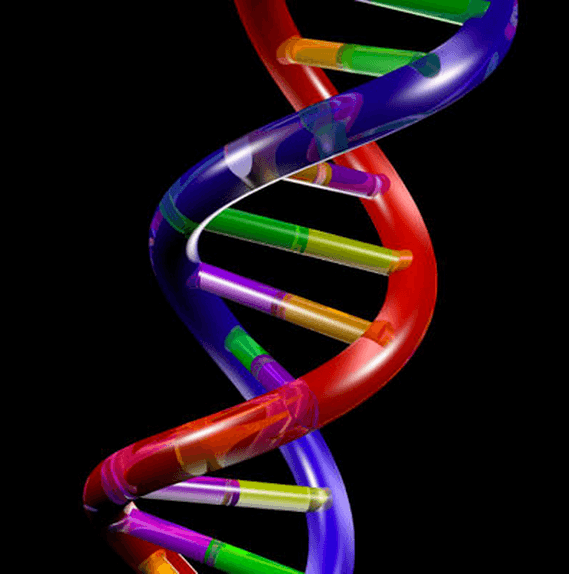
What determines the code, or information, of a DNA molecule?
a)
the shape (structure) of the nitrogen bases
b)
the order (sequence) of the nitrogen bases
c)
the color of the nitrogen bases
d)
the frequency (number) of nitrogen bases
9.
Which 2 molecules form the sides (backbone) of the DNA ladder?
a)
deoxyribose sugar and adenine
b)
deoxyribose sugar and a hydrogen bond
c)
deoxyribose sugar and the nucleus
d)
deoxyribose sugar and phosphate
10.
Which organelle is DNA usually found in?
a)
cell membrane
b)
vacuole
c)
chloroplast
d)
nucleus
11.
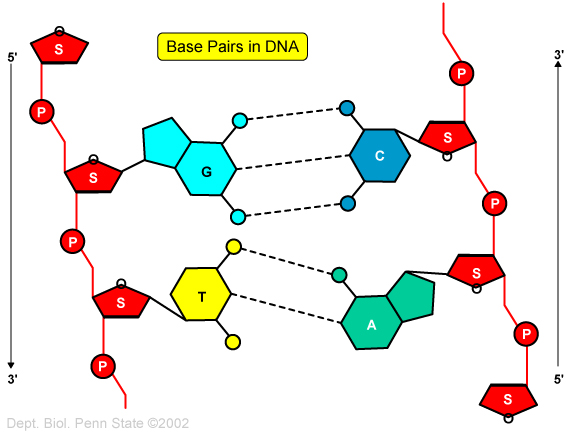
Nitrogenous bases are joined by which type of bond?
a)
polar bonds
b)
ionic bonds
c)
covalent bonds
d)
hydrogen bonds
12.

Replicate the following strand of DNA:
AATCATGGA
AATCATGGA
a)
AATCATGGA
b)
TTAGTACCT
c)
UUAGUACCU
d)
GGATAUCUA
13.
The enzyme that unzips the DNA to prepare for replication
a)
helicase
b)
replicase
c)
polymerase
d)
synthase
14.
DNA replication results in two DNA molecules,
a)
each one with two original strands
b)
each one with two new strands
c)
each one with one new strand and one original strand
d)
one with two new strands and the other with two original strands
15.

order of replication
a)
3, 2, 1, 4
b)
2, 1, 4, 3
c)
2, 3, 1, 4
d)
3, 4, 1, 2
16.
A process in which DNA has the unique ability to make an exact copy of itself.
a)
Replication
b)
Translation
c)
Transcription
17.
What is the correct complimentary strand for the following DNA?ATCGAG
a)
TACGAG
b)
ATCGAG
c)
TAGCTG
d)
TAGCTC
18.
In what phase of the cell cycle does DNA replication take place?
a)
G1
b)
S
c)
G2
d)
M
19.
What are the three components of a nucleotide?
a)
sugar, hydrogen, nitrogen base
b)
sugar, oxygen, nitrogen base
c)
sugar, phosphate, nitrogen base
d)
sugar, phosphate, protein
20.
What does DNA stand for?
a)
Deoxyribonucleic acid
b)
Denitrogenous acid
c)
Deribonucleic acid
d)
Diribonucleic acid
21.
What are the following rules called?
1 - The amount of A, T, G, and C varies from species to species.
2 - In each species, the amount of A = T and G = C.
1 - The amount of A, T, G, and C varies from species to species.
2 - In each species, the amount of A = T and G = C.
a)
Rosalind's Rules
b)
Watson's Rules
c)
Crick's Rules
d)
Chargaff's Rules
22.
Where does protein synthesis take place?
a)
Ligase
b)
Ribosomes
c)
Codon
d)
Endoplasmic Reticulum
23.
What part of the nucleic acid are DNA and RNA named for?
a)
Bases
b)
Phosphate
c)
Sugar
d)
Protein
24.
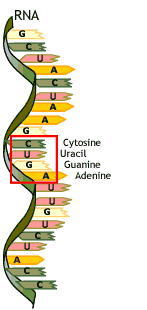
In RNA, Uracil pairs with ______.
a)
cytosine
b)
adenine
c)
guanine
d)
thymine
25.
DNA holds the code for
a)
lipids
b)
carbohydrates
c)
protein
d)
sugar
26.
Does the order of amino acids in a protein matter?
a)
YES!
b)
NO!
27.
How many amino acids are coded for by this sequence of nucleotides:
ATG GGA ACT CCA
ATG GGA ACT CCA
a)
4
b)
2
c)
6
d)
12
28.
Contains the bases adenine, uracil, cytosine and guanine
a)
DNA
b)
RNA
c)
Both
29.
How many codons are needed to specify for five amino acids?
a)
3
b)
5
c)
15
d)
30
30.
Which process is used to make mRNA from the DNA in the nucleus?
a)
transcription
b)
translation
c)
replication
31.
Which RNA bases would pair with TACGAA in transcription?
a)
AUGCUU
b)
ATGCTT
c)
GCATCC
d)
GCAUCC
32.
Where does transcription take place?
a)
nucleus
b)
cytoplasm
c)
ribosome
33.

What is occurring in this picture?
a)
Translation
b)
Replication
c)
Translocation
d)
Transcription
34.
What is the building block of proteins?
a)
Monosacchrides
b)
Polysaccharides
c)
amino acids
d)
Triglycerides
35.
Which is a difference between DNA and RNA
a)
RNA is double stranded
b)
RNA is not made of nucleotides
c)
RNA contains Uracil instead of Thymine
d)
RNA does not contain a sugar
36.
what does mRNA do?
a)
carry info from genes to ribosomes
b)
carry amino acids to ribosomes
c)
help with RNA splicing
d)
make up ribosomes
37.
If parts of a DNA sample is separated, the observer would notice that matching base pairs are always present in equal amounts. Which of the following statements best explains this occurrence?
a)
A. Bases do not form compliments. Instead they randomly appear in equal amounts.
b)
A. Bases are complimentary to one another. Each base always bonds with only one other specific base.
c)
A. One strand of DNA is a single base and the second strand is another base. When the two strands are put together it forms equal amounts.
d)
A. The observation made was a single isolated event
38.
In DNA replication, which enzyme is responsible for building the new DNA strand?
a)
helicase
b)
polymerase
c)
ligase
d)
primase
39.
Where does transcription take place?
a)
nucleus
b)
cytoplasm
c)
ribosome
40.
One difference between DNA and RNA is that....
a)
Only RNA has the base Uracil
b)
only RNA contains the base Thymine
c)
only RNA contains the base Cytocine
d)
only RNA contained the base Guanine
41.

What process is being shown here?
a)
Replication
b)
Translation
c)
Transcription
42.

The process represented in the diagram produces a molecule that is complementary to the template strand of DNA. What type of molecule is produced?
a)
New DNA
b)
Polypeptide
c)
Messenger RNA
d)
Carbohydrate
43.
what does mRNA do?
a)
carry info from genes to ribosomes
b)
carry amino acids to ribosomes
c)
help with RNA splicing
d)
make up ribosomes
44.
True or false: RNA is double-stranded.
a)
true
b)
false
c)
it depends on the type
45.
Which of these bases does not exist in RNA?
a)
C
b)
T
c)
U
d)
A
46.
A triplet of mRNA is called a
a)
codon
b)
anticodon
c)
amino acid
d)
peptide bond
47.
Which of the following units are repeatedly joined together to form a strand of DNA?
a)
amino acids
b)
nucleotides
c)
fatty acids
d)
polysaccharides
48.
Translation takes place in the
a)
ribosome
b)
chloroplast
c)
nucleus
d)
mitochondria
49.
Brings the amino acids to the ribosome
a)
mRNA
b)
tRNA
c)
rRNA
d)
DNA
50.
What would be the tRNA anticodon for the mRNA codon CAG?
a)
GTC
b)
GUC
c)
CUG
d)
CAG
51.
What is the term for a three-nucleotide sequence that codes for an amino acid?
a)
base
b)
codon
c)
amine
d)
serine
52.
Which phrase best describes translation?
a)
converts mRNA into a polypeptide
b)
catalyzes bonds between amino acids
c)
produces RNA from DNA molecules
d)
recycles tRNA molecules for reuse
53.
How many amino acids are coded for by this sequence of nucleotides:
ATG GGA ACT CCA
ATG GGA ACT CCA
a)
4
b)
2
c)
6
d)
12
54.

Which phase of which process does this picture show?
a)
Transcription
b)
Translation
c)
Replication
55.
The job of tRNA is to
a)
carry amino acids to the ribisomes
b)
carry ribisomes to the ER
c)
carry glucose to mitochondria
d)
carry mRNA out of the nucleus
56.
The codon is located on the
a)
DNA
b)
mRNA
c)
tRNA
d)
rRNA
57.
What would be the tRNA anticodon for the mRNA codon CAG?
a)
GTC
b)
GUC
c)
CUG
d)
CAG
58.
What would happen if we did not have start codons?
a)
Polypeptide chains would continue to grow
b)
Amino acids would bind to tRNA
c)
Protein synthesis wouldn't occur
d)
mRNA would form a double strand
59.
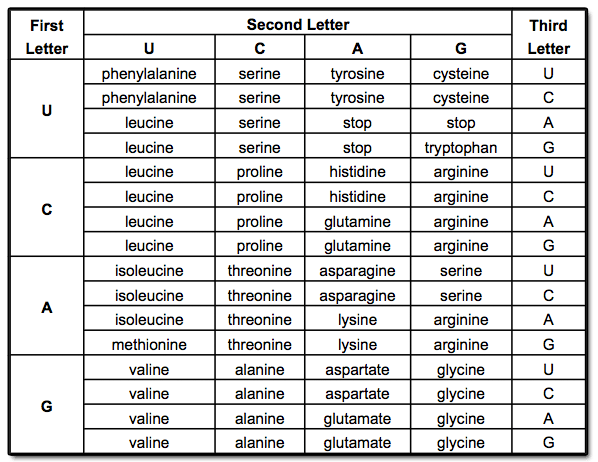
What is the correct amino acid sequence for the mRNA code AUGCCAGUAUGA
a)
Met-Pro-Ala-Val
b)
Met-Pro-Val
c)
Tyr-Gly-His
d)
Tyr-Gly-Arg-His
60.
Given the following sequence of mRNA, what series of amino acids are coded for?
mRNA: CUCAAGUGCUUC
mRNA: CUCAAGUGCUUC
a)
Ser-Tyr-Arg-Gly
b)
Val-Asp-Pro-His
c)
Leu-Lys-Cys-Phe
d)
Pro-Glu-Leu-Val
61.
In an mRNA strand, the codon AAG codes for the amino acid , while GUU codes for the amino acid .
a)
Lysine (Lys), Valine (Val)
b)
Lysine (Lys), Leucine (Leu)
c)
Asparagine (Asn), Valine (Val)
d)
Arginine (Arg), Glutamine (Glu)
62.
In an mRNA strand, the codon GCC codes for the amino acid ______ , while CCG codes for the amino acid _______
a)
Proline (Pro), Valine (Val)
b)
Alanine (Ala), Lysine (Lys)
c)
Valine (Val), Lysine (Lys)
d)
Alanine (Ala), Proline (Pro)
63.
The DNA sequence T A C C G T A G A G G C would produce which of the following amino acid sequences?
a)
Met-Val-Asp-Pro
b)
Met-Ala-Ser-Pro
c)
Val-His-Arg-Glu
d)
Glu-Lys-Ser-Leu
64.
What is the function of mRNA?
a)
to get message from DNA
b)
the find correct amino acid
c)
to help attach codons and anti-codons at ribosome
d)
make DNA
65.
YOU NEED YOUR CODON CHART!
mRNA: GGACCUAUUCAG
What is the amino acid sequence coded for by the mRNA above?
mRNA: GGACCUAUUCAG
What is the amino acid sequence coded for by the mRNA above?
a)
Gln-Ile-Pro-Gly
b)
Pro-Gly-Stop-Val
c)
Ser-Tyr-Arg-Gly
d)
Gly-Pro-Ile-Gln
66.
mRNA: GGACCUAUUCAG
The DNA sequence for the mRNA above is?
a)
CCUGGAUAAGUC
b)
CCTGGATAAGTC
c)
GGACCTATTCAG
d)
GGACCUAUUCAG
67.

A portion of DNA reads GAG. The corresponding mRNA would be
a)
GUG
b)
GTG
c)
CTC
d)
CUC
68.
The process of creating RNA using DNA as the template is
a)
translation
b)
transcription
c)
translocation
d)
Transylvania
69.
The process of making mRNA from DNA is called.
a)
Replication
b)
Transcription
c)
Translation
d)
Protein synthesis
70.
Protein synthesis takes place in two parts:
a)
Transcription then translation
b)
Replication then transcription
c)
Translation then transcription
d)
Replication then translation
71.
In DNA which is a correct base pairing?
a)
A with G
b)
G with T
c)
A with U
d)
A with T
72.
In RNA which is a correct base pairing?
a)
A with G
b)
G with T
c)
A with U
d)
A with T
73.
The building blocks of DNA & RNA consisting of a five-carbon sugar, a phosphate group, and a nitrogen-containing base.
a)
Genetics
b)
Replication
c)
Nucleotides
74.
What is the monomer of DNA and RNA?
a)
amino acids
b)
nucleotides
c)
fatty acids
d)
monosaccharide
75.
DNA codes for __________ which determine ___________
a)
mRNA, tRNA
b)
mRNA, ribosomes
c)
proteins. traits
d)
proteins, peptide bonds
76.
What is the difference between DNA and RNA
a)
DNA has uracil and RNA has thymine
b)
DNA is involved in transcription and RNA is involved in translation
c)
DNA contains thymine and RNA contains uracil
d)
DNA is made of nucleotides and RNA is not
77.
DNA has a ______ strand; RNA has a ______ strand.
a)
double/double
b)
double/triple
c)
double/single
d)
single/single
78.
What is the transcribed mRNA strand for CATTAA
a)
GUAAUU
b)
GTAATT
c)
AUGGUU
d)
CATTAA
79.
The rungs of the DNA molecules consist of
a)
a pair of nitrogen bases
b)
sugar and phosphate
c)
single strands
d)
single nitrogen bases
80.
What are the backbones (sides) of the DNA structure made up of?
a)
repeating phosphates and sugars
b)
nitrogen bases
c)
nucleotides
d)
adenine and thymine
81.

Who is responsible for producing this image?
a)
Francis Crick
b)
James Watson
c)
Rosalind Franklin
d)
Watson and Crick
82.
What did Erwin Chargaff conclude from his experiments?
a)
Nitrogen bases are held together by peptide bonds
b)
A and T, C and G always occur in equal amounts
c)
Proteins are the carriers of genetic information
d)
C and G rarely occur in eukaryotic organisms
83.

From his work with mice and pneumonia-causing bacteria, Frederick Griffith discovered what?
a)
Replication
b)
Transcription
c)
Transformation
d)
Translation
84.

By using radioactive isotopes, Hershey and Chase were able to conclude that _____ is the carrier of genetic information.
a)
DNA
b)
Protein
c)
Carbohydrate
d)
Lipid
100 %

