
 Worksheets
Sci.10_q1_2024_DNHS_Long Quiz
Total questions: 86
Worksheet time: 43mins
Where are most active volcanoes, earthquake epicenters, and major mountain belts found?
Randomly scattered across the globe.
Clustered along specific zones on Earth's surface.
Located primarily in the oceans.
Evenly distributed across continents.
ASSEMBLE THE SCRAMBLED WORD: (HINT: it is a type of Reversal theory)
TCMGANEI
(a)
ASSEMBLE THE SCRAMBLED WORD:
SEAREVRL
(a)
Assemble the scrambled word: (HINT: use for navigation)
MSCPSAO
(a)
Assemble the scrambled word:
NCIECOTOV
(a)
Assemble the scrambled word:
LTAEMN
(a)
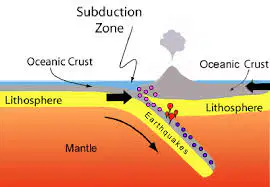
Assemble the scrambled word:
COSUUBNDTI
(a)
Assemble the scrambled word: (HINT: SPREADING)
LSOEOAFR
(a)
Which of the following is NOT a major zone where these features are concentrated?
Mid-Atlantic Ridge
African Rift Valley
Interior of continents
Ring of Fire
What is one feature associated with earthquake epicenters?
They are all very deep underground.
They mark the location of a volcano.
The ground always moves upwards.
The shaking is strongest at the epicenter.
Which type of plate boundary is most associated with the formation of major mountain belts?
Divergent boundary
Convergent boundary
Transform boundary
Hotspot
What is the primary reason why the Pacific Ring of Fire has a high concentration of active volcanoes?
Presence of transform faults
Frequent earthquakes
Subduction of oceanic plates
Hotspot activity
Earthquake epicenters are often aligned along specific regions of the Earth's surface. Which feature is most associated with these epicenters?
Mid-Ocean ridges
Ocean trenches
Fault lines
Hotspots
Major mountain belts, such as the Himalayas, are formed due to specific tectonic processes. Which plates' collision led to the formation of the Himalayas?
Pacific and North American Plates
South American and African Plates
Indian and Eurasian Plates
Australian and Antarctic Plates
The global distribution of active volcanoes provides insights into tectonic activity. What is the most common feature of areas with a high concentration of active volcanoes?
They are located near the center of tectonic plates.
They are near or along tectonic plate boundaries.
They are found in regions of continental rift zones.
They are found in areas with ancient, stable landmasses.
What happens at a divergent plate boundary?
New crust is created as the plates move apart, often accompanied by volcanic activity.
Plates push against each other, forming trenches and mountain ranges.
Plates slide past each other horizontally, causing earthquakes.
One plate subducts beneath another, melting rock and forming volcanoes.
How does the movement of plates at divergent boundaries differ from their movement at convergent boundaries?
At divergent boundaries, plates move apart creating new crust, while at convergent boundaries, plates push together, crumpling existing crust or subducting one plate under another.
Convergence always involves the formation of deep ocean trenches, while divergence does not.
Divergent boundaries are associated with mountain building, while convergent boundaries are not.
The movement is similar at both boundaries, just the outcome (landforms) differs.
Why are earthquakes more common at transform plate boundaries compared to divergent boundaries?
Friction between the plates sliding past each other builds up pressure, eventually releasing as earthquakes. Divergent boundaries lack this friction.
Transform boundaries are associated with volcanic activity, which triggers earthquakes. Divergent boundaries have less volcanic activity.
The molten rock at divergent boundaries acts as a lubricant, preventing earthquakes.
The presence of deep ocean trenches at convergent boundaries absorbs the energy that would cause earthquakes.
What is the term for the boundary between two tectonic plates?
Fault line
Plate margin
Rift valley
Subduction zone
What type of plate boundary occurs when two plates slide past each other horizontally?
Convergent boundary
Divergent boundary
Transform boundary
Collision boundary
Which type of plate boundary is associated with the formation of mid-ocean ridges?
Convergent boundary
Divergent boundary
Transform boundary
Collision boundary
Which type of plate boundary is characterized by two plates moving away from each other?
Convergent boundary
Divergent boundary
Transform boundary
Subduction zone
At which type of plate boundary do two tectonic plates slide past each other horizontally?
Divergent boundary
Convergent boundary
Transform boundary
Rift valley
What geological feature is commonly formed at a convergent boundary between two continental plates?
Mid-Ocean ridge
Ocean trench
Mountain range
Volcanic Island arc
What type of plate boundary is typically associated with the formation of new oceanic crust?
Convergent boundary
Divergent boundary
Transform boundary
Subduction zone
Which type of plate boundary involves one tectonic plate being forced beneath another, often leading to volcanic activity?
Convergent boundary
Divergent boundary
Transform boundary
Rift valley
What processes occur at plate boundaries that significantly impact the Earth's surface?
Plates diverge, converge, or transform, leading to volcanic activity, earthquakes, mountain formation, and ocean trench creation.
Plate boundaries are mostly inactive and have minimal effect on the Earth's surface.
The main process at plate boundaries is the grinding of plates, which smooths rocks.
Plate boundaries primarily affect the ocean floor.
What is the main consequence of plates moving apart at a divergent boundary?
Formation of deep ocean trenches
Subduction of one plate under another
Creation of new crust, often accompanied by volcanic activity
Increased pressure leading to earthquakes.
What type of landform is created by the horizontal movement of plates grinding past each other at a transform plate boundary?
Mid-ocean ridges
Mountain ranges
Deep ocean trenches
Large fault lines
How does the type of plate boundary (divergent, convergent, transform) affect volcanic activity?
Divergent boundaries typically have fewer explosive eruptions, while convergent boundaries with subduction zones produce more frequent, volatile-rich volcanic activity. Transform boundaries usually lack volcanic activity.
Volcanic activity is similar across all types of plate boundaries, regardless of their type.
Convergent boundaries experience the most intense volcanic activity due to the collision of thicker continental crust.
Transform boundaries produce the most explosive volcanic eruptions due to high pressure buildup.
Earthquakes are a common phenomenon along plate boundaries. How do the processes at convergent boundaries differ from those at transform boundaries, leading to earthquake characteristics?
Convergent boundaries experience compressional earthquakes due to the pushing together of plates. Transform boundaries experience shearing earthquakes due to the horizontal grinding motion.
Both boundaries experience similar types of earthquakes, but convergent boundaries have stronger tremors due to the larger forces involved.
Earthquakes at convergent boundaries are shallow, while those at transform boundaries are deep.
The presence of water at convergent boundaries dampens earthquake intensity compared to transform boundaries.
How do the processes occurring at plate boundaries relate to the distribution of earthquakes and volcanoes?
Earthquakes and volcanoes are randomly distributed
Plate boundaries have no impact on earthquake and volcano distribution
All plate boundaries produce earthquakes and volcanoes
Different plate boundaries have different relationships with earthquakes and volcanoes
How does the rate of plate movement affect the intensity of geological processes at plate boundaries?
Plate movement speed has no impact on geological processes
Faster plates always produce more intense processes
Slower plates lead to more intense geological processes
The relationship between plate speed and geological processes is complex
How does the interaction between tectonic plates and the Earth's mantle influence geological processes at plate boundaries?
The mantle has no role in plate boundary processes
The mantle is only involved in volcanic activity
The mantle drives plate movement and influences boundary processes
The relationship between the mantle and plate boundaries is unknown
What process typically occurs at a divergent boundary between two oceanic plates?
Mountain formation
Seafloor spreading
Subduction
Earthquake
Which process is most likely to occur at a convergent boundary where an oceanic plate meets a continental plate?
Oceanic ridge formation
Mountain building
Subduction and volcanic activity
Rift valley formation
At a transform boundary, what is the most common geological event?
Earthquake
Volcano formation
Mountain formation
Seafloor spreading
Which process occurs at a convergent boundary between two continental plates?
Formation of volcanic islands
Formation of mountain ranges
Formation of deep ocean trenches
Formation of mid-ocean ridges
What geological feature is formed at a divergent boundary between two continental plates?
Volcanic island arc
Rift valley
Ocean trench
Fold mountains
What is the outermost layer of the Earth, where we live and build our cities?
Mantle
Outer core
Inner core
Outer core
The mantle is the thickest layer of the Earth. What is its state (solid, liquid, or gas)?
Gas
Liquid
Solid (mostly) with some plastic-like behavior
Completely molten
The Earth's core is extremely hot. Is the outer core solid or liquid?
Solid
Liquid
Gas
It varies depending on location
How does the difference in temperature and pressure between the mantle and the core affect their states (solid vs. liquid)?
The high temperature in the core keeps it liquid, while the mantle, under immense pressure, remains mostly solid despite its high temperature.
The mantle is liquid due to the presence of molten rock rising from the core. The core cools and solidifies under pressure.
Both the mantle and core are in similar liquid states due to the extreme heat.
The mantle is cooler and more solid than the core because it radiates heat outwards.
The crust and the mantle are considered to be part of the same tectonic system, while the core is distinct. Explain why.
The crust and mantle share similar solid (or mostly solid) states and interact through plate tectonics. The core, being liquid, behaves differently.
The composition of the crust and mantle is similar, while the core is made of denser metals.
The crust is constantly being recycled through plate movement, while the mantle and core remain relatively stable.
All the above contribute to the distinction between the crust/mantle system and the core.
How does the density of Earth's layers vary from the core to the crust?
Density increases from core to crust
Density is constant throughout the Earth
Density increases from crust to core
Density varies randomly throughout the Earth
How does the Earth's internal heat affect the movement of tectonic plates?
Internal heat has no impact on plate movement
Internal heat cools the plates, slowing them down
Internal heat provides energy for plate movement
Internal heat has an unpredictable effect on plate movement
How does the study of seismic waves provide information about the Earth's internal structure?
Seismic waves cannot penetrate the Earth's interior
Seismic waves are unaffected by Earth's layers
Seismic waves are used to directly observe the Earth's core
Seismic waves are used to infer the properties of Earth's layers
Which layer of the Earth is the hottest and composed mainly of iron and nickel?
Crust
Mantle
Outer core
Inner core
What is the Earth's outermost layer called?
Crust
Mantle
Outer core
Inner core
Which layer of the Earth is responsible for the movement of tectonic plates?
Crust
Mantle
Outer core
Inner core
The Earth's core is divided into two parts. What distinguishes the outer core from the inner core?
The outer core is solid, and the inner core is liquid.
The outer core is liquid, and the inner core is solid.
Both the outer core and inner core are liquid.
Both the outer core and inner core are solid.
What is the layer of the Earth located directly beneath the tectonic plates, believed to be a key factor in plate movement?
Crust
Outer core
Inner core
Mantle
The theory of plate tectonics explains the movement of large plates that make up the Earth's crust. What are some of the possible mechanisms driving this movement?
Convection currents in the Earth's mantle, where hot, molten rock rises, cools, and sinks, creating a cyclical movement that drags plates along.
The gravitational pull of the sun and moon on the Earth's surface, causing the plates to shift.
The Earth's rotation creating a centrifugal force that pushes plates apart at the equator.
The cooling and shrinking of the Earth's core, causing the outer layers to wrinkle and fold.
The theory of plate tectonics suggests hot, molten rock moves within the mantle. What happens to this hot rock as it rises towards the surface?
It cools and sinks back down, creating a circulation pattern.
It vaporizes and escapes into the atmosphere.
It solidifies and becomes part of the crust.
It remains hot and molten all the way to the surface.
Does gravity play a part in plate movement according to plate tectonics?
No, gravity is not a significant factor in plate tectonics.
Yes, gravity pulls the plates down, but convection currents are the main driver.
Yes, the gravitational pull of the sun and moon influences plate movement.
The answer is unclear; the role of gravity is still being debated.
How do convection currents in the mantle influence tectonic plate movement?
Convection currents create a cycle where hot mantle rock rises and spreads, moving plates at the surface, while cooler rock sinks, dragging plates at subduction zones.
Convection currents primarily heat the mantle, expanding it and pushing plates apart.
The direct rising and sinking of mantle rocks push and pull tectonic plates across the surface.
Convection currents result from plate movement rather than causing it.
What geological feature is commonly formed at a convergent boundary where two continental plates collide?
Mid-ocean ridge
Volcanic island arc
Mountain range
Ocean trench
Which type of seismic wave is the fastest and travels through both solid and liquid layers of the Earth?
P-waves
S-waves
Surface waves
Rayleigh waves
What is the primary cause of tsunamis, often associated with tectonic activity?
Volcanic eruptions
Underwater landslides
Earthquakes
Storm surges
What type of geological feature is typically formed at a divergent boundary between two continental plates?
Rift valley
Mountain range
Ocean trench
Volcanic island arc
Which of the following is a characteristic of transform plate boundaries?
They are associated with the creation of new oceanic crust.
They often lead to the formation of mountain ranges.
They are characterized by horizontal sliding of plates past each other.
They result in significant volcanic activity.
What is the primary cause of earthquakes at plate boundaries?
Movement of tectonic plates along faults
Volcanic eruptions
Weathering of rocks
Melting of the Earth's core
What geological feature is commonly formed at a transform boundary where two tectonic plates slide past each other?
Fault lines
Mountain ranges
Volcanic arcs
Mid-ocean ridges
Which type of tectonic plate movement is primarily responsible for the creation of oceanic trenches?
Divergent movement
Convergent movement
Transform movement
Static movement
What is the primary cause of earthquakes at transform boundaries?
Subduction of one plate beneath another
Movement of plates sliding past each other
Expansion of magma beneath the surface
Collisions between continental plates
What type of geological activity is most commonly associated with transform boundaries?
Earthquakes due to the sliding motion of plates.
Volcanic eruptions caused by subduction.
Formation of new oceanic crust.
Mountain building through plate collision.
Which layer of the Earth is primarily responsible for the convection currents that drive plate tectonics?
Crust
Outer core
Inner core
Mantle
What is the primary cause of earthquakes at transform plate boundaries?
Sudden release of stress as plates slide past each other.
Subduction of one plate beneath another.
Volcanic activity from rising magma.
Expansion of the Earth's crust.
What geological feature is typically formed at a convergent boundary between an oceanic plate and a continental plate?
Volcanic island arc
Ocean trench
Mountain range
Rift valley
What type of plate boundary is characterized by plates sliding past each other without creating or destroying crust?
Divergent boundary
Convergent boundary
Transform boundary
Subduction zone
What is the primary cause of earthquakes at transform plate boundaries?
Movement of magma beneath the surface
Sudden release of stress accumulated along fault lines
Volcanic eruptions
Movement of tectonic plates away from each other
What is the primary cause of tectonic plate movement?
Gravitational pull from the sun
Convection currents in the mantle
Magnetic forces from the Earth's core
Wind patterns on the Earth's surface
Which geological feature is typically formed at a divergent boundary between oceanic plates?
Volcanic island arc
Mid-ocean ridge
Mountain range
Ocean trench
How do subduction zones contribute to volcanic activity?
They create new oceanic crust that leads to eruptions.
They cause one plate to slide beneath another, melting rock and forming magma.
They prevent volcanic activity by stabilizing the crust.
They are only associated with earthquakes, not volcanic activity.
What is the primary cause of earthquakes at transform plate boundaries?
Movement of tectonic plates sliding past each other
Subduction of one plate beneath another
Creation of new crust
Volcanic activity
Which layer of the Earth is primarily responsible for the generation of the Earth's magnetic field?
Crust
Outer core
Inner core
Mantle
What geological feature is typically formed at a divergent boundary between two oceanic plates?
Mid-ocean ridge
Mountain range
Volcanic island arc
Ocean trench
What geological process is primarily responsible for the formation of oceanic trenches?
Subduction of oceanic plates
Rifting of continental plates
Transform faulting
Volcanic activity
Which type of plate boundary is characterized by the collision of an oceanic plate with a continental plate?
Divergent boundary
Convergent boundary
Transform boundary
Passive margin
What is the primary geological feature formed at a divergent boundary between two oceanic plates?
Mid-ocean ridge
Volcanic island arc
Mountain range
Ocean trench
What type of geological feature is typically formed at a transform boundary?
Mid-ocean ridge
Fault line
Volcanic island arc
Rift valley
Which layer of the Earth is primarily responsible for tectonic plate movement?
Crust
Outer core
Inner core
Mantle
What is the primary cause of earthquakes at convergent boundaries?
Subduction of one plate beneath another
Seafloor spreading
Movement of plates sliding past each other
Expansion of magma chambers
What geological process is primarily responsible for the creation of oceanic trenches?
Subduction of one tectonic plate beneath another
Seafloor spreading
Continental collision
Transform faulting
Which layer of the Earth is primarily responsible for the convection currents that drive plate tectonics?
Crust
Outer core
Inner core
Mantle
What is the primary cause of earthquakes at transform boundaries?
Movement of plates sliding past each other
Subduction of one plate under another
Volcanic activity
Collision of two continental plates

