
 Worksheets
Chemistry Honors - Semester 2 Final Exam (LG5,6,7)
Total questions: 80
Worksheet time: 1hrs 8mins
Which of the following shows a metallic bond?


Which of the following has an ionic bond?


Which of the following have covalent bonds?


What is the molecular geometry of HCN?
linear
bent
trigonal planar
tetrahedral

What is the hybridization of the central carbon atom?
sp
sp2
sp3

What is the bond angle around the central carbon atom?
180
120
90
109.5

What is the hybridization of the central carbon atom?
sp
sp2
sp3

What is the bond angle around the central carbon atom?
180
120
109.5
90

What is the molecular geometry of CH2O?
linear
bent
trigonal planar
tetrahedral
What types of bonds are found in CH2O?
covalent bonds
ionic bonds
sigma bonds
pi bonds
metallic bonds
Which bond type involves the stealing (transfer) of electrons?
covalent
metallic
ionic
Which bond type involves the sharing of electrons between two atoms?
covalent
metallic
ionic
Which bond type involves the sea of electrons?
covalent
metallic
ionic
What type of compound is 6 MgO?
covalent
ionic
metallic
What type of compound is 3 CH4?
covalent
ionic
metallic
What type of compound is 8 Be?
covalent
ionic
metallic
When atoms share valence electrons, a __________ bond is formed.
covalent
ionic
metallic
When atoms donate electrons to the sea of electrons, a __________ bond is formed.
covalent
ionic
metallic
When electrons are transferred between atoms, an __________ bond is formed.
covalent
ionic
metallic

What type of compound is shown above?
covalent
ionic
metallic

What type of compound is shown above?
covalent
ionic
metallic

What type of compound is shown above?
covalent
ionic
metallic
What is the correct formula for this compound?
3 CH4
C3H12
CH4
3 C4H
What is the correct formula for this compound?
Mg6O6
6 MgO
Mg2O2
6 Mg6O6
What is the correct formula for this compound?
Be8
Be2
8 Be
8 Be2+
Which of the following have a low density?


Which of the following have a high density?
Which of the following are insoluble in water?
Which of the following have a high solubility in water?
Which of the following may or may not be soluble in water depending on the substance?
Which of the following can create electrolytes in water?
What is required in order for a substance to conduct electricity?
free moving neutral atoms
free moving charged particles
protons
electrons
Which of the following can conduct electricity as a solid?
Which of the following cannot conduct electricity as a solid?
Which of the following will conduct electricity when dissolved in water?

Which substance in the table above is most likely a covalent compound?
A
B
C
Which substance in the table above would you use to make a phone-charging cable?
A
B
C
Which substance in the table above would become conductive when added to water?
A
B
C
Which substance in the table above could be used to make an oven-safe baking pan?
A
B
C
Which of the following are evidence of chemical change?
color change
temperature change
formation of a solid
formation of a gas
giving off light
What is the coefficient of H2O after balancing the chemical reaction below?
___ C3H8 + ___ O2 → ___ CO2 + ___ H2O
4
1
2
3
5
Conservation of mass means...
the mass of reactants must be equal to the mass of products
the mass of reactants must NOT be equal to the mass of products
the number of elements on each side of the reaction must be equal
the number of elements on each side of the reaction must NOT be equal
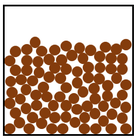
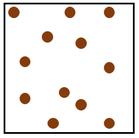
Which state symbol best describes the phase of the substance shown in this particle view diagram?
(s)
(l)
(g)
(aq)
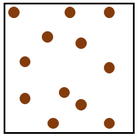
Which of the following best describes the phase of this substance?
compressible with fixed shape
compressible with changeable shape
rigid with fixed shape
rigid with changeable shape
Which of the following shows the phase of a substance whose shape and volume cannot change?
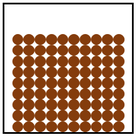
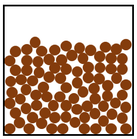
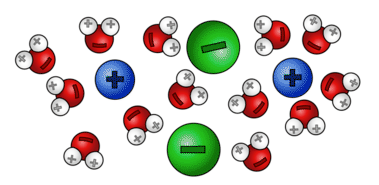
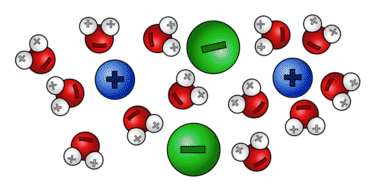
Which state symbol best describes the phase of NaCl in this particle view diagram?
(s)
(l)
(g)
(aq)
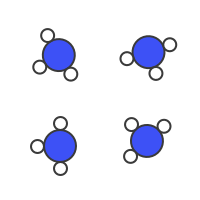
Which of the following formulas could be represented by this diagram?
AlF3 (g)
AlF3 (l)
NH3 (g)
NH3 (s)
Intermolecular forces (IMFs) are responsible for...
bonding atoms together
attracting molecules to each other
attracting electrons in the sea of electrons
holding electrons in an atom
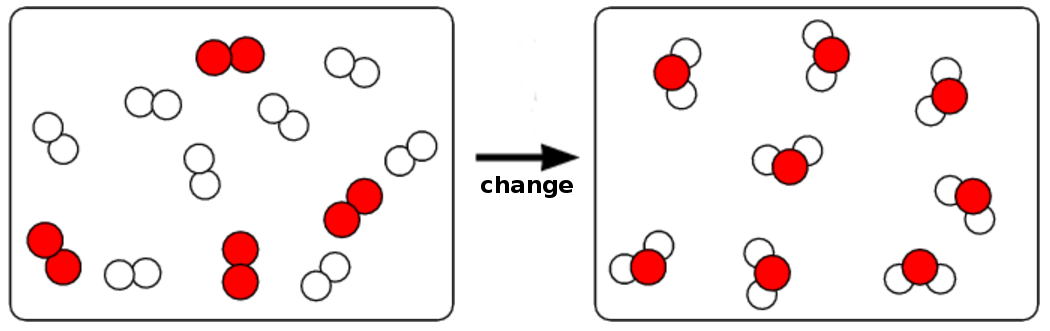
Which of the following best describes the change shown in this diagram?
Physical change because a new substance was created.
Physical change because no new substance was created.
Chemical change because a new substance was created.
Chemical change because no new substance was created.
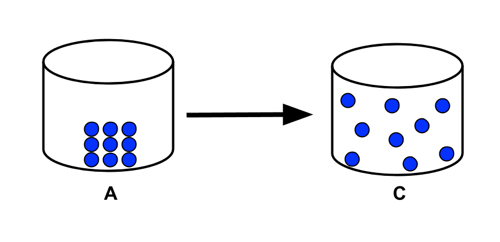
Which of the following best describes the change shown in this diagram?
Physical change because a new substance was created.
Physical change because no new substance was created.
Chemical change because a new substance was created.
Chemical change because no new substance was created.
Which of the following are examples of a chemical change?
liquid nitrogen boiling
cells producing energy
water freezing
vinegar and baking soda fizzing
Which of the following are examples of physical change?
liquid nitrogen boiling
burning coal
water melting
paper being cut into smaller pieces
Increasing the temperature of a substance causes the molecules to...
move faster
move slower
break their bonds
do nothing
For most substances, the phase of matter that has the highest density is...
solid
liquid
gas
aqueous
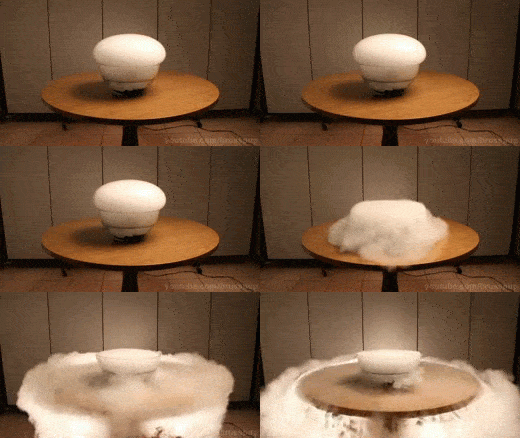
Which of the following best explains what is happening in this picture?
IMFs are becoming weaker as the bubble breaks
IMFs are becoming stronger as the bubble breaks
Bonds are becoming weaker as the bubble breaks
Bonds are becoming stronger as the bubble breaks
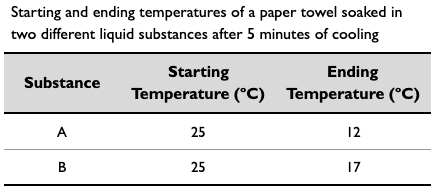
Which of the following best explains the difference in ending temperatures between substances A and B?
A had weaker IMFs because it evaporated faster
A had stronger IMFs because it evaporated faster
B had weaker IMFs because it evaporated faster
B had stronger IMFs because it evaporated faster
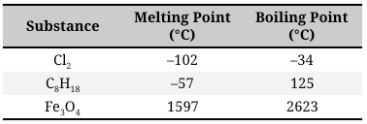
What phase will C8H18 be in at a temperature of 98ºC?
solid
liquid
gas
What phase will Fe3O4 be in at a temperature of 1200ºC?
solid
liquid
gas
What phase will Cl2 be in at a temperature of 25ºC?
solid
liquid
gas
Based on this table of melting and boiling points, which substance has the weakest IMFs?
Cl2
C8H18
Fe3O4
At room temperature, Br2 is a liquid and Cl2 is a gas. Which of the following best explains this difference?
Br2 has weaker IMFs than Cl2
Br2 has stronger IMFs than Cl2
Br2 has weaker bonds than Cl2
Br2 has stronger bonds than Cl2
Which of the following separation techniques could you use to separate an insoluble solid from a liquid?
(Hint: insoluble means that the substance will not dissolve)
crystallization
distillation
filtration
chromatography
The starting materials in a chemical reaction are called
products
reactants
starters
enders
New substances that are formed as the result of a chemical reaction are called
products
reactants
starters
enders

How many hydrogen atoms are on the product side of this chemical equation?
1
2
3
4

Why are chemical equations always balanced? (Select all that apply)
Matter cannot be created.
Matter cannot be destroyed.
Matter can only be rearranged/conserved.
Matter doesn't matter.
In a chemical reaction, no new atoms are created, and no atoms are destroyed.
true
false
The number in front of a chemical formula in an equation that indicates how many molecules or atoms of each reactant and product are involved in a reaction is called the
coefficient
reactant
subscript
product
group
In a chemical reaction . . .
the atoms of the reactants always stay together to form the products
the atoms of the reactants unbond, rearrange, and then rebond to form the products
new atoms are formed which combine to make the products
some atoms disappear while others multiply to form the products
If the reactants on the left side of a chemical equation are C₃H₈ + 5 O₂, the products in a balanced equation could be
4 CO₂ + 3 H₂O
3 CO₂ + 4 H₂O
2 CO₂ + 3 H₂O
3 CO + 4 H₂O
Which of the following options correctly balances the equation below?
__ HNO2 + __ O2 → __ HNO3
4, 1, 4
1, 2, 1
1, 2, 1
2, 1, 2
You know that a chemical reaction has occurred if
there is a precipitate (new solid)
there is a color change
there is a temperature change
any of these occurred
In chemical reactions, what does the Law of Conservation of Mass mean?
Matter is not created or destroyed.
The total mass of the reactants is greater than the total mass of the products.
The total mass of the reactants is less than the total mass of the products.
Matter is not changed.

The blue numbers in the image below represent
reactants
coefficients
subscripts
products
groups
In any chemical reaction, the mass of the products is always
slightly less than the mass of the reactants
much less than the mass of the reactants
the same as the mass of the reactants
greater than the mass of the reactants
Which of the reactions below does NOT obey the law of conservation of mass?
Xe + 3 F2 → XeF6
3 Xe + 9 F2 → 3 XeF6
XeF6 → Xe + 3 F2
2 XeF6 → 2 Xe + 12 F2
During a chemical reaction, the amount of reactant molecules __________, while the amount of product molecules __________.
increases; increases
increases; decreases
decreases; decreases
decreases; increases
A liquid reactant with a mass of 5 grams is placed into an empty beaker with a mass of 15 grams. Then 5 grams of a different liquid reactant is added to the beaker and a bright yellow solid is produced. If all of the reactants are consumed and no gases are produced, what is the total mass of the beaker and product?
5 grams
10 grams
15 grams
20 grams
25 grams

