wayground logo

Free Printable Worksheets

Font size

S
M
L
XL
Worksheets

Spring Final Review Chemistry

Total questions: 214

Worksheet time: 4hrs 11mins

Name
Class
Date
1.

How many VALENCE ELECTRONS does Chlorine have?

a)

2

b)

7

c)

8

d)

10

e)

17

2.

Ionic bonds are formed when electrons get

a)

Shared between two atoms

b)

Removed from both atoms

c)

Transferred from one atom to another

d)

Added to both atoms

3.

How many valence electrons does Mg have? (use the PTable)

a)

1

b)

2

c)

3

d)

4

e)

5

4.

How many valence electrons does Po (Polonium) have? (Use your PTable)

a)

2

b)

4

c)

6

d)

8

5.

Ionic bonds typically form between

a)

A metal and a nonmetal

b)

Two nonmetals

c)

Two metals

d)

A metalloid and a metal

6.

Atoms are most stable when their outer shell is complete.

a)

True

b)

False

7.

Why do elements form chemical bonds?

a)

Because they're friendly

b)

To create a new element

c)

To become stable

d)

Because they all need to gain more electrons

8.

What is the correct formula for Sodium Chloride?

a)

SCl

b)

NaCl

c)

SC

d)

NaCl2

9.

Name this ionic compound: Al2O3

a)

Dialuminum oxide

b)

Aluminum oxygen

c)

Oxygen Aluminide

d)

Aluminum oxide

10.

If you were to draw the lewis dot structure for Germanium (Ge), how many dots would you put around it?

a)

2

b)

4

c)

6

d)

8

11.

Cations _______ electrons, becoming _______ charged.

a)

Gain; positively (+)

b)

Gain; negatively (-)

c)

Lose; positively (+)

d)

Lose; negatively (-)

12.

Anions ____ electrons, becoming _____ charged.

a)

Gain; positively (+)

b)

Gain; negatively (-)

c)

Lose; positively (+)

d)

Lose; negatively (-)

13.

Write the chemical formula for K and Br (potassium bromide).

a)

KBr

b)

K2Br

c)

KBr3

d)

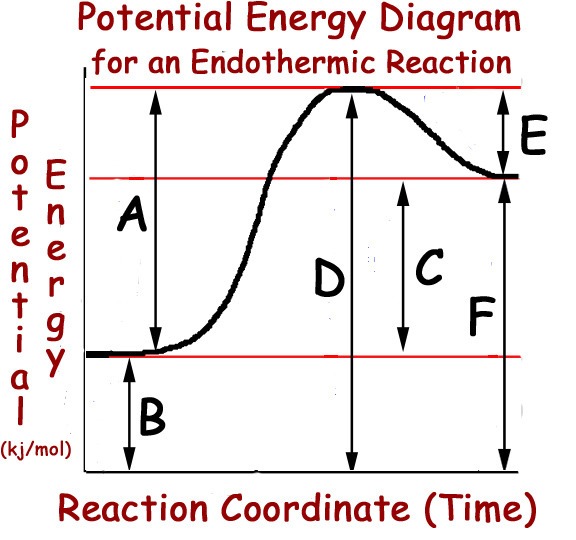
KBr2

14.

Write the chemical formula for Na and S (sodium sulfide).

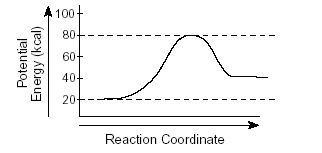
a)

NaS

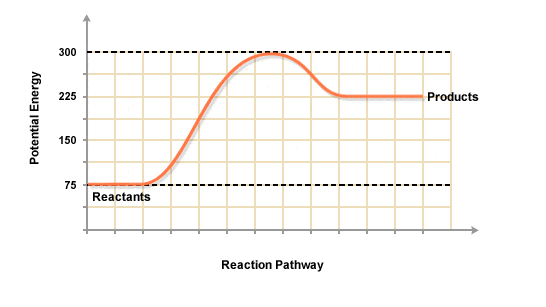
b)

S2S2

c)

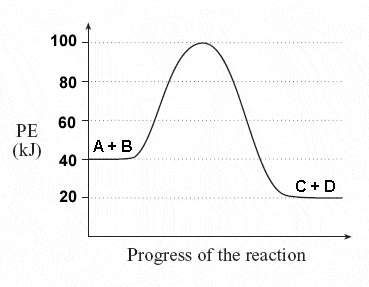
Na2S

d)

NaS2

15.

Metals (like Na) typically _____ electrons in the formation of ionic bonds.

a)

Gain

b)

Lose

c)

Keep the same

16.

Nonmetals (like Cl) typically ____ electrons when they form ionic bonds.

a)

Gain

b)

Lose

c)

Keep the same

17.

Why are there two sodiums (Na), in the formation of this ionic compound?

a)

There always has to be 2 metals

b)

The overall charge needs to add up to 4

c)

The overall charge has to be 0

d)

It needs to have more metal atoms than nonmetal

18.

Using the model for the formation of Scandium Fluoride (an ionic compound), write the chemical formula.

a)

Sc3F

b)

Sc3F3

c)

Sc+3F-1

d)

ScF3

19.

Using the model, write the chemical formula for an ionic compound that has Mg and Cl.

a)

MgCl2

b)

Mg2Cl2

c)

Mg+2Cl-1

d)

Mg2Cl2

20.

Ionic bonds are formed between...

a)

Non - metals

b)

A metal and a non-metal

c)

Metals

21.

How is an ionic bond formed?

a)

Sharing of electrons

b)

Delocalised electrons

c)

Transfer of electrons

22.

Select all of the statements below that are correct to describe the structure and properties of ionic compounds...

a)

They have high melting and boiling points

b)

They have a lattice structure

c)

The ions are held together by intermolecular forces

d)

They can conduct electricity when molten

e)

They can conduct electricity when solid

23.

Which of the below is an ionic compounds?

a)

Ni

b)

MgCl2

c)

H2O

d)

CH4

24.

An example of an ionic compound is Sodium Chloride, which is made from Na+ and Cl- ions. Why do these ions form an ionic bond?

a)

They have like charges

b)

They are from the same group

c)

They are from the same period

d)

They have opposite charges

25.

Lithium is in group 1 of the periodic table, which ion would it form?

a)

Li-

b)

Li2-

c)

Li+

d)

Li2+

26.

Oxygen is in group 6 of the periodic table, which ion would it form?

a)

O-

b)

O+

c)

O2-

d)

O2+

27.

Lead Chloride is an ionic compound, made up from Pb2+ ions and Cl- ions. Which is the correct formula for this compound?

a)

PbCl3

b)

PbCl

c)

PbCl4

d)

PbCl2

28.

Magnesium Hydroxide is an ionic compound made up from Mg2+ and OH- ions. Which is its correct formula?

a)

MgOH

b)

MgOH2

c)

Mg(OH)2

d)

MgO

29.

In an ionic bond, the ions are held together because...

a)

the positive nucleus of each ion attracts the other ion's negatively charged electrons

b)

the ions have opposite charges

c)

as the electron moved from one atom to another it pulled the atom along with it

d)

electrons are being shared

30.

Which element(s) will lose valence electrons to form an ion? Check all that apply.

a)

Phosphorus

b)

Iron

c)

Barium

d)

Neon

31.

Which of the following pairs of elements could NOT react to form an ionic compound?

a)

Carbon and Oxygen

b)

Potassium and Fluorine

c)

Silver and Oxygen

d)

Aluminum and Chlorine

32.

The following ionic crystal has 6 Fe ions (red) and 9 O ions (blue). What is the formula for this ionic crystal?

a)

FeO

b)

Fe2O3

c)

Fe3O2

d)

Fe6O9

33.

What is the name of the following compound: CuBr2

a)

copper bromine

b)

copper bromide

c)

copper (I) bromide

d)

copper (II) bromide

34.

What is the name of the following compound: K2SO4

a)

potassium sulfur

b)

potassium sulfate

c)

potassium (I) sulfate

d)

potassium (II) sulfide

35.

What is the name of the following compound: Mn2O3

a)

manganese oxide

b)

manganese (II) oxide

c)

manganese (III) oxide

d)

magnesium oxide

36.

What is the what charge of manganese in the compound: Mn2O3

a)

+1

b)

+2

c)

+3

d)

-3

37.

What is the charge of copper in the compound: CuBr2

a)

+1

b)

+2

c)

-1

d)

-2

38.

What is the what charge of lead in the compound: lead (IV) iodide

a)

+1

b)

+4

c)

+6

d)

-1

39.

Which is the correct formula for the compound: lead (II) fluoride

a)

Pb2F

b)

PbF2

c)

PbF

d)

PbF7

40.

Which is the correct formula for the compound: Calcium Oxide

a)

CaO

b)

CaO2

c)

Ca2O

41.
If fluorine is stronger then carbon, what charge will the fluorine receive?
a)
negative
b)
slight negative
c)
positive
d)
slight positive
42.
Which of the following has the highest boiling point?
a)
H2
b)
NH3
c)
N2
d)
O2
43.
Does H2O have hydrogen bonding?
a)
yes
b)
no
44.
A substance capable of hydrogen bonding has a ___________ boiling point than a similar substance that doesn't hydrogen bond.
a)
higher
b)
lower
45.
In general, substances with stronger intermolecular forces have ___________  boiling points than those with weaker intermolecular forces
a)
higher
b)
lower
46.

Which of the following molecule is not polar?

a)

NH3

b)

NF3

c)

BF3

d)

CHCl3

47.
Choose the correct shape for this molecule:
a)
Trigonal planar
b)
Trigonal pyramidal
c)
Tetrahedral
d)
Linear
48.
Choose the correct shape for this molecule:
a)
Trigonal planar
b)
Trigonal pyramidal
c)
Bent
d)
Linear
49.
Choose the correct shape for this molecule:
a)
Bent
b)
Trigonal pyramidal
c)
Trigonal planar
d)
Linear
50.
Choose the correct shape for this molecule:
a)
Trigonal planar
b)
Trigonal pyramidal
c)
Bent
d)
Tetrahedral
51.
Choose the correct shape for this molecule:
a)
linear
b)
Trigonal pyramidal
c)
Bent
d)
Tetrahedral
52.
Choose the correct shape for this molecule:
a)
linear
b)
Trigonal pyramidal
c)
Bent
d)
Tetrahedral
53.
Choose the correct shape for this molecule:
a)
Bent
b)
Trigonal pyramidal
c)
Tetrahedral
d)
Trigonal planar
54.
Choose the correct shape for this molecule:
a)
Bent
b)
Linear
c)
Tetrahedral
d)
Trigonal pyramidal
55.
 A lone pair is defined as
a)
A pair of bonding electrons
b)
One non-bonding electron
c)
A pair of non-bonding electrons
d)
A pair of electrons on the central atom
56.
What is the VSEPR theory used to predict?
a)
Bond Strength
b)
Polarity
c)
Molecular Shape
d)
Electronegativity
57.
Hydrogen is classified as a ________.  
a)
Metal
b)
Nonmetal
58.

In the diagram shown, what is the total number of electrons shared in the bond between the two carbon atoms?

a)

2

b)

3

c)

4

d)

6

59.

Which molecule contains a triple covalent bond between its atoms?

a)

N2

b)

O2

c)

F2

d)

H2

60.

In a covalently bonded molecule, the atoms ____.

a)

Share electrons

b)

Transfer electrons

c)

Neither

61.

What elements generally make a covalent bond?

a)

metal and nonmetal

b)

2 or more nonmetals

c)

metal

d)

none of the above

62.

What is the number of valence electrons for Neon and the other Noble Gases?

a)

5

b)

6

c)

7

d)

8

63.

What type of bond occurs in the molecule CO2?

a)

Ionic

b)

Covalent

64.

Fluorine is classified as a ________.

a)

Metal

b)

Nonmetal

65.
phosphorus trichloride
a)
KCl3
b)
PCl3
c)
K3Cl
d)
P3Cl
66.
silicon dioxide
a)
SO2
b)
NaO2
c)
SiO2
d)
SiO
67.
diphosphorus pentoxide
a)
P2O5
b)
PO5
c)
P5O2
d)
P2O6
68.
SiCl4
a)
silicon tetrachloride
b)
silicon quadchloride
c)
monosilicon tetrachloride
d)
silicon chloride
69.
The chemical formula of sulfur hexabromide is
a)
SBr₆
b)
S₆Br
c)
S(VI)Br
d)
S6Br
70.
The chemical formula of carbon tetrachloride is
a)
CCl
b)
C₄Cl
c)
CCl₄
d)
C(IV)Cl
71.
The chemical formula of dinitrogen textroxide is
a)
Ni₂O₄
b)
NiO
c)
N₂O₄
d)
NiO₂
72.
The name of P₄S₁₀ is
a)
phosphorous sulfide
b)
phosphorus sulfide
c)
tetraphosphorus decasulfide
d)
phosphorus (X) sulfide
73.
The chemical formula of tetraphosphorus heptaoxide is
a)
F₄O₁₀
b)
P₄O7
c)
PO
d)
P₁₀O₄
74.
The chemical formula of dinitrogen textroxide is
a)
Ni₂O₄
b)
NiO
c)
N₂O₄
d)
NiO₂
75.
What is the formula for Hexaboron Monosilicide
a)
B6Si
b)
BSi
c)
BSi6
d)
B6Si6
76.
What is the OFFICIAL name for H2O
a)
Hydrogen Oxide
b)
Oxygen Dinitride
c)
Agua
d)
Dihydrogen Monoxide
77.
What is the correct name for NO?
a)
Mononitrogen Monoxide
b)
Nitrogen Monoxide
c)
Mononitrogen Dioxide
d)
Nitrogen Oxide
78.
What explains the very high melting and boiling point of water
a)
Strong dipole-dipole bonds between water molecules
b)
Strong hydrogen bonds between water molecules
c)
Dispersion forces which are present in all molecules
d)
Asymmetrical shape of the polar bonds.
79.
Does HCl have hydrogen bonding?
a)
yes
b)
no
80.

Intermolecular forces for: NH3

Choose all that apply

a)

Dispersion Force

b)

Dipole dipole

c)

Hydrogen bonding

81.

what is the intermolecular forces in CH4 ?

Choose all that apply

a)

Dispersion

b)

Dipole - Dipole

c)

Hydrogen bonding

82.

what is the intermolecular forces in H2O ?

Choose all that apply

a)

Dispersion

b)

Dipole - Dipole

c)

Hydrogen bonding

83.

Intermolecular forces for: CO2

Choose all that apply

a)

Dispersion

b)

Dipole dipole

c)

Hydrogen bonding

84.

Intermolecular forces for: HCN

Choose all that apply

a)

Dispersion

b)

Dipole dipole

c)

Hydrogen bonding

85.
How many moles are in 4.5x1024 particles?
a)
0.747 particles
b)
0.747 mol
c)
2.71x1047 mol
d)
2.71x1047 particles
86.
What is the molar mass of Mg3N2?
a)
191.6 g/mol
b)
76.64 g/mol
c)
38.32 g/mol
d)
100.95 g/mol
87.
What is the mass of one mole of Al2(SO4)3?
a)
75.04 g
b)
342.14 g 
c)
75.04 mol
d)
342.14 mol
88.
How many moles of carbon atoms are there in 5g of carbon?
a)
60 mol
b)
17 mol
c)
0.42 mol
d)
7 mol
89.
How many molecules are there in 5.9 moles of NaCl?
a)
3.5x1024molecules
b)
9.79x10⁻²⁴molecules
c)
1.02x10²³molecules
90.
How many molecules are present in 69.0 moles of SrO?
a)
4.16x1025molecules
b)
8.72x10²¹molecules
c)
7,149.78 molecules
d)
6,893.32 molecules
91.
How many moles are there in 12.7g of CaF2?
a)
0.20 mol
b)
1,000.76 mol
c)
6.14 mol
d)
0.16 mol
92.
How many atoms of iodine are in a mole of iodine?
a)
53
b)
63.55g
c)
126.9
d)
6.02 x 10²³
93.
The number 6.02 x 10²³ is called...
a)
Obama's number
b)
Bohr's number
c)
Trump's number
d)
Avogadro's number
94.
Mole ratios are obtained from the
a)
balanced chemical equation
b)
periodic table
c)
molar mass
95.
What is the mole ratio of H2O to H3PO4 in the following chemical equation?   P4O10 + 6 H2O --> 4 H3PO
a)
6:4
b)
4:6
c)
1:3
d)
3:1
96.
2Al + 3H2SO4 -> Al2(SO4)3 + 3H2
How many grams of aluminum sulfate would be formed if 250g H2SO4 completely reacted with aluminum?
a)
0.85 g
b)
290 g
c)
450 g
d)
870 g
97.
Balance the following reaction :
 
CaC₂(s)   +   H₂O(l)   -->   C₂H₂(g)   +   Ca(OH)₂(aq)
a)
1,2,2,2
b)
1,2,1,1
c)
2,1,1,1
d)
2,1,2,1
98.
Using the following equation:
Fe2O3(s) + 3H2(g) → 2Fe(s) + 3H2O(l)
How many moles of iron can be made from  6 moles H2
a)
4 moles Fe
b)
6 moles Fe
c)
9 moles Fe
d)
2 moles Fe
99.
N2 +  3H2 → 2NH3 
How many moles of hydrogen are needed to react with 2 moles of nitrogen?
a)
6
b)
2
c)
3
d)
1
100.
For the Balanced Reaction: 3 Mg + 1 Fe2O3 → 3 MgO + 2 Fe; What is the Ratio of moles of MgO to moles Fe?
a)
3mol Mg / 2 mol Fe
b)
2 mol Mg/ 3 mol Fe
c)
1 mol Fe/ 2 mol Fe
d)
3 mol MgO / 2 mol Fe
101.
Cl2 + 2KBr → Br2 + 2KCl
How many grams of potassium chloride (KCl) can be produced from 356 g of potassium bromide (KBr)?
a)
749 g
b)
223 g
c)
479 g
d)
814 g
102.
CH4 + 2 O2 → CO2 + 2 H2O
How many moles of carbon dioxide are produced from the combustion of 110 g of CH4?
a)
13.7 mol
b)
2.75 mol
c)
6.11 mol
d)
6.85 mol
103.

What is the Law of Conservation of Mass?

a)

It states that matter cannot be created or destroyed.

b)

It states that energy cannot be created or destroyed.

c)

It states that matter can be created or destroyed.

d)

It states that sound can be created or destroyed.

104.
What is a coefficient?
a)
The small number on the right of the chemical symbol.
b)
The large number in front of a chemical formula.
c)
The number in between the chemical symbols.
d)
The number behind a chemical formula.
105.
What is the part of the chemical equation in green called? 
Fe + S --> FeS
a)
products
b)
reactants
c)
yield
d)
chemical formula
106.
What is the little number after an element in a chemical equation called.
Example: H2
a)
Coefficient 
b)
Subscript
c)
Atom
d)
Equation
107.
What coefficient should be used to make the following equation balanced?
N2+O2--> _NO 
a)
1
b)
2
c)
3
d)
4
108.
Is this balanced?
Al + O2 → 2Al2O3
a)
Yes
b)
No
109.

Balance this equation

_Al +_HCl --> _H2 +_AlCl3

a)

2,6,3,2

b)

it's already balanced

c)

4,12,3,4

d)

2,1,4,5

110.
What does the Law of Conservation of Mass state?
a)
Matter cannot be gained or lost in a chemical reaction.
b)
Matter can only be lost in a chemical reaction.
c)
Matter can only be gained in a chemical reaction.
d)
Matter can be gained and lost in a chemical reaction. 
111.
What is the right part of a chemical equation called...
2H2 + O2 --> 2H2O
a)
Reactants
b)
Products 
c)
Yields 
d)
Chemical Equation 
112.
Is the following equation balanced?
4Fe + 3O2 --> 2Fe2O3
a)
yes
b)
no
113.
Is the following equation balanced?
2C2H2 + 5O2 --> 4CO2 + 2H2O
a)
yes
b)
no
114.
In an exothermic process the surrounding looses heat. 
a)
True
b)
False
115.
In an endothermic reaction the system is releasing energy.
a)
True
b)
False
116.
Is the combustion of gasoline endothermic or exothermic?
a)
Endothermic
b)
Exothermic
117.
As someone is running on the track they begin to perspire.  If the runner is our system, are they endothermic or exothermic?
a)
Endothermic process
b)
Exothermic process
118.
A reaction is performed in a beaker with a temperature probe recording the temperature changes of the reaction.  If the temperature began at 15.0 degrees Celsius and ended at 27.5 degrees Celsius.  If the reaction is our system, is the system endothermic or exothermic?
a)
Exothermic
b)
Endothermic
119.
Which of the following is an endothermic process?
a)
solid to gas
b)
liquid to solid
c)
solid to liquid
d)
gas to liquid
120.

Thermochemistry is

a)

the study of heat changes when physical reactions occur.

b)

the study of heat changes when chemical reactions occur.

c)

the study of energy changes when chemical reactions occur.

121.

Exothermic reaction is where heat is __________ to the surrounding

a)

taken in

b)

absord

c)

released

122.

Endothermic reaction is when the heat is _________________ from the surrounding

a)

taken in

b)

released

c)

taken out

123.

Cake baking is

a)

endothermic

b)

exothermic

124.

The potential energy diagram of a reaction is shown. Which statement below is correct relating to this reaction?

a)

#1 represents the change in energy for this exothermic reaction.

b)

#2 represents the change in energy for this endothermic reaction.

c)

#3 represents the change in energy for this endothermic reaction.

d)

#4 represents the change in energy for this exothermic reaction.

125.

During an exothermic reaction, heat content in the surroundings increases because

a)

heat energy is destroyed during reactions

b)

the reaction absorbs heat energy

c)

the energy contained in the reactants is lower then the products

d)

the energy contained in the products is lower than the reactants

126.

The diagram represents two solids and the temperature of each. What occurs when the two solids are placed in contact with each other?

a)

Heat energy flows from solid A to solid B. Solid A decreases in temperature

b)

Heat energy flows from solid A to solid B. Solid A increases in temperature

c)

Heat energy flows from solid B to solid A. Solid B decreases in temperature.

d)

Heat energy flows from solid B to solid A. Solid B increases in temperature.

127.

The amount of heat energy required to change the temperature of 12 g of gold from 45°C to 15°C is -47 J. What is the specific heat capacity of gold?

a)

0.13 J/(g°C)

b)

17,000 J/(g°C)

c)

1600 J/(g°C)

d)

0.065 J/(g°C)

128.

A cast iron skillet is used to fry bacon. For optimal frying, the pan must be heated to about 178 oC from a room temperature of 22.0 oC. It is known that 1.58 x 10⁵ J of heat energy are absorbed by the pan to reach the desired temperature and the specific heat of iron is 0.450 J/g oC. What must the mass of the skillet be?

a)

12.7 kg

b)

2.25 kg

c)

110 kg

d)

1.97 kg

129.

Ice cream melting is an example of an __________ process.

a)

endothermic

b)

exothermic

130.

what does c stand for?

a)

heat capacity

b)

specific heat

c)

mass

d)

temperature

131.

What is the specific heat of water?

a)

4.184 J/gC

b)

1.00 cal/gC

c)

All of the above

d)

none of the above

132.

Kinetic energy is energy gained _______________

a)

while at rest

b)

during motion

133.

Heat flows from _______ to _________.

a)

warm to cool

b)

cool to warm

134.

What area of study in chemistry is concerned with the heat transfers that occur during chemical reactions?

a)

stoichiometry

b)

thermochemistry

c)

inorganic chemistry

d)

physical chemistry

135.

1 food calorie = _______ chemistry calories

a)

1000

b)

1

c)

500

d)

4.184

136.

The law of conservation of energy states that

a)

in any chemical or physical change, energy cannot be created or destroyed, only changed in form.

b)

heat changes occur during chemical and physical changes.

c)

energy is the capacity to do work or to supply heat

d)

there are two types of energy, kinetic and potential

137.
20 g of water. specific heat of water is 4.18 J/g°C.  temperature changes from 25° C to 20° Chow much heat energy (q) moves from the water to the surroundings?
a)
400 J
b)
210 J
c)
80 J
d)
4.18 J
138.
The specific heat of aluminum is 0.21 J/g°C.  How much heat(Q) is released when a 10 g piece of aluminum foil is taken out of the oven and cools from 100° to 50°?
a)
105 J
b)
10.5 J
c)
1.05 J
d)
0.105 J
139.
What type of reaction is shown in the picture?
a)
endothermic
b)
exothermic
140.
Do reactants in an endothermic reaction have a higher or lower energy than the products? 
a)
Higher
b)
Lower
141.
Do the reactants in an exothermic reaction have a higher or lower energy than the products?
a)
Higher
b)
Lower
142.

During an endothermic reaction in a beaker if we are part of the surroundings and touched the beaker, it would feel _______.

a)

Warm

b)

Cold

c)

Bubbly

d)

Damp

143.
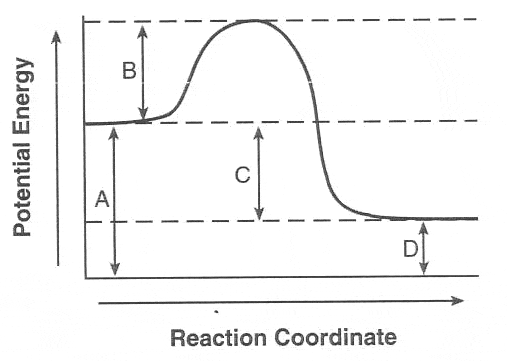
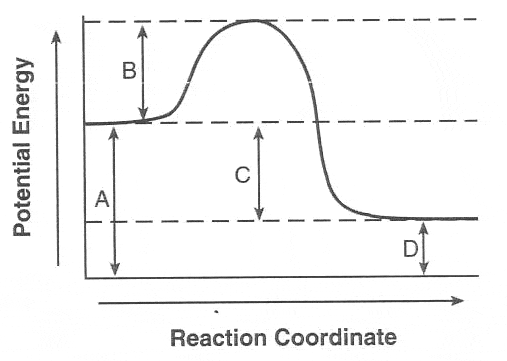
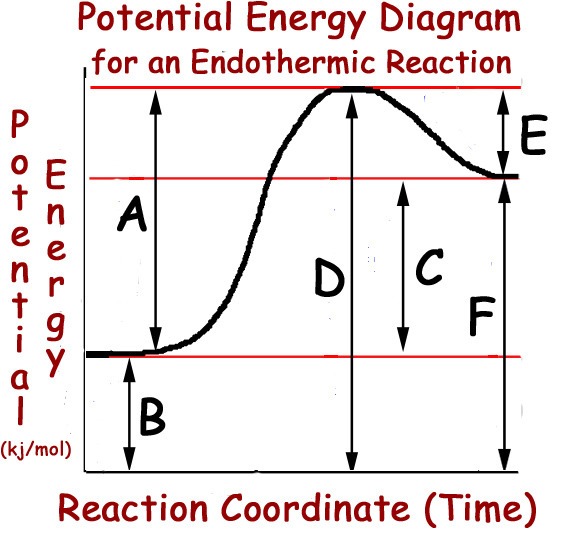
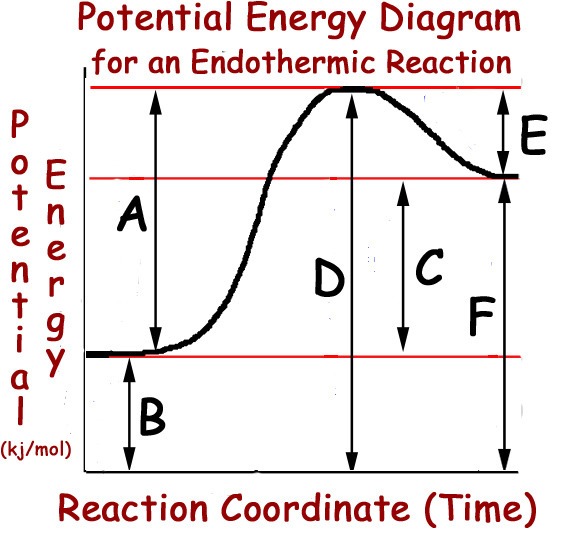
What letter represents the energy of the products?
a)
A
b)
B
c)
C
d)
D
144.
What type of reaction is this?
a)
Endothermic
b)
Exothermic
145.
What letter represents the activation energy?
a)
A
b)
B
c)
C
d)
D
146.
Is this reaction endothermic or exothermic?
a)
endothermic 
b)
exothermic
147.

What is the ΔH of this reaction?

a)

40 kJ

b)

20 kJ

c)

80 kJ

d)

-60 kJ

148.
What is the energy of the activated complex?
a)
75 kJ
b)
225 kJ
c)
300 kJ
d)
225 kJ
149.
What letter represents ΔH?
a)
A
b)
B
c)
C
d)
D
150.
What is the sign of ΔH for all endothermic reactions?
a)
Positive
b)
Negative
151.
What is the activation energy?
a)
40 kJ
b)
20 kJ
c)
100 kJ
d)
60 kJ
152.

What is the change of the heat of the reaction (ΔH)?

a)

-40 kJ

b)

-20 kJ

c)

100 kJ

d)

60 kJ

153.
Which letter represents the activation energy?
a)
B
b)
E
c)
C
d)
D
154.
What is the PE of the reactants?
a)
100 kJ
b)
175 kJ
c)
50 kJ
d)
75 kJ
155.
What is the PE of the products?
a)
100 kJ
b)
175 kJ
c)
50 kJ
d)
75 kJ
156.
What is the activation energy?
a)
100 kJ
b)
175 kJ
c)
50 kJ
d)
75 kJ
157.

What is the change of the heat of the reaction (ΔH)?

a)

100 kJ

b)

-175 kJ

c)

-50 kJ

d)

75 kJ

158.
Increase in temperature of the reactants can do one of the following
a)
Slow collision frequency
b)
Allow less effective collision between the particles
c)
Cause particles to lose speed
d)
Increase collision between the particles thus increasing the rate.
159.
Activation energy is required to start a chemical reaction. What is activation energy?
a)
The energy needed for a reaction to occur
b)
The minimum amount of energy needed for a reaction to potentially occur
c)
The energy added by a catalyst
d)
The energy possessed by the products
160.
Grinding a seltzer tablet into powder increases the rate of reaction due to increased
a)
concentration
b)
surface area
c)
temperature
d)
reactants
161.
Which factors increase the rate of a reaction.
a)
increasing temperature
b)
increasing concentration
c)
increasing surface area
d)
all of these
162.
A ______________ is a substance that increases the rate of a reaction without being used up during the reaction. 
a)
catalyst
b)
product
c)
reactant
d)
solute
163.
Smaller particle size allows for a _________ surface area to be exposed for the reaction.
a)
larger
b)
smaller
164.
Why does a higher temperature increase the rate of a reaction?
a)
it increases both the frequency and energy of particle collisions
b)
it only increases the frequency of particle collisions
c)
it only increases the energy of particle collisions
d)
it reduces the activation energy of the reaction
165.
Why does a higher concentration increase the rate of reaction?
a)
it increases the amount of reactants
b)
it lowers the activation energy
c)
it increases the energy of particle collisions
d)
it increases the frequency of particle collisions because there are more collision sites
166.
Which of these will NOT speed up the rate of reaction between a strip of magnesium and hydrochloric acid?
a)
tightly coil up the strip of magnesium
b)
cut up the strip of magnesium
c)
increase the concentration of the hydrocholoric acid
d)
increase the temperature of the hydrocholoric acid
167.
Products will form faster if____________
a)
the particle size of the reactants are larger.
b)
temperature is decreased.
c)
concentration of the reactants are increased.
d)
the reaction is not stirred.
168.
Explosions can happen when there is a large amount of powdered substance because of a large
a)
temperature
b)
surface area
c)
concentration
d)
pressure
169.
A substance that increases speed of chemical reaction without being being changed is called:
a)
Catalyst
b)
Acid
c)
Base
d)
pressure
170.
Increase in temperature of the reactants can do one of the following
a)
Slow collision frequency
b)
Allow less effective collision between the particles
c)
Cause particles to lose speed
d)
Increase collision between the particles thus increasing the rate.
171.

Why does a higher concentration increase the rate of reaction?

a)

it increases the amount of reactants

b)

it lowers the activation energy

c)

it increases the energy of particle collisions

d)

it increases the frequency of particle collisions

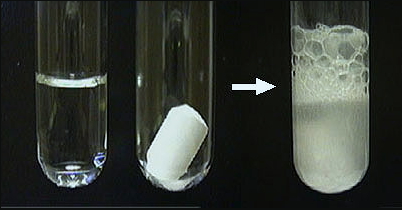
172.

How could we make this reaction happen more quickly?

a)

Decrease the concentration of the acid

b)

crush the chalk to increase the surface area

c)

Put the test tube in an ice bath

173.
What is the rate of reaction?
a)
How fast a reaction is 
b)
How big a reaction is
c)
How loud a reaction is
d)
How much gas a reaction produces
174.
What are the two factors to look for when determining if the reaction is at equilibrium?
a)
Forward reaction rate is faster than the reverse and concentrations are equal
b)
Forward and reverse reaction rates are equal and concentration is conctant
c)
Forward and revers reaction rates are equal and concentration is equal
d)
Forward reaction rate is faster than the reverse and concentration is equal
175.
This symbol indicates that a reaction is ____________
a)
reversible
b)
irreversible
176.
It is a chemical reaction where the reactants form products that, in turn, react together to give the reactants back.
a)
reversible reaction
b)
irreversible reaction
c)
decomposition reaction
d)
synthesis
177.

For the reaction...

SO2 + O2 ⇌ SO3

If the concentration of SO2 is increased, the equilibrium of the reaction will shift ___________.

a)

left

b)

right

c)

left and right

d)

neither left or right

178.

Which of the following is NOT true at equilibrium?

a)

The concentrations of reactants and products do not change.

b)

The forward and reverse reactions proceed at the same rate.

c)

The concentration of the reactants is equal to the concentration of the products.

d)

The forward and reverse reactions continue to occur.

179.

For the reaction...

SO2 + O2 <−> SO3

If the equilibrium shifts to the right, the concentration of O2 will ___________.

a)

increase

b)

decrease

c)

double

d)

stay the same

180.

Le Chatelier's Principle states that if a chemical system at equilibrium is stressed,

a)

the system will adjust to increase the stress

b)

the system will adjust to reduce the stress

c)

the system will not adjust

181.
For the reaction...
N2  +  O2  <=>  2NO
If  O2 is removed, the  concentration of N2 will _______.
a)
increase
b)
decrease
c)
remain the same
d)
double
182.
For the reaction...
N2 (g) +  3 H2 (g) <=> 2 NH3 (g)

If the pressure in the system is increased,  which substance(s) will increase in concentration?
a)
N (as 2 mol gas  → 4 mol gas)
b)
H2 (as 2 mol gas  → 4 mol gas)
c)
N2 and H(as 2 mol gas  → 4 mol gas)
d)
NH3 (as 4 mol gas  → 2 mol gas)
183.
For the reaction...
N2  +  O2  <=>  2NO:  Δ H = +182 kJ mol-1.
If the temperature is increased the equilibrium position will shift _______.
a)
to the left
b)
to the right
c)
to the left and right
d)
neither left nor right
184.
Ammonia has a pH of 12.  Ammonia is __________.
a)
an acid
b)
a base
c)
an element
d)
a metal
185.
Soap is a weak base.  What is true about the taste of bases?
a)
they taste sour
b)
they taste sweet
c)
they taste bitter
d)
they taste salty
186.
Explain what happens when a strong acid and a strong base are poured into the same container.
a)
they form separate layers
b)
they mix physically but not chemically
c)
they break apart into separate elements
d)
they react chemically to form a salt
187.
When dissolved in water, bases produce:
a)
acids
b)
salts
c)
hydrogen ions
d)
hydroxide ions
188.
Which of these solutions is an acid?
a)
Dish Soap: pH of 12
b)
Tomato Soup: pH of 4
c)
Baking Soda: pH of 9
d)
Drain Cleaner: pH of 14
189.
What does the pH scale measure?
a)
the concentration of acids and bases
b)
the malleability of a metal
c)
the temperature of the water in a swimming pool
d)
the amount of phosphorus in a compound
190.
Which statement is true when acids and bases are mixed together?
a)
acids become stronger
b)
bases become stronger
c)
there is no change
d)
they neutralize each other
191.
Ranging from 0 to 14, a pH value indicates how acidic or basic a solution is.  Which of these pH values would be a strong acid?
a)
2
b)
6
c)
9
d)
13
192.
What is the pH of water?
a)
0
b)
4
c)
7
d)
14
193.
Williams collected a rain sample and measured its pH to be 5.6.  What does this mean?
a)
the rain water is a weak base
b)
the rain water is neutral
c)
the rain water is a strong acid
d)
the rain water is a weak acid
194.
What is the pH of a neutral substance?
a)
0
b)
5
c)
7
d)
10
195.
Which of these pH values would indicate that a solution is a weak base?
a)
4
b)
5.6
c)
8
d)
13
196.
When dissolved in water, acids produce:
a)
bases
b)
salts
c)
hydrogen ions
d)
hydroxide ions
197.
Any substance that produces hydroxide ions in water is known as _____________.
a)
an acid
b)
a hydrogen ion
c)
a base
d)
a neutral
198.

For a solution, pH + pOH =

a)

7

b)

14

c)

1.0 x 10⁻¹⁴

d)

-log (1.0 x 10 -14)

199.

If the pH of a solution is 4.0, what is the pOH?

a)

4.0

b)

10.0

c)

1.0 x 10 -4

d)

cannot be determined from the information

200.

If the [H3O+] of a solution is 1 x 10⁻³ M, the pH is

a)

11

b)

-3

c)

3

d)

1

201.

If the pH of a solution is 8 the [H3O+] is

a)

1.0 x 10⁶ M

b)

8.0 x 101 M

c)

1.0 x 10⁸ M

d)

1.0 x 10⁻⁸ M

202.

Ammonia has a pOH of 2. Ammonia is a(n) __________.

a)

acid

b)

base

c)

neutral

d)

metal

203.

What is the [H+] if the pH is 4.0?

a)

1.0 x 10⁻¹⁰ M

b)

1.0 x 10⁻¹⁴ M

c)

1.0 x 10⁻⁴ M

d)

1.0 x 10⁻⁷ M

204.

What is the [OH-] if the [H+] is 1.0 x 10⁻³M?

a)

1.0 x 10⁻³ M

b)

1.0 x 10⁻¹⁴ M

c)

6.02 x 10⁻²³ M

d)

1.0 x 10⁻¹¹ M

205.
If the [H+] of a solution is 1 x 10⁻² mol/L the pH is
a)
2
b)
12
c)
-2
d)
1
206.
If the pH of a solution is 5 the [H+] is
a)
1.0 x 10 M
b)
1.0 x 10 M
c)
5.0 x 10 M
d)
1.0 x 10⁻⁵  M
207.
A  pH and a pOH will add up to:
a)
0
b)
7
c)
14
d)
1.0 x 10⁻¹⁴
208.
Man made carbon dioxide comes from the burning of fossil fuels.  An example of a fossil fuel is
a)
wood
b)
oil
c)
shale
209.
Ocean acidification begins with 
a)
pollution from ships
b)
carbon dioxide released from combustion
c)
dumping of waste from cities into the ocean
210.
Carbon dioxide and seawater combine to form
a)
calcium carbonate
b)
carbon monoxide
c)
carbonic acid 
211.
The H+ ion is a(n)
a)
acid
b)
base
c)
neutral
212.
The process of burning fuel to drive a car or operate a factory is called 
a)
photosynthesis
b)
combustion
c)
respiration
213.
Carbon dioxide levels in the air have changed throughout earth's history.  The difference today is how ______ the change is happening.
a)
rapidly 
b)
slowly 
c)
wide spread
214.
A greenhouse gas which is present in very high quantity is
a)
propane
b)
ethane
c)
CO2
d)
Methane