Wayground logo

Free Printable Worksheets

Font size

S
M
L
XL
Worksheets

Chemistry review

Total questions: 94

Worksheet time: 8hrs 50mins

Name
Class
Date
1.

Sodium + chlorine

a)

sodium chloride

b)

sodium hydroxide

c)

sodium oxide

d)

sodium

2.

Identify the product(s) in this word equation

a)

Sodium

b)

Sodium chloride

c)

Sodium and Chlorine

d)

Sodium and sodium chloride

3.
When a CHEMICAL reaction occurs, what is made?
a)
No new substance is made.
b)
A new substance is made with new atoms formed
c)
A new substance is made, with existing atoms rearranged
d)
All substances remain the same, but physical state may change.
4.

In a word equation the REACTANTS

a)

Are written on the right hand side of the arrow

b)

Are produced in a chemical reaction

c)

Are always the same

d)

Are the substances that react together

5.

The products in this reaction are?

a)

Two solids

b)

One solid and one gas

c)

Three solids and a gas

d)

Two solids and a gas

6.

In a chemical reaction...

a)

New atoms are created

b)

Atoms rearrange

c)

Atoms are destroyed

d)

Nothing Happens

7.

Magneisum reacts with oxygen to form magnesium oxide. The correct word equation is...

a)

A

b)

B

c)

C

d)

D

8.

In this chemical reaction zinc is a...

a)

Product

b)

Reactant

c)

Neither

9.

What are the reactants in this word equation?

a)

Carbon dioxide and oxygen

b)

Carbon dioxide and water

c)

Oxygen and glucose

d)

Oxygen and water

10.
What does this word equation represent: Iron + oxygen → Iron oxide
a)
A physical change in iron (nothing new gets made)
b)
A chemical reactino between iron and oxygen, where rust (iron oxide) is produced
c)
A chemical reaction between iron and rust, where oxygen is produced
d)
A physical change between iron and oxygen that forms a red color
11.

Sodium combines with chlorine to produce sodium chloride

a)

Sodium + chlorine --> sodium chloride

b)

Sodium chloride --> Sodium + chlorine

12.
Magnesium can be burned in air to produce solid magnesium oxide.
a)
2Mg(s) + O2(g)→ 2MgO(s)
b)
Mg(s) + O(g) → MgO(s)
c)
2Mg(s) + CO2(g) → 2MgO(s) + C(s)
d)
2Mg(s) + O2(g) → Mg2O2(s)
13.
Sodium reacts with chlorine to produce sodium chloride.
a)
NaCl(s) → Cl(g) + Na(s)
b)
Na(s) + CO2(g) → NaCO2(s)
c)
2Na(s) + Cl2(g) → 2NaCl(s)
d)
Na(s) + Cl(g) → NaCl
14.
How many Hydrogen are in 4H2O?
a)
6
b)
8
c)
2
d)
4
15.
Which of the following shows the correct way to balance the chemical equation?
Fe + O2 -> Fe2O3
a)
4Fe + 3O2 -> 2Fe2O3
b)
2 Fe + 3O2 -> Fe2O6
c)
4 Fe + O6 -> 2Fe2O3
d)
None of the options are correctly balanced.
16.
Is the following equation balanced?...
Al + O2 --> 2Al2O3
a)
Yes!
b)
No!
17.
Balance this equation-
__P4 + __O2 --> __P2O3
a)
it is already balanced
b)
2, 1, 3
c)
1, 2, 3
d)
1, 3, 2
18.
Balance this equation.
_Mg + _Cl2 --> _MgCl2
a)
1, 2,1
b)
already balanced
c)
2,1,1
d)
1,1,2
19.
Balance this equation.
_CH4 + _O2 --> _CO2 + _H2O
a)
1,2,1,1
b)
2,1,2,1
c)
1,2,1,2
d)
0,2,0,2
20.

The new substances formed in a chemical reaction are called

a)

Reactants

b)

Atoms

c)

Products

d)

Reagents

21.

Balance this equation, CaCO3(s) → CaO(s) + CO2(g)?

a)

3,1,2

b)

1,1,1

c)

1,3,1

d)

2,6,3

22.

Balance this equation, AlCl3 + NaOH → Al(OH)3 + NaCl

a)

3,1,3,1

b)

1,3,3,1

c)

1,1,1,3

d)

1,3,1,3

23.

PCl5 + ___ H2O → ___ HCl + H3PO4

a)

4, 5

b)

1, 6

c)

3, 8

d)

2,2

24.
Which problem is balanced?
a)
PbO2 + 2H2
b)
SO2 + H20 --> H2SO4
c)
2Na + 2H2O --> 2NaOH + H2
25.
Balance this equation.
_SnO2 +_H2-->_Sn +_H2O
a)
1,1,2,1
b)
1,2,1,1
c)
1,2,1,2
d)
1,2,2,1
26.
Is this equation balanced?
a)
yes
b)
no
c)
Not enough information
27.

The name of the compound containing copper and chlorine is.....

a)

copper chlorate

b)

copper chlorine

c)

Copper chloride

d)

chlorine copperide

28.

The correct formula for potassium nitride is.......

a)

KN

b)

KNO3

c)

KN3

d)

K3N

29.

The correct formula for aluminium oxide is .....

a)

Al2O3

b)

Al3O2

c)

AlO

d)

AlO3

30.
Balance this equation.
_CF4 + _Br2 -- _CBr4 + _F2
a)
2,1,2,1
b)
1,2,2,1
c)
1,2,1,2
d)
2,2,2,2
31.

What is the formula for iron (III) oxide? (If iron (III) has a 3+ charge)

a)

FeO

b)

Fe3O2

c)

Fe3O

d)

Fe2O3

32.
What is the symbol for Potassium?
a)
P
b)
K
c)
Pb
d)
Pd
33.
What is the symbol for Carbon?
a)
C
b)
Ca
c)
Cl
d)
H
34.
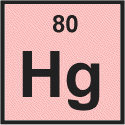
What is the name of this element?
a)
Helium
b)
Rubidium
c)
Hydrogen
d)
Mercury
35.
Which one of these is not a noble gas?
a)
Helium
b)
Radon
c)
Iodine
d)
Krypton
36.
What is the atomic number of Rubidium?
a)
37
b)
44
c)
45
d)
86
37.
What is the atomic number of Oxygen?
a)
6
b)
7
c)
8
d)
9
38.
Which one of these is the symbol for lead?
a)
Rb
b)
Pb
c)
Li
d)
Au
39.
What family is Sodium a part of?
a)
Transition Metals
b)
Halogens
c)
Alkali Metals
d)
Alkaline Earth Metals
40.
What two elements come together to make this substance in the picture?
a)
Oxygen and Carbon
b)
Sodium and Calcium
c)
Sodium and Chlorine
d)
Helium and Nitrogen
41.
If you were working out you would be "pumping _______."
a)
I
b)
Fe
c)
Mg
d)
Y
42.
Silicon is a 
a)
Metal
b)
Nonmetal
c)
Metalloid
d)
Halogen
43.
__________ would have some characteristics of metals and some characteristics of nonmetals.
a)
Gold
b)
Sodium
c)
Arsenic
d)
Bismuth
44.
Which element that starts with a B is an Alkaline Earth Metal?
a)
Barium
b)
Boron
c)
Bread
d)
Bromine
45.
What element is this?
a)
Silver
b)
Silicon
c)
Sulfur
d)
Selenium
46.

What is the name of group number 1?

a)

halogens

b)

noble gases

c)

alkali metals

d)

alkaline earth metals

47.

What is the name of group number 2?

a)

transition metals

b)

halogens

c)

metaloids

d)

alkaline earth metals

48.

where are the metaloids found

a)

far left, vertical

b)

stair step/diagonal

c)

far right horizontal

d)

at the bottom

49.

What group number are the halogens found?

a)

18 (8A)

b)

1

c)

2

d)

17 (7A)

50.

Periodic law states that the elements are arranged according to their atomic ________ so that elements with similar chemical properties are in the same ________ and properties repeat periodically.

a)

numbers, rows

b)

masses, rows

c)

masses, column

d)

numbers, column

51.

A family of elements based on similar chemical properties, arranged by columns in the periodic table

a)

Group

b)

period

c)

row

d)

isotope

52.

A row on the Periodic Table of Elements

a)

family

b)

period

c)

row

d)

isotope

53.

Metals (select all that apply)

a)

are found on the right side of the periodic table.

b)

are found on the left side of the periodic table.

c)

are good conductors of heat and electricity.

d)

are brittle.

e)

are malleable and ductile.

54.

Nonmetals (select all that apply)

a)

are found on the right side of the periodic table.

b)

are found on the left side of the periodic table.

c)

are good conductors of heat and electricity.

d)

are brittle.

e)

can be solid, liquids, or gases at room temperature.

55.

Which element is found in group 2, period 6?

a)

Oxygen (O)

b)

Barium (Ba)

c)

Selenium (Se)

d)

Carbon (C)

56.

Which halogen is found in period 4?

a)

Krypton (Kr)

b)

Xenon (Xe)

c)

Bromine (Br)

d)

Iodine (I)

57.
How many electrons does Si contain? (click to see image)
a)
14
b)
28
c)
2
d)
None of these
58.
How many electrons does potassium K contain? (click to see image)
a)
19
b)
39
c)
20
d)
40
59.
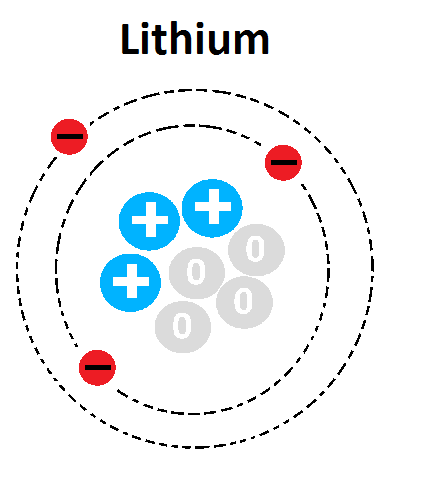
What element is represented in this Bohr Model? 
a)
Carbon
b)
Hydrogen
c)
Aluminum
d)
Lithium
60.
What is the mass number of this atom?
a)
1
b)
3
c)
4
d)
7
61.
What group does this element belong to?
a)
Group 1: Alkali metals
b)
Group 18: Noble Gases
c)
Group 2: Alkaline-Earth Metals
d)
Group 17: Halogens
62.
Carbon-12 has 6 protons and 6 neutrons. How many electrons will orbit the nucleus?
a)
12
b)
6
c)
3
d)
18
63.
What is the charge of a neutron?
a)
Positive
b)
Negative
c)
Neutral/no charge
64.
What is the center of the atom called?
a)
Orbital
b)
Nucleus
c)
Proton
d)
Electron shell
65.
What's a valence electron?
a)
electrons in the second energy level
b)
electrons in the outermost energy level
c)
the atomic number
d)
electrons in the first level
66.
Identify the element in the picture
a)
Boron
b)
Carbon
c)
Nitrogen
d)
Lithium
67.

How many valence electrons are shown in this Bohr diagram?

a)

2

b)

3

c)

5

d)

8

68.

This Bohr diagram has only one orbit (shell) with electrons in it. It must come from which row of the Periodic Table?

a)

1

b)

2

c)

3

d)

4

69.

This Bohr diagram shows 3 orbits (shells) with electrons. Which row of the Periodic Table?

a)

1

b)

2

c)

3

d)

4

70.

Which row of the Periodic Table must this element come from?

a)

1

b)

2

c)

3

d)

4

71.

Look at all those orbits (shells)! Which row of the Periodic Table is this element in?

a)

1

b)

2

c)

3

d)

4

72.

Recall that valence electrons are the electrons on the orbit (shell) farthest from the nucleus. How many valence electrons?

a)

2

b)

4

c)

6

d)

8

73.

How many valence electrons?

a)

5

b)

6

c)

7

d)

8

74.

How many valence electrons?

a)

2

b)

3

c)

8

d)

20

75.

Rows of the Periodic Table are also called "periods." Which period is this element in?

a)

1

b)

2

c)

3

d)

4

76.

Which period is this element in?

a)

1

b)

2

c)

3

d)

4

77.

Which of the following are not ionic compounds?

(i) KCl

(ii) HCl

(iii) CCl4

(iv) NaCl

a)

(i) and (ii)

b)

(ii) and (iii)

c)

(iii) and (iv)

d)

(i) and (iii)

78.
All of the following would classify an element as a metal except?
a)
Dull
b)
Luster
c)
Malleable
d)
Hard
79.
Iron is a good conductor, malleable and magnetic. What type of element is Iron? 
a)
Metal
b)
Nonmetal
c)
Metalloid
d)
Pretty
80.
A student is given a sample of an unknown substance. He is asked to determine if it is classified as a metal, a metalloid, or a nonmetal. He discovered that the unknown element conducted some heat and electricity, had a shiny luster, and broke easily. This element is most likely a 
a)
metal
b)
nonmetal
c)
metalloid
d)
cannot be determined
81.
The word “luster” refers to which property of matter?
a)
The ability to conduct electrical or thermal energy
b)
Capable of being drawn out into thin wires
c)
The way a surface appears when it reflects light
d)
Suitable for being shaped by beating or rolling
82.
If a material can easily be drawn into the shape of a wire, it is
a)
Ductile
b)
Magnetic
c)
Malleable
d)
Reactive
83.
Metalloids _____________
a)
have no properties of metals.
b)
have no properties of nonmetals.
c)
have some properties of both metals and nonmetals.
d)
none of the above
84.
How many Valance electrons does Iodine Have?
a)
6
b)
16
c)
7
d)
17
85.
Rows on the period table are called _____ while columns are called _____.
a)
groups, families
b)
groups, periods
c)
periods, groups
d)
families, groups
86.
Which of the following is NOT a clue that a chemical change has occurred?
a)
change in color
b)
production of gas
c)
formation of a precipitate
d)
change in shape
87.
The outer most negatively charged particles of an atom are known as what?
a)
electrons
b)
protons
c)
neutrons
d)
valance electrons
88.
Looking at the periodic table what other element reacts in a similar way to Si?
a)
Al
b)
P
c)
C
d)
H
89.
The atomic number tells you what?
a)
number of electrons
b)
number of protons
c)
number of neutrons
d)
both electrons and protons in an atom.
90.
How many energy shells does Barium (Ba) have?
a)
1
b)
2
c)
5
d)
6
91.
Which element has 2 energy shells and 3 valence electrons
a)
Si
b)
B
c)
Li
d)
He
92.

In this reactivity series, which of the following is the most reactive element?

a)

Gold

b)

Calcium

c)

Zinc

d)

Potassium

93.

True or False:

Magnesium is more reactive than silver.

a)

True

b)

False

94.

In a displacement reaction, it is the ____________ reactive metal that is displaced from a compound.

a)

Heaviest

b)

Least

c)

Most

d)

Worst