
 Worksheets
The Atmosphere and Oceans
Total questions: 90
Worksheet time: 55mins
Modern day atmosphere has approximately what percentage of the air is Oxygen ?
1%
21%
78%
52%
Most of the water on Earth is found in which of the following locations?
oceans
the atmosphere
groundwater
lakes and rivers

Use the table to answer the question. Each location has an average annual temperature above 18ºC (64ºF). Which location is most likely to have a tropical climate?
Location A
Location B
Location C
Location D

Heat transfer is really neat! It always goes from
hot to cold
cold to hot
top to bottom
bottom to top

Deep currents are caused mainly by differences in salinity and _____.
winds
gases dissolved in the water
the Coriolis Effect
water temperature

The Coriolis Effect changes a current's path due to Earth's
rotation
winds
tides
temperature differences
True or false: Ocean currents have no effect on air temperature
True
False
Which one of the following statements about Earth's atmosphere is TRUE?
The temperature in the atmosphere increases as it gets closer to the Sun.
The air pressure increases as you go up in the atmosphere.
The atmosphere has different temperatures and pressures at different altitudes.
The atmosphere has the same temperature and pressure at all altitudes.

Surface currents and deep ocean currents join together to make
the East Australian Current
warm currents
the global conveyor belt
the Coriolis Effect
Energy transferred through empty space
Conduction
Convection
Mechanical wave
Radiation
Energy transferred by particles touching each other
Conduction
Convection
Mechanical wave
Radiation
Energy transferred by a circulation caused by differences in temperature
Conduction
Convection
Mechanical wave
Radiation
Earth's Surface is heated by ___________
Conduction
Convection
Mechanical wave
Radiation
Earth's Atmosphere is heated by ___________.
Conduction
Convection
Mechanical wave
Radiation
Winds are caused by _____________.
Conduction
Convection
Mechanical wave
Radiation
What causes wind?
Rotation of Earth on its axis
Movement of air from land to water
Uneven heating of Earth's surface
Air passing Earth as it revolves around the Sun
What is the main source of energy that drives all Earth's weather patterns?
The Sun
Oceans
The Moon
Mountains
The stratosphere is the top layer of Earth's atmosphere.
True
False

Refer to the diagram of the winds and currents to answer the question.
Which of the following best explains the curvature of the arrows for the westerlies and the trade winds?
The ocean currents create winds flowing in a similar direction to the current.
The Coriolis effect causes the winds to curve that way because the Earth rotates from left to right.
The Coriolis effect causes the winds to curve that way because the Earth rotates from right to left.
The sun is shining and warming the air from the right side of this diagram.

Refer to the picture to answer the question.
Which of the following is most responsible for the moving bands of air around Earth that are shown in the picture?
conduction
convection
Coriolis effect
greenhouse effect
Put the atmospheric layers in order from closest to farthest from earth's surface.

The picture shows a situation that causes local winds.
Which way will the wind blow?
From A to B
From B to A
Temperature & air pressure decrease rapidly while moving up
Troposhere
Temperature rises while air pressure decreases
Stratosphere
Temperature & air pressure decrease while moving up
Mesosphere
Temperature rises again while air pressure still decreases
Thermosphere

What does the blue line represent in the Thermohaline circulation?
Warm salty water
Warm water
Cold water
Cold salty water
Which of the following types of water would SINK the fastest?
warm and salty
cold and salty
warm and fresh
cold and fresh


________ and _______ affect the ocean's density and cause the Global Conveyor Belt to travel
gravity and the Coriolis Effect
temperature and salinity
wind and climate
temperature and the Coriolis Effect

The density of ocean water is affected by temperature and ______________.
salinity
warmth

The Gulf Stream is an example of a _______________
upwelling
surface current
Without the Gulf Stream, the southeastern United States and Europe would be ______________.
warmer
cooler

True or False: Surface currents affect coastal climates.
True
False
What is the Coriolis effect?
heat transfer caused by the rising of hotter, less dense fluids and the falling of cooler, more dense fluids.
A punk rock band.
the apparent deflection of moving air as a result of Earth's rotation.
The amount of matter in a given volume.

What are a circular system of currents in the Earth's major oceans?
ocean current
gyre
upwelling
conveyor belt

When surface currents meet continents they ___?
Stop moving
Are deflected (change paths)
Continue in the direction they were going
Local winds blow over:
short distances
long distances
the poles
the equator
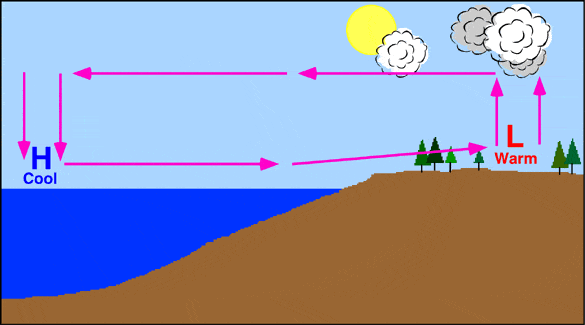
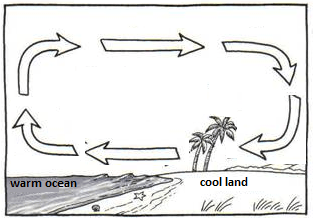
What direction does air move?
High Pressure to High Pressure
Low Pressure to Low Pressure
High Pressure to Low Pressure
Low Pressure to High Pressure
Wind appearing to curve to the right in the Northern Hemisphere is caused by what?
Unequal Heating
Coriolis Effect
Greenhouse Effect
Centripetal Force
Convection currents in the atmosphere are caused by what?
Warm air rising and warm air sinking
Cold air rising and cold air sinking
Warm air rising and cold air sinking
Cold air rising and warm air sinking
What drives global wind belts? Choose the two that apply.
Earth's Core
Earth's Rotation
Unequal Heating
Greenhouse Effect
What type of heat transfer is given off by flames of a fire?
Convection
Conduction
Radiation
The global ocean conveyor belt effects what around the globe?
Weather
Climate
Circulation of nutrients in water
All of these are correct
What is the major driving force that causes both sea breezes and land breezes.
rotation of Earth on its axis
heating and cooling of water and land
curved surface of Earth
global wind belts
What is created when air moves from high to low pressure?
Precipitation
Clouds
Winds
Gas
What do the Greenhouse gases do to heat in the atmosphere?
Absorb it
Reflect it
Trap it
Eliminate it
What drives deep ocean currents?
Surface Winds
Unequal Heating
Global Winds
Differences in Density
Air above the land warms up faster than air over the water, and the cooler air from the water blows toward land. What type of wind is this?
Land Breeze
Global Wind
Sea Breeze
Surface Wind
What part of the atmosphere helps to protect us from UV rays?
Exosphere
Thermoshpere
Ozone
Stratosphere
As surface currents flow from the equator towards the poles what happens to them?
They become warmer.
They become lighter.
They become more dense.
They slow down.
What factor is being changed to cause El Nino and La Nina?
Earth's Rotation
Coriolis Effect
Wind Direction
Climate
The transfer of thermal energy from one particle to another by direct contact
Conduction
Radiation
Convection
Thermal Energy
a pot sitting on the stove, touching a hot metal spoon, direct contact
are examples of heat transfer by conduction
are examples of heat transfer by convection
are examples of heat transfer by radiation
boiling water, steam, gases, liquids
are examples of heat transfer by convection
are examples of heat transfer by conduction
are examples of heat transfer by radiation
an abnormal climate event that occurs every 2-7 years in the Pacific Ocean (causes changes in wind, currents, and weather)
El Nino
La Nina
Currents
a climate even in the Pacific Ocean in which surface waters are colder than normal
La Nina
El Nino
Current
this is a climate event that occurs every 2-7 years in the Pacific Ocean the winds along the equator weaken an d reverse directions. There is also an increase in rain and flooding during this
El Nino
La Nina
This is the opposite of the event that occurs every 2-7 years and causes colder than normal winters
La Nina
El Nino
Why are the west coasts of England and Ireland warmer and wetter than inland parts of the continent that are further south?
the Polar Easterlies
The Gulf Stream
Tthe Trade Winds
Deep currents bringing warm water
Where is the ozone layer located?
thermosphere
stratosphere
troposphere
mesosphere
Which wind belt extends from the equator to the 30 degree North and South parallel?
Trade Winds
Westerlies
Polar Easterlies
Sea Breeze
Which atmospheric layer do we live in? It's name comes from the word "mixing".
Thermosphere
Mesosphere
Troposphere
Exosphere
Which wind belt affects most of the 48 states in the United States? It explains how our weather moves from the west coast to the east coast.
Trade winds
Westerlies
Polar Easterlies
Coriolis effect
How does the Coriolis effect the wind in the Northern Hemisphere?
It deflects the air to the left.
It deflects the air to the right.
It doesn't affect it at all.
It makes the wind stronger.
What surface on the Earth has the highest absorption of solar radiation?
Sand from a desert
Ice from glaciers
Water from the ocean
Leaves from the trees canopy

What is the name of the cell covered by the RED box?
Polar cell
Ferrel cell
Hadley cell
Which of these statements is NOT true?
At the equator, the ground is intensely heated by the sun.
At the equator, the air rises which then cools and forms thick storm clouds
At the equator a high-pressure zone is created.
Which of these biomes are found in low pressure areas?
Tropical rainforests
Polar
Desert

What is the name of the cell covered by the YELLOW labels?
(a)
What type of pressure zone is found at 30°N and 30°S?
High
Low
Which of these does NOT happen when air sinks at 30°N and 30°S?
It becomes warmer
It becomes drier
It creates an area of little cloud and low rainfall
It creates a low-pressure zone

Which of these statements about the Ferrel Cell is NOT true?
Air on the surface is pulled towards the poles.
These winds pick up moisture as they travel over the oceans.
At 60°N and S, the winds mean cold air which has drifted from the poles.
The Ferrel cell occurs at lower latitudes than the Hadley Cell.

