wayground logo

Free Printable Worksheets

Font size

S
M
L
XL
Worksheets

IAPS Semester 2 review D,E,F

Total questions: 120

Worksheet time: 2hrs 8mins

Name
Class
Date
1.
Objects of different masses are suspended from a height. Which combination of features will have the greatest gravitational potential energy?
a)
Low mass and low height
b)
Low mass and high height
c)
High mass and high height
d)
High mass and low height
2.
Which statement most accurately describes the Law of Conservation of Energy?
a)
Energy can not be created or destroyed but it can change from one type to another.
b)
Energy is created from the Earth and is destroyed when we use it.
c)
Energy should be saved (conserved) for use in the future.
d)
All forms of energy can be classified as either potential or kinetic.
3.
The efficiency of an average gasoline powered car is about 20%. This means,
a)
The gas tank needs to be 20% filled with gasoline for motion.
b)
The car uses 80% of the energy stored in the gasoline for motion.
c)
The car uses 20% of the energy stored in the gasoline for motion.
d)
The car wastes 20% of the energy stored in the gasoline.
4.
What energy transformation takes place when a radio is plugged in and turned on?
a)
Kinetic to potential
b)
Electrical to sound
c)
Wire to radio waves
d)
Battery to motion
5.
When you open the door to a refrigerator for a minute, what happens?
a)
Thermal energy in the refrigerator is transferred to the air outside the refrigerator.
b)
Thermal energy in the air outside the refrigerator is transferred to the inside of the refrigerator.
c)
The temperature of the air inside the refrigerator decreases.
d)
The temperature of the air just outside the refrigerator increases.
6.
Which list consists of only renewable energy sources?
a)
solar, nuclear, coal, wind
b)
wind, solar, hydro, tidal
c)
nuclear, petroleum, wind, hydro
d)
petroleum, tidal, solar, biomass
7.
On a summer day, asphalt is hot on your bare feet because the asphalt has __________ heat from the sun.
a)
absorbed
b)
transmitted
c)
reflected
d)
scattered
8.
Putting reflecting films on your car windows helps keep the interior cool by
a)
absorbing sun light
b)
transmitting sunlight
c)
reflecting sunlight
d)
scattering sunlight
9.
Solar energy is free energy from the sun, so why is it not used more as an energy source?
a)
equipment for collecting solar energy is expensive 
b)
equipment is not efficient 
c)
not all areas of the country receive a lot of sunlight
d)
All of these
10.
Alex has a string of lights that are not working. She tried replacing the battery and the string still does not light. She tried replacing the bulbs one at time. After a few a replacements, all the lights turned on. Is her string of lights wired in series or parallel? 
a)
Her lights must be a series because one bad bulb cut the flow of energy from the battery
b)
Her lights must be a parelle because one bad bulb cut the flow of energy from the battery
c)
None of these 
d)
You can't tell which one it is based on the evidence given.
11.
1.  Jake’s family decided to purchase a solar hot water heater. They were debating about where to place the photovoltaic panels. They wanted to place them in a place that will maximize their use. They were considering the following features: • Height from ground • Angle towards the sun • Area • Number • Efficiency • Shape.  Which features should not be considered?
a)
Jake’s family could consider all of the features except the height from the ground and shape because changing them won’t influence how much of the sun’s energy is absorbed
b)
Area and angle towards the sun
c)
Efficiency
d)
Number and efficiency 
12.

Heat always travels from...

a)

Warm to cool

b)

Cool to warm

c)

Warm to warm

d)

Cool to cool

13.

A hot air balloon rising is an example of ...

a)

conduction

b)

convection

c)

radiation

d)

connection

14.

Thermal energy that is transferred from one substance to another.

a)

heat

b)

temperature

c)

thermal energy

d)

radiation

15.

Warming up near a campfire is an example of ...

a)

conduction

b)

convection

c)

radiation

d)

connection

16.

At what point does the biker have the greatest Kinetic Energy?

a)

Point A

b)

Point B

c)

Point C

d)

Point D

17.

At what point does Potential Energy transform into Kinetic Energy?

a)

Point A

b)

Point B

c)

Point C

d)

Point D

18.

Which Apple has the greatest Gravitational Potential Energy?

a)

Apple A

b)

Apple B

c)

Apple C

d)

Apple D

19.

What is the Energy Conversion that is shown in the image?

a)

Radiant to Thermal

b)

Thermal to Chemical

c)

Chemical to Radiant

d)

Radiant to Chemical

20.

Which of the following is an example of a Thermal Conductor?

a)

Plastic

b)

Styrofoam

c)

Wood

d)

Copper

21.

Which of the following is an example of a Thermal Insulator?

a)

Iron

b)

Aluminum

c)

Wood

d)

Copper

22.

Thermal energy is the __________ _________ energy of moving particles

a)

total potential

b)

average potential

c)

average kinetic

d)

total kinetic

23.

Temperature is the __________ _________ energy of moving particles

a)

average potential

b)

average kinetic

c)

total potential

d)

total kinetic

24.

Objects with MORE MASS have______________

a)

lower potential energy

b)

lower number of atoms

c)

higher thermal energy

d)

higher temperature

25.

Cold things often have a _________ kinetic energy because_______

a)

lower; particles are moving around less

b)

lower; particles are moving around more

c)

higher; particles are moving around the same

d)

higher; particles do not move

26.

Four steel blocks were heated to different temperatures and stacked together as shown. In which direction will heat be transferred by conduction?

a)

From Sample 4 to Sample 1

b)

From Sample 2 to Sample 3

c)

From Sample 2 to Sample 4

d)

From Sample 3 to Sample 2

27.
All of the following are nonrenewable resources EXCEPT
a)
Coal
b)
animals
c)
petroleum (oil)
d)
natural gas
28.
Which of the following means of transportation uses a renewable resource for its energy source?
a)
solar powered car
b)
coal powered steam train
c)
natural gas car
d)
gasoline truck
29.
A farmer decides that he is going to produce his own energy on the farm by using a type of renewable energy. The renewable energy could come from--
a)
setting up wind turbines
b)
having a coal furnace
c)
using natural gas
d)
burning oil
30.
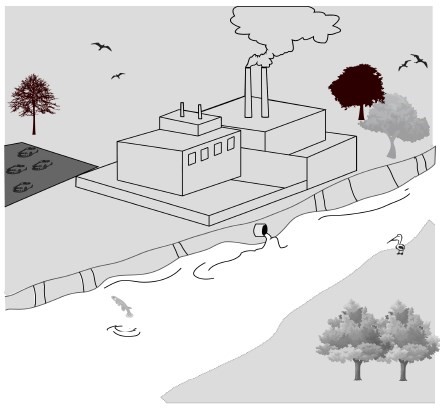
If the factory in this diagram was NOT practicing good environmental conservation, what effect would be produced?
a)
air and water pollution
b)
good fishing for recreation
c)
plentiful animals in the river
d)
purified drinking water
31.

Which object shows an energy transformation from electrical to mechanical?

a)
b)
c)
d)
32.
Efficiency is...
a)
The percentage of energy that is actually used to do work
b)
The stuff in the walls that keeps energy in
33.
This energy comes from heat, such as geysers, beneath earth’s surface.  
a)
Biomass 
b)
Geothermal 
c)
Solar
d)
Oil
34.

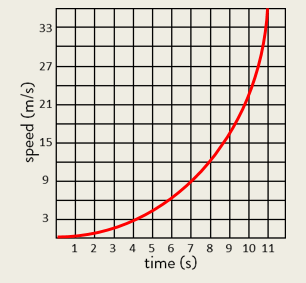
What is this graph showing?

a)

Gradually slowing down

b)

Gradually speeding up

c)

Constant speed

d)

Stopped

35.

What is this graph showing?

a)

At rest

b)

Acceleration

c)

Constant speed of 1 m/s

d)

Gradually speeding up

36.

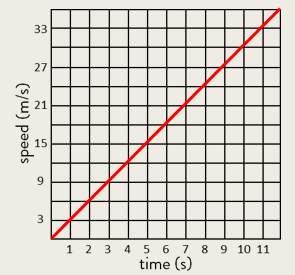
What is this graph showing?

a)

Constant speed

b)

Gradually speeding up

c)

Gradually slowing down

d)

At rest

37.
a)

Accelerating gradually

b)

Stopping

c)

Slowing down constantly

d)

Speeding up constantly

38.

What is this graph showing?

a)

Two objects speeding up constantly

b)

Two objects slowing down constantly

c)

Two objects accelerating

d)

Two objects at rest

39.
If a force of 50 Newton's was applied to an object with a mass of 500 grams, what will the object's acceleration be?
a)
10 m/s^2
b)
.1 m/s^2
c)
100 m/s^2
d)
1 m/s^2
40.
45 m/s2 is the... 
a)
Mass
b)
Force 
c)
Acceleration
d)
weight
41.
If a force of 26 N is exerted on two balls, one with a mass of 0.52 kg and the other with a mass of 0.78 kg, which ball will have the greater acceleration?  (F=ma)
a)
The one with a mass of .78 kg will have the greatest acceleration.
b)
The one with a mass of .52 kg will have the greatest acceleration.
c)
They will both accelerate at the same rate.
42.
A 20 kg bike accelerates at 10 m/s2.  what was the force?
a)
25 Newtons
b)
20 Newtons
c)
200 Newtons
d)
10 Newtons
43.
Unit of mass
a)
m/s 2
b)
m/s
c)
newtons
d)
kg
44.
A force of 250 N is applied to an object that accelerates at a rate of 5 m/s2.  What is the mass of the object? To solve this problem you must do - 
a)
250 ÷ 5
b)
5 ÷ 250
c)
250 x 5
45.
A 5 kg block is pulled across a table by a net force of 32 N. Calculate the acceleration of the object. To solve this problem you must do - 
a)
32 ÷ 5
b)
5 ÷ 32
c)
32 x 5
46.
The masses of four objects are given in this table. If all objects are struck with the same amount of force, which one will have the greatest acceleration?
a)
Object 1
b)
Object 2
c)
Object 3
d)
Object 4
47.
Examine the table provided. Which of the objects is producing the greatest force?
a)
Soccer Ball
b)
Tennis Ball
c)
Marble
d)
Ping-Pong Ball
48.

Some skateboarders use a structure called a half-pipe, like the one shown, to perform impressive tricks. Which of the positions will provide a skateboarder with the GREATEST potential energy?

a)

1

b)

2

c)

3

d)

4

49.

Mechanical energy is the sum of two types of energy—kinetic energy and potential energy of position. Which of the following is an example of an object that has kinetic energy?

a)

a snail crawling across a leaf

b)

a computer monitor sitting on a desk

c)

a tightly wound spring in a windup toy

d)

a roller coaster car just before it goes downhill

50.

Mechanical energy is the sum of two types of energy—kinetic energy and potential energy of position. Which of the following is an example of an object that has potential energy?

a)

a snail crawling across a leaf

b)

a computer monitor sitting on a desk

c)

a jumping windup toy

d)

a roller coaster car going downhill

51.

The table shows the speed and height over time of a ball that starts at rest, then is dropped from the top of a building, which is 60 meters (m) tall. Use the table to answer any questions that follow.


At which time is the ball's potential energy at its maximum?

a)

0.0 s

b)

0.5 s

c)

2.0 s

d)

2.5 s

52.

The diagram illustrates four phases of a model rocket's flight. Use the diagram to answer any questions that follow.


When is the rocket's potential energy decreasing and its kinetic energy increasing?

a)

when the rocket's motor is burning and when the rocket is free falling

b)

when the rocket's motor is burning and when the rocket is ascending

c)

when the rocket is at the peak of flight, only

d)

when the rocket is free falling, only

53.

The picture shows the path of a ball on a track. Use the picture to answer any questions that follow. Which series shows decreasing potential energy and increasing kinetic energy?

a)

T, Y, Z

b)

W, X, Y

c)

S, T, U

d)

V, X, Z

54.

1. Damon made the graph below to compare the speed limits on four different roads in his county. He converted the speed limits from miles per hour to miles per minute to get a closer comparison. Which road has the slowest speed limit?

a)

Road A

b)

Road B

c)

Road C

d)

Road D

55.

The graph shows the distance the object traveled from its starting point in 5 seconds. How would the graph look of the object were moving at a slower speed?

a)

The line would be steeper.

b)

The line would be less steep.

c)

The line would remain the same.

d)

The line would be curved like an upside down ‘U’.

56.
Speed is equal to 
a)
Distance/Time
b)
Time/Distance
c)
Time x Distance
d)
Acceleration
57.
A person walked 10 miles.  It took them 2 hours.  How fast were they walking?
a)
8 mph
b)
5 mph
c)
2 mph
d)
10 mph
58.
Which runner won the race?
a)
A
b)
B
c)
C
d)
It was a tie
59.
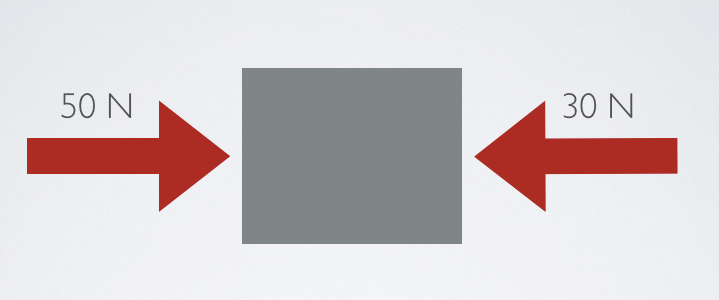
How will this object move? 
a)
It won't move. 
b)
It will move to the right. 
c)
It will move to the left. 
d)
It will move up. 
60.
What do you think the cyclist is doing between 11am and 1pm?
a)
The cyclist has stopped for lunch
b)
The cyclists is riding at a constant speed on flat ground
c)
The cyclist is practicing sprints
d)
The cyclist is riding up a hill
61.

1. Gordon is making a list of forces for his science class. Which of the following should Gordon not list as a force?

a)

Gravity

b)

Friction

c)

Push or Pull

d)

Mass

62.

1. The ball in the diagram below is thrown up into the air and follows the path shown. What causes the ball to follow the path beyond Point B?

a)

Power

b)

Gravity

c)

Electrical Charge

d)

Magnetic Attraction

63.

1. Luis rubbed a balloon on his hair and held the balloon next to the wall. He observed the balloon stick to the wall. Which of the following is responsible for the balloon sticking to the wall?

a)

Gravity

b)

Friction

c)

Magnetic Force

d)

Electrical Force

64.

1. Forces that act at a distance include electrical force and gravitational force. What other type of force acts at a distance?

a)

Friction

b)

Contact Force

c)

Magnetic Force

d)

Conduction

65.
What is a Force?
a)
The distance
b)
Mass
c)
A push or pull
d)
Give me a  failing grade 
66.

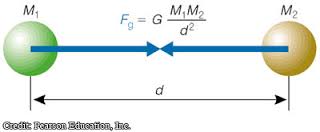
When placed at equal distances apart, the greatest gravitational attraction will be between two

a)

skateboards

b)

bowling balls

c)

school buses

67.

Which is needed to determine the amount of gravitational force between two objects?

a)

distance and mass

b)

weight and time

c)

area and weight

68.

The gravitational force exerted by an object depends on its

a)

volume

b)

mass

c)

weight

69.
Complete the following statement: The farther away two planets are the _______ the gravitational force between them.
a)
more
b)
same
c)
dosen't matter
d)
less
70.

Cindy decided to rearrange her bedroom by moving her dresser to the opposite wall. She tried pushing it, but found that the dresser would not move.

What force was Cindy NOT able to overcome?

a)

electrical force

b)

magnetic force

c)

balanced force

d)

frictional force

71.

A contact force is from

a)

objects physically touching

b)

far apart objects

c)

not touching object

d)

always a pull

72.

A non-contact force is between

a)

two objects that aren't touching

b)

two objects that are touching

c)

the ground and wheels

d)

you and me

73.

Which runner has the fastest constant speed?

a)

A

b)

B

c)

C

d)

Not enough information to tell

74.

Using the table, which graph shows Emanuel's bike trip?

a)
b)
c)
d)
75.
What is a factor, usually being measured or observed, that responds to, or depends on, another factor.
a)
Independent Variable
b)
Dependent Variable
c)
Controlled Variable
d)
Hypothesis
76.
What is the reproduction of a scientific investigation by another person to ensure accuracy.
a)
Replication
b)
Repetition
77.
What are making multiple sets (trials) of measurements or observations in a scientific investigation.
a)
Repetition
b)
Replication
78.
We tested the effect of water temperature on how fast a sugar cube dissolves. What was the independent variable?
a)
Time to Dissolve
b)
Amount of Water
c)
Water Temperature
d)
Beaker Size
79.
We tested the effect of water temperature on how fast a sugar cube dissolves. What was the dependent variable?
a)
Amount of Water
b)
Temperature of Water
c)
Time for Sugar cube to Dissolve
d)
Type of Beaker
80.
Why did each group test the amount of drops of water a penny could hold before changing their variable?
a)
It provides more data to include in a lab report
b)
It ensures that the hypothesis will be correct
c)
It adds an independent variable to the experiment.
d)
It is the control and serves as the basis for comparison
81.
How many variables should be changed in an experiment?
a)
ONE
b)
TWENTY
c)
THREE
d)
TEN
82.
What does friction produce?
a)
light
b)
sound
c)
heat
d)
gravity
83.
What direction does friction act relative to motion?
a)
in the same direction
b)
in the opposite direction 
c)
need more information
d)
depends on the force
84.
The rougher the surface, the faster an object will travel over the surface.
a)
True
b)
False
85.

Which of the following is NOT an example of friction?

a)

using the brakes on your bike to slow you down

b)

putting your hand out the window

c)

a satellite traveling through deep space

d)

a hockey puck going across an ice rink

86.

This car is turning, but there’s a puddle of water in the road. Which diagram best shows how the puddle will affect the path of the car after it hits the puddle?

a)
b)
c)
d)
87.

Waves that require a material to travel though are called

a)

electromagnetic waves

b)

mechanical waves

c)

ocean waves

d)

transverse waves

e)

I do not know and do not wish to answer.

88.

Electromagnetic waves are examples of

a)

transverse waves

b)

longitudinal waves

c)

mechanical waves

d)

ocean waves

e)

I do not know and do not wish to answer.

89.

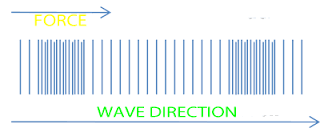
This picture is an example of a

a)

longitudinal wave

b)

transverse wave

c)

i do not know and do not wish to answer.

90.

This picture is an example of which type of wave?

a)

transverse wave

b)

longitudinal wave

c)

ocean wave

d)

I do not know and do not wish to answer.

91.

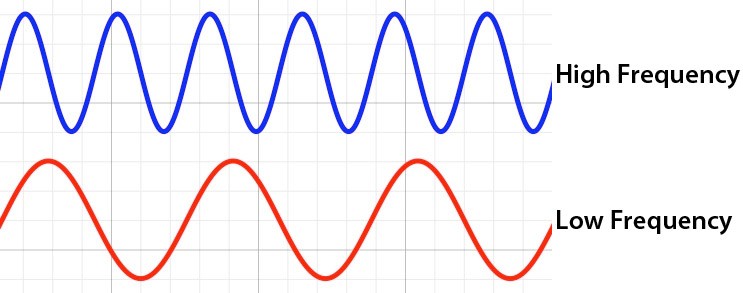
A short wavelength is equal to

a)

a low frequency

b)

slow wave speed.

c)

a high frequency

d)

I do not know and do not wish to answer.

92.

#1 refers to the

a)

wavelength

b)

amplitude

c)

crest

d)

trough

93.

#2 refers to the

a)

wavelength

b)

amplitude

c)

crest

d)

trough

94.

#3 refers to the

a)

wavelength

b)

amplitude

c)

crest

d)

trough

95.

#4 refers to the

a)

wavelength

b)

amplitude

c)

crest

d)

trough

96.

What is the ability to cause change?

a)

energy

b)

matter

c)

volume

97.

Which property of the wave would change if you changed the amount of energy the wave had?

a)

amplitude

b)

frequency

c)

wavelength

d)

wave speed

98.

If the wavelength of a wave increased, what would happen to the frequency?

a)

decrease

b)

increase

c)

stay the same

99.

Mechanical waves usually travel fastest through:

a)

solids

b)

liquids

c)

gases

100.

Mechanical waves usually travels fastest as the temperature of the medium:

a)

increases

b)

decreases

c)

stays the same

101.

The number of waves that pass somewhere in a second is:

a)

amplitude

b)

frequency

c)

wavelength

102.

A wave that can travel through matter and empty space is a:

a)

electromagnetic wave

b)

longitudinal wavy

c)

transverse wave

103.
Which waves do NOT need a medium?
a)
Sound
b)
Ocean
c)
Seismic
d)
Light
104.
What type of waves have compressions and rarefactions?
a)
longitudinal
b)
transverse
105.
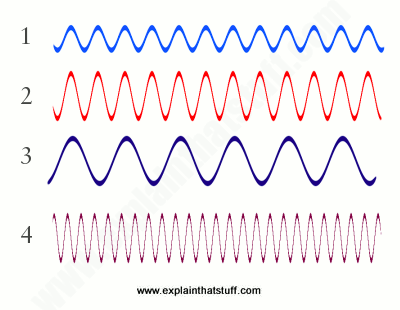
Which wave has the highest frequency?
a)
1
b)
2
c)
3
d)
4
106.
Frequency is
a)
Amount of time it takes for one wavelength
b)
How many wavelengths are completed in one second
c)
Distance between two crests or two troughs
d)
Amount of energy in a wave
107.
Which part of a longitudinal wave is where particles are packed closely together?
a)
compression
b)
rarefaction
c)
crest 
d)
amplitude
108.
What do all waves transfer?
a)
Light
b)
Sound
c)
Heat
d)
Energy
109.
Frequency is measured in
a)
Newtons
b)
Joules
c)
Hertz
d)
Decibels
110.

Sound waves are longitudinal waves. Which of the following properties of sound waves effect the speed at which they travel?

a)

frequency of wave

b)

wavelength

c)

origin of wave

d)

material that the wave travels through

111.

Why does the sign on the storage closet door look yellow?

a)

The sign reflects yellow and absorbs other colors

b)

The sign absorbs yellow and reflects other colors

c)

The sign reflect all colors and absorbs none

d)

The sign absorbs all colors and reflects none

112.

Which of the shown illustrations is modeling reflection?

a)

A

b)

B

c)

C

d)

None of them

113.

Which of the shown illustrations is modeling refraction?

a)

A

b)

B

c)

C

d)

None of them

114.

Which of the shown illustrations is modeling absorption?

a)

A

b)

B

c)

C

d)

None of them

115.

In which state of matter would sound travel the fastest?

a)

solid

b)

liquid

c)

gas

d)

sound speed is unaffected by the matter through which it transfers

116.

An illustration of waves on the EM spectrum is shown. What relationship do you notice between frequency and wavelength?

a)

Wavelength decreases as frequency decreases

b)

Wavelength decreases as frequency increases

c)

Wavelength increases as frequency increases

d)

There is no relationship

117.

An illustration of waves on the EM spectrum is shown. What happens to wavelength as frequency increases?

a)

Wavelength decreases

b)

Wavelength increases

c)

Frequency has no effect on wavelength

118.

Which type of wave shown is the most energetic?

a)

Radio

b)

Microwaves

c)

Infrared

d)

X-rays

e)

Gamma

119.

Which type of wave shown is the least energetic?

a)

Radio

b)

Microwaves

c)

Infrared

d)

X-rays

e)

Gamma

120.

Which type of material would be best to use to absorb sound waves?

a)

Plastic wrap

b)

Foam panels

c)

Copy paper

d)

Wood chips