wayground logo

Free Printable Worksheets

NEW

Font size

S
M
L
XL
Worksheets

Heredity

Total questions: 70

Worksheet time: 1hrs 2mins

Name
Class
Date
1.

The man who studied and came up with genetics is

a)

Watson

b)

Crick

c)

Mendel

d)

Darwin

2.
How many generations are shown in this pedigree?
a)
1
b)
2
c)
3
d)
4
3.
How many kids did the mother and father from the first generation have?
a)
2
b)
4
c)
5
d)
6
4.
In the second generation-how many people have the disease or display the physical trait?
a)
2
b)
4
c)
5
d)
6
5.
How many individuals are there in the 3rd generation?
a)
2
b)
3
c)
4
d)
6
6.
What do half colored symbols represent?
a)
The individual is a carrier (heterozygous).
b)
The individual expresses the trait.
c)
The individual has both recessive alleles.
d)
The individual has both dominant alleles.
7.
What is an affected individual?
a)
a person who shows a trait
b)
a person who doesn't show the trait
c)
a person who just inherited the trait
d)
a person with an extra chromosome
8.
What you see, or the physical appearance.
a)
Genotype
b)
Phenotype
c)
Homozygous
d)
Heterozygous
9.
How many alleles (letters) do each person carry for a trait?
a)
1
b)
2
c)
3
d)
4
10.
Aa, DD, bB, yy are all examples of
a)
genotypes
b)
phenotypes
11.
Dominant alleles are represented by a:
a)
Male gene
b)
lowercase letter
c)
recessive trait
d)
capital letter
12.
Which of the following is homozygous dominant?
a)
Yy
b)
Y
c)
yy
d)
YY
13.
 Which of these would best be described as a phenotype?
a)
blue eyes
b)
mutation
c)
Bb
d)
Tt
14.
Heterozygous is when...
a)
the alleles are the same
b)
the alleles are different
c)
the alleles are absent
d)
the alleles are present
15.
G = green, g = yellow
The genotype for a yellow plant is...
a)
GG
b)
Gg
c)
gg
d)
all of the choices result in yellow
16.
Two brown eyed parents (Bb) have a baby. What is the chance the baby is blue eyed?
a)
0 %
b)
25%
c)
50%
d)
75%
17.
What is a punnett square?
a)
graph used to predict the possible genotypes of offspring in a given cross
b)
a graph used to predict the possible birth rate of offspring.
c)
a graph used to predict the possible behavioral characteristics an offspring could have
d)
None of the above
18.
Which of the following genotypes is homozygous dominant?
a)
A
b)
Aa
c)
AA
d)
aa
19.
Which of the following genotypes is heterozygous?
a)
Bb
b)
BB
c)
bb
d)
B
20.
Complex molecule that carries genetic information that defines an organism's traits. It is stored in the nucleus.
a)
DNA
b)
protein
c)
RNA
d)
glucose nucleic acid (GNA)
21.
How many alleles (letters) does a child get from each parent for each trait?
a)
1
b)
2
c)
3
d)
4
22.

How are individuals III-2 and III-1 related?

a)

Cousins

b)

Dad and Daughter

c)

Uncle and Niece

d)

Grandpa and Granddaughter

e)

Siblings

23.

How are individuals III-2 and III-4 related?

a)

Cousins

b)

Dad and Daughter

c)

Uncle and Niece

d)

Grandpa and Granddaughter

e)

Siblings

24.
How are individuals I-2 and III-5 related?
a)
Grandpa and grandson
b)
Mom and son
c)
Uncle and nephew
d)
Grandma and grandson
25.
Each one of the boxes on the Punnett Square represents what probability of an offsprings' genotype?
a)
25%
b)
1%
c)
10%
d)
0%
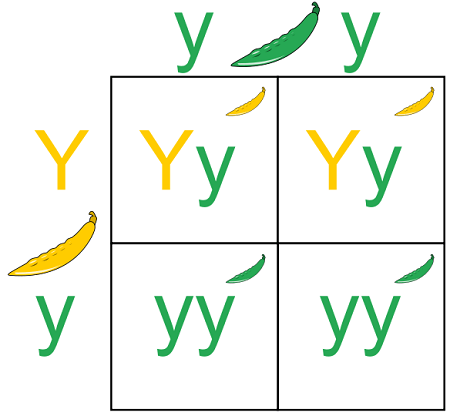
26.
The dominant trait as seen in this punnett square is
a)
yellow pea seeds
b)
green pea seeds
c)
there is no dominant seed
d)
Jolly green giant
27.
What is the percentage of offspring that have green pods?
a)
100%
b)
75%
c)
50%
d)
25%
28.
What is the phenotype of the heterozygous parent in the punnett square?
a)
green
b)
yellow
c)
hybrid
d)
purebred
29.
HOMOZYGOUS
a)
same
b)
different
30.
HETEROZYGOUS
a)
same
b)
different
31.
What are the possible genotypes for this cross?
a)
TT = 25% Tt= 50% tt=25%
b)
all tall
c)
TT= 75% tt = 25%
d)
Tt = 100%
32.

Which of Mendel's laws states that alleles are distributed to gametes independent of one another?

a)

Law of Dominance

b)

Law of Segregation

c)

Law of Independent Assortment

33.

If a dominant allele is present, the trait will always appear in the organism.

a)

Law of Segregation

b)

Law of Dominance

c)

Law of Independent Assortment

34.
Which choice best represents the genotype of this cross?
a)
1 Yy: 2 yy: 0 YY
b)
2 Yy: 2 yy: 0 YY
c)
3 Yy: 1 yy: 0 YY
d)
1 Yy: 3 yy: 0 YY
35.

A red flower (Rr) is crossed with a white flower (rr). What is the genotype? (I recommend sketching a punnett square!)

a)

0 RR; 0 Rr: 4 rr

b)

2 RR; 0 Rr: 2 rr

c)

4 RR; 0 Rr: 0 rr

d)

0 RR; 2 Rr: 2 rr

36.
What percentage of the offspring will have this recessive disease?
a)
0%
b)
25%
c)
50%
d)
75%
37.
Looking at this pedigree, how many female family members are carriers?
a)
1
b)
3
c)
10
d)
7
38.
Looking at this pedigree, how many family members have the disease?
a)
4
b)
7
c)
All
d)
None
39.
I have 2 X chromosomes. What am I?
a)
Male
b)
Female
40.
I have 1 X chromosome and 1 Y chromosome. What am I?
a)
Male
b)
Female
41.
Which of the following genotypes belongs in the red box in the Punnett square?
a)
XBXB
b)
XbXb
c)
XbY
d)
XBY
42.
1. In a certain species of animal, black fur (B) is dominant over tan fur (b).  
Which type of dominance does this cross show?
a)
Complete Dominance
b)
Incomplete Dominance
c)
Codominance
d)
Polygenic Inheritance
43.
Snapdragon flowers come in red, pink and white.  What type of inheritance is this?
a)
Complete Dominance
b)
Incomplete Dominance
c)
Codominance
d)
Polygenic Inheritance
44.
What type of inheritance do two alleles have if their traits blend together? 
a)
Incomplete Dominance
b)
Co-Dominance
c)
Mendelian Inheritance
d)
Homozygous Inheritance
45.
A calico cat shows both the traits for orange fur and black fur. What kind of allele expression is this?
a)
Incomplete Dominance
b)
Co dominance
c)
Independent assortment
d)
Recessive inheritance
46.
Which of the following statements is true regarding blood types?
a)
A and O are codominant, B is recessive.
b)
B and O are codominant, A is recessive.
c)
A and B are codominant, O is recessive.
d)
A , B and O are all codominant with each other.
47.
True or False: Men can NEVER be "carriers" for recessive sex-linked traits because they only have one X chromosome.
a)
True
b)
False
48.
A red lily crossed with a yellow lily produces heterozygous orange lily flowers. This is an example of which type of inheritance?
a)
Codominance
b)
Incomplete Dominance
c)
Sex Linked
d)
Polygenic Trait
49.
A yellow fish, when crossed with a blue fish, produces heterozygous fish with blue AND yellow scales. This is an example of which type of inheritance?
a)
Sex Linked
b)
Polygenic
c)
Codominance
d)
Incomplete Dominance
50.
If the heterozygous genotype leads to a BLEND of the other two traits, this is an example of ______________.
a)
Incomplete Dominance
b)
Codominance
c)
Multiple Alleles
d)
Polygenic Inheritance
51.
A heterozygous condition in which BOTH alleles are equally expressed is an example of _________________.
a)
Codominance
b)
Incomplete Dominance
c)
Polygenic Inheritance
d)
Multiple Alleles
52.
Phenotypes which result as a combination of MANY genes, such as skin color and eye color, are known as ______________ traits.
a)
Monogenic
b)
Dihybrid
c)
Multiple Allele
d)
Polygenic
53.
The range of human skin colors is caused by a variety of genes, each of which has at least 2 alleles.  This is an example of:
a)
incomplete dominance
b)
codominance
c)
multiple alleles
d)
polygenic inheritance
54.
What percentage of the female offspring will be a carrier for this recessive disease?
a)
0%
b)
50%
c)
100%
d)
25%
55.
If a gene is found only on the X chromosome and not the Y chromosome, it is said to be what?
a)
sex-linked trait
b)
polygenic trait
c)
codominant trait
d)
incomplete dominance trait
56.
If a woman is a carrier for a sex linked recessive trait of hemophilia and her husband has hemophilia, which of the following is true? Make a punnett square!
a)
All sons will have hemophilia
b)
all daughters will have hemophilia
c)
50% of daughters and 50% of sons have hemophilia
d)
100% of sons have hemophilia and 100% of daughters are carriers
57.
A cross between Red Reebops (an organism that feeds off the blood of cute, furry puppies) and White Reebops produced Pink Reebops. What type of inheritance pattern just occurred here?
a)
Codominance
b)
Complete Dominance
c)
Incomplete Dominance
d)
Epistasis
58.
Concerning the Multiple Allele System of blood type alleles, ABO, a woman has type A blood and is heterozygous for the trait. What is her genotype?
a)
A
b)
AA
c)
AO
d)
AB
59.
Color-blindness in humans is a sex-linked trait carried on the X chromosome. XC represents the gene for color-blindness. It is recessive. If a homozygous normal female and a color-blind male get married, what percentage of their sons will be color-blind, on average?
a)
0%
b)
25%
c)
50%
d)
100%
60.
Color-blindness in humans is a sex-linked trait carried on the X chromosome. XC represents the gene for color-blindness. It is recessive. A woman is color-blind and marries a normal man. She gets pregnant and learns that it will be a boy. What is the chance that he will be color-blind?
a)
25%
b)
50%
c)
75%
d)
100%
61.
Color-blindness in humans is a sex-linked trait carried on the X chromosome. XC represents the gene for color-blindness. It is recessive. If a color-blind male marries a woman who is not color-blind but who carries the allele, what percentage of their SONS would be color-blind?
a)
25%
b)
50%
c)
75%
d)
100%
62.
A cross between a brown cow and a white cow produces a roan (brown and white together) pattern. What percent of calves would have roan fur if a roan cow is crossed with a brown cow?
a)
0%
b)
25%
c)
50%
d)
100%
63.

Which inheritance pattern does this illustrate?

a)

Incomplete Dominance

b)

Codominance

c)

Dominant / Recessive Inheritance pattern

64.

Which inheritance pattern does this illustrate?

a)

Incomplete dominance

b)

Codominance

c)

Dominant / Recessive Inheritance pattern

65.

What kind of inheritance pattern does this image depict?

a)

Codominance

b)

Dominant / Recessive Inheritance Pattern

c)

Incomplete dominance

66.
What gamete possibilities could come from this parent's genotype?
a)
AB, AB, aB, aB
b)
Ab, AB, Ab, ab
c)
Ab, Ab, Ab, Ab
d)
AB, aB, ab, aB
67.
What goes in box 1
a)
AABb
b)
AABB
c)
aabb
d)
AaBb
68.
What goes in box 3
a)
Aabb
b)
AABB
c)
AAbb
d)
aaBb
69.
What goes in box 6
a)
AaBB
b)
AABB
c)
aaBB
d)
AAbb
70.
What goes in box 15
a)
abab
b)
ABAB
c)
aBaB
d)
AbAb