wayground logo

Free Printable Worksheets

NEW

Font size

S
M
L
XL
Worksheets

Spring Semester Exam

Total questions: 75

Worksheet time: 2hrs 3mins

Name
Class
Date
1.

Subatomic particles with a negative charge

a)

Electrons

b)

Neutrons

c)

Protons

d)

Quarks

2.
Subatomic particles with a positive charge
a)
neutrons
b)
atomic mass
c)
protons
d)
isotopes
3.

How many electrons does an Iodine atom have?

a)

53

b)

126

c)

73

d)

179

4.
What is atomic number?
a)
Number of protons in an atoms 
b)
Number of neutrons in an atom
c)
Mass of an atom
d)
Charge on an atom
5.
Which subatomic particles are found in the nucleus of an atom?
a)
Protons and Electrons
b)
Protons and Neutrons
c)
Neutrons and Electrons
d)
Protons, Neutrons and Electrons
6.
The total number of protons and neutrons in an atom is called the...
a)
Atomic number
b)
Proton number
c)
Mass number
d)
Weight number
7.

What element has 9 protons, 9 electrons, and 10 neutrons?

a)

nitrogen

b)

oxygen

c)

fluorine

d)

neon

8.

What is the mass number of this atom?

a)

1

b)

3

c)

4

d)

7

9.
An element with a mass number of 11 and an atomic number of 5 has how many neutrons?
a)
11
b)
5
c)
6
d)
16
10.
What is the atomic number of the atom pictured? 
a)
9
b)
10
c)
18
d)
19
11.

Which parts of the atom move around the nucleus?

a)

electrons

b)

protons

c)

electrode particles

d)

neutrons

12.
A tiny but very dense, positively charged portion of the atom that holds most of the atomic mass
a)
Electron Shells
b)
Orbitals
c)
Electron Cloud
d)
Nucleus
13.
The mass of this particle is so small that it is not counted.
a)
proton
b)
electron
c)
neutron
d)
quark
14.
What's a valence electron?
a)
electrons in the second energy level
b)
electrons in the outermost energy level
c)
the atomic number
d)
electrons in the first level
15.
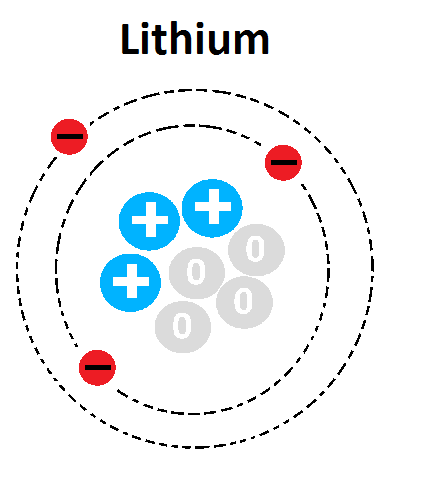
What is the name of this element?
a)
Lithium
b)
Boron
c)
Carbon
d)
Neon
16.

How many valence (outer) electrons does an Oxygen atom have?

a)

2

b)

6

c)

8

d)

16

17.
Valence electrons are: 
a)
Electrons farthest away from the nucleus
b)
Electrons closest to the nucleus
c)
Electrons that just come and go - they don't stay with the atom
d)
Electrons in the second shell
18.

How many electrons can go in the first energy level?

a)

2

b)

8

c)

18

d)

32

19.

How many electrons can go in the Second energy level?

a)

2

b)

8

c)

18

d)

32

20.

Which Bohr model represents Be?

a)
b)
c)
d)
21.
Where is most of the mass in an atom located?
a)
in the nucleus
b)
in the protons
c)
in the neutrons
d)
in the electrons
22.
For an atom, the number of electrons is equal to the number of _____
a)
protons
b)
protons plus neutrons
c)
neutrons
d)
nucleons
23.

The period number tells you the number of

a)

protons

b)

energy levels

c)

valence electrons

24.

what period would this element be in?

a)

2

b)

3

c)

5

d)

7

25.

Elements in the same _________ have the same number of valence electrons.

a)

Period

b)

Group

26.

Each row in a periodic table is called a

a)

period

b)

group/family

27.

Each column is called a

a)

period

b)

group/family

28.

It is the number of ________________ that distinguish one element from another.

a)

Protons

b)

Neutrons

c)

Electrons

d)

Atomic Mass

29.

Period 4 has how many electron shells?

a)

6

b)

8

c)

4

d)

112

30.

Which of the following elements is most likely to have similar properties to those of sodium (Na)?

a)

Magnesium (Mg)

b)

Sulfur (S)

c)

Francium (Fr)

d)

Titanium (Ti)

31.

Which element is most likely to have three electron energy levels?

a)

Argon (Ar)

b)

Lithium (Li)

c)

Boron (B)

d)

Europium (Eu)

32.

Which element is most likely to have six electrons in its 4th energy level?

a)

Oxygen (O)

b)

Selenium (Se)

c)

Krypton (Kr)

d)

Potassium (K)

33.

In which group would an element that is not reactive most likely be located?

a)

1

b)

2

c)

16

d)

18

34.

In which group would an element that is very reactive most likely be located?

a)

1

b)

5

c)

15

d)

18

35.

In which group would an element that is a gas most likely be located?

a)

1

b)

3

c)

12

d)

18

36.

Which of the following elements is most likely a poor conductor of electricity?

a)

Beryllium (Be)

b)

Gold (Au)

c)

Phosphorus (P)

d)

Copper (Cu)

37.
Look at the periodic table that is provided. Where would metals be located? 
a)
to the left of the table 
b)
to the right of the table 
c)
in the zigzag line 
38.
If a student observes a silvery solid that is malleable, good conductor, and ductile it is a...
a)
nonmetal 
b)
metal 
c)
metalloid
39.
How many groups and periods are on the Periodic Table?
a)
over 100 groups and periods
b)
18 groups, 8 periods
c)
18 periods, 7 groups
d)
18 groups, 7 periods
40.
Group 18, Period 4
a)
Krypton
b)
Argon
c)
Radon
d)
Xenon
41.
Which group of the periodic table is composed of inert (not reactive)  gases?
a)
alkali metals
b)
alkaline earth metals
c)
halogens
d)
noble gases
42.

How many valence electrons do (most) atoms need to be stable?

a)

1

b)

4

c)

6

d)

8

43.
How many protons are in Beryllium?
a)
4
b)
9
c)
5
d)
2
44.

Elements in the same group or family have _____________.

a)

the same number of valence electrons and different properties.

b)

the same number of valence electrons and similar properties

c)

different number of valence electrons and similar properties.

d)

different number of valence electrons and different properties.

45.

Where are metalloids located on the Periodic Table?

a)

In the s block.

b)

In the f block.

c)

In the d block.

d)

The elements that touch the staircase except aluminum.

46.
Which is a halogen?
a)
Helium
b)
Chlorine
c)
Oxygen
d)
Neptune
47.
Which is an alkali metal?
a)
Magnesium
b)
Iron
c)
Sodium
d)
Europium
48.
An element's identity is determined by the number of
a)
electrons.
b)
protons.
c)
neutrons.
d)
valence.
49.
Group 18 elements are known as the _____ _____ and have full valence shells.
a)
royal gases.
b)
supreme solids.
c)
noble gases.
d)
legit liquids.
50.

Which group of elements have a full outer shell of 8 valence electrons and are unreactive and stabel?

a)

halogens

b)

metalloids

c)

metals

d)

noble gases

51.

Elements in the Periodic Table are arranged according to their

a)

atomic number

b)

atomic mass

c)

relative activity

d)

relative size

52.

How many valence electrons?

a)

2

b)

3

c)

4

d)

5

53.

What group does this element belong to?

a)

1

b)

2

c)

17

d)

18

54.

Which group includes soft, highly reactive metals with one electron in their outer shell?

a)

Alkai metals (group 1)

b)

Alkaline metals (group 2)

c)

Halogens (group 17)

d)

Noble gasses (group 18)

55.

Which group includes highly reactive nonmetals with seven electrons in their outer shell?

a)

Alkai metals (group 1)

b)

Alkaline metals (group 2)

c)

Halogens (group 17)

d)

Noble gasses (group 18)

56.

Which elements are in the same period

a)

Lithium and Sodium

b)

Sodium and Magnesium

c)

Carbon and silicon

d)

Silicon and Tin

57.

Acceleration is

a)

slowing down

b)

turning

c)

going faster

d)

all of the above

58.
My dog Trevor, who is 9.09 kg, jumps for a treat, with an acceleration of 0.7 m/s2. What is the force that his legs exert?
a)
6.36 N
b)
12.9 N
c)
0.077 N
59.
My dog Trevor shakes his favorite chew toy with a force of 43 N at an acceleration of 0.18 m/s2. What is its mass?
a)
7.74 kg!
b)
239 kg!
c)
.004 kg!
d)
43.18 kg!
60.
My dog Trevor got hungry and made his way downstairs at a speed of 3.3 m/s. He realized he was getting steak for dinner so he sped up to 4.2 m/s, all within 1 second. What was his acceleration?
a)
0.9 m/s2
b)
-0.9 m/s2
c)
0.9 N
d)
0.9 kgm/s
61.

Force is measured in

a)

kg

b)

m/s

c)

N

d)

m/s2

62.
How much force is needed to accelerate a 3kg skateboard at 5m/s2. 
a)
8N
b)
1.6N
c)
0.6N
d)
15N
63.
A speed boat is traveling at 100 km/hr. How many hours will it take for the boat to cover a distance of 115 km?
a)
1.15 hours
b)
15 hours
c)
0.87 hours
d)
11,500 hours
64.
Dave runs a 400 m race with a speed of 4 m/s. What time will it take him to finish the race?
a)
400 minutes
b)
100 minutes
c)
100 seconds 
d)
.25 seconds 
65.
If there are two forces going in the same direction how would you find the net force?
a)
Subtract
b)
Add
c)
Neither
d)
Multiply
66.
Forces that have a net force of zero ( the object is still).
a)
Balanced force
b)
Unbalanced force
67.

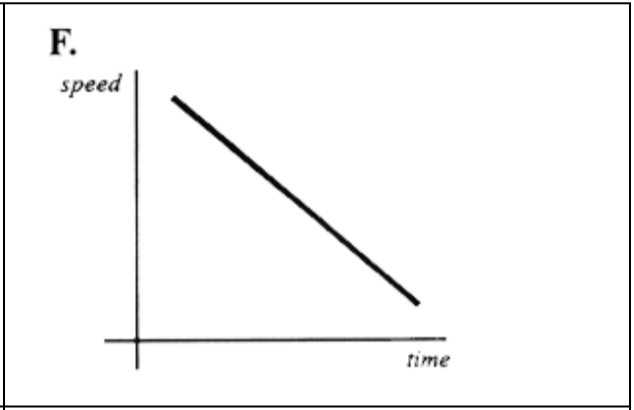
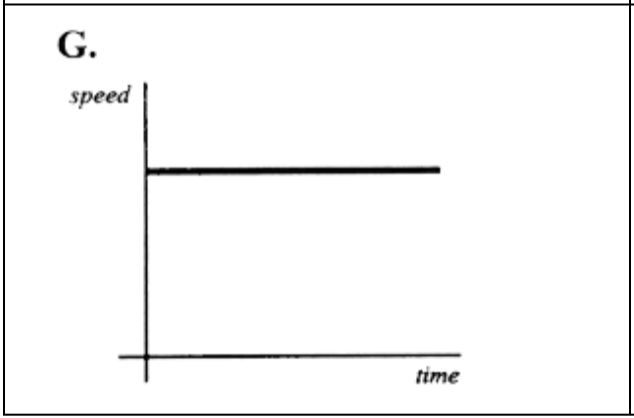
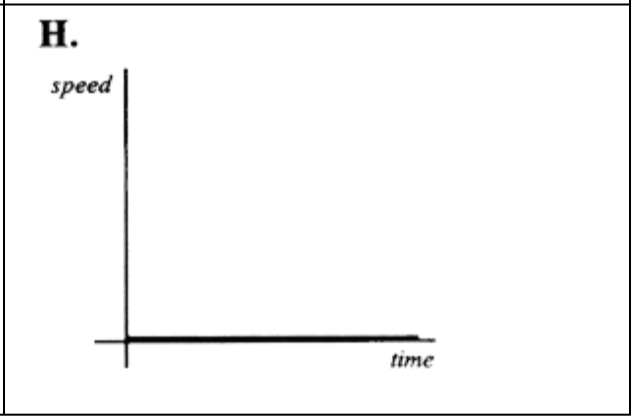
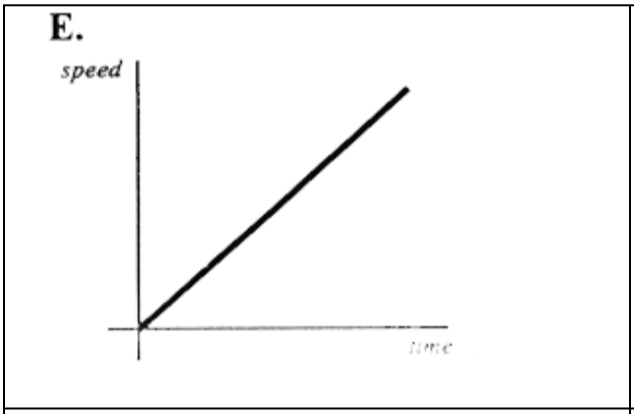
Match the graph to the description:

"The car is traveling at a constant speed."
a)
b)
c)
d)
68.
A person is pushed forward into their seatbelt when a car stops
a)
1st
b)
 2nd
c)
2 and 3
d)
3rd 
69.

Letting go of a balloon full of air is demonstrating Newton's ______ _______ ________ _________ because the air comes out of the back and the balloon moves forward.

a)

1st law of motion

b)

2nd law of motion

c)

3rd law of motion

d)

13th law of motion

70.
The force that opposes motion between two surfaces in contact with each other.
a)
inertia
b)
friction
c)
momentum
d)
gravity
71.

The clown walked 27 feet in 9 seconds. what was his velocity?

a)

18 feet/sec

b)

243 feet/sec

c)

36 feet/sec

d)

3 feet/sec

72.
Speed is different from velocity because
a)
Velocity has a direction
b)
Speed uses Distance /Time
c)
Velocity doesn't include time
d)
Velocity doesn't include distance
73.
At 60 seconds, how far had this object traveled? 
a)
0 m
b)
10 m
c)
20 m
d)
40 m
74.
Calculate the Net Force. 
a)
60N, Left 
b)
40N, Right 
c)
0N
d)
60N, Right
75.
What is the net force?
a)
30 N left
b)
25 N right
c)
5 N left
d)
55 N right